
Lecture
In the tests presented, choose one or more correct answers.
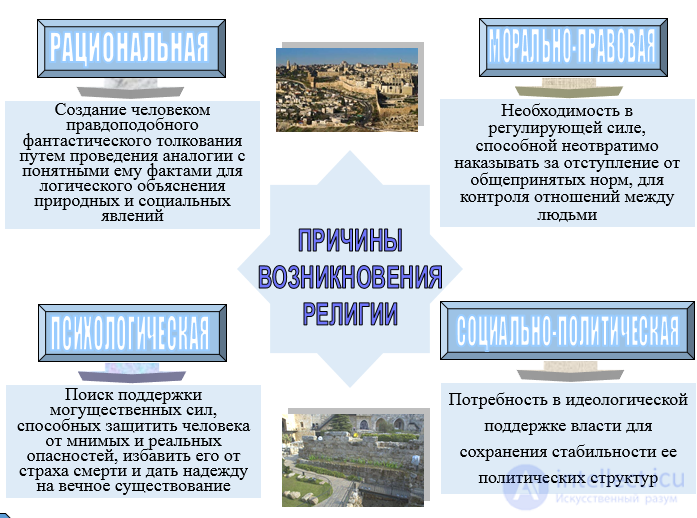
1. List the main causes of the emergence of religion.
2. Among the aborigines of Polynesia and Melanesia, this was the name given to the force controlling natural processes (indicate):
3. Which philosopher believed that people invented gods to instill fear in others and make them obey the laws?
4. Which stage of the development of religion is characterized by the search for personal ethical principles?
5. Which philosopher believed that religion is based on fear of the formidable forces of nature?
6. The primary form of religion was (indicate):
7. Which philosopher saw the roots of religion in man's uncertainty about his own strength, in his constant vacillation between hope and fear?
8. On which continents is animism most widespread today?
9. J. Lubbock and E. Tylor proposed the following classification of religion in human civilization (list):
10. Primitive peoples were unfamiliar with the concept of «nature», so the object of their worship was an impersonal natural force denoted by the concept (indicate):
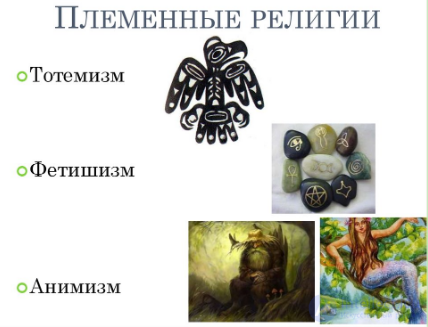
11. The veneration of inanimate material objects to which supernatural properties are attributed is called (indicate):
12. The belief in the spiritual animation of nature is called (indicate):
13. The kinship of groups of people with certain species of animals, plants, or natural phenomena is called (indicate):
14. The belief in the ability of certain people to communicate with spirits and use their power for healing and other purposes is called (indicate):
15. On which continent were fetishes first discovered?
16. Beliefs and rites based on faith in the possibility of influencing people, objects and phenomena of the visible world by supernatural means are called (indicate):
17. The cult of ancestors is one of the most vividly expressed (indicate):
18. Among the Eastern Slavs, those who died a natural death were called (indicate):
19. The intermediary between the world of people and the world of spirits is called (indicate):
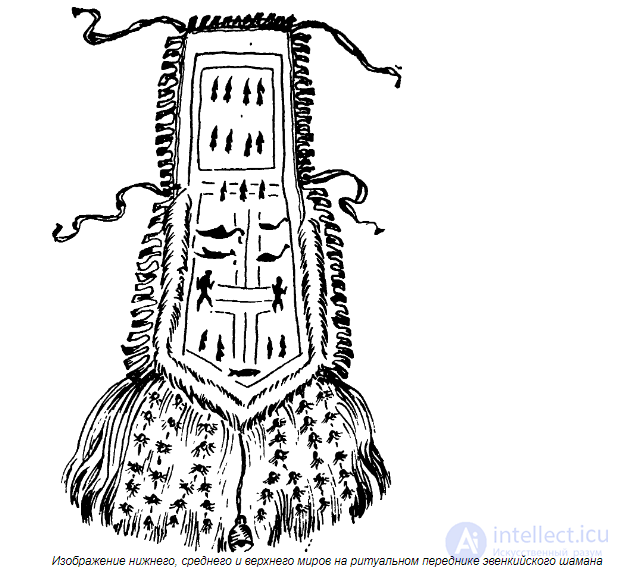
20. In the views of many peoples who have retained shamanism, the universe consists of three spheres (list):
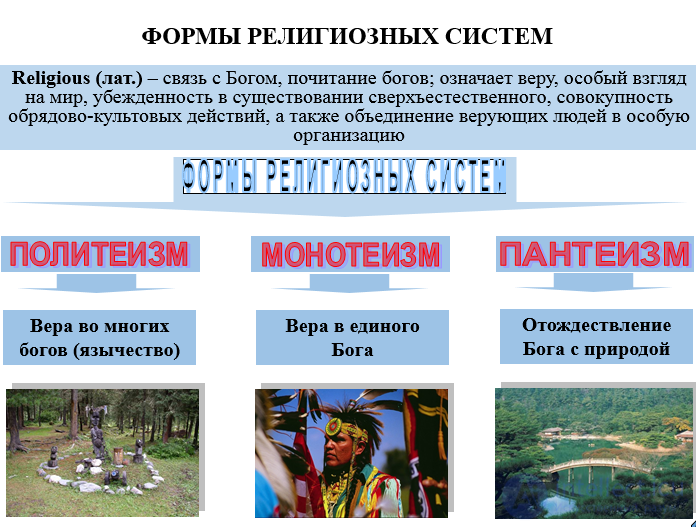
21. The class of pagan teachings that ascribe power in the world to gods who, directly or indirectly, personify the forces of nature is called (indicate):
22. The teaching about gods personifying the local forces of individual areas, and having significance for the compact communities living there, is called (indicate):
23. Which of the following types of polytheism represents the world of the gods as an indivisible, integral community (indicate):
24. The class of teachings that recognize the singularity of the living power ruling the world is called (indicate):
25. In everyday life, magic has survived in the form of (list):
26. Within totemism, a whole system of prohibitions arose, which were called (indicate):
27. By method of influence, magic is divided into (list):

28. By purpose of influence, magic is divided into (list):
29. Do animistic beliefs form an essential component of all the religions of the world?
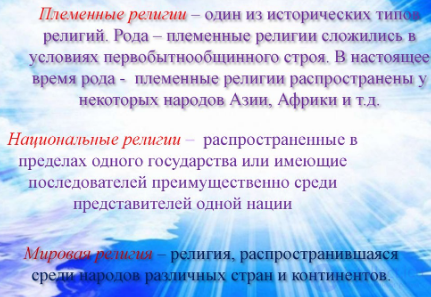
30. The concept of «tribal religion» relates to the period (indicate):
31. In the conditions of the Ancient world, religions were (indicate):
32. A classic example of polytheism is (indicate):
33. A characteristic feature of the religions of antiquity was (indicate):
34. In the religion of the Ancient world, a special place was occupied by (list):
35. List the sources of animistic beliefs.
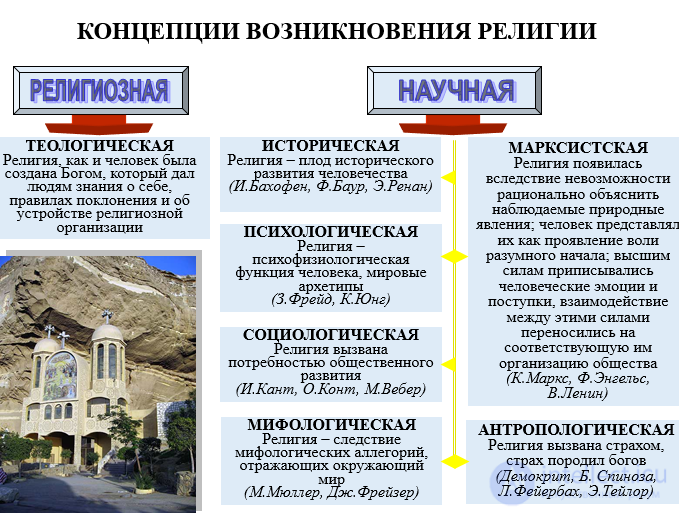
36. Which view on the origin of religion holds that religion arises at a certain level of consciousness due to the impossibility of scientifically explaining observed natural phenomena?
37. Can an animal such as the kangaroo be regarded as a totem?
38. Who introduced the term «totemism» into scholarly use?
39. What, in your opinion, did scholars R. Marett and J. Frazer believe preceded animism?
40. Tribal religions are (indicate):
In the tests presented, fill in the blanks with the words you consider most appropriate. Observe the case and declension indicated in the sentences.
1 The medieval philosopher ………….. saw the roots of religion in man's uncertainty about his own strength, in his constant vacillation between hope and fear.
2. A person possesses …………., when he is happy, fortunate and demonstrates some unusual achievements, for example, as a farmer, warrior or chief.
3. The veneration of many …………. was replaced by polytheism, which turned the most revered spirits into deities.
4. The theological concept of the origin of religion was subjected to serious criticism only in the second half of the 19th century, when, at the intersection of rapidly developing sciences, modern ……………………….. arose, which from the very beginning set itself the task not of defending established notions, but of the dispassionate study of the religions of the world.
5. Scholars have established that the biblical …………….. is not the starting point of religious evolution, but only an intermediate stage in the development of religions.
6. W. Schmidt built an entire concept of ………………….. and devoted to it a 12-volume work, «The Origin of the Idea of God».
7. S. Freud developed the so-called psychoanalytic method for recognizing and treating neuroses and psychoses and attempted to apply it to the interpretation of the phenomena of everyday life, and later of religion, in his book «……………. and Taboo».
8. Fetishism is the veneration of ………………… material objects to which supernatural properties are attributed.
9. Animism is …………… in the spiritual animation of nature.
10. Totemism is the ………………… of groups of people with certain species of animals, plants, or natural phenomena.
11. Shamanism – the belief in the ability of certain people to communicate with ……………. and use their power for healing and other purposes.
12. The cult of ………………… is one of the most vividly expressed animistic cults.
13. The shaman's communication with ………………. is a ritual.
14. All the traditional religions of the Ancient Mediterranean and the adjacent barbarian Europe represented ……………………………. paganism, that is, teachings about world justice carried out by the combined will of the gods ruling the world.
15. Polytheism is the class of pagan teachings that ascribe power in the world to …………………., who directly or indirectly personify the forces of nature.
16. Topographical polytheism is a teaching about ……………, personifying the local forces of individual areas and having significance for the compact communities living there.
17. Monistic polytheism represents the world of the gods as an indivisible, integral ……………….., whereas dualistic polytheism more or less strictly divides them into two opposing camps – good and evil.
18. In hierarchical polytheism, the gods are always strictly grouped by relations of power and subordination: in the monistic pantheon, at the top stands the ……………….. god, who governs the other gods and makes final decisions about the lives of people; in the dualistic pantheon, each of the two camps of gods is headed by a leader-god – the chief good or evil living force of the universe.
19. Polydemonism is the ………………… of a multitude of spirits
20. Durkheim believed that it was ……………., not animism, that represents such an «elementary form» of religion.
21. The Egyptians deified ………………….
22. Service to the gods in Ancient Egypt was carried out by ……………, who formed a special caste.
23. The Egyptians — the most pious of all peoples – this conviction was formed by ………………….. from his travels.
24. Egypt — a classic example of the deification of royal power, unlike ……………, which places priests above kings.
25. Zoroastrianism, as a prophetic ……………, sees the meaning of the world not in its existence, but in the fulfillment of a god-established purpose at the end of days.
26. The primary cause of totemism, in the opinion of ……………., is the recognition of the sacred. «Totemism, he wrote, is a belief not in some animals, some people or some images, but in a certain nameless and impersonal force dwelling in each of these beings, without being merged with any of them».
27. In magic, mysterious power is attributed to specific ……………… of people.
In the tasks presented, indicate the correct statements (assertions).
Task No. 1
1. Religion – a faith capable of controlling communication between people, since it presents itself as a supreme power capable of constantly and rigidly controlling everyone and inevitably punishing deviation from generally accepted norms.
2. Religion – a force capable of controlling communication between people, since it presents itself as a supreme power capable of constantly and rigidly controlling everyone and inevitably punishing deviation from generally accepted norms.
3. Religion – a thought capable of controlling communication between people, since it presents itself as a supreme power capable of constantly and rigidly controlling everyone and inevitably punishing deviation from generally accepted norms.
Task No. 2
1. The founder of ancient materialism Herodotus stated that religion is based on fear of the formidable forces of nature.
2. The founder of ancient materialism Helvétius stated that religion is based on fear of the formidable forces of nature.
3. The founder of ancient materialism Democritus stated that religion is based on fear of the formidable forces of nature.
Task No. 3
1. The French Enlighteners of the 17th century saw the roots of religion in the suffering and fear oppressing man and believed that religion originally arose from man's powerlessness before the forces of nature.
2. The French Enlighteners of the 18th century saw the roots of religion in the suffering and fear oppressing man and believed that religion originally arose from man's powerlessness before the forces of nature.
3. The French Enlighteners of the 16th century saw the roots of religion in the suffering and fear oppressing man and believed that religion originally arose from man's powerlessness before the forces of nature.
Task No. 4
1. Scholars of religious studies identify the following causes of the emergence of religion: intellectual, cultural, moral and socio-political.
2. Scholars of religious studies identify the following causes of the emergence of religion: intellectual, psychological, spiritual and socio-political.
3. Scholars of religious studies identify the following causes of the emergence of religion: intellectual, psychological, moral and socio-political.
Task No. 5
1. The philosopher of Citium believed that people invented gods to instill fear in others and force them to obey the laws.
2. The philosopher of Citium believed that shamans invented gods to instill fear in others and force them to obey the laws.
3. The philosopher of Citium believed that people invented gods to instill faith in others and force them to obey the laws.
Task No. 6
1. The primary form of religion was the knowledge of nature.
2. The primary form of religion was faith in nature.
3. The primary form of religion was worship of nature.
4. The primary form of religion was worship of money.
5. The primary form of religion was worship of presidents.
Task No. 7
1. Primitive peoples were unfamiliar with the concept of «religion», so the object of their worship was an impersonal natural force denoted by the concept of «mana».
2. Primitive peoples were unfamiliar with the concept of «God», so the object of their worship was an impersonal natural force denoted by the concept of «mana».
3. Primitive peoples were unfamiliar with the concept of «nature», so the object of their worship was an impersonal natural force denoted by the concept of «mana».
Task No. 8
1. Mana is sent by priests, which implies that they possess mana first and foremost.
2. Mana is sent by shamans, which implies that they possess mana first and foremost.
3. Mana is sent by gods, which implies that they possess mana first and foremost.
Task No. 9
1. The central figure in shamanism is the priest – an intermediary between the world of people and the world of spirits.
2. The central figure in shamanism is the shaman – an intermediary between the world of good and the world of evil.
3. The central figure in shamanism is the shaman – an intermediary between the world of people and the world of spirits.
Task No. 10
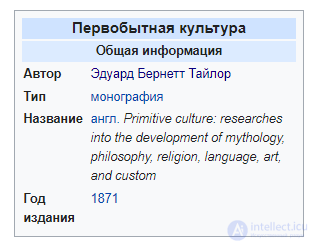
1. The term animism was introduced into religious studies by the English scholar E. Tylor in his work «Primitive Culture».
2. The term animism was introduced into religious studies by the English scholar E. Durkheim in his work «Primitive Culture».
3. The term animism was introduced into religious studies by the English scholar D. Easton in his work «Primitive Culture».
Task No. 11
1. Totemism, taboo, Lamaism, fetishism, and animism characterize the beliefs and rites of primitive man.
2. Totemism, taboo, Judaism, fetishism, and animism characterize the beliefs and rites of primitive man.
3. Totemism, taboo, magic, fetishism, and animism characterize the beliefs and rites of primitive man.

Comments