
Lecture 22 min.
Christian theology is a system of various theological disciplines within Christianity, each of which sets out different aspects of doctrine and worship.
Traditionally, theology in Christianity is understood as a systematic analysis of the nature, purposes and activity of God, as an attempt to speak about the Divine Being.
In Orthodoxy, the main source of theology is Holy Scripture and Holy Tradition, with Holy Scripture (the Bible) being the most important form (part) of Holy Tradition.
In Catholicism, Holy Scripture and Holy Tradition are two distinct ways of transmitting the Word of God, and Holy Scripture is not part of Holy Tradition. Orthodox Christians and Catholics regard the experience of communion with Christ in the Holy Spirit, that is, participation in the life of the Church, as the most important means of transmitting Holy Tradition, including its undocumented and intangible aspects, and faith stands above reason.
The main foundational source of official Protestant theology is Holy Scripture, the Bible. Holy Tradition, reason and experience are regarded as auxiliary sources.
Those who wish to study theology more deeply enroll in specialized educational institutions, namely seminaries and theological academies, where they receive a foundational theological education and study the history of the development of theological thought, or in the theology faculties of universities.
By the “founders of Christian theology” one can understand the people who laid down its basic concepts, methods and doctrines; specifically, these are:
If the question is specifically about the “founding fathers of Christian theology”, and not about all significant theologians, I would single out three levels:
The initial foundation:
The formation of properly ecclesiastical theology in the 2nd–3rd centuries:
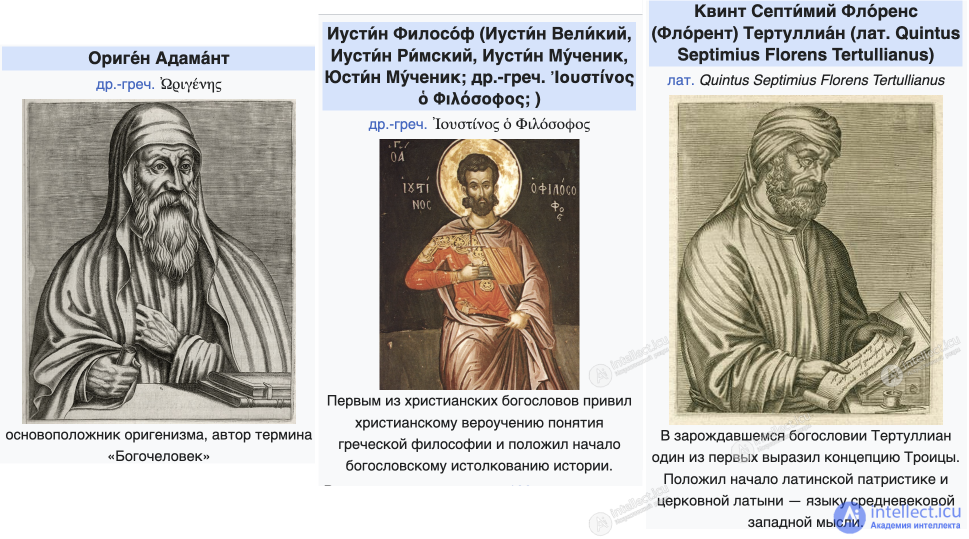
The formation of classical dogmatics in the 4th–5th centuries:
At the same time, it is important to distinguish between the founders of Christian teaching (Jesus and the apostles) and the founders of systematic Christian theology (above all Origen, Irenaeus, Tertullian, Athanasius, the Cappadocians and Augustine).
Because different approaches to theological scholarship have always existed throughout Christian history, theology as a discipline has never been, and could never be, unified. Over time this situation was aggravated by the emergence of an ever greater number of confessions, denominations, movements and theological schools and trends.
Modern Christian theology is divided along confessional lines into the theology of the Church of the East, Orthodox theology of the churches of the Byzantine tradition, the Miaphysite theology of the Oriental Orthodox Churches, Catholic theology, and the theology of Protestant confessions, including evangelical denominations, and others.
The undoubtedly authoritative doctrinal texts in Orthodoxy are the Holy Scripture of the Old and New Testaments, the Horoi (definitions of faith, or dogmas) of the Ecumenical Councils (the Niceno-Constantinopolitan Creed, the dogmas of the two natures and two wills in Jesus Christ, the dogma of the veneration of icons), the definitions of faith of some Local Councils (the Fourth Council of Constantinople (879—880), the Council of Constantinople of 1156—1157, the Fifth Council of Constantinople (1341—1351)), the Confession of the Orthodox Faith of Saint Gregory Palamas, and the Confession of the Orthodox Faith of Saint Mark of Ephesus.
Although a concise exposition (a catechism) is not entirely organic to Orthodoxy, various Orthodox catechisms with differing confessional significance were created in modern and recent times: first because of the existence of various spurious Orthodox catechisms, in order to expose them; and then because a large number of Catholics accustomed to catechisms joined the Orthodox Church, following the example of the Roman Catholic and Protestant churches:
The doctrinal texts of the Catholic Church are the decrees of the seven Ecumenical Councils, as well as of the councils of the Catholic Church that it recognizes as Ecumenical, and the bulls of the Roman popes.
Unlike in Orthodoxy, in modern Catholicism the catechism is an organic exposition of the Catholic faith.
Well-known Catholic catechisms:
Orthodox theology differs from Western theology (theologia) in that, in our time, after the end of the Ecumenical Councils, Orthodox theologians do not develop their basic teaching through disputes about the truths of the faith (as all the sciences and theology do). Of the doctrines, only Christian hermeneutics, patrology, church history, church archaeology, icon painting, architecture, art history, philosophy, canon law and so on are developed. Orthodox dogmas merely prescribe to believers how doctrine and philosophy may not be interpreted, and Orthodox theology relies on the use of all of Greek philosophy, beginning with Socrates (the “Greek faith”).
Unlike for Protestants, for the Orthodox “Theology” is not only a word, a verbal expression, but also the icon, a symbolic representation, especially the Earthly Church's representation of the Heavenly Church. A peculiarity of the doctrine and theology (heterodox theology) of the Western churches is their acceptance of the so-called “Apostles'” and (pseudo-)“Athanasian” creeds, with the result that the starting point is not the Father, as in the Nicene and other ancient creeds, and as the fathers of the Greek branch of patristics theologize, but the one God in the Trinity, with the “monarchy” of the Father as the one Source and Cause clearly diminished. This Augustinian theology, rejected by the Orthodox (unlike the ideas of Augustine himself when correctly interpreted in the light of Orthodox dogmas), gave rise to the Catholic acceptance as true of the assertion of Charlemagne, who is not an authority in matters of faith, that the Holy Spirit proceeds also from the Son, and culminated in Thomas Aquinas's identification of essence and energy in the Godhead, which the Orthodox do not accept. For centuries, until Thomism was declared preferable in 1879, the teaching of Thomas Aquinas competed in the Catholic Church with the original Augustinianism, even after Protestant theology developed on the basis of Augustinianism.
As noted by Aleksei Ruslanovich Fokin, head of the theology sector of the Institute of Philosophy of the Russian Academy of Sciences and editor-in-chief of the Center for Biblical and Patristic Studies of the Synodal Department for Youth Affairs, Orthodox theologians are less familiar with the Western fathers and use their works less because of the lack of translations or their quality. Yet the only difference between the Western and Eastern fathers that he found in the sphere of mystical experience is the Western fathers' dogmatic understanding of the experience of seeing uncreated light as the Divine essence, or nature, and not as energy. But they, like the Eastern fathers, describe the vision of this light. And there were of course as yet no sensual enthusiasms or sensual visions, such as the crucifixion of Christ and meditations upon it. This begins to appear in the Middle Ages, but only in modern times does the mysticism of the West differ radically from Eastern mysticism, perhaps beginning with Thomas à Kempis, Ignatius of Loyola, and with women's mysticism. But in any case such distortions of spiritual life do not extend to the ancient Western patristic tradition. A. R. Fokin: “One cannot divide the single patristic tradition into Eastern and Western.” The Western fathers, evidently, were not familiar with the teaching of the Essenes (“healers”) — the “people of the New Testament,” the “sons of light,” with whom the ancient tradition of hesychasm, which influenced the character of Orthodox theology, is apparently connected. By the system of Orthodox theology is understood a set of various theological disciplines (branches of theology), each of which sets out different aspects of doctrine and worship. From the point of view of some thinkers of the Russian Orthodox Church, the difference between Orthodox theology and non-Orthodox theology (“theologia”) lies in the fact that “The sources of Orthodox theology are Holy Scripture (the Bible) and Holy Tradition (the tradition of understanding the Sacred Text), as well as its particular worldview and mystical experience. The Bible and Tradition are not set against each other; on the contrary, Tradition is the context, the spiritual environment in which the Bible was created; Holy Scripture is to a certain extent itself Tradition… Moreover, it was Tradition that formed the biblical canon as we have it today.”
Holy Tradition communicates Divine Truth, but the understanding of it was not revealed all at once and deepened over the centuries. All pre-Christian pagan wisdom is also churched within Holy Tradition. The Russian Orthodox Church incorporates into its Holy Tradition the pre-Orthodox wisdom, where it does not contradict its doctrine, of the widely branching Russian people (Ukrainians, Belarusians, Russians, Rusyns, Polishchuks) and of all the other peoples under its spiritual care in the former USSR, Japan, China and Thailand. Tradition also implies that spiritual reality which cannot be put into words and which is preserved in the silent experience of the Church, handed down from generation to generation. The unity and continuity of this experience, preserved in the Church down to the present, constitutes the essence of Church Tradition.
Unlike theologians, Orthodox theologians do not develop Christian doctrine through disputes about the truths of the faith, and do not abandon this or that religious doctrine when new knowledge appears, because the Orthodox believe that the Church is the mystical Body of Christ, of which Christ alone is the head, and that until the Second Coming there is not and cannot be any person or group of people who are vicars of God on Earth and are therefore empowered to change the doctrine of the Orthodox Church.
Theologians labor so that every letter of the faith of the Orthodox of the 21st century is exactly the same as that of Orthodoxy of the 9th—20th centuries, and the meaning is the same as that of the Orthodox of the 1st—8th centuries, including the Teaching of the Twelve Faithful Apostles, and they restore ancient piety. Orthodoxy recognizes only some purely external changes (changes in the vestments of priests, in monastic rules, new fasts, the rules of Ecumenical and Local Councils, etc.), but not a word has been changed in the Creed[source not specified 3641 days]. The goal of any changes was the confession of the old Faith in new circumstances. For example, the Bible and service books were translated into new languages. Or rites were added that emphasized the particular features of new converts. But the principle remains: “One God, One Faith and One Baptism.”
The Orthodox, unlike the Roman Catholics, do not consider Tradition primary and Holy Scripture secondary. Nor do they agree with Protestant theologians, who consider Holy Scripture primary.
Orthodox theologians stress that Christ did not leave us a single written line. Christianity in the eyes of the Orthodox is a religion of encounter with God, and not of a rationalistic interpretation of written texts (whether of Tradition or of Scripture). The Orthodox believe in the resurrection of Christ not because they have read about it, but because they themselves, through their own inner experience, have come to know the Risen One.
The experience of communion with Christ in the Holy Spirit — the subject of theology proper — is higher than any verbal expression of this experience, whether Holy Scripture, documents of Holy Tradition or any other written source. The Catholic Encyclopedia partly agrees with this view, confirming that in Catholicism Holy Tradition is indeed recognized as a constantly developing element of the faith, whereas in Orthodoxy it is regarded as complete and not subject to further change. The so-called Latin scheme of the relation to Holy Tradition took its final shape in the 16th—17th centuries. According to it, part of the teaching received from the apostles was recorded in the books of Holy Scripture, while another part, not included in Scripture, was transmitted through oral preaching and was written down in the post-apostolic era. This second part of the teaching constitutes Holy Tradition. But, in the opinion of the Catholic Encyclopedia, the Russian Orthodox Church until the beginning of the 20th century de facto adhered to the Latin scheme, developing Holy Tradition, and only in the 20th century finally formed its understanding of Holy Tradition, set out above, as essentially unchanging.
The view is also widespread in Orthodoxy that Christianity is not a religion but a new life, life in God, opened up through Christ — this is what He brought to people. Developing this thought, John Meyendorff stressed that although the Orthodox are in favor of social justice, they do not regard as reliable allies on the path to establishing social justice the supporters of various movements that turn revolution into a new religion — a true opium of the people.
The etymology of the Russian word for “theology” (bogoslovie), unlike that of “theology” (theologia), does not go back to the terms “science of God” or “branch of knowledge about God.” In Church Slavonic (and modern Serbo-Croatian) “Bogoslovia” means “seminary.” Until 1868, “theology” was also the name of the senior class of the seminary in Russia, as readers of Nikolai Gogol's novella “Viy” remember. The Slavic word “bogoslovie” derives from the opening words of the Gospel of John the Theologian, who was the first to call Jesus the Logos (the Word): “In the beginning was the Word, and the Word was with God, and the Word was God.” Thanks to John the Theologian, the Logos (Word) was always identified with the second Person of the Trinity, the Son of God, Jesus Christ, for example by Clement of Alexandria, apparently one of the first heads of the first school of theology (the Catechetical School, literally catechetical, but later combining catechesis with the education of theologians). Among the meanings of the term “bogoslovie” in Church Slavonic are: 1) “a word about God”; 2) “a word from God”; 3) “a word to God and for God.” These three meanings, and the interpretation of all of Holy Scripture as “theology” — the books of the Old Testament being “ancient theology,” the books of the New Testament “new theology,” and accordingly the “theologians” being the Prophets and Apostles — to a considerable extent determine the meaning of the term “theology.” But in general “logos” has about 100 meanings, one of which is Jesus Christ. I. Dvoretsky's Ancient Greek–Russian dictionary contains 34 clusters of meanings of the word “logos.” Each cluster in turn has several meanings. But if we speak of the main religious and philosophical sense of the concept of “theology,” then, as Professor A. I. Osipov believes, it most correctly corresponds to “knowledge,” “cognition,” “vision,” and the Greek term θεολογία should be translated as “knowledge of God, God-knowing, the knowing of God.” By knowledge in Christianity is meant not at all what the pagans thought — not words and reasoning about God, but a special, spiritual experience of the direct experiencing, the apprehension of God by a pure, holy person. Since the denial of the achievements of science in theology, unlike in theologia, is tantamount to doubting the Omnipotence of God, Orthodox theology, unlike theologia, does not interfere in the affairs of science as an instrument of cognition, except for problems of scientific ethics and professional ethics. At the same time, theology discusses problems of the application of scientific knowledge, so many theologians are also scientists, and the high level of training of theologians allows them to engage successfully in many sciences. Among these sciences are philosophy, religious philosophy, Christian hermeneutics, ecclesiology and many other disciplines of theology, not only secular sciences. Not thanks to theological literature, but, as V. N. Lossky writes: “Only in the Church can we consciously discern in all the sacred books a single inspiration, because the Church alone possesses Tradition, which is the knowledge of the incarnate Word in the Holy Spirit.” That is, in Orthodoxy theology necessarily includes the practice of communion with God carried out through the mediation of the Church, implying faith and a prayerful striving toward God as the object of faith, hope and love, and activity in accordance with faith — love. In this sense Orthodox theology can be understood as a synonym of prayer, contemplation, spiritual life. According to Justin the Philosopher, the truth in Christ's statement “I am the truth” is interpreted as the eternal truth of Socrates. “And they will turn away from the truth and turn to fables” (the holy chief apostle Paul). Therefore, resorting (instead of to physicians) to magic, folk healers, occultists, charlatans, astrologers, mediums, spiritualists, warlocks, witches, sorcerers, wizards, “folk healers,” fortune-tellers, soothsayers, palmistry, chirosophy, unorthodox mysticism, interconfessional theology and esotericism is regarded as betrayal of God. Orthodoxy condemns superstition — beliefs not based on knowledge, including knowledge of theology. In other respects Orthodox theology does not limit the love of wisdom and the striving for eternal truth, but, on the contrary, stimulates them.

Comments