
Lecture
Islam is the third of the «world religions» in order of emergence. This religion plays an enormous role in the history of the peoples of the Near and Middle East, North Africa, and Southeast Asia, exerting a significant influence on their socio-political and cultural life. In such countries as Iran, Afghanistan, Pakistan, Saudi Arabia, Libya, Tunisia, Sudan, and some others, Islam is the state religion. On the territory of the CIS states, a significant portion of the population of Central Asia, Kazakhstan, the North Caucasus, Transcaucasia, Tatarstan, and Bashkortostan consider themselves followers of Islam.
At present the «world of Islam», based on Muslim conceptions, norms, and values, unites approximately 1 billion people living on various continents and belonging to different races, nations, classes, and social strata.
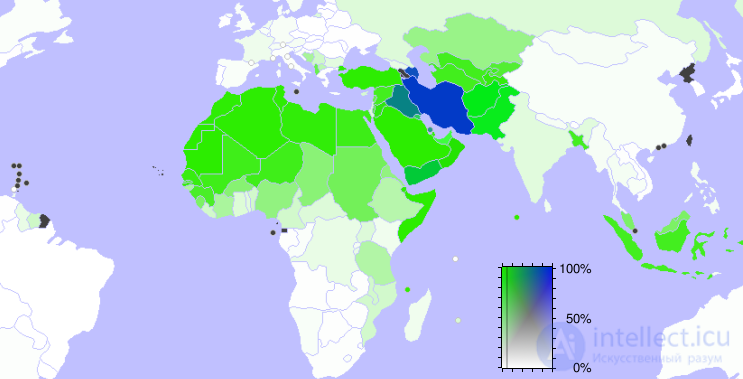
Countries where Muslims make up more than 10% of the population. Sunnis are marked in green, Shiites in blue. Countries for which no information is available are marked in black.
Islam took shape in the 7th century CE on the Arabian Peninsula, which at that time was inhabited by Semitic tribes - ancestors of the present-day Arabs, who, according to the biblical account and Muslim tradition, trace their origin to the forefather Abraham.
Most of these tribes led a nomadic way of life, engaging in animal husbandry, while some tribes lived a settled existence, favoring agriculture and crafts. Trade played a major role in the economic life of the ancient Arabs. From ancient times the Arabs maintained close cultural and economic ties with such countries as Syria, Palestine, Egypt, and Ethiopia. The main trade routes between these countries passed through the territory of the Arabian Peninsula. In addition, a caravan route connecting Europe and Asia passed through Arabia.
The most important point at the intersection of the trade routes was the city of Mecca, located near the coast of the Red Sea. The clan nobility of the powerful Quraysh tribe, settled in Mecca, derived enormous benefit from the caravan trade. Craftsmen and farmers had the opportunity to sell their goods profitably, and merchant caravans were under the reliable protection of the local tribes. However, in the 6th century the decline of the caravan
trade in South Arabia began, as most routes shifted to the northeast. At around the same time, merchants began to make wide use of the sea route, which in turn led to the desolation of the caravan roads. The trading centers of South Arabia, including Mecca, found themselves in a state of serious crisis. The situation was further aggravated by the fact that during this period the Arab tribes were undergoing a transition from a patriarchal clan system to a class-based one. This led to the collapse of established ties and the traditional way of life, and to a sharpening of internal contradictions. Under these conditions, the interests of the entire population demanded the unification of the Arab tribes and the creation of a strong state capable of overcoming the crisis and ensuring the viability of society. To achieve these goals an ideological banner was needed, under which the consolidation of Arab society could proceed. Islam became that banner.
At that time the Arabs had no single religion. Following Semitic traditions, they worshipped the sun and the moon, the fearsome forces of nature, and various gods and spirits. At the same time, each tribe had its own pantheon of gods and worshipped only them. Such religious conceptions united people only at the level of the tribe, while setting different tribes against one another. This is why, in the 6th century, a tendency arose toward the unification of tribal cults and the formation of a common Arab religion.
The process of forming a unified religion of the Arabs was greatly influenced by the monotheistic religions already established by that period: Judaism, Christianity, and Zoroastrianism. A significant number of Jews and Christians lived in Arabia and actively propagated the main tenets of their religions. The religious beliefs of the native inhabitants of South Arabia were also influenced to a certain degree by Zoroastrianism, which penetrated from Iran and was close to the idea of a single God.
Under the influence of the idea of monotheism, the movement of Hanif preachers, who called for abandoning the worship of various gods, idols, and fetishes in favor of a single God, became widespread in South Arabia in the 6th century. Some of the Hanifs used the word «Allah» to designate their deity. Sometimes they proclaimed themselves the trusted representatives of the one God, but their preaching met with no particular success. Success fell to the lot of
Muhammad - a man who went down in the history of Islam as the great prophet.
Muhammad (known in Europe as Mahomet) was a real historical figure. He was born on August 29, 570, in Mecca, into the family of a merchant from the noble Quraysh tribe. Orphaned early in life, he at first tended the flocks of his uncle Abu al-Muttalib, and then entered the service of the wealthy widow Khadijah and began managing her trading affairs. Soon Muhammad married Khadijah, and despite the difference in age (the widow was 15 years older than Muhammad), their marriage was a happy one. Thanks to his wife's wealth and his successful trading activity, Muhammad achieved complete financial independence. This allowed him to devote himself entirely to religious searching. According to Islamic tradition, Muhammad began to be visited by «visions», and he began to hear «divine voices» calling him to a difficult but honorable mission. In 610, in his fortieth year, Muhammad came forward as a religious preacher. Muhammad's chief achievement was that he put forward a call for the unification of the Arabs under the banner of the one God, Allah, and demanded that all people submit to His will («Islam», translated from Arabic, means «submission»).
From the idea of the one God - Allah - followed the concept of the brotherhood of people: those who responded to Muhammad's preaching became members of a kind of religious brotherhood, within which relations based on love, mercy, and justice were considered the only ones compatible with true faith. In the early stages of his prophetic activity, Muhammad did not claim to be creating a new religion. Some of Muhammad's tenets he had borrowed from the Jews and Christians, whom he invited into his community and considered spiritual brothers. It is telling that in the early years of the spread of Islam, Muhammad even prayed with his face turned toward the holy city of the Jews and Christians - Jerusalem. Only after the Jews began to seek out theoretical and dogmatic «errors» in Muhammad's teaching did the prophet prescribe that during prayer one should turn one's face toward Mecca, where the religious center of the Arabs was located.
As Muhammad's authority and the number of his followers grew, so too did the resistance in Mecca from the wealthy Quraysh merchants, the most influential inhabitants
of the city. Relying on the Kaaba sanctuary located in Mecca, where the cult objects of various Arab tribes were gathered, they saw no point in the new religion and feared its adherents. The death of Muhammad's wife Khadijah and of his uncle Abu al-Muttalib, who, although he did not accept Islam, was very sympathetic toward his nephew, deprived the prophet of support in Mecca, and in 622 he was forced, together with his followers, to relocate to the neighboring city of Yathrib (Medina), which had long rivaled Mecca. The inhabitants of this city, hostile to the Quraysh, readily accepted Muhammad, and soon after his arrival almost the majority of Medina's population became adherents of Islam. This was an enormous success for the prophet, a genuine triumph for the new religion. It is therefore no accident that the year 622 - the year of the migration - came to be regarded as the first year of the Muslim calendar.
In Medina, under Muhammad's direct guidance, the first house of Muslim prayer (mosque) was built, and a charter was written that laid the foundation for Islam as a religious, political, and social order. According to this charter, all believers constitute a single people. All discord between them was to be forgotten. Blood feud was abolished. Muslims defend one another (as they had previously defended fellow tribesmen) with weapons in hand. The resolution of all disputed matters was entrusted to Muhammad. A special treaty of alliance was concluded with the local Arabs who had not accepted Islam, and with the tribes professing Judaism and Christianity.
Thus arose a small theocratic state, in which supreme power belonged to the clergy. At its head stood the messenger of God-Allah - Muhammad - and his two assistants, Abu Bakr and Umar, who deputized for him when necessary in prayer and in affairs of state. In their hands were concentrated both political and military power, as well as spiritual matters proper - care for the upbringing of the people, the spread of the new faith, and the new morality. The example of the prophet became law.
Soon almost all the tribes of South and West Arabia submitted to the influence of Islam. Sometimes through persuasion, sometimes through force, Muhammad's followers established the new religion. Mecca held out the longest, although Muslim detachments constantly plundered its caravans, dealing painful blows to its economy. In 630 Muhammad triumphantly
entered this independent city, whose population was forced to accept Islam. Moreover, the wealthy Quraysh, who had been Muhammad's most irreconcilable opponents, became his closest assistants. Having won a decisive victory over his opponents in his native city, Muhammad did not settle in Mecca but chose to return to Medina. Shortly before his death he made a pilgrimage to Mecca, which was thereafter proclaimed the sacred capital of Islam. In 632 Muhammad died, leaving behind thousands of zealous followers who carried on his work.
After Muhammad's death, some nomadic tribes attempted to rebel against the new order, but the prophet's successors swiftly and decisively suppressed the internal unrest. They saw their main task as the conquest of neighboring peoples and countries. The Arab conquests under the banners of Islam unfolded at an unprecedented pace: in the 7th-8th centuries they subjugated Central Asia, the Near East, and northern India, and reached the borders of China. In North Africa they seized Libya, Tunisia, and Morocco; then, crossing the Strait of Gibraltar, the Arabs conquered Spain and invaded France, where their victorious advance was halted only at the Battle of Poitiers (732).
As a result of these conquests an enormous state arose - the Arab Caliphate - whose population underwent Islamization. The methods of Islamization were quite varied. In some cases this process occurred through the cultural assimilation of the local population; in others, powerful economic incentives were employed; in still others, military force was used. Thus, already in the 7th century, Islam went beyond national boundaries and became a world religion, one that largely determined the subsequent development of the Islamized peoples.
According to Muslim tradition, the word and will of Allah, His commandments and the essence of His teaching, were conveyed to the prophet Muhammad through the archangel Gabriel. The great prophet then communicated them to the people in his sermons, which are set forth in the sacred book of the Muslims - the Qur'an (from the Arabic «qara'a» - «to read» ). This sacred book, revered by the adherents of
all Muslim currents, was compiled and canonized after the prophet's death, under Muhammad's third successor, Uthman, around 650.
The Qur'an is divided into 114 chapters (surahs). Each chapter, or surah, whose purpose is to convey a complete revelation, consists of verses, or, as they are called, ayats. The word «ayat» means «sign», «miracle». If one excludes the first surah, all the others are arranged according to a purely external principle, namely, in order of decreasing length. The longest surahs are placed at the beginning of the Qur'an, the shortest at the end. The first surah - «The Opening of the Book» - is a short prayer, often recited by the faithful, and performs approximately the same function in Islam as the «Our Father» does in Christianity.
In terms of content, the Qur'an is a collection of laws, ordinances, and traditions, as well as an exposition of various mythical narratives, including some borrowed from other religions, legends, and traditions widespread among the Arab population.
The Qur'an contains provisions regulating trade, property relations, and family and marriage relations, and it sets out moral norms binding on every Muslim. But it speaks chiefly of Allah, the one God, who is to be worshipped without question. The Qur'an teaches that Allah created the world in six days: on the first day the heavens were created; on the second - the sun, moon, stars, and wind; on the third - the creatures living on the earth and in the seas, as well as the angels dwelling in the seven heavens, and the air; on the fourth day Allah created water and appointed food for all creatures, and on this same day, at His command, rivers began to flow; on the fifth day paradise was created; on the sixth, the first people, Adam and Eve. By Saturday all the works were completed, and there was no new creation - order and undisturbed harmony reigned in the world. According to the Qur'an, Allah created 7 heavens, placing them one above another like vaults. He fixed the sun and moon on the lowest vault in order to adorn the heavens and to «repel devils». Then He spread the earth beneath people's feet like a carpet and secured it with mountains so that it would not shake. Man is regarded as the crown of creation. «God created everything beautifully, and then proceeded to create man». He formed man's body from earth or clay, giving it a particular structure, endowing it with sight, hearing,
furnished it with a heart, and then breathed life into it from the Holy Spirit.
Another part of the religious literature of the Muslims is the Sunnah, consisting of traditions (hadiths) about the life and teachings of Muhammad and his companions. The Sunnah consists of 6 canonical collections and is meant to address questions of faith not covered in the Qur'an.
Thus, the canonical texts of the Qur'an and the numerous hadiths of the Sunnah form the basis of Islamic doctrine. Because the Qur'an and the Sunnah were not accessible to every Muslim, they were analyzed and carefully studied by literate and educated people: experts in Islamic dogma, theologians, and jurists. For the broad masses, a kind of «Creed» was developed, comprising the following dogmas:
1. Every Muslim must believe that there is only one God - Allah - who is one and indivisible.
2. The faithful must believe that Muhammad was a prophet of Allah, chosen by God Himself. However, Muslims do not consider Muhammad to be «consubstantial with God», seeking thereby to preserve the purity of monotheism.
3. A Muslim must know that God also sends other prophets to people, including Ibrahim (Abraham), Musa (Moses), and Isa (Jesus). Muhammad, however, was exalted above all the prophets and is regarded as the «seal and crown of the prophets».
4. Binding upon Muslims is the dogma of the eternity and uncreatedness of the Qur'an. Any statement contained in the Qur'an has a sacred character, because this book is not so much the creation of men as the divine word.
5. A Muslim must believe that angels and evil spirits (jinn) exist. All of them were created by Allah and carry out His will. The angels considered closest to God are Gabriel, Michael, Israfil, and Azrael. It is Gabriel's duty to convey divine commands; Michael is to watch over the mechanism of the universe; Israfil is to sound a special horn, giving the signal for the coming of the Last Judgment; Azrael is the terrible angel of death. One angel who refused to obey Allah, known by the name Iblis (the devil, Satan), was cursed by God. The all-powerful God could have destroyed the rebellious Iblis, but decided
to leave him until the Last Judgment, so that he might tempt people, testing the strength of their faith and their resistance to temptations incompatible with Islam.
6. Binding upon the followers of Islam is belief in divine predestination - belief that Allah has predetermined the fate of every person in advance.
7. Muslims must believe in the end of the world, believing that on the last day of the world the dead will be resurrected and each person will receive their due: sinners will suffer in hell, while the righteous will delight in paradise.
The cultic side of Islam is as simple as its dogmatics. It rests upon five «pillars of Islam». The first of them - the principle of profession of faith - comes down to the requirement to pronounce the widely known and frequently used formula: «There is no god but Allah, and Muhammad is His prophet». By pronouncing this formula, a person becomes submissive to Allah and must fulfill the remaining duties of a believer.
The second «pillar of Islam» is prayer (namaz), a daily five-fold ritual, from which only the sick, the infirm, and young children are exempt.
A Muslim must pray at dawn, at midday, in the afternoon, at sunset, and before sleep. Before prayer the rite of purification is performed (partial or complete ablution). If there is no water at hand (for example, in the desert), one may purify oneself with sand. So that the faithful will not forget about prayer while going about their affairs, tall minarets are erected at mosques, from which special servants - muezzins - announce in loud voices that the time has come to perform one of the most important duties of Muslims.
The third «pillar of Islam» is considered to be the fast (uraza). In Islam there is only one obligatory fast, which lasts a whole month (Ramadan). During this month the faithful, from dawn to sunset, have no right to eat, drink, or engage in amusements. After sunset they may eat and drink, but very moderately, devoting their main attention to pious reflection on Allah. Since the Muslim lunar year has only 354 days, the fast may fall not only on short winter days but also on long, hot summer days, and it may coincide with the season of field work. Yet the law is inexorable: the faithful are ob
ligated to work from morning till evening without food or water, and severe punishments are prescribed for breaking the fast.
The fourth «pillar of Islam» - almsgiving (zakat). Every propertied Muslim is obliged once a year to share his income, setting aside a portion for the benefit of the poor. In addition to the obligatory zakat, Islam also has a supplementary form of almsgiving - sadaqah. These are voluntary donations to the poor, as well as to pious causes (the construction of mosques, hospitals, etc.). Almsgiving is perceived as a purifying ritual for the propertied and helps sustain the existence of the poorest members of Muslim communities.
The fifth «pillar of Islam» is the pilgrimage (hajj). It is held that every healthy Muslim must, at least once in his life, visit the holy places in Mecca and bow before the Kaaba. The pilgrimage is an entire complex of rites, including circling the Kaaba seven times, kissing the black stone, walking briskly between the hills of Safa and Marwa, drinking water from the sacred well of Zamzam, standing at Mount Arafat, casting stones in the valley of Mina, and offering a sacrifice to Allah. Those who manage to complete the hajj gain the right to be called hajji and to wear a white turban.
Muslim theologians sometimes add a sixth to the five «pillars of Islam» - holy war against unbelievers (jihad, or ghazawat). In the Qur'an this prescription is formulated quite clearly. During 8 months of the year (4 months are considered forbidden) one is to wage war against polytheists, destroy them, and seize their property. Owing to the belief that participation in holy war frees one from all sins and, in the event of death, guarantees a place in paradise, the idea of jihad acquired an almost absolute value in Islam. Entire countries and peoples were not infrequently sacrificed to this idea. Under the banner of jihad were waged not only wars of conquest but also wars of liberation. Under this same banner, numerous liberation movements unfolded in the 20th century. Alongside the principles listed above, Islam prescribes for its faithful a number of additional duties (for example, the rite of circumcision) and imposes on them numerous prohibitions. Thus, Muslims are forbidden to drink wine, eat pork, depict people and animals, and so on.
One of the main attributes of Islam is its holidays. Among the most revered holidays among Muslims is Eid al-Fitr, the joyous festival of breaking the fast, dedicated to the end of the fasting month. It lasts 3-4 days: after communal prayer, a lavish feast is held, alms and gifts are distributed, and friends and ancestors' graves are visited. 70 days after the end of the fast, Eid al-Adha is observed - the festival of animal sacrifice, in commemoration of how Ibrahim was prepared to sacrifice his son Ismail to Allah. On the days of the holiday, Muslims are obliged to make a sacrifice (qurban), that is, to slaughter a sheep, cow, or camel while reciting the appropriate prayer. There is a belief that, riding on the back of the sacrificed animal across the bridge of Sirat, stretched over hell, the faithful will be able to proceed to paradise. If a person avoids making the sacrifice, it is believed that he will fail to cross the Sirat and will fall into hell. This holiday is observed with great solemnity: a special service is held in the mosque, sermons are read, and abundant refreshments are prepared in homes. During the holiday, Muslims visit the graves of their ancestors, pray for them, and give alms. Monetary and other donations to the mosque, holy persons, and holy places are customary.
Muslims widely celebrate Muhammad's birthday, the day of his journey to Jerusalem, as well as Friday, which is observed weekly and is honored in the same way that the Sabbath is among Jews and Sunday among Christians. Prayers, rituals, and solemn ceremonies held on holidays are, from the standpoint of Islam, a collective spiritual salvation for Muslims.
Islam attaches great importance to the family - the basic cell of Muslim society. Female religiosity is regarded by it as one of the foundations on which Islamic values in society rest. A religious woman is, above all, a mother - the guardian of Islamic traditions within the family. The close bond between mother and children, and her authority, also serve as a source for reproducing the Islamic worldview in the new generation, and for preserving the cultural heritage of Islam.
Islam recognizes three types of marriage: permanent marriage, temporary marriage, and marriage with concubines. At present, permanent marriage is mainly practiced.
Temporary marriage is gradually falling out of practice and survives mainly in certain areas of Iran, where followers of Shiism live.
Islam takes a negative view of celibacy and monasticism. As for divorce, according to Muslim law it is distinguished by its ease and the absence of any formalities. It is enough for a man, without any explanation, to say to his wife three times: «You are not my wife» or «I swear by Allah, your back is to me like my mother's back», and so on, and the divorce is already considered to have taken place. Under Islam, four main types of divorce are practiced: divorce bain (final); divorce raj'i (with the husband's return to the wife) - with this divorce the husband does not lose the right to reconcile with his wife and return to the family; divorce khul' (by the wife buying off the husband) - the wife compensates the husband materially for the freedom he grants; divorce mubara'a (by mutual renunciation). This type of divorce is to some extent similar to khul', but there is also a difference between them. In both cases, upon divorce the husband receives compensation (material) from the wife for his consent to the divorce. However, whereas in the case of khul' the initiative belongs to the wife and the husband agrees only on condition of receiving material compensation, in the case of mubara'a both parties agree to the divorce, but the husband is the first to set conditions and demand material compensation. In all cases of divorce, except those caused by the husband's physical or mental deficiencies, the rights of women and men are almost equal. However, women often do not wish to raise the question of divorce, because public opinion may interpret such an act as immoral. Divorces are extremely rare in Muslim families.
Prohibitions and permissions occupy an exceptionally important place in Islam. The prohibitions of Islam pervade all areas of Muslim life. All of them have a definite social and religious orientation. Thus, Islam contains prohibitions on trade and financial transactions. Ignorance of the subtleties of Sharia can, in particular, cause damage to Russian economic networks when concluding trade agreements with countries of the Muslim world, since the prohibitions of Islam specifically concern the conduct of trade between Muslims and non-Muslims. Attention should be drawn to the six
canonized cases of prohibited trade transactions. These are: the purchase and sale of «impure things» (Sharia classifies pork, alcoholic beverages, etc. among «impure things») and of usurped goods; the sale of items not belonging to the seller; trade dealings connected with forbidden games of chance (qimar); a transaction involving an element of usury (riba); and the sale of «mixed» goods or products that cannot be separated from one another (for example, oil mixed with another fat).
Dietary prohibitions are worked out in very great detail in the canons of Sharia. Most of these prohibitions have their roots in the pre-Islamic era. For example, the prohibition on eating pork already existed in ancient Egypt and among the Jews. Dietary prohibitions are discussed in many surahs of the Qur'an and in the hadiths - sayings of the prophet Muhammad. One of the hadiths states: «God has forbidden the consumption of blood, carrion, alcoholic beverages, and pork».
One cannot fail to mention Islam's prohibition on the use of gold and silver dishware. These prohibitions are connected with early Islamic doctrine, which condemns excessive attachment to earthly goods and wealth. Gold ornaments and precious gold vessels were always accessible only to the affluent strata of society and provoked envy and irritation among the impoverished masses. It was believed that such a situation could lead to discord within Muslim society. According to Muslim ideologues, excessive earthly wealth weakens a believer's striving to fulfill religious duties and love for the world to come.
The prohibitions of Islam in matters of family and marriage have important social, political, and moral significance. Islam, for example, forbids men from entering into marriage with certain categories of women. It is forbidden to marry one's mother, one's own sister, or one's mother-in-law. Under Sharia, a Muslim woman has no right to marry either a kafir (an unbeliever) or a person of another Scripture (a Christian or a Jew). A Muslim man, however, has the right to marry a Christian or a Jewish woman.
Among the prohibitions of Islam, a special place is occupied by the exclusion of people of other faiths from the holy places. Classical Islam knows nothing of permission to visit
houses of prayer and other holy places for tourists, still less for non-Muslims. In Islam, the mosque has a strict purpose - solely for prayer and the worship of God. Naturally, in our day these prohibitions have been relaxed to a certain degree. Today many mosques - unique architectural and historical monuments of Islam in Egypt, Turkey, Iran, and other places - have been turned into sites of tourist visits. However, the sacred region of Saudi Arabia - the Hejaz, where the holy cities of Mecca and Medina are located - remains, even today, strictly forbidden to non-Muslims. This prohibition rests on two factors: the notion of «impurity» and «defilement», and the prohibition against houses of prayer receiving any income. In the Muslim view, Christians and Jews are followers of the one God - «People of the Scripture» - but, since they consume alcoholic beverages and pork (except for the Jews) and engage in usury and the like, they are considered «defiled».
All the legal, moral, and cultural prescriptions that determine the behavior of believers and are considered binding on all Muslims are brought together into a single system called Sharia (Arabic «shari'a» - the straight, correct path). The sources of Sharia and of its constituent part - Muslim law (fiqh) - are the Qur'an and the Sunnah. Sharia began to take shape in the 8th century and came to include norms regulating the state, property, family and marriage, civil, and other relations among Muslims.
Originally, all actions of Muslims were divided into two types - forbidden (haram) and approved (mustahabb). By the time the formation of Sharia was complete, all deeds of Muslims had been divided into five categories: fard - actions whose performance is considered obligatory; sunnat - actions whose performance is desirable; mubah - voluntary actions; makruh - desirable actions; haram - strictly forbidden types of action.
Under Sharia, dietary norms are established, and it is forbidden to play musical instruments, to decorate one's home with artistic paintings and sculptural depictions of humans and animals, to marry non-believers who have not accepted Islam, and
so forth. At present, many of these prohibitions have lost their force.
Initially, Islam constituted a unified whole, but this did not last long. Muhammad's death in 632 raised the question of who should become his successor (caliph). Closest to the prophet by kinship was his cousin Ali, husband of Fatima (Muhammad's daughter) and father of Muhammad's two beloved grandsons - Hasan and Husayn. However, the first caliph elected was not him, but Abu Bakr - the senior companion of Muhammad, a participant in the migration from Mecca to Medina. The second caliph was Umar, whom Abu Bakr appointed as his successor. The third to ascend to the caliphal throne was Uthman, who belonged to the wealthy Quraysh clan of the Umayyads.
With Uthman's rise to power, members of this clan took control of all the lucrative posts in the Caliphate, which provoked the discontent of many Muslims, and above all of the supporters of Ali, who came to be called Shiites (from the word «shi'a» - group, party, sect). The Shiites claimed that the elected caliphs were usurpers and that Muslims ought to be governed by people bound to Muhammad by ties of kinship. The matter ended when, in 656, crowds of Shiites, gathered in Medina under the guise of pilgrims from various regions of the Caliphate, stormed Uthman's palace and killed the caliph. Ali was proclaimed the new caliph, and one of his first acts was to remove all the governors appointed by Uthman. Only one of them - Mu'awiya of the Umayyad clan - refused to obey Ali and effectively broke away from the Caliphate with the Syria under his control. In 661 Ali fell victim to a conspiracy, after which the Shiites were removed from leadership of the Caliphate. An attempt by Ali's son Husayn to reclaim the throne ended in failure - Husayn was killed. His death put an end to the ambitious hopes of the Shiites, but Shiism became one of the largest oppositional movements within Islam.
The dominant branch from the time of Mu'awiya onward became Sunnism. Sunnis regard Muhammad as the supreme prophet, recognize as legitimate all the elected caliphs, and count among the sacred texts the Qur'an in Caliph Uthman's redaction, as well as all the hadiths of the Sunnah.
For the Shiites, however, it is important not only to exalt Muhammad but, equally important, to hold Ali and his descendants in special veneration. Legends arose within the Shiite milieu intended to confirm Ali's authority. Some of these legends contain a hint that the archangel Gabriel, sent by Allah to earth, allegedly confused Muhammad and Ali, since they resembled one another so closely. The development of this idea prompted the Shiites to develop their own corpus of sacred texts. While accepting the canonical version of the Qur'an as a whole, the Shiites claim that it does not sufficiently reflect Ali's role, because the Qur'an was compiled during the reign of illegitimate caliphs. There exist other Shiite versions of the Qur'an with the addition of the surah «The Two Luminaries», in which Muhammad and Ali are placed side by side. As for the Sunnah, the Shiites recognize only some of its hadiths. In place of the rest, they created their own «sacred traditions» - akhbar.
The main body of Shiites, the most numerous today, belongs to the so-called Imamites. The essence of their doctrine is that the leader of the faithful can only be an imam from among those close to Ali. Shiites usually recognize 12 imams, whose grace was passed down by inheritance from Ali, through Hasan, Husayn, their children and grandchildren, down to a certain Muhammad who vanished without a trace in the 9th century, but did not die. This twelfth, «hidden» imam plays a special role among the Shiites; it is believed that sooner or later he will appear again to people as a savior (mahdi) and bring universal prosperity with him. The doctrine of the Imamites became the foundation on which numerous Shiite trends and sects were formed (Kaysanites, Isma'ilis, Druze, Alawites, and others). As a rule, the disagreements among them come down to disputes about the number of venerated imams and about which of these imams is to appear as the mahdi.
Besides Mecca the places of worship for the Shiites are Najaf and Karbala (Iraq), Qom and Mashhad (Iran). The most influential clergy among the Shiites are considered to be the mullahs (mujtahids). Among the mullahs, the most authoritative and revered theologian-scholars are awarded the title of «ayatollah» («divine sign»), while the highest rank in the Shiite branch of Islam is considered to be «grand ayatollah» («reflection of Allah»). Unlike Sunni Islam, the Shiites have a widespread cult of martyrs. Among them there
is a holiday called «Ashura», also known as «Shahsey-Vakhsey». According to the teaching of Shiite theologians, it was on this day that Ali's son, Imam Husayn, was killed.
At present the Shiites live mainly in Iran, Iraq, Lebanon, Yemen, and Bahrain; there are also adherents of Shiism in Afghanistan, Pakistan, India, and Syria. Many Muslims of Azerbaijan and some Muslims of Tajikistan are Shiites.
Sunnis and Shiites adhere to different legal schools. In Sunnism, the schools that arose in the 8th-9th centuries are recognized: the Hanafi, Maliki, Shafi'i, and Hanbali. More than a third of Sunni Muslims worldwide are adherents of the Hanafi school. They live in Afghanistan, Pakistan, India, China, Turkey, Egypt, and Russia. Adherents of the Maliki school predominate in North and West Africa. The influence of the Shafi'i school extends to the population of Syria, Indonesia, and part of Africa. The Hanbali school has spread in Saudi Arabia. In Shiism, the Ja'fari legal school holds influence.
Another major movement within Islam is Sufism (from «sufi» - wool, a coarse woolen cloak). Its adherents are sometimes called the mystics of Islam or Muslim monks. The first religious organizations of Sufis appeared in the 13th century in Iraq and in Syria. They then spread rapidly throughout the entire territory of the Arab Caliphate, from Spain to India. In their religious zeal, the adherents of Sufism were ready to renounce earthly goods for the sake of the holy faith and the striving to merge with Allah. By frightening people with their unusual appearance and behavior, the Sufis at first aroused suspicion and even persecution from the official authorities. For their devotion to the faith and their zealous service to Allah, they came to be revered by all Muslims, who saw contact with the Sufis as a sure means of partaking of their holiness and, consequently, of drawing closer to Allah.
From roughly the 11th century onward, Sufi orders began to arise. Loosely defined organizational forms gradually gave way to strict hierarchical structures headed by sheikhs, murshids, pirs, and shaykhans. A common feature of all the Sufi orders was a stern
discipline, complete devotion to Islam in the form preached by the head of the order, and readiness to wage holy war against unbelievers at the first call of the leader. These orders often turned into powerful fighting detachments, around which national liberation movements formed. In particular, Shamil's uprising in the Caucasus in the 19th century unfolded as a Sufi movement that came to be known as «Muridism».
Through the efforts of the Sufis, the cult of saints spread within Islam - something that could not have been spoken of during the prophet's lifetime or the reigns of the early caliphs. It was precisely with the flourishing of Sufism, with the appearance of orders and sheikhs who possessed virtually unlimited power, that the cult of saints also appeared. Among the Sufis there arose the notion that the religious leaders of the orders were bearers of divine grace capable of being passed down from the founder of an order to his successors. It is no surprise that many sheikhs were revered almost as saints even during their lifetimes. After their death, the names and deeds of the sheikhs became overgrown with legends, and their burial places (mazars) became holy sites. It was believed that the tombs of such people possessed a miraculous power capable of healing people, of helping the faithful in the most difficult situations, and so on. Visiting them was considered a pious deed, and in some cases two or three such visits were counted as equivalent to the hajj.
The cult of saints introduced by the Sufis spread rapidly throughout the entire Islamic world, and in some regions, such as North Africa, it even pushed the cult of Allah into the background. This state of affairs in the world of Islam provoked discontent among a certain part of the Muslims. In the 17th century, al-Wahhab and his followers - the Wahhabis - rose up against everything that contradicted the norms of original Islam, in particular against the cult of saints and holy places. Under the banner of jihad, the Wahhabis seized a number of Arabian cities, including Mecca. In the early 19th century they founded an emirate, headed by a sa'um. His descendants still rule in Saudi Arabia today, and Wahhabism has become the state religion of that country.
Islam in Russia has ancient historical roots. The main regions
of the spread of Islam are the Middle and Lower Volga region, the Urals, Siberia, and the North Caucasus, as well as such major cities as Moscow, St. Petersburg, and others. Islam is traditionally professed by Tatars, Bashkirs, Avars, Chechens, Lezgins, Kabardians, Karachays, Balkars, Circassians, Kumyks, Ingush, and part of the Ossetians. The total number of Muslims in Russia is approximately 20 million people.
Islam has existed on the present-day territory of the Russian state for more than 1,100 years. This religion, as specialists believe, began to spread among the Turkic tribes of the Volga region 120 years earlier than Christianity did among the Slavs of Kievan Rus. As it spread through the regions of the North Caucasus, the Volga region, and the Urals, Islam displaced local beliefs and customs, absorbing the cultural heritage of the Turkic, Iranian, and Caucasian tribes, while at the same time assimilating the traditional conceptions of various ethnic groups of the Caucasus, the Volga region, and the Urals.
Since the time of its spread, Islam on the present-day territory of Russia has passed through the following stages:
The flourishing of Islam and of state-Islamic relations in the Volga region and the Urals (10th-16th centuries) falls within the period of three powerful Muslim state formations that successively replaced one another - Volga Bulgaria, the Golden Horde, and the Kazan Khanate.
As a result of the conquering campaigns of Ivan the Terrible, who subjugated the Kazan and Astrakhan Khanates, the Muslim Volga region was incorporated into the Muscovite state in the 16th century. By decrees of the tsarist authorities, mosques were destroyed, madrasas were closed, and Muslims were subjected to cruel persecution. Until the mid-18th century, the tsarist government made determined efforts to convert the Muslims of the Volga region to Orthodoxy. Then, when the futility of such a policy became evident, the autocracy
gradually began to ease the pressure on its Muslim subjects, and under Catherine II it even turned to directly supporting the loyally disposed Muslim clergy.
It was at this time that a system of Muslim spiritual administrations was formed. In 1782 the Orenburg Spiritual Assembly was created, and all Muslim communities, with the exception of the Taurida province, were placed under its authority.
The Taurida Spiritual Assembly was established in 1831. The Muslim spiritual assemblies contributed to strengthening the political and economic influence of Islam on Russian society.
By the end of the 19th century, the Muslims of Russia had achieved a higher level of social and cultural development compared to their brethren in Central Asia and other Muslim countries. Before the establishment of Soviet power, Muslim theology developed successfully in Russia. Printed books on Islam published in Orenburg, Kazan, and Bakhchisarai were known in many countries of the Near and Middle East.
Islam, like other confessions in Russia, experienced many complications and difficulties in its relations with the new authorities after the October Revolution. The separation of church from state and of school from church, together with the Soviet government's rejection of religious ideology as a basis for the new social order, dealt a serious blow to Islamic traditions. The point is that Islam has a thousand-year experience of ideologically underpinning the state system and political and legal order; it upholds the indivisibility of secular and spiritual functions and everywhere promotes the preservation of the indivisibility of spiritual and secular power. The charitable activity of Islamic organizations had always been effective. Mosques served not only for prayer; the destitute constantly felt their assistance. Very popular was the hashar, a communal work day, when Muslims would gather as a community and help a poor person build a house. A special Muslim tax was intended for the most destitute. As a result of the anti-religious campaigns during the years of Soviet power, Islam, like Christianity, suffered greatly - most mosques
were closed and destroyed, and many clergy were sent to the camps.
In the post-Soviet period a revival of Islamic traditions is observed in Russia. According to sociological research, in the regions of the former Soviet Union where Islam has traditionally spread - Central Asia, the Caucasus, Tataria, and Bashkiria - since 1985, between 60 and 80% of those surveyed consider themselves Muslims. At present, about 30 Muslim spiritual assemblies operate on the territory of Russia: in Tataria, Bashkiria, the republics of the North Caucasus, Moscow, the Middle Volga region, Siberia, and other places. With the end of party control over the activities of religious organizations, many new Muslim communities have emerged, many mosques have been built, and Islamic theological scholarship has continued to develop. A sign of the revival of religious life is the year-on-year growth in the number of believers making pilgrimages to the holy places of Islam in Mecca and Medina.
Russia has approximately 3,500 mosques. In Tatarstan, Bashkortostan, and the republics of the North Caucasus a number of Islamic institutes of higher learning and madrasas operate. More than 50 people are studying at religious educational institutions in Saudi Arabia, Syria, Turkey, Egypt, Libya, and other Islamic countries.
Three Islamic parties have formed in contemporary Russia: the Islamic Renaissance Party (IRP), the Islamic Democratic Party (Bashkortostan, Tatarstan), and the Islamic Democratic Party (Dagestan). The most mass-based is the Islamic Renaissance Party, formed in 1990. Its headquarters is located in Moscow. The IRP is headed by a Council of Ulama. The IRP adheres to a fundamentalist orientation, calling for a return to the «pure» Islam of the prophet Muhammad and the Qur'an, taking a critical view of the official Muslim clergy, and refusing to recognize the authority of sheikhs and imams. The majority of IRP members are Tatars. Among the party's leaders there are a fair number of intellectuals. Members of the Azerbaijani community, as well as Russians, play a significant role in the IRP's activities.
What goals does the IRP pursue? In those regions where Muslims are a minority, the party seeks to defend their rights under any political
regime. For Tatarstan and other territories where Muslims and non-Muslims are roughly equal in number, IRP leaders consider the example of Malaysia - where 46% of the population is Muslim and 44% is non-Muslim Chinese - to be optimal. Where Muslims constitute an absolute majority, true Muslims (rather than former Communists or clergy), in the IRP's view, ought to hold power. In doing so, the rights of non-Muslims would also be ensured.
The Islamic Democratic Party was founded in Kazan in 1991. At its founding conference, the party proclaimed as its goal «liberation from the colonial yoke of Communist Russia and the creation of a sovereign state of Tatarstan». Lacking broad mass support either among the population or in religious circles, the party leadership relies on extreme nationalism.
The Islamic Democratic Party in Dagestan has a different character. It was founded in 1990 at a conference in Makhachkala, has more than 4,000 members, and enjoys the support of influential Murid brotherhoods. This party opposes interregional and interethnic strife and advocates a democratic Dagestan within Russia. Party activists have helped ease Chechen-Dagestani contradictions and the Kumyk-Avar conflict within Dagestan itself.
Islamic parties in contemporary Russia are just as diverse as the Muslim world itself is multifaceted. Within one and the same party, people of polar political views often coexist. Thus, within the Islamic Renaissance Party there are leaders sympathetic to democrats and ideologists sympathetic to national-patriots. Islamic parties that call themselves alike, «Islamic-democratic», may in fact have nothing in common and set diametrically opposed goals for themselves.
At all stages of the development of Islam a confrontation between two tendencies, traditionalism and modernism, can be observed. This confrontation manifested itself most vividly in the 19th-20th centuries. The point is that the «world of Islam», which experienced a brilliant flourishing in the Middle Ages, was, by the 19th century, far from being at the forefront in economic and cultural terms. Under the influence of
the European experience of development, where capitalist relations had become established, an era of reforms and transformation of Islam began, full of complexities and contradictions, and continuing to this day.
Among the movements advocating reform in the second half of the 19th and the early 20th centuries, Pan-Islamism and Islamic nationalism occupied a prominent place. The main difference between them came down to the fact that the Pan-Islamists called for the unification of all Muslims regardless of their national affiliation, while the nationalists advocated political and religious reforms only within their own countries, emphasizing their particular characteristics. However, both sought to reconcile Islam with new social conditions and strove to understand the Qur'an and the Sunnah from rationalist positions.
Despite fierce resistance from defenders of Islam's inviolability, reforms began to be carried out in many Arab countries from the early 20th century onward. The most striking example in this respect was Turkey, where, after the revolution of 1924, many Islamic traditions were revised. As a result of the transformative activity of Mustafa Kemal Atatürk, Islam, with all its religious norms and values, was separated from the state. The Sharia courts lost all their former significance and gradually gave way to secular courts based on European legal principles and norms. The status of women changed dramatically, as they were freed from seclusion and drawn into active social life. Monogamy was introduced by law.
In other regions where Islam had spread, the process of modernization proceeded much more slowly, encountering numerous inhibiting factors. In India, for example, it was complicated not only by the development of the national liberation movement but also by constant Hindu-Muslim conflicts. In Indonesia and in many Arab countries the process of modernization went hand in hand with national resistance to the colonizers. Under these conditions it was quite natural for many Muslims to seek to rely on the norms of original Islam and to set them against the influence of the West.
After the Second World War and the collapse of the colonial system, the question of which path to follow in their further development confronted the newly liberated countries of Asia and Af
rica. Some of them followed the path of bourgeois reforms, while in others the concept of «Islamic socialism» was brought to the fore. Its essence came down to seeking points of contact between original Islam and the theory of scientific communism. Left-leaning Muslim theologians claimed that Muhammad would have welcomed the teaching of Marxism-Leninism, had it not contained atheism within it. Which elements of early Islam did they consider socialist in their essence? Among these they included Islam's idea of the equality of all people before God, the principle of the elective nature of the head of the religious community, the striving to regulate relations among people in the sphere of distribution by means of an obligatory tax, state ownership of land, and the struggle against excessive wealth.
The first practical experience of building «Islamic socialism» was undertaken in Indonesia after the Second World War. President Sukarno and his supporters attempted to build socialism, relying on Islamic ethics and Muslim traditions. However, the result proved deplorable - a crisis broke out in the country, repressions against leftist forces followed, and soon the slogan of «Islamic socialism» was dropped from the agenda in Indonesia. Despite the negative outcome of the Indonesian experience, attempts to build socialism were made in a number of other countries (Algeria, Syria, Libya), but they too ended in failure. At present the concept of «Islamic socialism» no longer enjoys popularity, and in many countries of the Muslim world there is a direct assault on this very notion.
In the 1970s-80s there was a sharp strengthening of the economic and political positions of the leading Islamic countries in connection with the energy crisis and the oil problem. The transformation of these countries into an influential force in the modern world led to a growth in the nationalist ambitions of the ruling circles. Correspondingly, the role of Islam also grew, its norms and values being set against foreign traditions. A vivid example confirming the thesis of the revival of Islamic fundamentalism can be seen in the events in Iran, where, as a result of the 1979 revolution, the fundamentalist wing of the Shiite clergy, headed by Ayatollah Khomeini, came to power
Officially, Khomeini did not hold a single state post, but he was regarded as the «spiritual leader». No important social or political question in the country was decided without his consent. He directed and coordinated the activity of the legislative and executive bodies. Khomeini himself believed that secular knowledge and broad education could not serve as reliable criteria for holding high office and governing the state.
In accordance with this position, a noisy campaign of «brain cleansing» was carried out in Iran. Examinations on knowledge of the Qur'an and the norms of Sharia were arranged for ministers, high-ranking officials, scholars, and teachers. Traditional norms of Islam, sometimes by fairly harsh methods, were instilled into the everyday life of Iranians. For example, a woman appearing on the street with an uncovered face or bare arms risked being mutilated by the steel spikes carried by the guardians of the Islamic revolution.
Today Islam possesses enormous vital force, continuing to play a major role in the socio-political life of many peoples of the world.
7th century - the emergence of Islam;
570 - 632 - the dates of the life of the prophet Muhammad;
622 - the Hijra (Muhammad's migration from Mecca to Medina);
632-634 - the reign of Muhammad's first successor, Abu Bakr;
634-644 - the reign of the second caliph, Umar;
644-656 - the reign of the third caliph, Uthman;
656-661 - the reign of the fourth caliph, Ali;
732 - the Battle of Poitiers (France);
1244 - the Muslim conquest of Jerusalem;
1453 - the Ottoman Turks' conquest of Constantinople, the fall of the Byzantine Empire;
18th-19th centuries - the emergence of reform movements in Islam: Wahhabism, Pan-Islamism, modernism, and others;
Second half of the 20th century - the emergence of independent Muslim states in Asia, Africa, and the Near East;
1. How and when did Islam arise?
2. How is the kinship of the ancient Jews and Arabs reflected in Muslim mythology and in the Old Testament?
3. What is the Qur'an and what is its structure?
4. Why is Islam considered a world religion?
5. What are the main branches of Islam?
6. What are the main tenets of Muslim doctrine?
7. What are the main Muslim holidays?
8. What place does the «Islamic factor» occupy in the development of the modern world?
1. The social and historical conditions for the emergence of Islam.
2. The Qur'an - the sacred book of the Muslims.
3. «Pillars» of Islam.
4. The main Muslim holidays and rites.
5. Traditionalism and modernism in contemporary Islam.
6. The socio-political orientations of Muslim organizations.
7. Islam in Russia.
1. Islam as a world religion.
2. The emergence of Islam.
3. The doctrine of Islam.
4. The main branches of Islam.
5. Islam and the modern world.
6. The content of the concept and the practice of Pan-Islamism.
1. Prepare an account of the life and activity of the prophet Muhammad.
2. Describe how Islam became established. Compare the circumstances of its spread with the circumstances of the spread of Christianity.
3. Familiarize yourself with the text of the Qur'an. Write out and comment on the main tenets of Muslim doctrine contained in this text.
4. Find on a geographical map the states in which Sunni Muslims and Shiite Muslims live.
5. Solve the crossword puzzle on the topic.

Down:
1. A Muslim feudal state headed by a caliph.
2. The ninth month of the Muslim lunar year of the Hijra.
3. A constituent part of each chapter of the Qur'an.
4. The Muslim sacred tradition, consisting of hadiths.
5. The Muslim shrine in Mecca.
6. Adherents of one of the two main branches of Islam.
Across:
7. One of the symbols of Islam.
8. The name of a chapter of the Qur'an.
9. The territory where Islam originated.
10. The holy city of the Muslims and site of their pilgrimage.
продолжение следует...
Часть 1 7. Islam: doctrine and origins

Comments