
Lecture
Это окончание невероятной информации про ад.
...
Liars». However, the most famous Zoroastrian text with a detailed description of hell is the Book of Arda Viraf. It describes particular punishments for individual sins — for example, being trampled by cattle as punishment for neglecting the needs of working animals. Other descriptions can be found in the Book of Scripture (Hadhokht Nask), Religious Judgments (Dadestan-i Denig), and the Book of the Judgments of the Spirit of Wisdom (Menog-i Khrad).
The Mandaeans believe in the purification of souls within Leviathan, which they also call Ur. In the houses of detention, the so-called Matarta, detained souls will be subjected to punishment so severe that they will wish for the Second Death, which, however, will (for now) not befall their spirit. At the end of days, the souls of the Mandaeans who could be purified will be released from the mouth of Ur. After that, Ur will be destroyed together with the souls remaining within it, and they will die the second death.
The Gardnerian Wicca and Alexandrian Wicca sects include the «Wiccan Laws», written by Gerald Gardner, which state that Wiccan souls have the privilege of reincarnation, but that the souls of Wiccans who break the Wiccan laws, «even under torture», will be cursed by the goddess, never to be reborn on earth, and «to remain where they belong, in the Christian hell». Other recognized Wiccan sects do not include Gerald Gardner's «Wiccan Laws». The influential Wiccan writer Raymond Buckland wrote that the Wiccan laws are of no consequence. Solitary Wiccans, not belonging to organized sects, do not include the Wiccan laws in their doctrine.
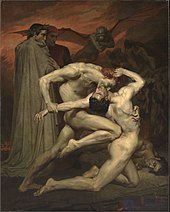
Dante and Virgil in Hell (1850) by William-Adolphe Bouguereau. In this painting they both observe the condemned.
In his Divina commedia («The Divine Comedy»), set in the year 1300, Dante Alighieri used the idea of taking Virgil as a guide through Hell (and then, in the second canticle, up the mountain of Purgatory). Virgil himself in Dante's poem is not condemned to hell, but rather, as a virtuous pagan, is confined to Limbo, on the edge of hell. In this work the geography of hell is laid out in great detail: nine concentric rings lead deeper into the Earth and deeper into various infernal punishments, until at the center of the world Dante finds Satan himself, locked in the frozen lake of hell, Cocytus. A small tunnel leads past Satan to the other side of the world, to the foot of the mountain of Purgatory.
John Milton's «Paradise Lost» (1667) begins with the fallen angels, including their leader Satan, awakening in hell after their defeat in the war in heaven, and the action returns there at several points throughout the poem. Milton portrays hell as an abode of demons and a passive prison from which they plot revenge against heaven through the corruption of humankind. The nineteenth-century French poet Arthur Rimbaud also referenced this concept in the title and theme of one of his major works, «A Season in Hell» (1873). Rimbaud's poetry depicts, in poetic form, his own suffering as well as other themes.
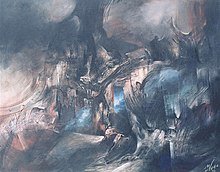
«A Visit to Hell» by the Mexican artist Mauricio García Vega.
Many of the great epics of European literature include episodes set in hell. In the Roman poet Virgil's Latin epic «The Aeneid», Aeneas descends into Dis (the underworld) to visit his father's spirit. The underworld is described only vaguely: one unexplored path leads to the punishments of Tartarus, while the other leads through Erebus and the Elysian Fields.
The idea of hell has greatly influenced writers such as Jean-Paul Sartre, who in 1944 wrote the play «No Exit», about the notion that «hell is other people». Although Sartre was not a religious man, he was fascinated by his own interpretation of the infernal condition of suffering. C. S. Lewis's book «The Great Divorce» (1945) borrowed its title from William Blake's book «The Marriage of Heaven and Hell» (1793), and was inspired by the «Divine Comedy», since the narrator likewise passes through hell and heaven. Hell here is depicted as an endless, desolate, twilight city, upon which night imperceptibly descends. The night is in fact the Apocalypse and heralds the arrival of demons after their judgment. Before night falls, anyone can escape hell if they abandon their former self and accept Heaven's offer, and the journey to heaven reveals that hell is infinitesimally small; it is nothing more than what happens to a soul that turns away from God and withdraws into itself.
Piers Anthony, in his «Incarnations of Immortality» series, depicts examples of heaven and hell through Death, Fate, the Incarnation of the Underworld, Nature, War, Time, the Good God, and the Evil Devil. Robert A. Heinlein offers a yin-yang version of hell, within which there is still something good; most evident in his 1984 book «Job: A Comedy of Justice». Lois McMaster Bujold uses her five gods, «the Father, the Mother, the Son, the Daughter, and the Bastard», in «The Curse of Chalion» to portray hell as formless chaos. Michael Moorcock is one of many who present Chaos-Evil (Hell) and Uniformity-Good (Heaven) as equally unacceptable extremes that must be kept in balance, especially in the «Elric» and «Eternal Champion» series. Fredric Brown wrote a number of fantasy stories about the actions of Satan in hell. Cartoonist Jimmy Hatlo created a series of cartoons about life in hell called «Hatlo's Inferno», published from 1953 to 1958. [160]
Часть 1 Hell: its features and essence in different religions
Часть 2 In literature - Hell: its features and essence in different

Comments