
Lecture
The history of many states includes the relationship between secular and ecclesiastical authorities, between the state and religious organizations. Recently, the influence of the church, and of religious norms and values, on the life of society in post-socialist states has noticeably increased. This is explained to a certain extent by the substantial change in living conditions and by an approach to religion as the most important integrating force and factor in the spiritual and moral revival of peoples.
The outstanding Russian philosopher I.A. Ilyin (1883-1954) defined the relationship between state and church as follows: «The Church and the state are mutually alien to one another - in institution, in spirit, in dignity, in purpose, and in mode of action. A state that attempts to appropriate to itself the power and dignity of the church commits sacrilege, sin, and vulgarity. A church that attempts to appropriate to itself the power and sword of the state loses its dignity and betrays its calling... The Church must not take up the sword - neither for the planting of faith, nor for the execution of a heretic or evildoer, nor for war... In this sense the church is «apolitical», the task of politics is not its task, the means of politics are not its means; the rank of politics is not its rank».
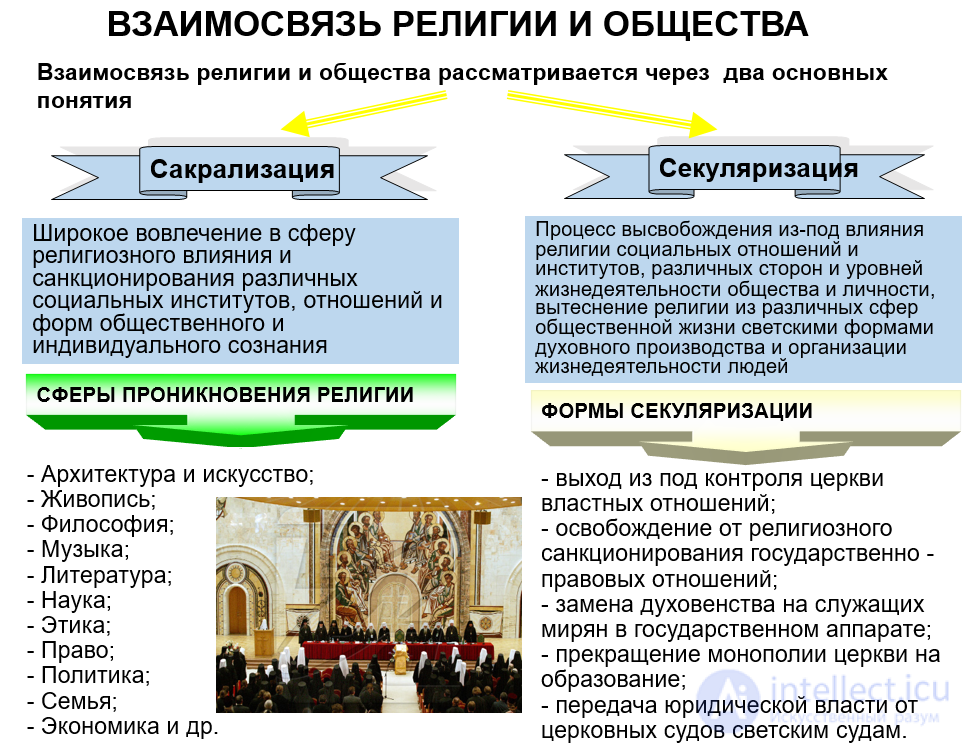
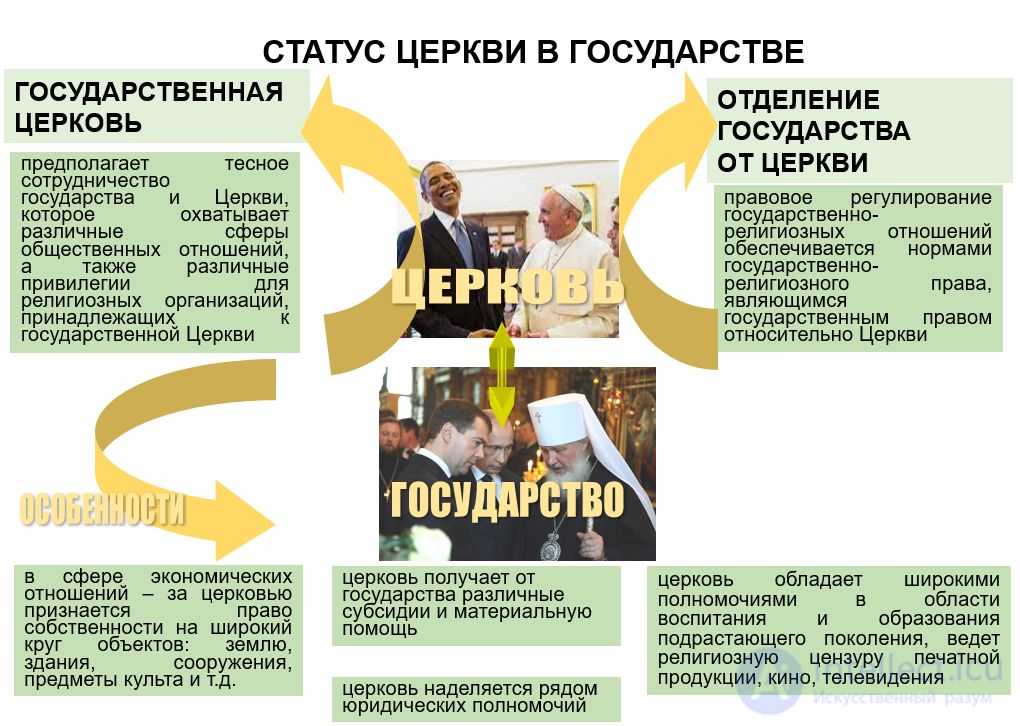
An analysis of legislation and practice makes it possible to distinguish two main types of the status of the church within the state:
The status of a state church presupposes close cooperation between state and church, encompassing various spheres of social relations, as well as various privileges for religious organizations belonging to the state church. In Great Britain the official state church is the Anglican (Protestant-Episcopal) church, whose head is the monarch. In pre-revolutionary Russia this status belonged to the Russian Orthodox Church.
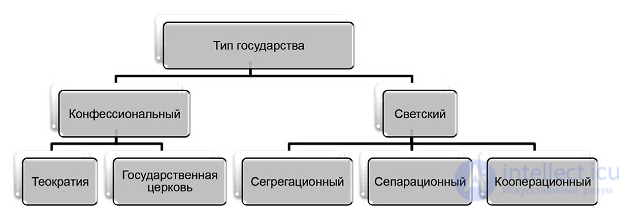
The status of a state church is characterized by a number of features.
1) In the sphere of economic relations - the church is recognized as having the right of ownership over a wide range of objects: land, buildings, structures, cult objects, etc. In many cases the state exempts church property from taxation or substantially reduces taxes on it. Thus, before October 1917 the Russian Orthodox Church was exempt from taxes and civil duties. According to data from 1905, the Orthodox church and monasteries owned about 3 million desyatinas of land.
2) The church receives various subsidies and material assistance from the state. For example, in Great Britain the state maintains chaplains in the army and in prisons at its own expense. In pre-revolutionary Russia the Orthodox church received large subsidies from the state. In 1907, 31 million rubles were allocated from the treasury for the maintenance of the church apparatus - the same amount as for the Ministry of Public Education.
3) The church is vested with a number of legal powers - it has the right to register marriage, birth, and death, and in a number of cases - to regulate marriage and family relations.
4) In the sphere of political relations the church has the right to participate in the political life of the country, including through representation of the church in state bodies. Thus, in Great Britain representatives of the higher clergy of the Anglican church sit in the House of Lords. The Orthodox church in pre-revolutionary Russia was part of the state apparatus. The Synod was composed of representatives of the clergy, appointed by order of the tsar. The Most Holy Synod was headed by the Ober-Procurator, a secular official who nevertheless possessed extensive powers allowing him to interfere in the internal affairs of the Orthodox church, including the appointment of bishops. Only persons professing the state religion have the right to occupy all leading state posts (Denmark, Norway, Paraguay, Sweden, etc.).
5) In the sphere of religious relations the union of church and state consists in the fact that the head of state, even under a republican form of government, takes a religious oath or vow upon taking office. The church also participates in the coronation of monarchs,
6) The church possesses broad powers in the sphere of raising and educating the younger generation, and exercises religious censorship of printed material, cinema, and television. Compulsory teaching of religion is provided for by the legislation of Austria (with parental consent), Sweden, Italy, and Spain in all primary, secondary, and specialized schools, and in educational institutions for training teachers and kindergarten educators. In Great Britain the study of religion is a compulsory subject in primary and secondary state schools. In Israel the study of Judaism is compulsory in all schools.
In almost 30 Muslim countries Islam is officially recognized as the state religion. In the constitutions and other constitutional acts of Pakistan, Morocco, Jordan, Bahrain, the UAE, and other countries, the concept of an Islamic form of government is enshrined, and accordingly the privileged position of Islam, whose role in Muslim states is especially great. Religion regulates all aspects of the life of society by means of a legal system based on the teaching of Islam - Muslim law. The constitutional declaration of Islam as the state religion serves to establish the supremacy of Muslim law in relation to laws adopted by the state. Researchers note that not a single one of the Arab states establishes a secular character of the state. Even where the constitution does not proclaim Islam the state religion, this does not mean the separation of religion from the state, but only serves as recognition of the existence, besides Islam, of other confessions (Libya, Sudan).
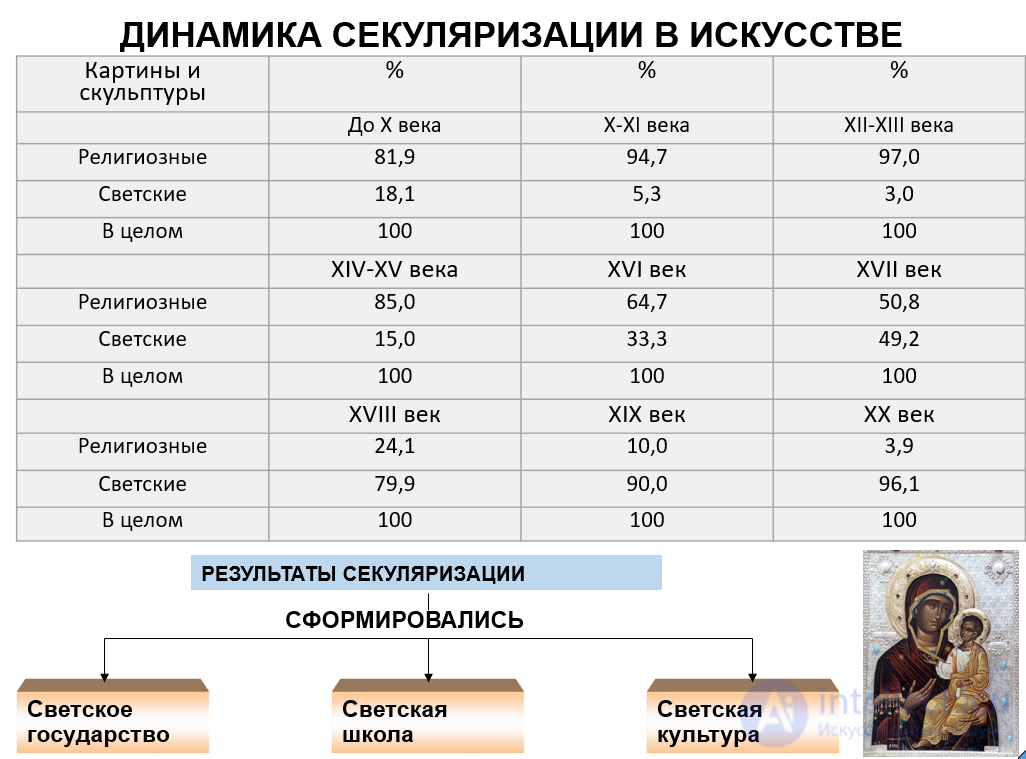
In those states where one of the religions is declared to be the state religion, other religions may also exist, but their status is more limited compared with the official church. For example, a government memorandum of 1918 permitted the activity of Catholic church missionary organizations on the territory of the British colonies possessing the status of «recognized societies», i.e., societies whose activity was certified by the Archbishop of Westminster. In Russia, Islam occupied the position of a «tolerated» religion. Spiritual affairs of Muslims were placed under the jurisdiction of the Ministry of Internal Affairs. Persons of non-Orthodox confession were officially called of foreign faith. Conversion from Orthodoxy to any other confession was permitted only in exceptional cases. According to the Criminal Code of 1903, «seduction» into a non-Christian faith was subject to criminal punishment in the form of imprisonment for a term of up to three years. Conversion to Orthodoxy, by contrast, was not hindered by any obstacles and was even welcomed.
In some countries formal equality of all religions has been established, which is a sign of a democratic society (Ireland, Argentina), since it enshrines tolerance toward other religions. However, this equality is not always observed in practice. In particular, in Italy, where in 1984 the government and the Vatican signed a concordat abolishing the status of the Catholic religion as the sole state religion of Italy, the positions of Catholicism nevertheless remain very strong.
The regime of separation of church from state exists in many countries - in contemporary Russia, in France, in Germany, Portugal, and others. This regime is most often conditioned by the desire to deprive the church of a monopoly on the performance of ideological and integrative functions, since the church possesses powerful potential for influencing the consciousness of people. It is characterized by the following features:
1) the state and its bodies have no right to control the attitude of their citizens toward religion and do not keep records of citizens on this basis;
2) the state does not interfere in intra-church activity (provided current laws are not thereby violated). In particular, the state does not interfere in the content of religious doctrines, rites, ceremonies of worship and other forms of satisfying religious needs, in the internal self-governance of religious organizations, in the relations between organs of religious organizations, in their relations with believers, or in the expenditure of funds connected with religious needs;
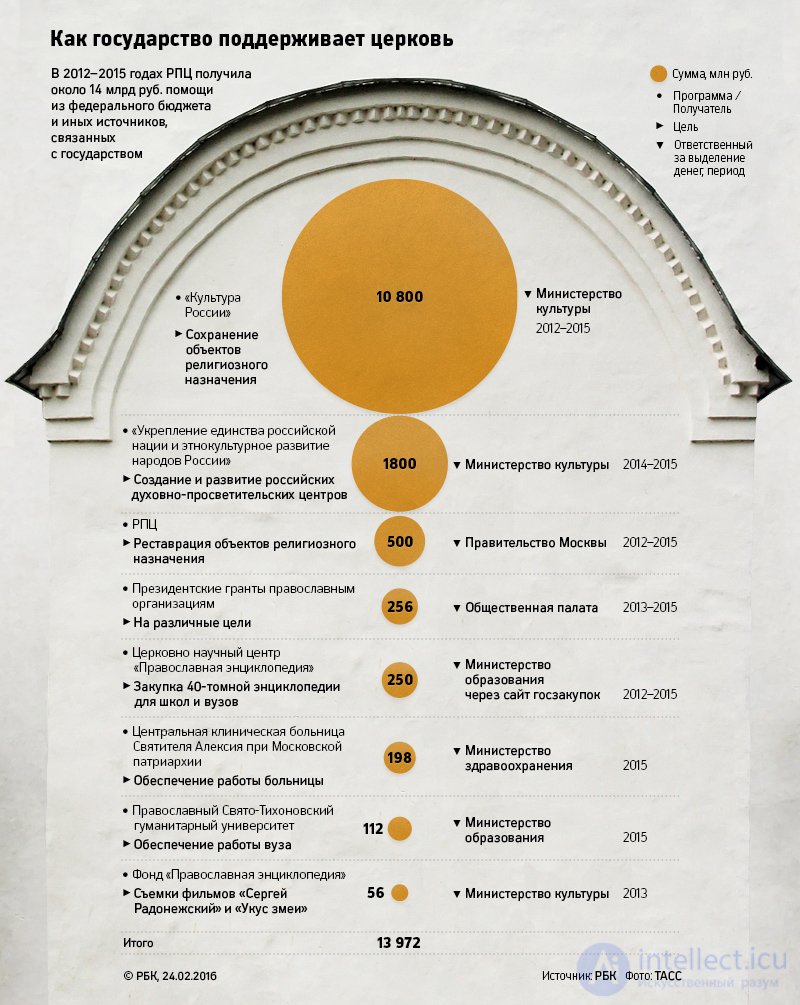
3) the state does not provide the church with material or any other, including financial, support;
4) the church does not perform any state functions;
5) the church does not interfere in the affairs of the state, but is concerned only with matters connected with satisfying the religious needs of citizens. The state, for its part, protects the lawful activity of the church and religious organizations.
Thus, the regime of separation of church from state means the reorientation of public life toward secular values and norms.
The formation of the Soviet state was based on the Marxist understanding of freedom of conscience and the theoretical position on the breaking up of the old bourgeois state machine, which presupposed the liquidation of the political ties between state and church. At one time K. Marx believed that the Paris Commune had quite correctly proclaimed the separation of church from state, expropriated the property of churches, expelled clerics from local organs of power, abolished the judicial oath on the Bible, and removed from the church the keeping of civil status records. Marx characterized the measures of the Paris Commune as a prototype of the policy of the future state of the dictatorship of the proletariat toward the church. F. Engels, likewise, in «A Critique of the Erfurt Programme of the German Social-Democratic Party», noted the necessity of the complete separation of church from state, which meant, in his opinion, that the state should treat all religious organizations as private associations, that they should be deprived of any state support, and of any influence whatsoever on schools. V.I. Lenin shared these views and held that «the state should have no business with religion, religious societies should not be tied to state power.» These theoretical propositions became the basis of the policy of the Soviet state and received consolidation in a number of its first acts, in particular in the Decree «On the Separation of Church from State and School from Church» of 23 January 1918. Subsequently this principle found consolidation in all Soviet constitutions.
The Decree of 23 January 1918 deprived the church of its economic base, establishing that all church and religious societies had no right to own property. The property of these organizations was declared national property and passed into state ownership. Local and central organs of state power could grant religious societies buildings and objects intended for worship only for use. The Soviet regime deprived religious associations and societies of the rights of legal entities. In the sphere of political relations the decree provided that all actions of state and other public-legal institutions should not be accompanied by any religious rites or ceremonies. Religious oaths, or vows, were abolished.
In the legal sphere the church was deprived of the right to register acts of civil status. It was likewise deprived of state funding. The decree consolidated the separation of school from church, i.e., citizens could teach religion to their children and be taught it themselves only in a private capacity. Thus, no place at all was allotted to the church in state-legal relations. Freedom of conscience, in turn, was interpreted not only as freedom of religion, but also as freedom of atheism. It is important to emphasize that the proclaimed secular character of the Soviet state was transformed in essence into militant atheism. During the years of Soviet power the Russian Orthodox Church and other confessions had to endure a veritable genocide: temples and other buildings intended for worship were destroyed, icons and religious literature were burned or taken abroad, high religious hierarchs and even ordinary believers were exterminated. Orthodoxy was subjected to particular persecution, evidently as the formerly state religion. According to materials of the Committee for State Security, the Central Party Archive, and the State Historical Archive of the USSR, in just one decade - from 1930 to 1940 - a third of all Russian churches was destroyed. Gilding was washed from their domes, and valuables accumulated over centuries were confiscated. It was reported in the press that 422 kg of gold alone was «washed off» the domes of the Cathedral of Christ the Savior.
It has now become widely known that in a secret letter from Lenin to Molotov for members of the Politburo of the Central Committee of the RCP(b) of 19 March 1922, the leader of the world proletariat, with staggering cynicism, proposed to take advantage of the terrible disaster afflicting the country - the famine of 1921-1922 - in order to plunder churches and deal with clergy. Church valuables were to be used for state work and for strengthening the international position of the party and the state. At the same time it was recommended to shoot as many «representatives of the clergy and the reactionary bourgeoisie» as possible. «It is necessary», Lenin wrote, «precisely now to teach this public such a lesson that for several decades to come they will not dare even to think of any resistance».
Lenin's letter served as the basis of the plan for the destruction of the church, upon which the Bolsheviks invariably looked, in the figurative expression of one of the newspapers, «through the notch of a gun sight». The plan for the destruction of the church was proposed to the Politburo on 30 March 1922 by Trotsky, who, with his characteristic Jesuitism, in addition to direct persecution and violence against the church, worked out measures for the corruption of the church by means of various renovationist movements within it. All the subsequent years were marked by reckless arrests, reprisals, and executions of clergy.
It cannot, however, be thought that such a policy of the Soviet regime met with no resistance whatsoever. The civic courage of Patriarch Tikhon commands admiration; on the first anniversary of October he addressed a denunciatory letter to the Council of People's Commissars. «You have divided the entire people», he wrote, «into camps at enmity with one another and plunged it into fratricide unprecedented in its cruelty. You have openly replaced the love of Christ with hatred, and in place of peace you have artificially inflamed class enmity... You promised freedom... In every indulgence of the base passions of the crowd, in the lawlessness of murders and robberies, lies the freedom you have granted».
In fairness it must be noted that during the Great Patriotic War of 1941-1945, in view of the great patriotic activity of the Orthodox Church, a certain normalization of relations occurred between it and the state. In particular, by a special governmental act of 1944 religious organizations were granted the right, with the permission of state organs, to build, rent, or purchase premises necessary for their needs, to acquire vehicles, to open special theological schools, to train cadres of clergy, to establish workshops for the manufacture of cult objects, and to publish religious literature. The state's relations gradually normalized with all the other major confessions as well - Muslim, Buddhist, Jewish, Roman Catholic, and others.
The regime of separation of church from state does not mean the absence of all control on the part of the state over the activity of religious organizations. The state does not shrink from the legal regulation of their status and activity. Thus France, having proclaimed in 1905 the separation of church from state (the Law of 9 December 1905), nevertheless employed certain means of controlling missionary activity in its former colonies, for example control over the content of sermons, established a permit-based procedure for opening missionary schools, and also regulated by means of laws certain elements of intra-church organization (the formation of church-territorial districts, the status of missionary organizations).
The regime of separation of church from state presupposes the legal regulation of the activity of religious organizations, which ensures a certain balance of church-state relations and allows church and state to cooperate in resolving social issues. In regulating the legal status of religious organizations, the legislation of most states proceeds from recognition of freedom of conscience and religion, i.e., the right to profess any religion, to freely choose and disseminate religious convictions. Freedom of conscience is counted among universal human values. Thus, according to the International Covenant on Civil and Political Rights (Article 18), everyone has the right to freedom of thought, conscience, and religion, which includes the free choice of religion and beliefs, and freedom, either alone or in community with others and in public or private, to worship, to observe religious and ritual rites. Freedom of conscience is subject only to such limitations as are necessary to protect public safety, order, health, morals, and the rights of others. In another international legal document - the Declaration on the Elimination of All Forms of Intolerance and of Discrimination Based on Religion or Belief of 25 November 1981 - it is proclaimed that any discrimination against people on the basis of religious belief is an affront to human dignity and is condemned as a violation of human rights and fundamental freedoms.
In domestic and foreign religious studies, different content is invested in the understanding of freedom of conscience, and therefore an analysis of the various approaches to these questions is entirely warranted. The concept of freedom of conscience has concentrated within itself the ideas of humanism, tolerance, and freedom of worldview choice. At the same time, this concept has a long history of formation and development.
At present the following propositions are dominant in determining the understanding of the essence of freedom of conscience in domestic religious studies.
A distinction is drawn between the «broad» and «narrow» understanding of freedom of conscience: in the broad sense, freedom of conscience is understood as freedom of a person's convictions in general, while in the narrow sense it is a person's attitude toward religion and atheism.
Many scholars, however, believe that a final understanding of freedom of conscience has not yet taken shape and has not received corresponding scholarly grounding.
An analysis of the development of conceptions of freedom of conscience testifies to the fact that at the basis of the problems of freedom of conscience lies the individual's choice of his attitude toward religion and atheism as polar worldview orientations. The freedom of this choice is determined by the dialectical interconnection of the democratic rights and freedoms functioning in a given society, and by the individual's genuine right to determine independently his attitude toward religion and atheism. It is precisely in this that the specificity of the concept of freedom of conscience consists: in the individual's ability to express his attitude toward the religious and the atheistic worldview. It should be added that an individual's choice between a religious and an atheistic worldview can be made at various levels - at the level of the development of the social system, of spiritual culture, of democratic traditions.
Thus, freedom of conscience is the provision within society of such democratic rights and freedoms as guarantee the individual a free choice between a religious and an atheistic worldview and the possibility of openly professing his convictions.
At present the problem of the interrelation between conceptions of freedom of conscience and economic development is topical. Unfortunately, it has not found due reflection in contemporary scholarship.
The influence of the economic structure of society on various levels of the superstructure is exercised indirectly, most often through the sphere of politics and law. Errors and miscalculations made in economic policy manifest themselves at the superstructural level, including a deforming influence on the scope of democratic rights and freedoms, and on the principles of equality and social justice. Objective economic laws come into play, imposing a corresponding logic on the course of events. For example, however progressive the legal principles of freedom of conscience may be, under conditions combining command-administrative and economic structures their practical implementation encounters numerous difficulties. Under conditions of transition to a market economy, the role and significance of the economic aspect of freedom of conscience increase, since one cannot fail to take into account the interests and needs of all members of society, both believers and atheists.
In singling out the economic aspect of freedom of conscience, let us draw attention to the fact that religious organizations essentially do not produce material values, with the exception of certain objects of religious cult. However, their monetary funds constantly grow through the voluntary offerings of believing citizens. Thus a peculiar redistribution of a portion of monetary funds from the state to religious organizations occurs. In fulfilling their moral duty, believers, through their organizations, render the state feasible assistance in solving existing social problems: they transfer funds to the fund for the protection of historical and cultural monuments, make charitable donations, acts of mercy, and so on.
The legal aspect of freedom of conscience is rather contradictory. In Soviet literature it was at one time proposed to regard freedom of conscience exclusively as a personal right of citizens. In doing so it was emphasized that freedom of conscience has an individual character, and that this is what distinguishes it from other rights and freedoms. In our view, freedom of conscience, as one of the most important democratic rights, is determined above all by the level of development of democracy in society.
In the 1970s-1980s the viewpoint on the priority of the legal aspect of freedom of conscience gained currency. In analyzing this aspect, one should single out such an independent form of social consciousness as legal consciousness. It represents a totality of views and ideas expressing an attitude toward law, legality, and toward what is lawful or unlawful. Legal consciousness makes it possible to regulate the existing rights of believers and non-believers, and also to foresee the prospects for their further development on the basis of equality and social justice.
There is also a moral aspect of freedom of conscience. Genuine freedom of conscience consists not simply in a person's ability to act in accordance with his morality, but also in the ability to organize his life activity in accordance with the generally accepted norms of public morality. A study of the social aspect of freedom of conscience makes it possible to examine the mechanism of formation of the subject's moral conviction under both a religious and a materialist worldview. Thus, the study of each of the aspects of freedom of conscience makes it possible to investigate this concept more deeply.
Freedom of conscience and freedom of religion in post-Soviet society have a number of specific features. Let us draw attention to the fact that the religious situation in the countries of the CIS is not uniform. The weakest aspects of the confessional policy of the CIS countries are the following
The question of proselytism has acquired great acuteness. The presence in the CIS countries of a large number of confessions impels religious organizations toward acute rivalry in the struggle for a flock. In doing so, each of the confessions employs methods and opportunities peculiar to it. For example, Protestants widely conduct missionary work before mass audiences, in concert halls, in cinemas. They also make use of the financial, material, and organizational support of many foreign centers.
The Orthodox Church, which strives to counter Protestant propaganda effectively, has no such experience of missionary activity, just as it lacks sufficient means and trained preachers. There is discontent with «heterodox» missionaries who have filled the CIS countries and are leading Christian souls astray from the true path. Hence also the appeal to the state with an insistent request to limit or even prohibit activity of this kind.
The non-religious part of society in Ukraine and Russia, which is quite substantial - up to 50% of the population, also experiences discomfort. They perceive religious freedom as aggression, as violence against conscience. The conviction is spreading that contemporary society is being artificially clericalized by certain forces. Symptoms of this phenomenon manifest themselves distinctly in the mass media (especially on television), in the sphere of education, in the army, and in the organs of state administration. This is attested by the demonstrative manifestation of religiosity on the part of statesmen, and by the widespread occurrence of all manner of «consecrations» of state institutions, military facilities, regimental banners, and warships. The sense of being aggrieved among this category of non-religious citizens is exacerbated under these conditions also by the fact that the population has no opportunities for the propagation of non-religious views and convictions.
Thus, growing national tension is being added to the political and social stratification already existing in society.
The struggle to exercise the right to freedom of conscience under present conditions is rather complex and dramatic, since the state attempts to subordinate to its influence both religious movements and societies of freethinkers.
Freethinking is a worldview position asserting the independence of the individual from religion and church in resolving social and personal problems
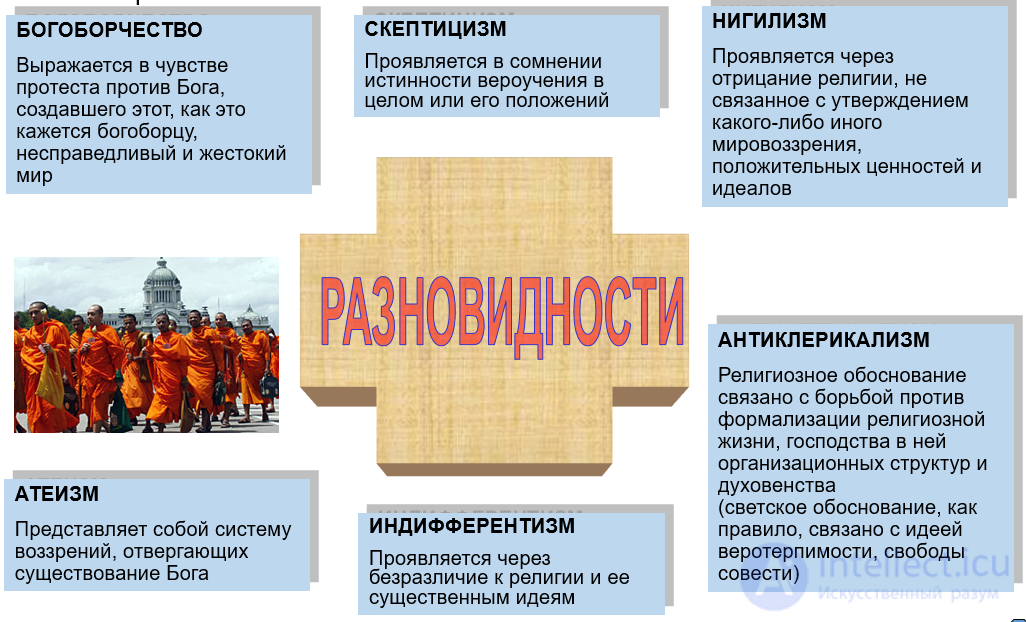
Freedom of conscience represents a peculiar point of intersection of the interests of church and state. Under conditions of separation of church from state, the latter, by consolidating freedom of conscience and religion as a legal principle, thereby expresses its attitude toward the status of religious organizations. For the church, freedom of religion serves as a means of representing its interests as a religious organization in the political-legal sphere of social life.
At present a number of states, through the constitutional proclamation of the secular character of the state, seek to eliminate the church's participation in political activity. At the same time, the church is drawn into resolving the social problems of society through the formation of various charitable societies. Thus, the state uses the church as a social institution ensuring communicative and integrative ties within the political system. Despite the proclamation of the separation of church from state, their actual isolation has not occurred. In foreign literature these relations are characterized as a partnership of a special kind. In their mutual relations church and state in many cases act as fully equal partners, cooperating for the sake of the common good. In Germany, for example, representation of the church at state events is permitted, and joint actions are also carried out at the municipal level. Under the Constitution of 1949 the church is guaranteed the right to levy taxes and to teach theological disciplines. As regards taxes, close cooperation between state and church is observed here. The church tax in Germany is withheld by employers from the wages of believers only and is transferred to state financial structures, which then pass it on to the church. These measures are carried out on the basis of an agreement concluded between the church and the state. In turn, the state turns to the church when it needs the assistance of clergy, for example for teaching religion in schools, for conducting appropriate work among soldiers or police officers, or for the activity of a pastor in prisons, etc.
The Constitution of 1949 provides for the possibility of the church appealing to the courts when disputed questions between it and state structures cannot be resolved in any other way (Article 19). Separation of church from state does not mean that the church may be indifferent to the activity of the state. It has the right openly to censure actions on the part of state power that are harmful from its point of view, and thereby it shapes public opinion and influences legislation. I.A. Ilyin wrote on this score that the church must not remain silent if state power permits, for example, trade in hashish, supports usury and the exploitation of workers through a system of concentration camps, if state power allows the spread of various forms of public depravity, legalizes polygamy, and so on. And if the church does not pass all this over in silence, would this be, I.A. Ilyin asked, «an intrusion into politics»? And he answered in the negative.
«The people create. The state governs. The Church teaches - he asserted. - The state is the defense and support of an independent church; and the church is the confessor and guardian angel of the Christian state».
The integrative function of the church is directed toward the unification of social interests. At the same time the church performs yet another important function, which may be conventionally designated as social control, since the church orients people to be guided in their actions and deeds by generally accepted humanistic values.
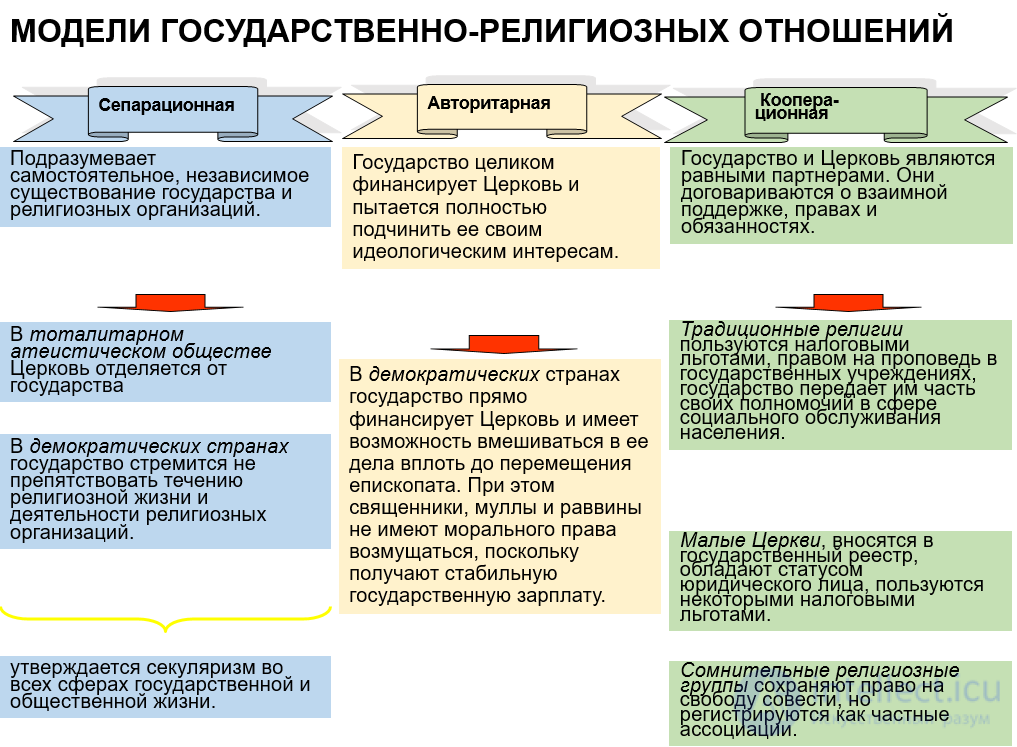
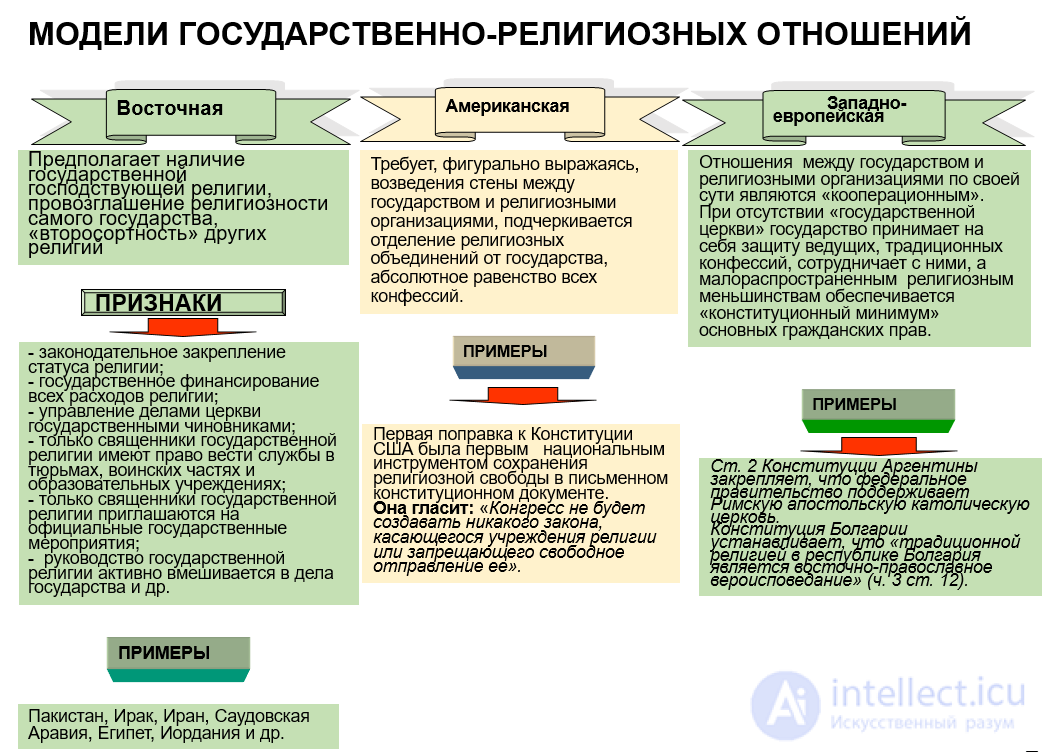
The formation of an independent policy on religious questions in the Russian Federation began following the policy of «perestroika and glasnost» announced in 1985. Over the time that has passed this process has not yet reached completion. For the Russian state the task remains topical of building a model of relations with religious organizations that would correspond to Russian traditions and mentality, take into account the experience of past years, and also the complex situation in the religious sphere of contemporary society.
The process of formation of state-church relations in contemporary Russia is directly connected with the adoption at the end of 1990 of the Law «On Freedom of Religion». The positive features of this Law are: the removal of all unjustified restrictions on the cult activity of religious organizations, the creation of conditions for the activity of the most diverse kinds of them, the simplification of the procedure for registering societies, the removal of prohibitions on the social, production-economic, and other non-cult activity of religious organizations, the recognition for them of the rights of a legal entity and property rights, and the extension of the norms of labor legislation on social security and social insurance to all citizens, including ministers of religion.
At the same time there is hardly any basis for speaking of any kind of «fundamental» difference between this Law and analogous acts of the Soviet period. In the Law «On Freedom of Religion» there are no norms that were not previously contained in the Constitutions of the USSR or the RSFSR, in legislation on religious cults, or in various acts of higher organs of power concerning particular questions of the regulation of the activity of religious associations. Proof of the «perfection» of any law should be sought above all in how the implementation of legislative norms is ensured in practice. According to the Law, control over compliance with legislation on freedom of religion was exercised by the Soviets of People's Deputies and law-enforcement bodies. Matters of registering the charters of religious organizations are handled exclusively by the Ministry of Justice and its local organs. However, the Soviets of all levels soon lost their power, and the fact of the legal recognition of religious organizations by means of an act of registration placed them essentially outside the jurisdiction of the Ministry of Justice.
The withdrawal of the state and its local organs from exercising control over compliance with laws concerning religious organizations predetermined arbitrariness in the religious sphere. Moreover, the Law failed to take into account the ethno-confessional differences among the constituent entities of the Russian Federation, and the specifics of state-church relations in its «Orthodox», «Islamic», or multi-confessional form.
After the adoption of the Law, thousands of cult buildings were handed over to believers, dozens of monasteries, theological educational institutions, religious centers, brotherhoods and missions, and church journals and newspapers were opened. Practically all substantiated applications by believers for the registration of societies were resolved positively. At the beginning of 1994 about 11 thousand religious organizations that had obtained the right of a legal entity were operating in Russia, and about another 5 thousand organizations were operating without registration of their civil charters.
However, the adoption of the Law and the subsequent amendment of the corresponding article of the Constitution of the Russian Federation did not lead to the creation of an integral model of the state's church policy. Complex problems of state-church relations were often regulated by mutually unrelated decrees and orders of the president and the government. At times a wish was expressed that the state should not interfere at all in the life activity of religious organizations. Destructive tendencies in state-church relations led to the forcible incursion into Russia of so-called new non-traditional religions, to the politicization of religions and the sacralization of the policy of the state and its institutions, to the weakening of friendly ties among religious confessions and even to inter-confessional friction and intra-church struggle, to the decline in authority of some Russian religious organizations and, finally, to discrimination against non-believers. Tension accumulated in the religious sphere of the life of society, and the question of changing the state's church policy came acutely onto the agenda.
The beginning of the formation of a new model of state-church relations is connected with the Constitution of the Russian Federation adopted in December 1993. It confirmed as the legal basis of the state's church policy such civilized norms as the secular character of the state, the equality of citizens irrespective of their attitude toward religion, and the equality of religious organizations. Illusions regarding the state's non-involvement with problems arising in the religious sphere of society gradually became a thing of the past; state organs returned once again to the practice of regulating and controlling relations with religious organizations, as well as to general oversight of the state of the religious situation in the country. Under these conditions the duties of establishing and maintaining ties with religious organizations, rendering them legal and other assistance, as well as expert-consultative functions for local administrations on issues of state-church relations, were assigned to sectors, departments, and committees on relations with religious organizations that were being formed.
In 1994 a Commission on Questions of Religious Associations was formed under the Government of the Russian Federation. Its membership included representatives of the government apparatus, a number of ministries and agencies, and scholar-experts. According to the regulation on the Commission, one of its principal aims is the consideration of questions arising in the sphere of relations between the state and religious organizations, including questions of transferring to them cult buildings and other property falling within the competence of the Government.
The principal tasks of the Commission are the preparation of proposals for the settlement of questions connected with the activity of religious organizations and requiring decisions of the Government; the informational-analytical support of the Government's activity on questions affecting the sphere of relations between the state and religious organizations, as well as facilitating the Government's contacts with them. In accordance with these tasks the Commission works out recommendations, prepares draft decisions of the Government on questions within its competence, drafts of laws of the Russian Federation for submission in the established manner to the State Duma; gives opinions on draft decisions submitted to the Government concerning questions of relations between the state and religious organizations; performs coordinating-methodological functions with respect to federal organs of executive power on questions within its competence; carries out interaction with state and public organizations, scientific institutions, and religious associations; requests and receives necessary information from state, public, and religious organizations.
Such structures as the Presidential Administration, the Federation Council, and the State Duma of the Federal Assembly are also closely engaged with the problems of the religious sphere of the life of society, where there are either special groups or specialists on state-church relations.
For the present stage in the formation of a new model of the state's church policy in Russia, it is characteristic to recognize that the state has no right to underestimate the significance of the religious sphere of society, to withdraw from resolving problems arising within it, or to forget that in the relations between state and church it is precisely the state that is the leading force, ensuring the realization of the interests of all citizens, believers and non-believers alike. Finally, the state is obliged to create a legal field for the normal life activity of associations of citizens arising on the basis of worldview convictions.
The process of forming a model of state-church policy in contemporary Russia has proved extremely complex. To this day the state does not have a scientifically grounded model of confessional policy applicable to the transitional period of the country's development. A persistent tendency remains, the beginning of which was laid by the Law «On Freedom of Religion», of reducing the constitutional right of citizens to freedom of conscience exclusively to freedom of religion. Thereby society, as it were, returns to the ideals of the turn of the 19th-20th centuries, while the state continues to ignore the rights of non-believers to freedom of conscience. Such constitutional principles of freedom of conscience as the separation of church from state and school from church, the equality of religions and religious associations, and the equality of the rights of believers and non-believers are not always observed. The question of a person's right to freedom of conscience is increasingly regarded not as an element of citizens' private life, but as part of the problems of the sphere of public-legal relations. This inevitably leads to the politicization of the activity of religious organizations, to the forcible clericalization of public and state institutions, and to the substitution of the interests of believing citizens by the interests of church bureaucracy. Hence the development of the legislative base of state-church relations is particularly important.
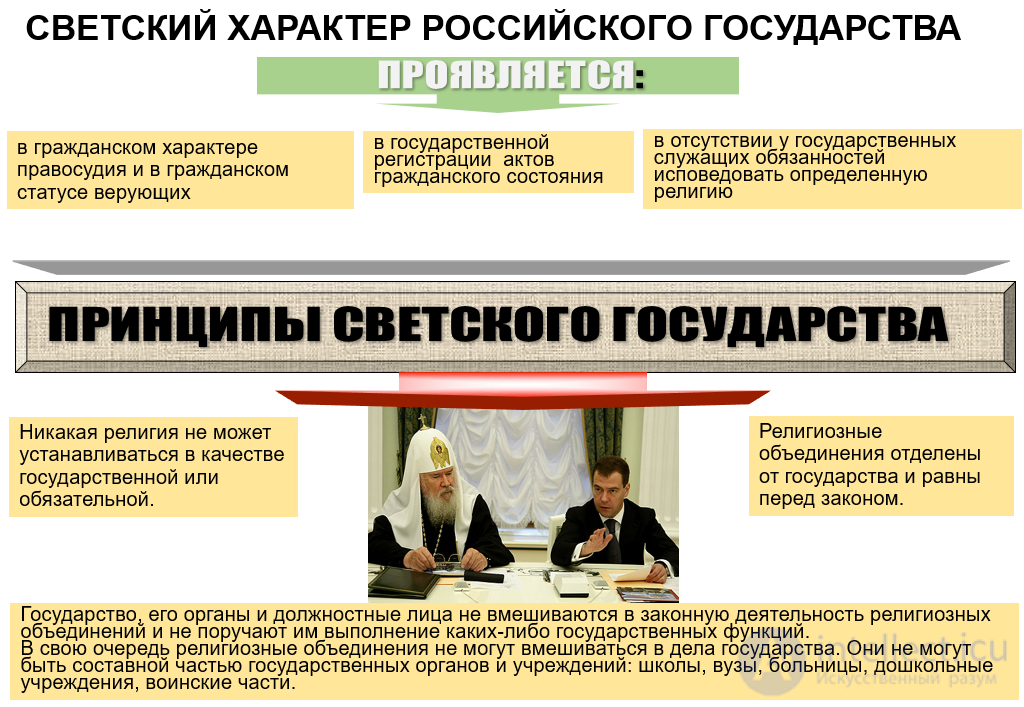
The resolution of the problems outlined above in the sphere of relations between the state and religious organizations will be all the more successful the sooner the state and organs of administration at all levels are able to break free from the inertia of past years, when state-church relations were regarded as something of tertiary importance among state interests. Today it is necessary not only to demonstrate that the protection of citizens' constitutional right to freedom of conscience is a sphere of its vital interests, but also to actually ensure it. It is necessary to uphold and put into practice the principle of the secular character of the state, generally accepted in the civilized world, to eliminate everything that might lead to schism and conflict in society on religious grounds, ensuring equal conditions for satisfying the spiritual needs of both believing and non-believing citizens. Statesmen at various levels need to abandon the temptation to use one or another religious organization to achieve their own pragmatic goals within the country and beyond its borders.
The historical experience of Russia, the complexity and ambiguity of the religious situation in the country, as well as the experience of many Western countries, convincingly attest to the pressing need to form, within the structure of executive power at the center and locally, special organs that would defend the interests of the state in relations with religious organizations, constantly monitor the processes in this delicate sphere of social relations, provide the Government and organs of state administration with information on the religious situation, and, where necessary, offer corresponding expert assessment. These organs could serve as reliable conduits for proposals and appeals put forward by religious organizations directly to the power structures.

Comments