Used to assess behavioral strategy in stressful situations and for socio-psychological diagnosis of personality
TEST
| Full name of the person being assessed |
_______________________________________ |
| Age (full years) |
_______________________________________
|
| Position |
_______________________________________
|
| Department |
_______________________________________
|
| Date completed |
_______________________________________
|
Instructions
Carefully read each question (statement) and choose the answer option that corresponds to your behavior.
Test Task
1. Do you find it difficult to find time to go to the hairdresser?
- 1) Never.
- 2) Sometimes.
- 3) Almost always.
2. Is your job the kind that «energizes» and stimulates you?
- 1) Less than most people's jobs.
- 2) About the same as most people's.
- 3) More than most people's.
3. Your everyday life is mostly filled with:
- 1) Matters requiring decisions.
- 2) Ordinary, routine matters.
- 3) Matters that bore you.
4. Some people's lives are often overflowing with surprises, unforeseen circumstances, and complications. How often do you encounter such events?
- 1) Several times a day.
- 2) Several times a week.
- 3) About once a day.
- 4) Once a week.
- 5) Once a month or less.
5. If something weighs heavily on you, presses on you, or people demand too much of you, do you:
- 1) Lose your appetite and/or eat less.
- 2) Eat more often and/or more than usual.
- 3) Notice no significant changes in your usual appetite.
6. If something is weighing on you, pressing on you, or you have urgent matters to attend to, do you:
- 1) Take appropriate action immediately.
- 2) Think it through carefully before acting.
7. How fast do you usually eat?
- 1) I usually finish eating before others.
- 2) I eat somewhat faster than others.
- 3) I eat at about the same speed as most people.
- 4) I eat slower than most people.
8. Have your family and friends ever told you that you eat too fast?
- 1) Yes, often.
- 2) Yes, once or twice.
- 3) No, no one has ever told me that.
9. How often do you do several things at once, for example, eating and working?
- 1) Often.
- 2) Sometimes.
- 3) Almost never.
10. When you're listening to someone and that person takes too long to finish a thought, do you feel the urge to hurry them along?
- 1) Often.
- 2) Sometimes.
- 3) Almost never.
11. How often do you actually «finish» the thought of a slow talker in order to speed up the conversation?
- 1) Often.
- 2) Sometimes.
- 3) Almost never.
12. How often do your loved ones and friends notice that you're inattentive when they tell you something in too much detail?
- 1) Once a week or more often.
- 2) Several times a month.
- 3) Almost never.
- 4) Never.
-
13. If you tell your family and friends you'll arrive at a certain time, how often are you late?
- 1) Sometimes.
- 2) Rarely.
- 3) Almost never.
- 4) I'm never late.
14. Do you sometimes rush to a meeting place even though you have plenty of time?
- 1) Often.
- 2) Sometimes.
- 3) Rarely or never.
15. Suppose you are supposed to meet someone at an agreed time, for example on the street, in a subway lobby, etc., and that person is 10 minutes late. Do you:
- 1) Wait calmly.
- 2) Pace back and forth while waiting.
- 3) Usually have a newspaper or book with you to occupy yourself while waiting.
16. If you have to stand in line, do you:
- 1) Wait calmly for your turn.
- 2) Feel impatient, but don't show it.
- 3) Feel so impatient that others notice it.
- 4) Flatly refuse to stand in line and try to find a way to avoid wasting time.
17. If you're playing a game with a competitive element (volleyball, football, etc.), do you:
- 1) Exert all your strength to win.
- 2) Try to win, but not too hard.
- 3) Play more for enjoyment than seriously.
18. Imagine that you and your friends or colleagues are starting a new job. What do you think about competition and rivalry in this job?
- 1) I prefer to avoid it.
- 2) I accept it, because it's inevitable.
- 3) I enjoy it, since it energizes and stimulates me.
19. When you were significantly younger, most people considered you:
- 1) Someone who often tries and genuinely wants to be first and best at everything.
- 2) Someone who sometimes tries and likes to be first and best at everything.
- 3) Someone who is usually content with things as they are (usually relaxed).
- 4) Someone who is always relaxed and not inclined to compete.
20. What do you think distinguishes you at present:
- 1) You often try (or genuinely want) to be first and best at everything.
- 2) You sometimes try and like to be first and best at everything.
- 3) You're usually content with things as they are (usually relaxed).
- 4) You're always relaxed and not inclined to compete.
21. In the opinion of your family and friends, you:
- 1) Often try (or genuinely want) to be first and best at everything.
- 2) Sometimes try and like to be first and best at everything.
- 3) Are usually content with things as they are (usually relaxed).
- 4) Are always relaxed and not inclined to compete.
22. How do your family and friends rate your overall activity level?
- 1) Insufficient activity, slowness, need to be more active.
- 2) About average, there's always something going on.
- 3) Overactivity, boundless energy.
23. Would people who know you agree that you take your work too seriously?
- 1) Yes, absolutely.
- 2) Probably yes.
- 3) Probably not.
- 4) Absolutely not.
24. Would people who know you agree that you are less energetic than most people?
- 1) Yes, absolutely.
- 2) Probably yes.
- 3) Probably not.
- 4) Absolutely not.
25. Would people who know you agree that you're able to accomplish a large amount of work in a short time?
- 1) Yes, absolutely.
- 2) Probably yes.
- 3) Probably not.
- 4) Absolutely not.
26. Would people who know you agree that you get angry and irritated easily?
- 1) Yes, absolutely.
- 2) Probably yes.
- 3) Probably not.
- 4) Absolutely not.
27. Would people who know you agree that you live a peaceful and calm life?
- 1) Yes, absolutely.
- 2) Probably yes.
- 3) Probably not.
- 4) Absolutely not.
28. Would people who know you agree that you do most things in a rush?
- 1) Yes, absolutely.
- 2) Probably yes.
- 3) Probably not.
- 4) Absolutely not.
29. Would people who know you agree that you enjoy competition and try very hard to win?
- 1) Yes, absolutely.
- 2) Probably yes.
- 3) Probably not.
- 4) Absolutely not.
30. What was your temperament like when you were significantly younger?
- 1) Quick-tempered, hard to control.
- 2) Quick-tempered, but controllable.
- 3) Quite even-tempered (no problems).
- 4) Almost never angry (never lose my temper).
31. How would you describe your temperament today?
- 1) Quick-tempered, hard to control.
- 2) Quick-tempered, but controllable.
- 3) Quite even-tempered (no problems).
- 4) Almost never angry (never lose my temper).
32. When you're absorbed in work and someone (not your boss) interrupts you, how do you feel?
- 1) I feel fine, since after an unexpected break I work better.
- 2) I feel a slight annoyance.
- 3) I feel irritated, because it interferes with the task.
33. If repeated interruptions at work really anger you, do you:
- 1) Respond sharply.
- 2) Respond calmly.
- 3) Try to do something to prevent it.
- 4) Try to find a quieter place, if possible.
34. How often do you do work that must be completed by a certain deadline?
- 1) Daily or more often.
- 2) Weekly.
- 3) Monthly or less often.
35. Work that you must finish by a certain deadline usually:
- 1) Causes no tension, because it's routine and monotonous.
- 2) Causes strong tension, since missing the deadline could affect the work of a group of people.
36. Do you set your own deadlines for work at your job and at home?
- 1) No.
- 2) Yes, but only occasionally.
- 3) Yes, quite often.
37. Toward the end of a set deadline, the quality of work you do tends to be:
- 1) Better.
- 2) About the same.
- 3) Worse.
38. Do you ever perform two or more tasks at work simultaneously, switching from one to the other?
- 1) No, never.
- 2) Yes, but not that often.
- 3) Yes, constantly.
39. Would you be satisfied with the opportunity to stay in your current job next year?
- 1) Yes.
- 2) No, I would like to achieve more.
- 3) Certainly not, I'm doing everything I can to get promoted, otherwise I would be very upset.
40. If you could choose, what would you prefer?
- 1) A pay raise.
- 2) A promotion without a significant increase in salary.
41. Toward the end of your vacation, you:
- 1) Want to extend it for another week or two.
- 2) Feel ready to return to your regular work.
- 3) Want the vacation to end so you can get back to work.
42. Over the past three years, have you ever taken less vacation than is customary at your organization?
- 1) Yes.
- 2) No.
- 3) No, never.
43. Do you ever find that during your vacation you can't stop thinking about work?
- 1) Yes, often.
- 2) Yes, sometimes.
- 3) No, never.
44. In the last three years, have you received any recognition at work?
- 1) No, never.
- 2) Sometimes.
- 3) Yes, often.
45. How often do you bring work-related materials home and study them?
- 1) Rarely or never.
- 2) Once a week or less often.
- 3) Almost constantly.
46. How often do you stay at work after the end of the workday or shift, or come in outside working hours?
- 1) That's impossible at my job.
- 2) Very rarely.
- 3) Sometimes.
47. Do you usually stay home if you have a fever or chills?
48. If you feel yourself getting tired from work, do you:
- 1) Work less intensively for a while, until your strength returns.
- 2) Keep working just as intensively despite the fatigue.
49. When you work in a team, do others expect you to take the lead?
- 1) Rarely.
- 2) No more often than others.
- 3) More often than others.
50. Do you write down a schedule for the day (what needs to be done) to help you remember?
- 1) Never.
- 2) Sometimes.
- 3) Often.
51. If someone treats you unfairly, do you:
- 1) Point it out to them directly.
- 2) Feel undecided and act depending on the circumstances.
- 3) Say nothing.
52. Compared to others doing the same work, do you put in:
- 1) Much more effort.
- 2) Somewhat more effort.
- 3) About the same effort.
- 4) Much less effort.
53. Compared to others doing the same work, do you feel:
- 1) Significantly more responsibility.
- 2) Somewhat more responsibility.
- 3) About the same responsibility.
- 4) Somewhat less responsibility.
- 5) Significantly less responsibility.
54. Compared to others doing the same work, do you feel the need to hurry:
- 1) Much more.
- 2) Somewhat more.
- 3) The same.
- 4) Somewhat less.
- 5) Much less.
55. Compared to others doing the same work, are you:
- 1) Significantly more careful/precise.
- 2) Somewhat more careful/precise.
- 3) About as careful/precise.
- 4) Significantly less careful/precise.
56. Compared to others doing the same work, is your attitude toward it:
- 1) Much more serious.
- 2) Somewhat more serious.
- 3) Little different from others.
- 4) Somewhat less serious.
- 5) Significantly less serious.
57. Compared to the work you did three years ago, do you now work during the week:
- 1) More hours.
- 2) About the same number of hours.
- 3) Fewer hours than before.
58. Compared to the work you did three years ago, does your current work require:
- 1) Less responsibility.
- 2) Just as much responsibility.
- 3) More responsibility.
59. Compared to the work you did three years ago, is your current work:
- 1) More prestigious.
- 2) Just as prestigious.
- 3) Less prestigious.
60. How many different jobs have you had in the last five years (counting any changes in the nature or place of work)?
- 1) No changes.
- 2) Two.
- 3) Three.
- 4) Four.
- 5) Five or more.
61. Over the past 5 years, have you cut back on your leisure activities due to lack of time?
Thank you!
Answer Key for the Wasserman and Gumenyuk Test for Diagnosing Behavioral Activity Type
Description
The method for diagnosing behavioral activity type developed by L.I. Wasserman and N.V. Gumenyuk is designed to identify a person's behavior type, their overall activity level, and the resulting personality characteristics. This questionnaire falls within the field of diagnosing behavioral activity strategies under stress, as well as socio-psychological diagnosis of personality development.
The test material is presented as 61 questions. Each answer carries a different weight – from 1 to 13 points. Depending on the total score obtained, the person tested can be assigned to one behavioral activity type or another (directly proportional to the number of points scored, from the minimum – Type A, to the maximum values – Type B).
The authors of the test identified the following five personality types:
- pronounced behavioral activity – Type A. A hyperactive, super-energetic, impatient, impulsive personality;
- a tendency toward Type A behavioral activity (conditionally – Type A1). An energetic personality striving for competitiveness, without ambition or aggression, with heightened business activity;
- an intermediate (transitional) type of personal activity – Type AB. A balanced personality with no overt tendency to dominate, confident and emotionally stable;
- a tendency toward Type B behavioral activity (conditionally – Type B1). A rational, cautious, unhurried personality with moderate activity;
- pronounced Type B personal activity – Type B. A gentle personality who weighs things carefully and is inclined toward reflective activity.
Answer Key
For each question (statement), the selected answer options are scored as follows:
| Question number |
Answer option |
| 1 |
2 |
3 |
4 |
5 |
| 1 |
13 |
7 |
1 |
|
|
| 2 |
13 |
7 |
1 |
|
|
| 3 |
1 |
7 |
13 |
|
|
| 4 |
1 |
4 |
7 |
10 |
13 |
| 5 |
1 |
7 |
13 |
|
|
| 6 |
1 |
13 |
|
|
|
| 7 |
13 |
9 |
5 |
1 |
|
| 8 |
1 |
7 |
13 |
|
|
| 9 |
1 |
7 |
13 |
|
|
| 10 |
1 |
7 |
13 |
|
|
| 11 |
1 |
7 |
13 |
|
|
| 12 |
1 |
4 |
7 |
10 |
13 |
| 13 |
13 |
9 |
5 |
1 |
|
| 14 |
1 |
7 |
13 |
|
|
| 15 |
13 |
7 |
1 |
|
|
| 16 |
13 |
9 |
5 |
1 |
|
| 17 |
1 |
7 |
13 |
|
|
| 18 |
13 |
7 |
1 |
|
|
| 19 |
1 |
5 |
9 |
13 |
|
| 20 |
1 |
5 |
9 |
13 |
|
| 21 |
1 |
5 |
9 |
13 |
|
| 22 |
13 |
7 |
1 |
|
|
| 23 |
1 |
5 |
9 |
13 |
|
| 24 |
13 |
9 |
5 |
1 |
|
| 25 |
1 |
5 |
9 |
13 |
|
| 26 |
1 |
5 |
9 |
13 |
|
| 27 |
13 |
9 |
5 |
1 |
|
| 28 |
1 |
5 |
9 |
13 |
|
| 29 |
1 |
5 |
9 |
13 |
|
| 30 |
1 |
5 |
9 |
13 |
|
| 31 |
1 |
5 |
9 |
13 |
|
| 32 |
13 |
7 |
1 |
|
|
| 33 |
1 |
5 |
9 |
13 |
|
| 34 |
1 |
7 |
13 |
|
|
| 35 |
13 |
1 |
|
|
|
| 36 |
13 |
7 |
1 |
|
|
| 37 |
1 |
7 |
13 |
|
|
| 38 |
13 |
7 |
1 |
|
|
| 39 |
13 |
7 |
1 |
|
|
| 40 |
13 |
1 |
|
|
|
| 41 |
13 |
7 |
1 |
|
|
| 42 |
1 |
7 |
13 |
|
|
| 43 |
1 |
7 |
13 |
|
|
| 44 |
13 |
7 |
1 |
|
|
| 45 |
13 |
7 |
1 |
|
|
| 46 |
13 |
9 |
5 |
1 |
|
| 47 |
13 |
1 |
|
|
|
| 48 |
13 |
1 |
|
|
|
| 49 |
13 |
7 |
1 |
|
|
| 50 |
13 |
7 |
1 |
|
|
| 51 |
1 |
7 |
13 |
|
|
| 52 |
1 |
4 |
7 |
10 |
13 |
| 53 |
1 |
4 |
7 |
10 |
13 |
| 54 |
1 |
4 |
7 |
10 |
13 |
| 55 |
1 |
4 |
7 |
10 |
13 |
| 56 |
1 |
4 |
7 |
10 |
13 |
| 57 |
1 |
7 |
13 |
|
|
| 58 |
13 |
7 |
1 |
|
|
| 59 |
1 |
7 |
13 |
|
|
| 60 |
13 |
10 |
7 |
4 |
1 |
| 61 |
1 |
13 |
|
|
|
Result:
- if the total score does not exceed 167, a pronounced Type A behavioral activity type is likely diagnosed;
- 168–335 points – a certain tendency toward Type A behavioral activity is diagnosed (conditionally – A1);
- 336–459 – an intermediate (transitional) type of personal activity is diagnosed – Type AB;
- 460–626 points – a certain tendency toward Type B behavioral activity is diagnosed (conditionally – B1);
- 627 points and above – a pronounced Type B personal activity type is likely diagnosed.
Interpretation
Subjects with pronounced behavioral activity – Type A – are characterized by:
- an exaggerated need for activity – overinvolvement in work, initiative-taking, inability to step away from work and relax, lack of time for rest and leisure;
- constant strain of mental and physical strength in the struggle for success, high achievement motivation combined with dissatisfaction with what has been achieved, persistence and overactivity in pursuing goals, often in several areas of life at once, unwillingness to give up on a goal despite «defeat»;
- inability and unwillingness to perform everyday, thorough, and monotonous work;
- inability to maintain long and stable concentration of attention;
- impatience, a drive to do everything quickly: walking, eating, talking, making decisions;
- energetic, emotionally charged speech, reinforced with gestures and facial expressions and often accompanied by tension in the facial and neck muscles;
- impulsiveness, emotional lack of restraint in arguments, inability to hear the other person out fully;
- competitiveness, a tendency toward rivalry and recognition, ambition, aggressiveness toward those who obstruct their plans;
- a drive for dominance in a group or company, easy frustration from external circumstances and life difficulties.
Individuals diagnosed with a tendency toward Type A1 behavioral activity are characterized by:
- heightened business activity, assertiveness, engagement with work, purposefulness. The lack of time for rest is compensated to some extent by prudence and the ability to choose the main direction of activity and make quick decisions;
- energetic, expressive speech and facial expressions;
- an emotionally rich life, ambition, a drive for success and leadership, incomplete satisfaction with what has been achieved, a constant desire to improve the results of completed work;
- sensitivity to praise and criticism;
- instability of mood and behavior in high-stress situations;
- a drive for competitiveness, but without ambition or aggression;
- when circumstances hinder the fulfillment of planned goals, anxiety easily arises and the level of self-control decreases, but is overcome through an effort of will.
Individuals diagnosed with the intermediate (transitional) AB behavioral activity type:
- are characterized by active, purposeful diligence and a broad range of interests;
- are able to balance business activity and intense work with a change of occupation and well-organized rest;
- show moderately expressed motor activity and speech expressiveness.
Individuals of Type AB:
- do not show an overt tendency toward dominance, but in certain situations and circumstances confidently take on the role of leader;
- are characterized by emotional stability and predictability in behavior;
- show relative resistance to stress factors;
- adapt well to different kinds of activity.
Individuals diagnosed with a certain tendency toward Type B1 behavioral activity are characterized by rationality.
14-Item «Type D Scale» Test
similar to HADS (Hospital Anxiety and Depression Scale), STPI (The State-Trait Personality Inventory), and MSPSS (The Multidimensional Scale of Perceived Social Support).
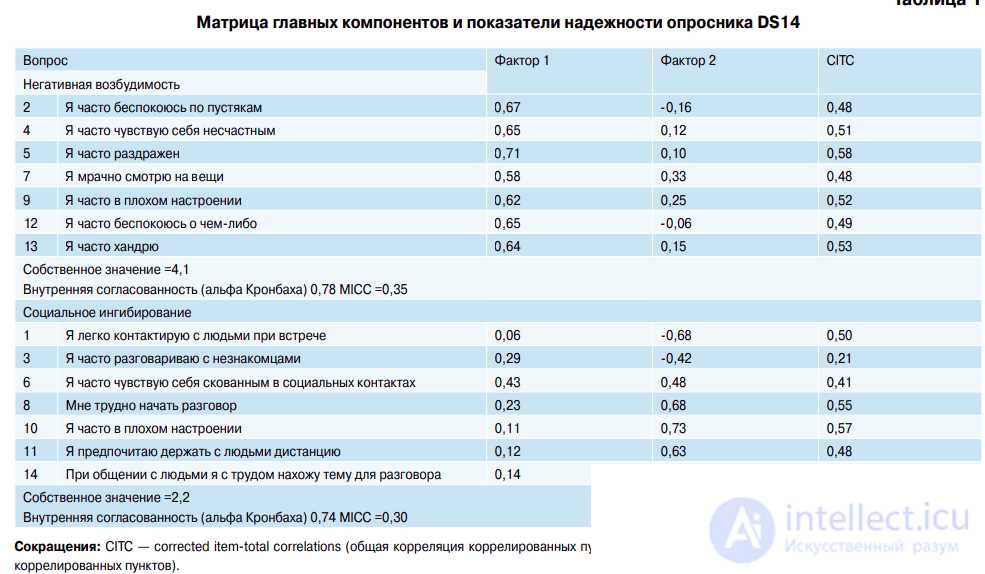
Type D personality was determined using the Russian-language version of the 14-item scale for identifying Type D personality. The questionnaire consists of two subscales: negative affectivity (NA) and social inhibition (SI), each containing seven questions. A 5-point Likert scale from 0 (“false”) to 4 (“true”) was used to rate agreement with each question. Thus, scores on the NA and SI subscales can range from 0 to 28 points. If the subject scored 10 points or more on each subscale, they were diagnosed with Type D personality.


Comments