
Lecture
Stanislav Grof, one of the founders of transpersonal psychology, used the term perinatal matrices (peri: Greek, meaning "around"; natal from the Latin natalis: "pertaining to birth") or basic perinatal matrices to designate four fundamental patterns of experience which, in his view, arise during biological birth and correspond to matching patterns of psychological experience. These matrices can be understood as internal control systems that shape a person's experiences when activated by a current event, for example during LSD intoxication. Affectively charged hallucinatory scenes may then arise, full of symbolic condensation - as in a dream state. These matrices are named according to the different physical states of the fetus during the birth process. Hanscarl Leuner, also a pioneer of LSD research, used so-called "transphenomenal systems of dynamic control" (tdyst) to describe patterns of experience comparable to Grof's perinatal matrices.
Stanislav Grof postulated in his works that the human psyche is formed not only during the biographical stage but also during the perinatal (pre-biographical) period, corresponding to the embryonic stage and the birth process. The perinatal domain of the psyche pertains to the unconscious and consists of four separate parts corresponding to successive physiological stages of pregnancy and childbirth. These areas of the unconscious were designated by the term "basic perinatal matrices."
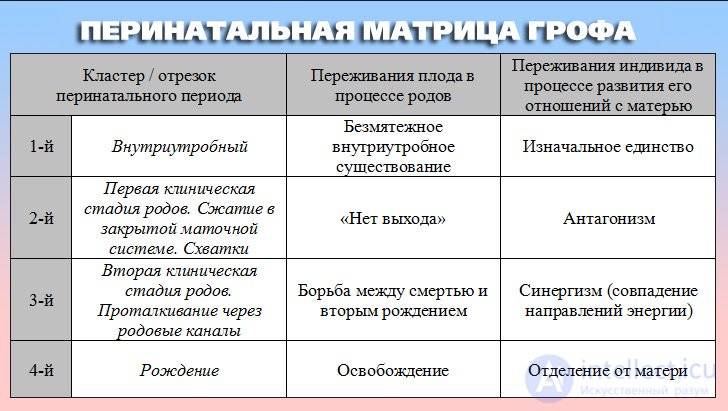
Grof defines the following four perinatal matrices:
The dominant sensation is that of being in the mother's womb. Feelings are experienced positively, including oceanic feelings and a sense of unity with God or nature. This refers to the experience of the fetus's original symbiotic unity with the maternal organism during intrauterine existence. However, Grof also writes that adverse emotional situations can sometimes prevail and come to define this matrix instead. Causes may include maternal stress, alcohol use, or somatic factors.
The decisive factor here is the painful experience of the onset of labor, characterized by uterine contractions and dilation of the cervix. Images of hell arise, along with feelings of endless suffering, confinement, and meaninglessness. A blow to the head or a sense of threat or injury from monsters is experienced as danger. PM II is, in particular, linked to infernal fantasies characteristic of endless physical torment, the most intense pain, images of hot, cramped spaces, and the hopelessness of the situation.
This matrix arises during the second clinical phase of biological birth; the cervix is dilated, allowing the fetus to gradually advance through the birth canal. Movement through the birth canal is central, associated with a sense of titanic struggle and enormous mechanical pressure. Catastrophes, a martial mood, and destruction feature prominently, especially through the action of water. The scenarios are dominated by fantasies of ritual killing, sadomasochistic orgies, and sacrifice. Activation of PM III is often accompanied by excessive sexual arousal, as well as coprological elements and a sensation of pain from fire.
This matrix arises at birth, upon emergence from the mother's body. It corresponds to the third clinical phase of labor, i.e., the delivery stage. The agonizing struggle of labor is over. This separation from the mother can be experienced as redemption, but also as total annihilation, as the death of the ego. At the end of the birth process, one may feel an "emergence into the light of life."
According to Grof, certain disorders can arise if the corresponding patterns of experience are insufficiently integrated. He attributes them to the basic perinatal matrices as follows:
PM I: Schizophrenic psychoses (paranoid symptoms), a sense of mystical union; hypochondria; hysterical hallucinosis
PM II: schizophrenic psychosis (a sense of infernal torture), severe retarded endogenous depression, an irrational sense of inferiority and guilt, hypochondria.
PM III: schizophrenic psychosis (sadomasochistic elements), agitated depression, sadomasochism, obsessional neurosis, neurasthenia, organ neuroses.
PM IV: Schizophrenic psychoses (experiences of death and rebirth, a delusional sense of mission)

Comments