
Lecture
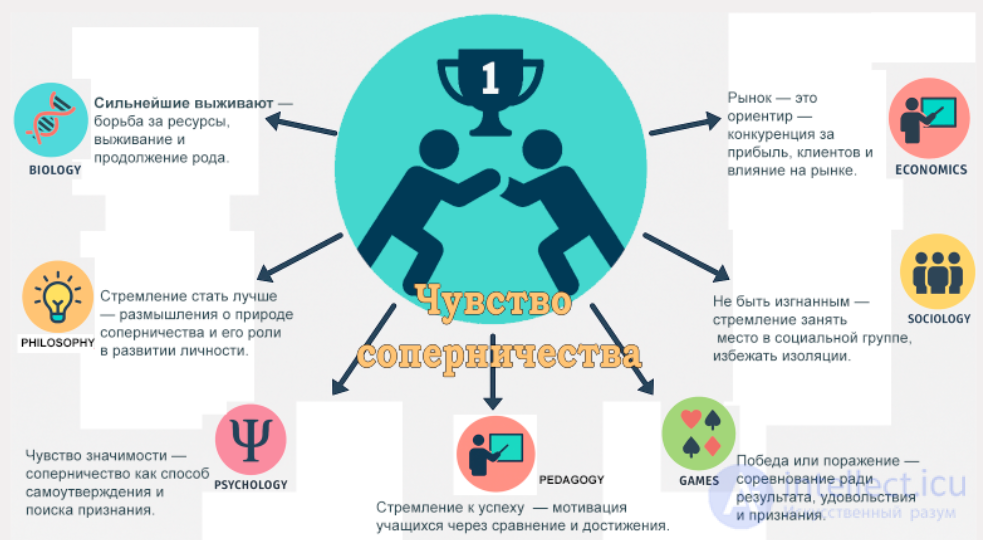
The sense of rivalry, competition, and the drive to compete are universal phenomena that permeate the most diverse spheres of human life and nature. From the struggle for resources in biological systems to intellectual battles in philosophy, from economic strategies to pedagogical approaches — these concepts play a key role in shaping behavior, motivation, and the structure of society. Their manifestations are multifaceted: in some cases they stimulate development, in others they give rise to conflict. Understanding the nature of rivalry and its functions in various disciplines allows for a deeper grasp of the mechanisms of interaction between individuals, groups, and systems.
Rivalry is a form of interaction between people based on the desire to obtain something significant. People can compete for influence, recognition, feelings, material resources, and much more. Nowadays, virtually every sphere of human activity is organized on the principle of contest.
Even seemingly creative fields, such as painting or musical composition, include elements of competition. Some specialists in psychology believe that competition fosters personal growth, while others view its influence as ambiguous and debatable.
Competition is a form of rivalry in which two or more parties strive for a common goal that cannot be shared: where one's win means another's loss (an example of this being a zero-sum game). Competition can arise between such entities as organisms, individuals, economic and social groups, and so on. Rivalry can arise over the achievement of some exclusive goal, including recognition.
Competition is often considered the opposite of cooperation; however, in the real world, a combination of cooperation and competition is the norm. In economics, as the philosopher R. G. Collingwood argued, "the joint presence of these two opposites is essential to an economic system. The parties to an economic action cooperate by competing, like two chess players." Optimal strategies for achieving goals are studied in the branch of mathematics known as game theory.
Competition is studied in various fields, including psychology, sociology, and anthropology. Social psychologists, for example, study the nature of competition. They investigate the natural drive toward competition and its circumstances. They also study group dynamics to understand how competition arises and what its consequences are. Sociologists, in turn, study the impact of competition on society as a whole. In addition, anthropologists study the history and prehistory of competition in various cultures. They also investigate how competition has manifested in various cultural settings in the past and how it has evolved over time. Competition occurs in nature between living organisms that coexist in the same environment. Animals compete for water supplies, food, mates, and other biological resources. Humans typically compete for food and mates, although once these needs are met, deep competition often arises from the drive for wealth, power, prestige, and fame in a static, repetitive, or unchanging environment. Competition is a basic principle of market economics and business, often associated with business competition, as companies compete with at least one other firm for the same customer base. Competition within a company is usually driven by the larger goal of satisfying and achieving higher quality of service or improved products that the company can produce or develop.
Competition within, between, and among species is one of the most important forces in biology, especially in the field of ecology.
Competition among members of a species ("intraspecific") for resources such as food, water, territory, and sunlight can lead to an increase in the frequency of the variation of the species best suited to survival and reproduction, until it becomes fixed in the population. However, competition for resources also has a strong tendency to diversify among members of the same species, leading to the coexistence of competitive and non-competitive strategies or cycles between low and high competitiveness. Third parties within a species often favor highly competitive strategies, which leads to the extinction of the species under harsh environmental conditions (evolutionary suicide).
Competition is also present between species ("interspecific"). When resources are limited, several species may depend on those resources. Thus, each species competes with others for access to resources. As a result, species less adapted to compete for resources may go extinct if they do not adapt, for example by changing their characteristics. According to evolutionary theory, this competition within and between species for resources plays an important role in natural selection. On shorter time scales, competition is also one of the most important factors controlling diversity in ecological communities, but on larger scales, the expansion and contraction of ecological space is a much more important factor than competition. This is illustrated by living plant communities, where asymmetric competition and competitive dominance are often found. Numerous examples of symmetric and asymmetric competition also exist for animals.
In psychology, healthy rivalry is regarded as a set of behavioral and verbal strategies through which a person demonstrates a readiness to fight for the achievement of their interests and goals. Often, competition is directed not only at obtaining what is desired, but also at preventing someone else from succeeding. One of the complexities of rivalry is the ambiguity of motivation — it is difficult to determine exactly what drives the participants. Winning can bring various emotions, from satisfaction to pride, and the harder the struggle, the more vivid these feelings are felt.
Rivalry relies on the idea of natural selection, where the fittest survives. However, in the modern world, survival does not always depend on superiority — many people live quite comfortably without being the best. Nevertheless, the spirit of competition underlies most contests and conflicts. In sports, a display of strength and skill is perceived as the norm, whereas hostile clashes often lead to negative consequences.
It is natural for a person to compare themselves with those around them, striving to surpass them. This desire to be better prompts people to enter competitions, take up challenges, and feel their superiority through success in rivalry.
Psychologists identify several varieties of rivalry, each with its own characteristic features and manifestations. Below is a summary with additions:
This type of competition is considered basic and vitally important. It arises in situations where participants fight over limited resources necessary for survival — such as food, water, housing, or safety. Examples can be observed in the animal world: predators fight over prey, packs compete for territory. In humans, structural rivalry manifests, for example, in the struggle for jobs, social benefits, or access to healthcare. Here, competition is not merely desirable — it is necessary.
This type of competition is associated with the drive for recognition, status, and respect. People take part in competitions, contests, and Olympiads to prove their superiority, not for the sake of survival, but for the sake of self-affirmation. Winning brings a sense of pride and enhances social significance. This type of rivalry is often found in sports, art, science, and even the corporate environment, where success becomes a symbol of personal worth.
The most complex and psychologically strained type. It arises in people with internal conflicts and unstable self-esteem. Its main features are:
Constant comparison of oneself with others, even without objective reason.
Success does not bring satisfaction — the person strives for exceptionality, not merely victory.
Hidden aggression arises toward those who achieve similar or better results.
The main goal is not achievement itself, but the impression that the victory makes on others.
In case of failure — strong disappointment, anxiety, and even the destruction of relationships.
Such people may resort to manipulation, sabotage, or other dishonest methods to prevent others from winning. They strive to be both leaders and favorites at the same time, which creates internal conflict and increases the risk of emotional burnout.
Until recently, there was a belief that rivalry has a positive effect on personality and contributes to success in all spheres of life. Only in recent years have psychologists begun to view competition as a potentially harmful factor capable of negatively affecting both the individual and society as a whole. The idea that the drive to win stimulates development is so deeply rooted in people's minds that abandoning it seems impossible to many.
The main problem is that a constant struggle for primacy forces a person to focus exclusively on themselves and on how to prevail in a disputed situation, instead of seeking ways toward mutual understanding or compromise. The possibility of losing is perceived as unacceptable, and concessions as weakness. As a result, the goal becomes not resolving the conflict but winning at any cost.
This approach forms an attitude in society that being right and successful is a mandatory condition. People begin to perceive any disagreement as a challenge requiring the defense of their own interests. This leads to increased aggression, distrust, and alienation between people. Although competition, like cooperation, is part of human behavior, it is not innate — a person learns it in the course of life. Children also have a drive toward rivalry, but it is expressed more mildly and rarely affects their relationships with those around them.
There is an opinion that it is precisely the spirit of rivalry that allowed humanity to survive; however, a much more important factor of survival has been and remains cooperation. Through joining forces, people have been able to build communities, support one another, and overcome difficulties.
Today, caught up in the idea of constant competition, many forget that the best results are often achieved through joint work. Excessive concentration on winning can lead to psychological difficulties: a person withdraws into themselves, is afraid to open up, and fears being vulnerable. It is widely believed that one must not share one's weaknesses, lest they be used against them.
Such distrust and internal tension create an unfavorable atmosphere that can lead to stress, emotional exhaustion, and mental health problems. When a person is constantly in a state of vigilance, this inevitably affects their overall well-being and quality of life.
Constantly comparing oneself with others can cause internal tension that negatively affects the psyche and the general state of the nervous system. The drive to be first in everything requires enormous effort and takes up a great deal of time, often without bringing satisfaction. It is important to accept the fact that every person is an individual, and any attempts to compare oneself with others are inherently unfair.
To reduce the influence of competition on one's life, several useful approaches can be used:
Value your achievements. Regardless of one's occupation, everyone has unique abilities. It is important not to forget one's successes, even small ones, and to regularly remind oneself of them. This helps strengthen confidence and inspires further steps.
Prioritize true values. Real life guideposts are not victories and rankings, but love, friendship, and kindness. These things cannot be measured, but they are what make life full. Rivalry can be useful, but it should not overshadow deeper goals.
Recognize imperfection — one's own and others'. No one is perfect. Everyone has their own difficulties, fears, and weaknesses. Victory becomes especially meaningful when it is achieved through overcoming something. Remembering this helps preserve humanity and compassion.
Change your surroundings. Sometimes it is enough to change one's environment in order to look at a situation in a new way. This is especially important if the competition arises in personal relationships — between friends, partners, or colleagues. Shifting attention to other areas of life helps reduce tension and restore inner balance.
In the theory of work psychology, the sense of rivalry is regarded as a motivational and behavioral phenomenon that influences the effectiveness, interaction, and emotional state of workers. Here is how this concept is presented in the context of work activity:
The sense of rivalry in work psychology is an internal attitude that prompts a person to strive for superiority over colleagues or other participants in the professional environment. It can manifest as a striving to be the best, to gain recognition, to obtain a higher position, or to achieve better results.
| Concept | Description |
|---|---|
| Motivation | Rivalry can strengthen the drive to achieve goals and grow. |
| Individual differences | The impact depends on the worker's temperament, self-esteem, and personal values. |
| Emotional tension | Often accompanied by stress, anxiety, and fear of failure. |
| Social dynamics | Can increase conflict, reduce trust, and hinder teamwork. |
| Productivity | In some cases increases efficiency, but not always sustainably. |
It was previously believed that competition among employees contributes to increased productivity. However, modern research (for example, by McKinsey) shows that cooperation and support within a team increase efficiency by 20–25% more than rivalry.
Psychologists emphasize that excessive rivalry can lead to burnout, decreased motivation, and a worsened psycho-emotional climate within a team.
In the work environment, it is important to balance healthy competition and cooperation. The optimal model is one where employees strive for personal growth while also being able to work as a team.
Thus, rivalry is a natural part of human behavior, reflecting the drive to defend one's interests. It can be either constructive or destructive — it all depends on the goals a person sets for themselves and the ways they pursue them. It is important to learn to use the spirit of competition as a source of growth, rather than as a cause of anxiety and isolation.
In work psychology, the sense of rivalry is a dual mechanism: it can be a source of motivation and development, but it can also cause tension and damage working relationships. Effective work organization requires the conscious management of competition, the creation of conditions for positive interaction, and support for employees' individual characteristics.
People who enjoy taking part in contests are called "compers."
People who are keen on gambling and games of chance can develop a strong dependence on them. This is called the psychopathology (addiction) of "pathological gambling." According to psychoanalyst Edmund Bergler, there are six characteristics of pathological gamblers:
Rivalry is an integral part of most computer games. It manifests in players' desire to surpass one another, prove their skill, and take leading positions. Unlike in real life, where competition can be hidden or socially restrained, in virtual space it often becomes open and even encouraged.
Games create a safe environment for expressing ambitions: here one can take risks, lose, try again — all without real-world consequences. This is precisely why gaming rivalry is often perceived as motivation for development rather than a source of stress.
One of the key elements of gaming rivalry is the leaderboard (a symbol of recognition) — a table of leaders displaying the best players by various criteria: points, wins, completion time, difficulty level, and so on.
Why is it needed?
Motivation: seeing your name on the list of the best is a powerful incentive to keep playing and improving.
Recognition: the leaderboard is a public confirmation of achievement, which earns respect among other players.
Social status: in online communities, leadership on the leaderboard can become the basis of reputation, influence, and even friendly or competitive relationships.
Individual: a player competes against themselves or against others for records and achievements.
Team: groups of players fight for victory in matches, tournaments, or rankings.
Seasonal: many games introduce temporary tables where results are reset after a certain period, creating new challenges.
Creative: in games with user-generated content (such as Minecraft or Roblox), rivalry can manifest in the originality of builds, scenarios, or modifications.
Although competition can be useful, it can also give rise to:
Toxicity: aggressive behavior, insults, cheating.
Dependence on recognition: the drive to be first at any cost, even at the expense of enjoying the game.
Burnout: constant pressure and the need to maintain one's standing can lead to fatigue and loss of interest.
Focus on progress, not victory: it is important to value one's own growth, not just comparison with others.
Community support: a friendly atmosphere and respect for opponents make the game enjoyable.
Flexible goals: one need not be first — one can strive for personal records, unique styles, or team harmony.
Many philosophers and psychologists have identified a trait in most living organisms that may drive them toward competition. This trait, called competitiveness, is seen as having high adaptive value, which coexists with the drive for survival. However, competitiveness, or the tendency toward competition, has become synonymous with aggressiveness and ambition in the English language. More developed civilizations integrate aggressiveness and competitiveness into their interactions as a way of allocating resources and adapting. Many plants compete with their neighbors for sunlight.
The term is also applied in econometrics. Here it represents a comparative measure of a firm's or subsector's ability and efficiency to sell and produce/supply goods and/or services in a given market. Two academic approaches to assessing competitiveness are the "structure-conduct-performance paradigm" and the more modern "New Empirical Industrial Organization" model. Forecasting changes in the competitiveness of business sectors is becoming an integral and obvious step in public policy development. In capitalist economic systems, the aspiration of enterprises is to maintain and enhance their own competitiveness.
One-upmanship, also called "one-upsmanship," is the art or practice of consistently outdoing a rival. This term was first used in the title of a book by Stephen Potter, published in 1952 as a sequel to "The Theory and Practice of Gamesmanship (or the Art of Winning Games without Actually Cheating)" (1947), and in the titles of Lifemanship in his series of ironic self-help books, as well as in derivative films and television that teach various tricks for achieving this goal. This comic satire of self-help style guides manipulates traditional British conventions for the player for whom all of life is a game, and who understands that if you're not one up, you're one down. Potter's unscrupulous principles apply to virtually any possession, experience, or situation, extracting maximum undeserved rewards and confusing the opponent. The 1960 film "School for Scoundrels" and its 2006 remake became satirical portrayals of how Potter's ideas can be used.
In this context, the term refers to a satirical course used for the systematic and deliberate practice of "creative intimidation," making colleagues feel inferior and thereby gaining a status of "superiority." Taken seriously, this is a phenomenon of group dynamics that can have significant consequences in the sphere of management, for example, manifesting in office politics.
Social competition is competition for social status or social power, examples of which are the drive to keep up with the Joneses, and intrasexual competition among women or men. Social competition can contribute to the emergence of social stress. "Keeping up with the Joneses" is an idiom in many parts of the English-speaking world, meaning comparing oneself to a neighbor who serves as a benchmark of social class or the accumulation of material goods. Failing to "keep up with the Joneses" is perceived as a demonstration of socio-economic or cultural inferiority. The phrase originated from a comic strip of the same name from the 1910s.
It manifests in the drive to occupy a higher position in society, to gain recognition, influence, or power. It is often observed in politics, business, and media.
It arises in friendship, family, or romantic relationships. People may compete for attention, love, authority, or influence within a group. This is often a hidden form of rivalry that can lead to tension and conflict.
Competition is an important factor in education. On a global scale, national education systems, striving to raise the best of the next generation, encourage competitiveness among students through scholarships. In countries such as England and Singapore, there are special educational programs oriented toward specialist students, which gives rise to accusations of academic elitism. Having received their academic results, students tend to compare their grades to determine who is better. In severe cases, the pressure associated with the need to perform better academically is, in some countries, so great that it can lead to the stigmatization of intellectually disabled students or even suicide due to exam failure. Critics of competition as a motivating factor in education systems, such as Alfie Kohn, argue that competition actually has a net negative effect on students' level of achievement and that it "turns us all into losers." Economist Richard Layard commented on the harmful consequences, stating: "People feel they are under enormous pressure. They feel that their main goal in life is to outdo others. This is what young people are taught in school every day. And this is not a good foundation for a society."
However, other studies, such as the Torrance Tests of Creative Thinking, show that the impact of competition on students depends on their level of autonomy. Students with a high level of autonomy thrive in competition, are motivated, and are willing to take risks. Compared to peers with low levels of autonomy, these students, as adults, are more likely to be flexible, adaptive, and creative.
Found among artists, musicians, and writers — those who strive to stand out, be original, and leave their mark on culture. Here, competition can be both inspiring and destructive, especially when accompanied by envy.
Merriam-Webster gives one definition of competition (as applied to business) as "[...] rivalry: as, for example, [...] the effort of two or more parties acting independently to secure the business of a third party by offering the most favorable terms." Adam Smith, in his 1776 book "The Wealth of Nations," and later economists described competition in general as the allocation of productive resources to their most valuable use and as a spur to efficiency. Later microeconomic theory distinguished between perfect and imperfect competition, concluding that no system of resource allocation is more efficient than perfect competition. According to the theory, competition forces commercial firms to develop new products, services, and technologies that provide consumers with a wider range of choices and better-quality products. Greater choice usually leads to lower prices for products compared to the price that would exist in the absence of competition (monopoly) or with weak competition (oligopoly).
However, in some cases competition can also lead to wasted (duplicated) effort and increased costs (and prices). For example, fierce competition for a small number of leading jobs in music and film leads many aspiring musicians and actors to invest heavily in training that does not pay off, since only a few of them achieve success. Critics also argue that competition can have a destabilizing effect, particularly competition between certain financial institutions.
Experts also question the constructiveness of competition in matters of profitability. It is argued that goals oriented toward competition are counterproductive for increasing revenue and profitability, since they limit the range of strategies available to companies as well as their ability to offer innovative solutions in response to market changes. In addition, a strong desire to beat competitors by offering competitive prices can very likely lead to price wars.
Another distinction that appears in economics is the distinction between competition as an end result (as in the case of perfect and imperfect competition) and competition as a process. This is the process of rivalry among firms (or consumers) that intensifies selective pressure toward improvements. It can be rephrased as a process of discovery.
Three levels of end-state economic competition have been classified:
In addition, companies compete for financing in the capital markets (equity or debt) in order to obtain the funds necessary for their operations. Investors typically consider alternative investment opportunities based on their risk profile, rather than only companies competing on product alone (direct competitors). Expanding the investment universe to include indirect competitors leads to a broader range of comparable, indirectly competing companies.
Competition need not be between companies. For example, business writers sometimes speak of internal competition. This is competition within companies. The idea was first proposed by Alfred Sloan at General Motors in the 1920s. Sloan deliberately created areas of overlap between the company's divisions so that each division would compete with the others. For example, the Chevrolet division competed with the Pontiac division for certain market segments. Competing brands within the same company allowed parts to be developed by one division and used by several divisions, for example, parts developed by Chevrolet were also used by Pontiac. In 1931, Procter & Gamble initiated a deliberate system of internal brand rivalry. The company was organized around different brands, with each brand allocated resources, including a dedicated staff ready to champion the brand. Each brand manager was responsible for the success or failure of the brand and was compensated accordingly.
Most companies also encourage competition among individual employees. An example of this is competition among sales representatives. The sales representative with the highest sales volume (or the greatest sales growth) over a given period receives benefits from the employer. This is also known as intra-brand competition.
Shalev and Asbjornsen found that the success (i.e., the savings achieved) of reverse auctions correlates most closely with competition. The literature widely supports the importance of competition as the main factor in the success of reverse auctions. Their findings appear to support this argument, since competition correlates strongly with the success of reverse auctions, as well as with the number of participants.
Business and economic competition in most countries is often [quantitatively] limited or restrained. Competition is often subject to legal restrictions. For example, competition may be prohibited by law, as in the case of a state monopoly or a monopoly granted by the state. Governments may impose tariffs, subsidies, or other protectionist measures to prevent or limit competition. Depending on the relevant economic policy, pure competition is regulated to a greater or lesser extent by competition policy and competition law. Another component of this activity is the process of discovering new opportunities, whereby cases of stricter government regulation usually result in the launch of less competitive enterprises.
Nicholas Gruen mentioned the "Fallacy of Competition," in which competition is considered unambiguously good, even when it affects the rules of the game. He argues that this leads to financialization (roughly doubling the share of economic resources allocated to finance and to "rule-setting and administering" professions such as law, accounting, and auditing).
The Department of Justice building in Washington, D.C., houses the influential enforcers of US antitrust competition law.
Competition law, known in the United States as antitrust law, has three main functions:
In all three cases, competition legislation aims to protect consumer welfare, ensuring that every business must compete for its share of the market economy.
Game theory is "the study of mathematical models of conflict and cooperation between intelligent, rational decision-makers." Game theory is used primarily in economics, political science, and psychology, as well as in logic, computer science, biology, and poker. It originally dealt mainly with zero-sum games, in which one person's gain results in another participant's loss.
Game theory is the primary method used in mathematical economics and business to model the competitive behavior of interacting agents. Applications include a wide range of economic phenomena and approaches, such as auctions, bargaining, merger and acquisition pricing, fair division, duopolies, oligopolies, social network formation, agent-based computational economics, general equilibrium, mechanism design, and voting systems; as well as in such broad fields as experimental economics, behavioral economics, information economics, industrial organization, and political economy.
These studies typically focus on specific sets of strategies known as "solution concepts" or "equilibria." It is commonly assumed that players act rationally. In non-cooperative games, the best known of these is the Nash equilibrium. A set of strategies is a Nash equilibrium if each strategy is the best response to the other strategies. If all players use strategies consistent with the Nash equilibrium, they have no unilateral incentive to deviate, since their strategy is the best possible one given the actions of the others.
The concept of "rivalry" has been little explored in Russian scholarly thought. The term "competition," meanwhile, has attracted considerably more attention, especially in the context of economic research. This asymmetry is due to features of the recent historical period: in the Soviet era, priority was given to collective forms of interaction and cooperation, and any manifestations of competition were viewed with wariness. Nevertheless, today it is especially important to recognize that both competition and rivalry are integral components of social life. Thoughtful reflection on them opens up possibilities for uncovering the positive, health-promoting potential inherent in competitive activity.
In the context of ancient philosophy, two key concepts close in meaning to rivalry can be identified: "agon" and "thymos." Agon referred to contests held on the occasion of religious or public celebrations. These agonistic events helped strengthen physical endurance and courage, and also played an important role in shaping national self-awareness and a sense of pride and dignity among the ancient Greeks. Winners of such contests became heroes of epic narratives, acquiring the status of cultural symbols of their time.
Margaret Heffernan's study "A Bigger Prize" examines the dangers and drawbacks of competition in (for example) biology, family, sports, education, commerce, and the Soviet Union.
Karl Marx insisted that "the capitalist system encourages competition and selfishness in all its members and completely undermines all genuine forms of community." It fosters "a climate of competitive selfishness and individualism," in which there is competition for jobs and competition among workers; Marx argued that competition among workers exceeds that displayed by company owners. He also notes that competition divides people, and although the concentration of workers and the development of better communication mitigate this effect, they are not a solution.
Gandhi speaks of selfish competition. In his view, such qualities, when praised and/or unrestrained, can lead to violence, conflict, discord, and destruction. According to Gandhi, competition arises from the ego, and therefore society should be based on mutual love, cooperation, and sacrifice for the well-being of humanity. In the society Gandhi aspires to, every person will cooperate and serve for the benefit of others, and people will share each other's joys, sorrows, and achievements as the norm of social life. In his view, in a non-violent society there is no place for competition, and this must be realized as more people make the personal choice to reduce their inclination toward selfishness and self-love.
Rivalry, competition, and contest are not merely behavioral patterns, but fundamental principles underlying evolution, progress, and social dynamics. In biology they ensure the survival of the fittest, in economics — market efficiency, in pedagogy — motivation to learn, and in philosophy and psychology — the search for meaning and self-determination. Studying them in an interdisciplinary context reveals the complex interconnections between individual striving for success and collective mechanisms of development. A conscious attitude toward these phenomena makes it possible to use their potential for good, while minimizing the risks of destructive competition.
Rivalry is a multifaceted phenomenon that can both stimulate development and cause internal and external conflicts. It all depends on the motivation, personal maturity, and context in which it manifests.

Comments