
Lecture
Stress adaptation, coping (from the English coping, coping strategy) — is what a person does in order to cope with stress. The concept unites cognitive, emotional, and behavioral strategies used to cope with stress and, more generally, with the psychologically difficult situations of everyday life. A closely related concept, widely used and deeply developed in the Russian psychological school, is perezhivanie, or "experiencing" (overcoming the adverse consequences of stress) (see, for example, F. E. Vasilyuk).
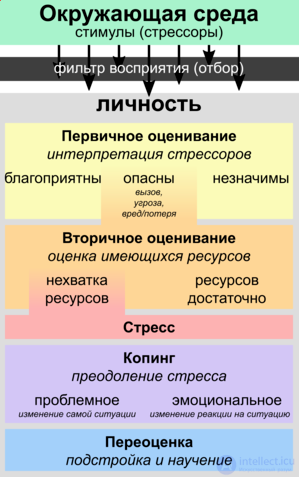
The term first appeared in psychological literature in 1962; L. Murphy applied it while studying how children overcome developmental crises. Four years later, in 1966, Richard Lazarus, in his book «Psychological Stress and the Coping Process», turned to coping to describe conscious strategies for coping with stress and with other anxiety-inducing events.
As shown by Lazarus, stress — is the discomfort experienced by a person in responding effectively to the demands of the environment, given their individual perception of the insufficiency of the resources available and accessible to them. It is the individual who assesses the situation as stressful or not. According to Lazarus and Folkman, individuals assess for themselves the magnitude of a potential stressor by comparing the demands of the environment with their own assessment of the resources they possess to cope with those very demands.
Over time, the concept of «coping» came to include a response not only to «demands that exceed or tax a person's resources», but also to everyday stressful situations. The content of coping, however, remained the same: coping — is what a person does to cope with stress: it unites cognitive, emotional, and behavioral strategies used to deal with the demands of everyday life. Thoughts, feelings, and actions form coping strategies, which are used to varying degrees in particular circumstances. Thus, coping — is the behavioral and cognitive efforts applied by individuals to manage person-environment relationships. It is emphasized here that an individual's reactions to a stressful situation can be either voluntary or involuntary. Involuntary reactions — are those based on individual differences in temperament, as well as those acquired through repetition that no longer require conscious control.
Modern social reality makes difficult situations important elements of a person's interaction with the surrounding world. Numerous studies of coping behavior have established that the factors influencing the choice of style and strategy of coping behavior include both the characteristics of the situation and the perceived control over it, as well as personality characteristics. Among the personal determinants most frequently cited are:
Psychologists working on the problems of coping behavior hold different views on the effectiveness of coping strategies. While many theories acknowledge that coping strategies can by their nature be either productive, functional, or unproductive, dysfunctional, there are authors for whom usefulness is an inherent characteristic of coping behavior; they define coping as «adaptive, purposeful, and potentially conscious actions»[13], which are consistently used by the individual to cope with stress. Other similar terms are coping tactics and coping resources (Frydenberg, Lewis, 1999)[14].
Fairly recently, researchers working on coping strategies have come to adopt what is known as the resource approach when looking at coping. The resource approach emphasizes that there exists a process of «commerce of resources», which explains the fact that some people manage to preserve their health and adapt despite various life circumstances [Frydenberg, Lewis, 2002, p. 176].
Resource theories suggest that there exists a certain set of key resources that «govern» or direct the overall pool of resources. That is, «a key resource is the primary means that controls and organizes the distribution (trade) of other resources» [Hobfoll, 1988, p. 12, quoted in: ].
The resource approach also includes the work of some serious researchers whose work previously had no connection to the study of coping behavior (Frydenberg, Lewis). Within the resource approach, a broad spectrum of different resources is considered, both environmental (the availability of instrumental, moral, and emotional help from the social environment) and personal (the individual's skills and abilities)[15]. Hobfoll[16] proposes the Conservation of Resources (COR) theory, in which he considers two classes of resources: material and social, or esteem-related. Thus, for example, M. Seligman [Seligman, 1992, 1995,[17][18] quoted in: ] considers optimism to be the main resource in coping with stress. Other researchers propose the construct of «hardiness» as one of the resources influencing the coping strategies used [Maddi, 2002[19]; Solcova, Tomanek, 1994[20]; Williams et al., 1992[21]].
The construct of self-efficacy, developed by Albert Bandura, can also be considered an important resource influencing coping behavior (Frydenberg, Lewis) . According to E. Frydenberg, self-efficacy is linked to cognitive processes related to people's internal beliefs about their own ability to cope. This belief in a person emphasizes the ability for «central» organization and use of one's own resources, as well as the ability to obtain resources from the surrounding environment (Frydenberg, Lewis) .
The resource approach suggests that the possession and management of resources and the coping strategies employed can mutually influence one another. Thus, if an adolescent has no desire to interact effectively with their social environment, they will have few friends. In this case, one could say that the coping strategy has influenced the resources. Conversely, if a child grew up in an impoverished social environment, that is, the child had limited resources, this circumstance may influence the coping strategies they prefer and the frequency with which they use social support as a strategy for coping with stress (Frydenberg, Lewis) .
Since interest in coping strategies arose in psychology relatively recently, and due to the complexity of the phenomenon of coping with difficulties itself, researchers have not yet arrived at a single unified classification of coping behavior. Work on coping strategies remains rather fragmented, so that nearly every new researcher studying coping behavior proposes their own classification. At the same time, in order to at least somewhat systematize the existing approaches to coping strategies, efforts are already being made to classify the classifications themselves.
The researchers who first used the concept of coping in psychology also proposed the first classification of coping strategies. Lazarus and Folkman proposed a dichotomous classification of coping strategies, distinguishing the following orientations[22]:
According to Lazarus, both a problem-focused and an emotion-focused aspect are present in the coping process.
Other researchers have proposed similar classifications of coping strategies. For example, Moos and Schaefer distinguish three strategies[23]:
Pearlin and Schooler propose a classification similar to the one suggested by Moos and Schaefer, distinguishing the following three strategies[24]:
These two classifications practically repeat the classification of Lazarus and Folkman. At the same time, Moos and Schaefer and, correspondingly, Pearlin and Schooler, distinguish two types of actions within the «problem-focused» strategy:
Many of the classifications of coping strategies that arose following the classification of Lazarus and Folkman were composed in the same tradition, proposing a dichotomous division of coping strategies according to the principle of «working on the problem» versus «working on one's attitude toward the problem». Thus, many classifications of coping strategies mainly come down to distinguishing between active, problem-focused efforts to cope with the external demands of the problem, versus more introspective efforts to reframe or cognitively reappraise the problem so that it better corresponds to external requirements.
In addition, some researchers propose classifications in which coping strategies are differentiated depending on the types of processes (cognitive, behavioral, emotional) underlying them. Thus, Nikolskaya and Granovskaya distinguish three large groups of coping strategies, occurring at the following levels: cognition, behavior, and emotional processing of the suppressed.
There are also classifications that deal with only one type of process. Thus, for example, Coplik[11], examining purely cognitive coping strategies, proposes a dichotomous classification: the strategy of information seeking and the strategy of closedness to information. Conversely, Vitaliano[12] distinguishes three modes of emotion-oriented coping: self-blame, avoidance, and preferred interpretation [quoted in Nartova-Bochaver]. Another theory [Fabes, Eisenberg & Eisenbud, 1993] also distinguishes three types of emotional coping, but the basis of this classification is not the type of reaction displayed, but rather what the coping actions are directed at: the regulation of the internal (experienced) emotion; the regulation of behavior associated with experiencing the emotion; the regulation of the context that triggers the emotion [quoted in Losoya, 1998[22]].
At the same time, some researchers have come to group strategies into coping styles, representing functional and dysfunctional aspects of coping. Functional styles represent direct attempts to deal with the problem, with or without the help of others, while dysfunctional styles are associated with the use of unproductive strategies. In the literature it is customary to call dysfunctional coping styles «avoidant coping». Thus, for example, Frydenberg proposes a classification in which 18 strategies are grouped into three categories: turning to others (seeking support from others, whether peers, parents, or others), unproductive coping (avoidance strategies associated with an inability to cope with the situation), and productive coping (working on the problem while maintaining optimism, social connection with others, and tone). As can be seen, the coping strategy in the «Turning to others» category stands apart from the categories of «effective» and «ineffective» coping. Thus, although this classification is based on the dimension of «effectiveness or ineffectiveness», researchers have nonetheless made an attempt here to single out yet another dimension — «social activity» — which, in the researchers' view, cannot be unambiguously assessed as productive or unproductive.
Psychological literature also presents other classifications that view coping strategies as specific behavioral manifestations of the processes of voluntary control over action, namely, as planned behavioral strategies that serve to maintain or restore control in situations where it is under threat . Thus, for example, in the BISC classification proposed by these authors [Behavioral Inventory on Strategic Control], it is assumed that children's coping strategies vary along four dimensions of strategic behavioral control: active activity, indirect activity, prosocial behavior, and antisocial behavior.
A similar classification is proposed by Hobfoll . In his COR theory (Conservation of Resources), he proposes considering six axes in coping behavior: prosocial or antisocial orientation, direct or indirect behavior, and passive or active behavior.
Today, the subject of coping strategies is actively studied in a wide variety of fields and using a wide variety of types of activity as examples. Serious attention is paid to studying the connection between the coping strategies an individual applies and their emotional state, success in the social sphere, and so on. In this, coping strategies are assessed in terms of their effectiveness or ineffectiveness, with the reduction of the feeling of vulnerability to stress taken as the criterion of effectiveness[25].
Thus, for example, data have been obtained showing that coping reactions focused on the problem (for example, an attempt to change something in a stressful relationship with another person or between other people in one's social environment) are associated with lower levels of negative emotions in stressful situations that are perceived as controllable . Furthermore, the use of problem-focused coping strategies is negatively associated with behavioral problems [Ayers, Sandler, West & Roosa, 1996,[26] quoted in Losoya, 1998[22]] and with social problems [Compas, Malcarne & Fondacoro, 1988,[27] quoted in: Losoya, 1998[22]]. It has also been shown that children who use problem-focused coping strategies less often experience more problems with adaptation [Compas et al., 1988,[27] quoted in: Losoya[22]]. Conversely, frequent use of emotion-focused coping is associated with more serious behavioral problems, as well as with a greater number of symptoms of anxiety and depression [Compas, Ey, Worsham, Howell, 1996,[28], Compas et al., 1988,[27] quoted in Losoya, 1998[22]].
Strategies such as seeking social support, aggressive coping (for example, verbal/physical aggression in order to solve a problem or express feelings), and denial also appear to be associated with competence and adaptability[22]. Data obtained in other studies also support the effectiveness of the «seeking social support» strategy [Parsons et al., 1996[29]]. It was shown here that (male) schoolchildren who received higher scores on the academic performance scale used this coping strategy more actively (in ).
The strategy of active problem-solving also deserves a positive assessment. Thus, it has been shown that adolescents capable of active problem-solving demonstrate greater ease in adaptation [Ebata, Moos, 1991,[30]quoted in: ].
Experimental studies provide varying data regarding how to evaluate a strategy such as avoidant coping (avoiding stressful thoughts or situations at the behavioral and cognitive level). On the one hand, it is linked to a higher level of depression [Herman-Stahl et al., 1995,[31]quoted in Losoya, 1998[22]; Seiffge-Krenke, 1998[32]], anxiety [Lewis & Kliewer, 1996, quoted in Losoya, 1998[22]], and difficulties adapting at school [Causey & Dubow, 1993,[33] quoted in Losoya, 1998[22]]. Conversely, other researchers show that children who use avoidance strategies demonstrate fewer behavioral problems at school [Kliewer, 1991; Eisenberg et al., 1993, quoted in Losoya, 1998[22]] and, according to teachers' reports, possess greater social competence [Kliewer & Sandler, 1993, quoted in Losoya, 1998[22]]. It is possible that avoidant coping is positively associated with social success in cases where the stressful situation is uncontrollable and where avoidance helps prevent the negative situation from escalating. Furthermore, researchers suggest that avoidant coping may be useful in situations of brief stress, but in the case of prolonged stressful situations, avoidance is regarded as a maladaptive response .
The coping strategy of «positive reappraisal of the situation» is also assessed ambiguously [Carpenter, 1992,[34]Wethington, Kessler, 1991,[35]quoted in Muzdybaev, 1998[15]]. On the one hand, giving the problem a positive meaning reduces stress and serves emotional adjustment to it; on the other hand, changing one's attitude distracts from solving specific practical problems. Nevertheless, it appears that the strategy of positive reappraisal can be effective in a situation where the subject cannot control the outcome.
As for the academic sphere, work studying the influence of coping strategies on academic success is still very weakly represented in the psychological literature. For example, one cannot clearly and unambiguously claim that successful coping strategies lead to overachievement in studies (overachievement here being understood as a higher level of achievement than the average for students of a given ability level). [Parsons, Frydenberg, Poole, 1996[29]]. Nevertheless, one can already cite data indicating, for example, that (male) adolescents who choose more productive coping strategies have a clear advantage in their studies; namely, they demonstrate a strong tendency to perform better than we would expect based on their IQ test results [ibid.].
Strategies aimed at solving problems are, in general, more effective than strategies whose purpose is to cope with the individual's attitude toward the problem. But be that as it may, research also shows that applying several coping methods at once is more effective than choosing only one particular way of responding to a situation [Carpenter, 1992,[34]Wethington, Kessler, 1991,[35] quoted in Muzdybaev, 1998[15]]. As has already been said, the effectiveness of coping strategies depends both on the reaction itself and on the context in which that reaction takes place. Coping strategies that are ineffective in some situations may turn out to be quite effective in others; for example, strategies that are ineffective in a situation beyond the subject's control may be effective in situations that the subject is able to control and change in the desired direction.
Religious coping — is turning to religion when experiencing life's difficulties, seeking social support within a group of fellow believers. This type of coping includes internal (through one's own system of values, beliefs, intentions, and actions), horizontal (based on the bond between people through their shared identity within a community of fellow believers), and vertical (carried out through the relationship between a person and the Creator) coping. Religious coping — is an adaptive variant in the cognitive sphere (it engages forms of thinking aimed at assessing difficulties relative to other life events).
Interest in coping strategies among psychologists arose not so long ago, and at present no unified classification exists. In order to systematize the currently existing approaches, efforts are already being made to classify the classifications themselves. At the same time, most researchers do not mention religious coping as a separate strategy for coping with difficult life situations.
Existing classifications of coping strategies:
At present, there are only two widely known classifications of religious coping, since this term was introduced at the beginning of the 20th century, and psychologists working in this field are only now beginning to develop their own classifications.
Kenneth Pargament proposed the following classification:
A study by E. L. Nikolaev and E. Yu. Lazareva, «Religiosity and social support in patients with chronic cardiovascular disease» , showed that patients with heart defects, more than other groups of patients, associate religion with support and comfort. The highest level of faith, according to their self-assessment, is found among patients with cardiovascular disease and significantly exceeds the corresponding indicator among healthy people. People with hypertension show the lowest levels of faith among all cardiovascular patients. They tend to perceive religion more as a philosophical concept and believe in magical rituals, and to a lesser degree than other groups of patients, perceive religious teaching as a model of moral standards of behavior. They also show the least interest in pseudoscientific knowledge and unexplained phenomena and have the lowest internal need for faith among all patients. Patients with ischemic heart disease are characterized by a high level of perception of religion as a model of the moral standards of human life. Questions of morality in religion are of great importance to them. Sirota N. A. and Fetisova B. A. studied the characteristics of coping behavior in women with breast cancer, with and without a visible post-surgical defect. The results of the study showed that women with a visible post-surgical defect, compared to women without one, use the strategy of «negative religious coping» in their behavior, which serves to relieve psychological tension. It manifests as spiritual strain and doubt, a feeling of inner insecurity, and there is a likelihood of conflicts arising and a tendency to struggle against the people around them and against higher powers.
Religious coping strategies can help reduce depressive disorders, especially in old age. Australian researchers have shown that faith and religious beliefs, together with religious behavior, have a beneficial effect on the course of depression in old age; it is worth noting that elderly people with physical infirmity turn to religion more often . Studies have shown that remission from depressive disorder occurs more quickly in people of genuine faith. Among people suffering from depression who, according to tests, score higher on a scale of genuine religiosity, remission occurred more quickly than in those with lower scores. According to research, turning to religious coping becomes more frequent in cases of severe illness or approaching death. Many elderly people choose religion as a coping strategy in the case of the loss of a loved one, which is usually accompanied by a reassessment of values. In this case religion serves as a source of comfort. Doctor of Medical Sciences Yu. I. Polishchuk pointed to the significant therapeutic potential of religious faith, its preventive and rehabilitative significance, and noted the importance of the religious coping strategy in which humility, submissiveness, and patience «create an effect of spiritual-psychological defense, playing a ‘psychologically cushioning role’ in the face of psychologically traumatic influences and events». Smirnova E. T. points to religion's provision of psychotherapeutic functions by reorienting unsatisfied needs and feelings toward religious objects; this creates a new state with an optimized mental disposition.
Stress inoculation training is one of the methods of behavior modification used in cognitive-behavioral psychotherapy. This method was developed between 1974 and 1985 by the Canadian psychologist Donald Meichenbaum (born 1940). In Russian-language literature this technique is also sometimes called a «vaccination against stress» or «stress vaccination training». The method is called «inoculation» because it bears a certain resemblance to the technique of biological immunization: just as medical immunization helps the body prepare to defend against serious infections, psychological immunization is intended to prepare a person to encounter stressful demands of increasing intensity and complexity. This method allows the client to move from a state of «learned helplessness» to a state of «learned competence».
Meichenbaum's method consists of teaching self-control techniques that help a person cope with stressful situations. This technique can also be used to develop optimal behavior in problematic situations that provoke anger, physical pain, or other negative emotions and unpleasant sensations. In Meichenbaum's own words,
A detailed program for training coping skills for stress, followed by applied training in using these skills with various stressors, is the complete opposite of the haphazard, unconsidered ways of acquiring such skills that our contemporaries are often forced to resort to. Research devoted to stress has made it possible to identify the skills necessary for coping with stress, and the method of cognitive behavior modification, as it seems to us, is a promising means of teaching these skills.
The procedure of stress inoculation training is usually clearly structured, task-focused, and in most cases does not take much time. This technique is successfully used to prepare a patient for an upcoming operation, to prepare athletes for competition, and in the professional sphere — to train workers in more effective strategies of behavior in a difficult situation (with regard to people who, by the nature of their work, often find themselves in stressful situations — for example, military personnel, law enforcement officers, managers). The model can be applied in both individual and group psychological counseling.
Stress inoculation training was created on the basis of the cognitive model of stress: it is assumed that the degree of negative impact of stress depends to a significant extent on how the situation is perceived by each particular person (that is, on the emergence of rational and adaptive, or irrational, destructive, and distracting thoughts about the problematic situation). It should also be noted that anxious, irrational, and destructive thoughts connected with past negative experience usually become activated in stressful situations. For this reason, objectively identical events can be perceived completely differently by different people (depending on their personality characteristics and life experience), which leads to different styles of behavior in a given situation and, correspondingly, to different consequences. According to Meichenbaum, a maladaptive reaction to stress arises if
Such beliefs have a pronounced negative effect following the «self-fulfilling prophecy» pattern: anxious expectations in a stressful situation lead to the emergence of maladaptive behavior and a painful reaction to stress, which, in turn, convinces the individual of the truth of their negative attitudes.
By changing the beliefs connected with the problematic situation, and the content of one's inner dialogue, a person can be prepared for difficulties they are experiencing or anticipating. This is precisely what «stress vaccination training» consists of. If the therapist manages to change the client's inner monologue (using the method of self-instruction), then a positive change occurs in the physiological component of emotions in the stressful situation, which reduces the individual's anxiety, improves their capacity for self-control, and allows them to behave more rationally and adaptively.
Although Meichenbaum's technique is primarily based on changing beliefs and inner dialogue, it is assumed that to some extent the effectiveness of this method is connected with the phenomenon of habituation to the stressor (which brings this method closer to the technique of systematic desensitization). Although stress inoculation training is based primarily on changing the inner monologue, this technique also uses relaxation methods, as well as strategies designed for problem-solving.
The training is conducted individually or in a group, with the active participation of the client. It consists of the following stages:
This phase is also sometimes called the «clarification stage». At this stage, the client is explained the psychological and biological mechanisms of the stress response. The therapist helps the client distinguish adaptive and effective reactions from maladaptive or painful ones. It is emphasized that negative emotions can lead to maladaptive behavior in a stressful situation. The therapist explains to the client that high anxiety usually arises in cases where the individual focuses their attention on their own unpleasant sensations and on their own inadequacy, as well as on thoughts that lower self-esteem and belief in their own abilities (for example, thoughts such as «there's nothing that can be done here» or «I can't do anything about either my thoughts or the situation»). Correspondingly, low anxiety is associated with focusing attention on the external situation, which increases the ability to self-control and helps solve the problem.
The therapist also helps the client realize that any person is themselves the source of their negative thoughts, feelings, and actions, and therefore can change them to more positive ones. The therapist explains that behavior can be modified by reconsidering one's attitude toward the problematic situation and developing self-control skills.
It should be emphasized that a person may not notice that automatic negative thoughts automatically appear in them in a stressful situation, or may not be aware of what negative consequences these thoughts lead to. Therefore, it is necessary to teach self-observation techniques that help a person «hear» their own inner monologue and notice how negative attitudes affect their emotions, well-being, and behavior. Meichenbaum lists various diagnostic ways of identifying automatic thoughts in stressful situations: patient examination, diagnostic study of behavior, group discussion, situation analysis, and homework assignments (self-observation and keeping a journal).
In addition, clients are taught problem-solving strategies (for example, how to define the problem, work out possible alternative courses of action, weigh the pros and cons of each possible solution to the problem, and find a way to implement the best of all possible solutions).
The client is also taught how to use self-instruction that promotes improved self-control and reduced anxiety, using, for example, phrases such as: «I can do this», «I need to act calmly, and everything will work out», «Focus on the present: exactly what needs to be done?», «Don't give up your efforts; don't expect perfection or immediate success», «You can work out a plan for dealing with this», «It's better to simply think about what you can do about it. That's better than worrying», «Relax: you're in control of yourself. Take a slow, deep breath» [10], «You are capable of developing a strategy to overcome this!», «There's no point in being nervous and worrying: it won't help matters. Think about what can be done in this situation».
This phase also explains how to recognize signs of rising emotional tension in a timely manner, which will allow the client to quickly apply the necessary techniques and prevent a loss of self-control in the stressful situation.
Finally, at this stage the client determines which stressors are most problematic for them and identifies their expectations regarding the results of the training. Based on this, the therapist and client develop a plan for joint work.
At this stage the client is invited to try out in practice various strategies (coping skills) that reduce the negative impact of stressful situations. These strategies are practiced in imagined stressful situations, and the client is advised not to deny, but rather to note, the negative, maladaptive, and anxious thoughts that arise when confronting the problematic situation, and to replace them with rational, positive thoughts that lead to adaptive forms of behavior («coping strategies»).
This phase is also sometimes called the «confrontation stage». At this stage, the acquired skills are consolidated and transferred into real life. The client «tests» the new techniques in specific situations and confirms their effectiveness for themselves. This stage also requires the therapist's participation, but to a much lesser degree (monitoring and minor correction). If the goal is to develop communication skills, this stage is often carried out within group therapy, which makes it possible to simulate a communication situation close to reality. This stage includes a variety of practical exercises, such as role-playing. In addition, real actions in real situations are practiced.
At the stage of confronting stress, the client uses the following cognitive-behavioral scheme:
At the final stage of the training, if necessary, the therapist gives the patient a card with instructions (coping card), which states what should be done in a problematic situation (for example, in the case of a panic attack). The patient can carry such a card with them, place it on their desk, or hang it at home in a visible spot. The need for such cards is related to the fact that in a stressful situation the patient may become confused and forget what the therapist recommended doing (especially if it involves a complex sequence of actions). Moreover, simply having the card often has a calming effect on the patient. Finally, by constantly looking at the card, the patient «internalizes» the program of actions they need to carry out: they mentally rehearse, so to speak, what they will need to do in the problematic situation. This helps them perform the actions better at the moment when it becomes necessary. It has been observed that even after the problem has disappeared, many patients periodically reread the instruction card, and this reduces their fear that they will be unable to cope with the problem if it arises again in the future.
Scream therapy – is a kind of stress-therapy method developed by Arthur Janov. Scream therapy is effective because when you scream, the happiness hormone endorphin is released. Scream therapy helps people release their emotions instead of bottling up negativity inside themselves.

Comments