
Lecture
Delayed happiness syndrome is a psychological habit of putting off joy, rest, pleasure, and full living until the future. A person, in effect, tells themselves: «Once I earn more money, lose weight, finish the project, buy an apartment, find a partner, or move, then I'll really start living.»
The problem is that this «later» keeps getting pushed further away. Having achieved one goal, a person quickly finds a new reason why it's still too early to be happy. As a result, life turns into an endless preparation for happiness, but the happiness itself never arrives.
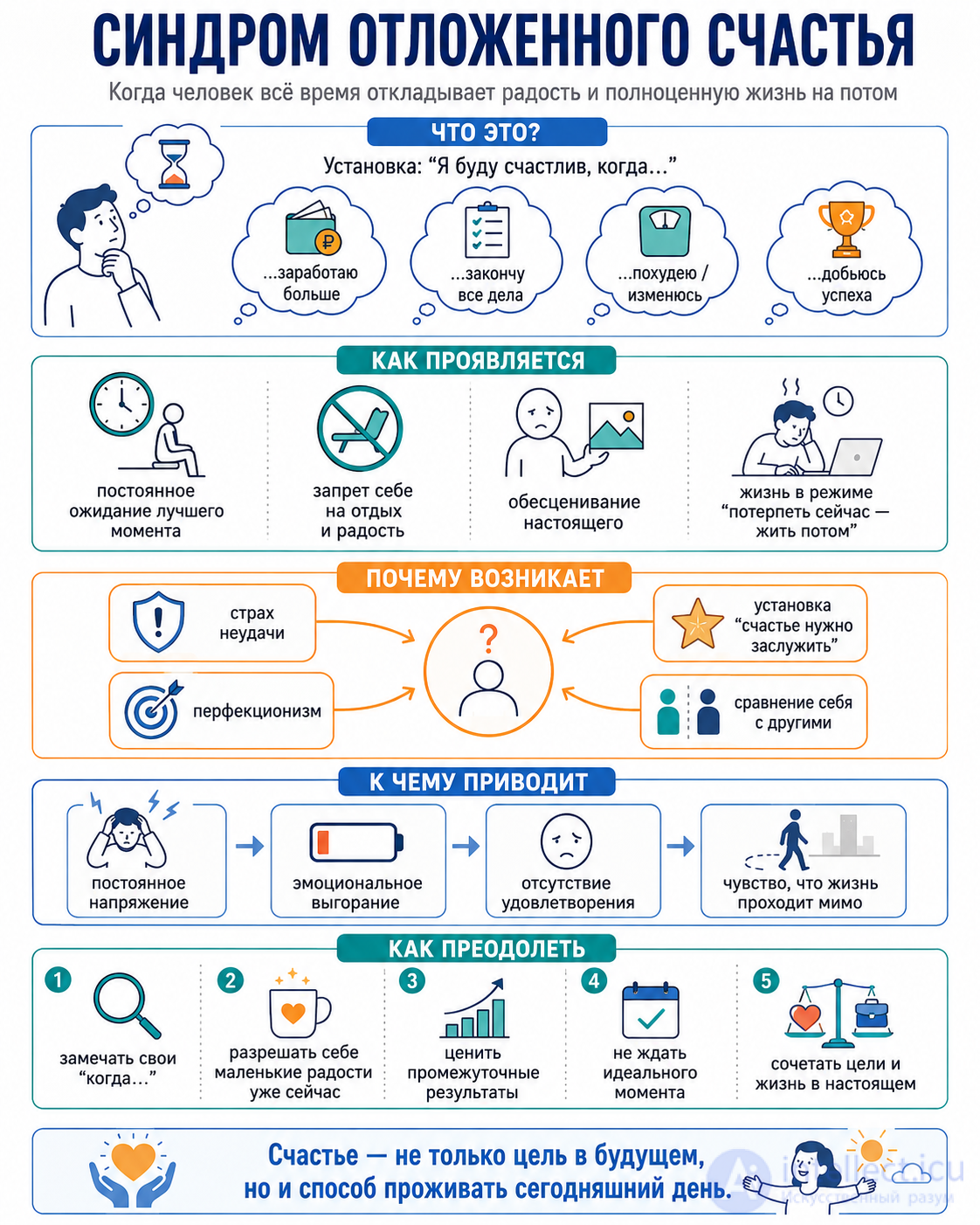
A person with delayed happiness syndrome often thinks:
«I can't relax right now, I need to hold on a little longer.»
«I'll rest once I finish everything.»
«First I need to become successful, and only then can I enjoy life.»
«Until I reach the level I need, I don't have the right to be content.»
«I just need to push a little harder, and then a normal life will begin.»
In practice, this can look like this: a person goes years without buying themselves nice things, without taking a vacation, without pursuing a hobby, without seeing friends, without celebrating small wins. They live in a state of waiting, as if their current life were a rough draft and the real one would begin later.
One of the main causes is the belief that happiness must be earned. If, in childhood, a person was often praised only for their achievements, they may have grown accustomed to thinking: «I can only be loved and respected when I am useful, successful, convenient, or productive.»
The syndrome can also develop out of fear of failure. A person sets themselves a condition: «I will be happy once everything becomes perfect.» But the perfect moment almost never comes. There are always unfinished tasks, financial worries, everyday problems, new goals, and doubts.
Another cause is social comparison. In a world of social media, it's easy to feel that other people's lives have already come together, while yours is still «not enough»: not enough money, beauty, status, travel, or achievements. Because of this, a person forbids themselves from enjoying what they already have.
At first glance, this mindset seems to help a person stay disciplined. They work, grow, and strive for something better. But if happiness is constantly made contingent on future conditions, this can lead to emotional burnout.
A person stops noticing the present. They may achieve their goals but not feel satisfaction. Joy becomes brief, while anxiety becomes constant. A sense arises that life is passing them by.
In addition, delayed happiness syndrome damages relationships. A person may think: «I don't have time for family, friends, love, or rest right now.» But closeness and joy require time now, not at some point in the future.
Planning for the future is normal. Setting goals, working, developing, saving money, and building a career are an important part of life. The problem begins when, for the sake of the future, a person completely devalues the present.
A healthy stance sounds like this: «I'm striving for more, but I can already live, enjoy myself, and take care of myself right now.»
The delayed-happiness stance sounds different: «I don't have the right to be happy until I achieve the result I need.»
The difference is that in the first case, the goal complements life, while in the second, it replaces it.
The first step is to notice your own conditions for happiness. It's useful to honestly ask yourself: «What do I keep putting off? Rest? Joy? Self-care? Socializing? Creativity?»
The second step is to stop perceiving happiness as a reward for a perfect life. Happiness doesn't have to be a big event. It can be found in simple things: a walk, a delicious breakfast, a conversation with a loved one, beautiful music, a quiet evening, a small purchase, a completed task.
The third step is to allow yourself small joys without feeling guilty. You don't have to wait for a vacation to rest. You don't have to wait for major success to praise yourself. You don't have to wait for the perfect body to dress nicely. You don't have to wait for wealth to make life more pleasant.
The fourth step is to celebrate intermediate results. If you only allow yourself to feel joy at the very end, you can miss a huge part of the journey. Small wins matter too: a completed task, a new skill, a difficult conversation, a day without procrastination, taking care of your health.
Try finishing the sentence:
«I will start enjoying life when…»
Now replace it with another one:
«I can add a little joy to my life today if…»
For example:
«I can add a little joy today if I go for a walk.»
«I can add a little joy today if I make myself a good dinner.»
«I can add a little joy today if I allow myself to rest without feeling guilty.»
«I can add a little joy today if I stop waiting for the perfect moment.»
Delayed happiness syndrome makes a person live as though their real life will begin later. But life doesn't begin after a promotion, buying an apartment, losing weight, moving, or achieving perfect success. It is already happening.
The future matters, but it shouldn't completely take over the present. It's possible to strive for goals while also enjoying what you have right now. Happiness is not only the final point of the journey, but also a way of traveling along it.

Comments