Welcome to the Tests in Correctional Psychology! This unique course is designed for anyone striving for personal growth, overcoming obstacles, and developing their potential. Here you will find valuable answers, diagrams, and methods that will help you better understand and deepen your knowledge of the special psychology course.
During our tests, you will become familiar with leading methods of correctional psychology, developed by experienced specialists in the field of psychology and psychotherapy. We offer you a unique opportunity to take these tests and gain valuable insight into your emotional reactions, negative beliefs and habits, as well as the patterns and schemas that may be hindering your development.
While taking the tests, you will review various aspects of correctional psychology, including defectology, development, and much more. Each test and diagram you complete is designed with scientific data in mind and aims to help you understand your difficulties and find effective ways to overcome them.
We invite you on a journey to a better version of yourself. Are you ready to take responsibility for your emotional, cognitive, and psychological well-being? Join our course in correctional psychology and start your path to a full and happy life today!
1. Special psychology is:
- a) a science that studies and develops means and methods for compensating for and correcting developmental disorders;
- b) a science studying the essence, patterns, and trends in managing the development of the individuality and personality of a child with disabilities;
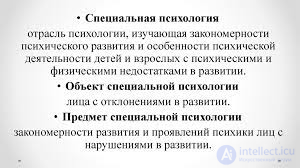
- *c) a branch of psychological science that studies the psychological characteristics of people who show a deviation from the norm of mental development.
2. Compensation of impaired functions is:
- a) the concentration of excitation and inhibition processes in a specific area of the cerebral cortex;
- b) the totality of the body's reactions to damage;
- *c) a complex process of restructuring the body's functions in the event of impairment or loss of certain functions.
3. Deprivation is:
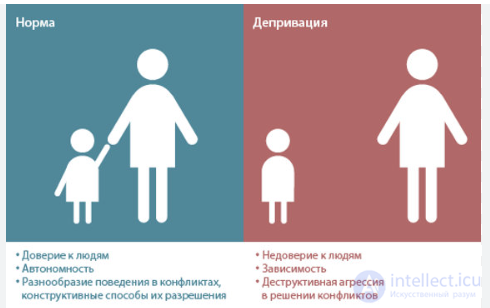
- *a) a mental state arising from the prolonged non-satisfaction of basic psychological needs;
- b) a mental state accompanied by feelings of fear and anxiety, leading to mental disorders;
- c) a depressed, oppressed state observed in almost all mental illnesses.
4. Dementia is:
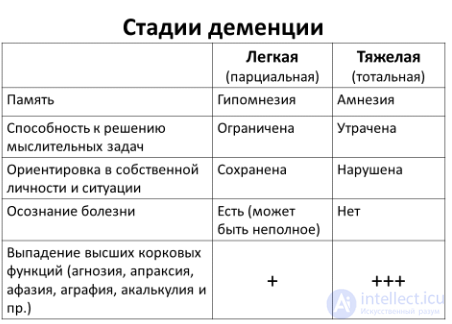
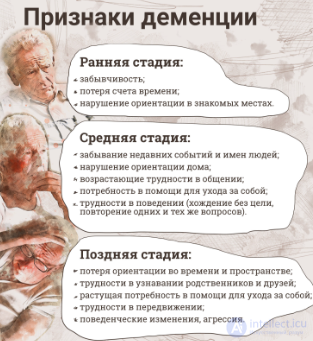
- *a) a persistent weakening of cognitive activity, decreased critical thinking, impoverishment of emotions, and behavioral disturbance resulting from organic brain damage in the late postnatal period;
- b) a special form of mental underdevelopment expressed in a persistent decline in cognitive activity;
- c) a mild degree of oligophrenia.
5. Intellectual disability is:
- a) a state of persistent decline in intelligence resulting from organic brain damage;
- b) a persistent weakening of cognitive activity and disturbance of the emotional-volitional and personal sphere, caused by organic brain damage in the late postnatal period;
- *c) a special form of mental underdevelopment, primarily intellectual, arising as a result of pathogenic factors during the prenatal period of the child's development.
6. Developmental delay is:
- a) one of the characteristic signs of oligophrenia;
- *b) a disruption of the normal rate of mental development;
- c) an irreversible lag in the development of cognitive processes.

7. Distorted mental development is:
- a) intellectual disability;
- b) dementia;
- *c) early childhood autism.

8. Cerebral palsy is:
- *a) impairment of the body's motor functions due to damage to the motor centers of the brain;
- b) increased tone in certain muscles or limbs due to impaired innervation;
- c) a special developmental variant in which both motor function and intelligence are impaired.
9. Imbecility is:
- a) the most severe degree of oligophrenia;
- b) a mild degree of oligophrenia;
- *c) a moderate degree of oligophrenia.
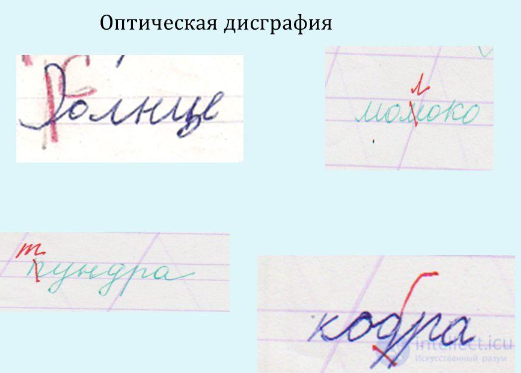
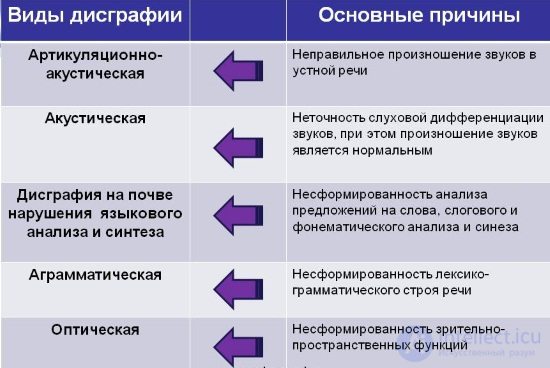
10. Dysgraphia is:
- a) impaired sound production;
- b) impaired speech tempo;
- *c) a disorder of written language.
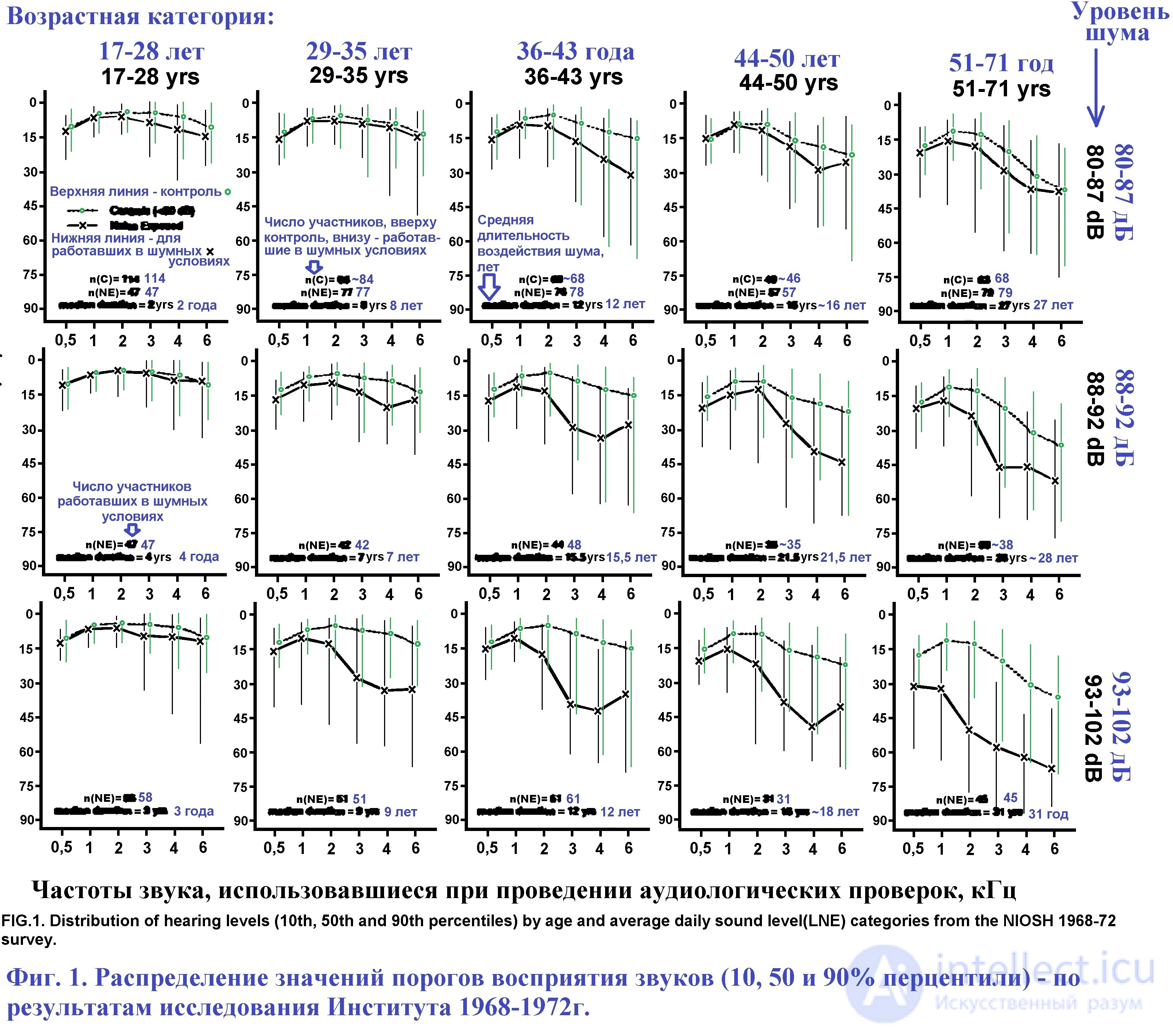
11. Audiometry is:
- a) a way of measuring visual acuity;
- *b) measurement of hearing acuity;
- c) a way of measuring the body's physical parameters.
12. Children with early childhood autism are characterized by:
- a) impairment of the cognitive sphere;
- b) impairment of the motor sphere;
- *c) impairments of the emotional sphere and communication.
13. The main groups of causes of developmental disorders are:
- a) congenital and hereditary;
- *b) exogenous and endogenous;
- c) prenatal and natal.
14. In children with hearing impairments, the following are noted as secondary deviations:
- a) intellectual impairments;
- b) impairments of the motor sphere and personality;
- *c) speech impairments.
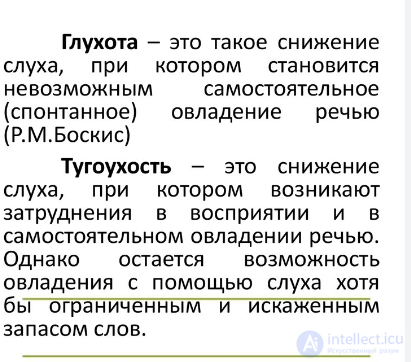
15. Deafness is:
- a) the same as hearing impairment;
- *b) a persistent loss of hearing in which independent acquisition of speech is impossible;
- c) a persistent decrease in hearing in which independent accumulation of a minimal vocabulary is possible;
- d) a temporary loss of hearing due to illness or injury.
16. In early childhood autism:
- a) intellectual impairments are always present;
- b) intellectual impairments are never diagnosed;
- *c) intellectual impairments may be present.
17. Cerebral palsy is:
- *a) a congenital pathology of the musculoskeletal system;
- b) a disease of the nervous system;
- c) an acquired disease and damage to the musculoskeletal system.
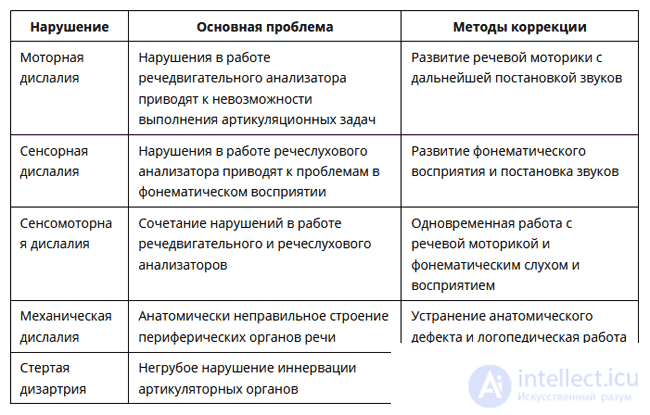
18. Dyslalia is:
- *a) impaired sound production;
- b) a voice disorder;
- c) underdevelopment of speech.
19. The branches of special psychology are:
- a) pathopsychology, psychopathology, psychiatry;
- b) special pedagogy, defectology, correctional pedagogy;
- *c) typhlopsychology, speech-language psychology, deaf psychology.
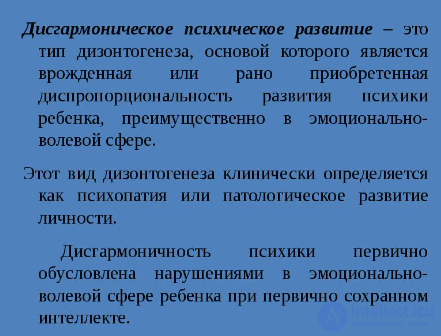
20. Disharmonious development is:
- a) developmental delay;
- b) cerebral palsy;
- *c) psychopathy.
21. Special pedagogy is a science:
- a) about the psychological characteristics of children with developmental disorders;
- b) about providing pedagogical assistance to a person with disabilities and limitations in daily life;
- *c) about the theory and practice of special education for people with psychophysical developmental disorders.
22. One of the tasks of domestic special pedagogy at its current stage of development is:
- a) finding its own pedagogical terms that reflect its essence;
- b) clarifying «parallel terminology» of related subject areas;
- *c) drawing on specialized medical and psychological terms and concepts.
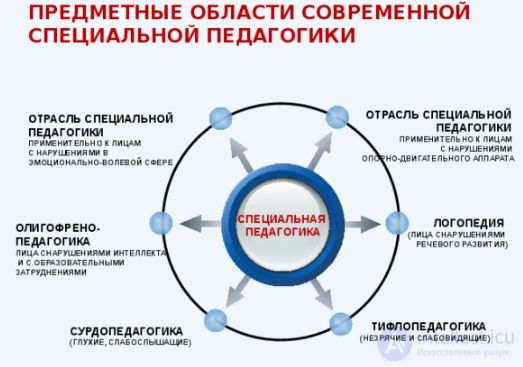
23. The branches of special pedagogy are:
- a) special psychology, psychopathology, pathopsychology;
- *b) education of children with intellectual disabilities, education of the deaf, education of the visually impaired, speech therapy;
- c) general pedagogy, family pedagogy, preschool pedagogy.
24. The ultimate goal of special pedagogy involves:
- a) the complete elimination of the developmental disorder;
- *b) achieving the greatest possible independence and autonomy in life for a person with disabilities;
- c) overcoming the consequences of the developmental disorder.
25. Integrated education is:
- a) a system of interconnected educational institutions in which children with various hearing, vision, intellectual, musculoskeletal, and speech impairments are educated;
- b) educating children with various impairments in a single educational institution;
- *c) the education and upbringing of children with psychophysical developmental disorders in mainstream educational institutions together with typically developing children.
26. When teaching children with various developmental disorders, the following are used:
- a) general pedagogical methods and techniques of instruction;
- *b) general pedagogical methods and techniques of instruction, adapted to the capabilities of the learners;
- c) special methods and techniques of instruction.
27. Fingerspelling and sign language are used for teaching:
- a) blind children;
- *b) deaf children;
- c) children with intellectual disabilities.
28. Early detection of a developmental disorder:
- *a) makes it possible to prevent the emergence of other disorders;
- b) ensures the child's psychological readiness for schooling;
- c) has as its goal the prevention of secondary deviations.
29. Group size in a specialized preschool institution depends on:
- a) the number of children with disorders;
- b) the wishes of the teaching staff;
- *c) the type of disorder and the age of the children.
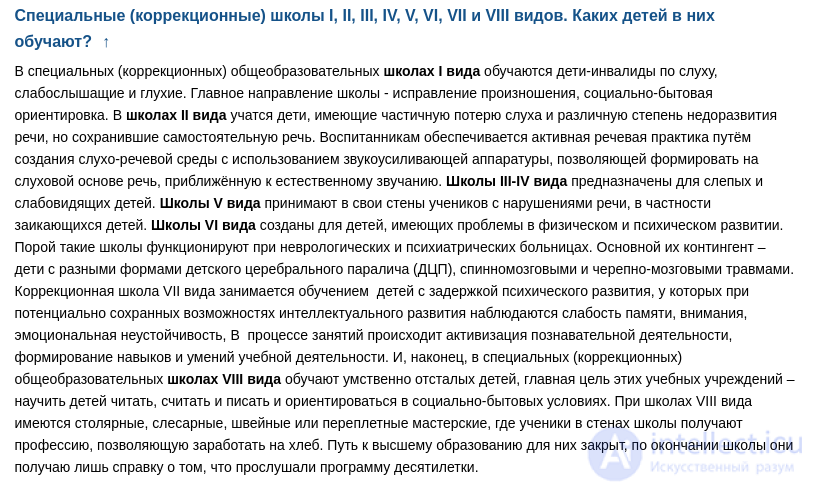
30. A Type V school is a special educational institution for children:
- *a) with speech disorders;
- b) with musculoskeletal disorders;
- c) with intellectual disorders.
31. To prepare for school children who do not attend special preschool institutions, the following is provided:
- a) individual counseling;
- b) instruction at home;
- *c) preparatory classes are created at special schools.
32. Who can obtain secondary and higher vocational education:
- a) any graduate of a special school;
- *b) a graduate of a special school who has intact intelligence and a high level of preparation;
- c) a highly gifted graduate of a special school.
33. Children with speech disorders are:
- *a) children with significant speech impairments but intact intelligence and hearing;
- b) children with significant speech impairments;
- c) children with a complex defect structure.
34. Holding therapy is:
- a) a special method of providing assistance to children with early childhood autism;
- b) a way of providing assistance to parents raising a disabled child;
- c) a rehabilitative method for children suffering from cerebral palsy.
35. Choose one correct answer. Oligophrenopsychology is a science:
- *a) about the psychological characteristics of children with intellectual disorders;
- b) about the theoretical foundations of raising and educating people with intellectual disorders;
- c) about the theory and practice of special education for people with psychophysical developmental disorders.
36. Choose one correct answer. In children with intellectual impairment, the most affected is:
- a) attention;
- *b) thinking;
- c) speech.
37. Complete the sentence: Oligophrenopedagogy is closely connected with sciences such as…
- * a) special pedagogy and psychology, education of the visually impaired, education of the deaf, speech therapy.
- b) biology, mathematics
- d) medicine, politics
38. Arrange the terms in order of decreasing degree of intellectual disability:
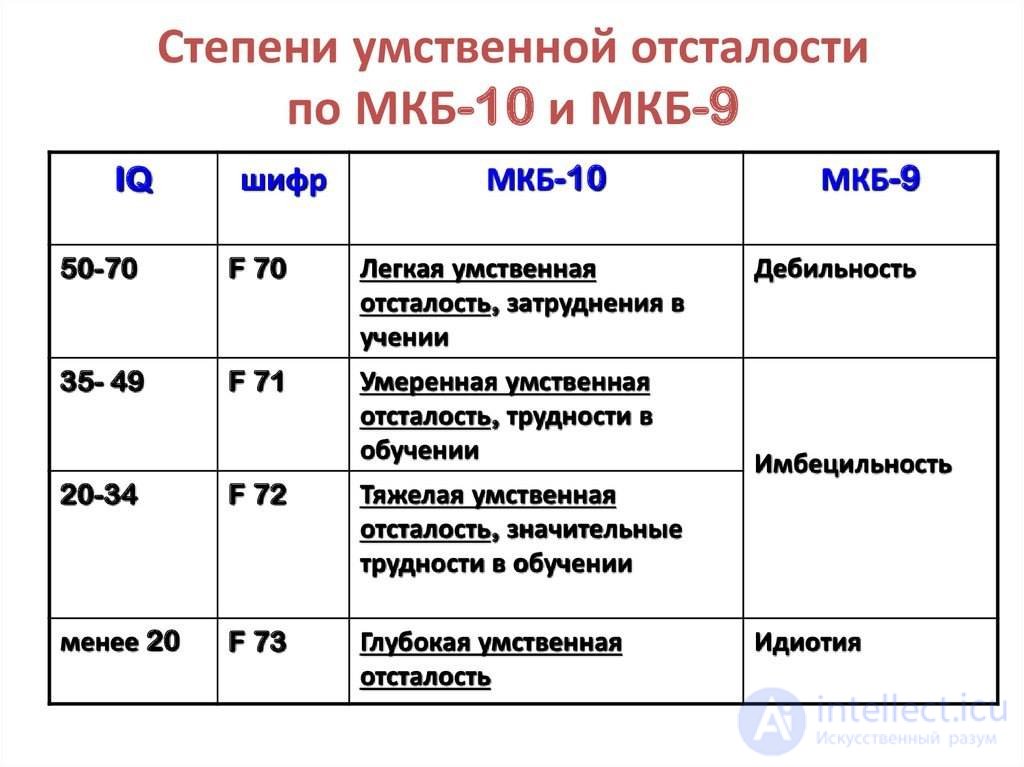
- * a) debility, imbecility, idiocy.
- b) imbecility, idiocy, debility
- c) idiocy, debility, imbecility,
- d) debility, oligophrenia, imbecility, idiocy

39. Complete the sentence: Debility is...
- a) a term denoting an intellectual deficiency coefficient of 50-70 *
- b) a term denoting an intellectual deficiency coefficient of 10-50
- c) a term denoting an intellectual deficiency coefficient of 70-100
- d) a term denoting an intellectual deficiency coefficient of 100-170
40. Choose one correct answer: In contemporary Russian oligophrenopsychology, the most appropriate terms for designating the category of intellectually disabled children are:
- a) abnormal child, defective child;
- b) problem child, child with a pathology;
- *c) child with intellectual disorders, child with special educational needs, child with disabilities.
41. Complete the sentence: Rehabilitation is…
- a) the application of a complex of medical, social, educational, and vocational measures aimed at preparing or retraining persons who have lost their abilities as a result of injury or illness;*
- b) treatment
- c) restoration
42. Complete the sentence: Special education is…
- a) preschool, general, and vocational education, for the receipt of which special conditions are created for persons with disabilities *
- b) education in mainstream schools and universities
- c) sports sections and clubs
43. Complete the sentence: The ultimate goal of special psychology and pedagogy involves…
- a) achieving the greatest possible independence and autonomous living for a person with disabilities *
- b) the improvement of the human being
44. Choose one correct answer: Imbecility is a term denoting:
- *a) a moderate degree of intellectual decline;
- b) a profound degree of intellectual decline;
- c) the most severe degree of intellectual decline.
45. Complete the sentence: With idiocy, children are unable to…
- feed themselves, drink, or take care of themselves independently *
- vote for politicians
- find triple integrals
- dance the polka and the rumba
46. Choose one correct answer: The first specialists to provide assistance to intellectually disabled people in Russia were:
- a) L.S. Vygotsky, A.R. Luria, S.D. Zabramnaya;
- *b) E.K. Gracheva, V.P. Kashchenko; I.V. and E.Kh. Malyarevsky;
- c) B.P. Puzanov, A.A. Kataeva.
47. Complete the sentence: When teaching children with intellectual impairment, the methods and techniques used are...
- appropriate to the learners' capabilities *
- those that have been paid for
- not prohibited by legislation
48. Choose one correct answer: Raising a child with an intellectual deficiency involves:
- a) the purposeful formation of positive character traits;
- b) preventing the formation of negative character traits;
- *c) the purposeful formation of socially valuable personal qualities and the prevention of negative personal and behavioral manifestations.
49. Complete the sentence: Special (correctional) schools of Type VIII are attended by …
- intellectually disabled children*
- intellectually gifted children
- children of the elite and of businessmen
50. Complete the sentence: Early detection of a disorder in intellectual development has as its goal …
- the prevention of secondary deviations*
- the obedience of the populace
- saving the state budget
51. Choose one correct answer: Special preschool educational institutions are staffed with children:
- a) at the wish of parents and teachers;
- b) if the appropriate conditions exist at the preschool institution, and with parental consent;
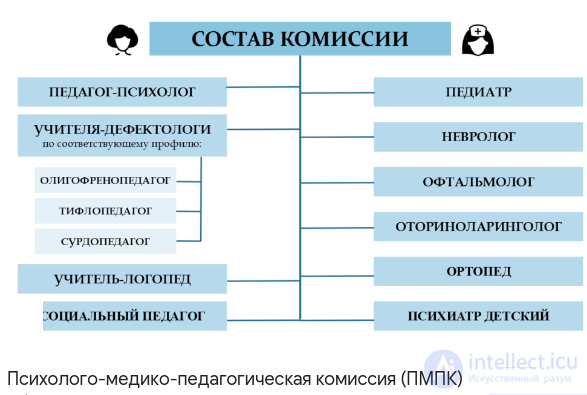
- *c) by decision of the psychological-medical-pedagogical commission (PMPK) and education authorities, and with parental consent.
52. Choose one correct answer. Group size in special preschool institutions depends on:
- a) the number of children with disorders;
- b) the wishes of the teaching staff;
- *c) the type of disorder and age.
53. Complete the sentence: Short-stay groups in preschool institutions are created for …
- preparing for school children who did not attend special preschool institutions *
- so that children can eat
- so that children can socialize
54. Choose one correct answer: A Type VIII school is a special educational institution for children:
- a) with speech disorders;
- b) with musculoskeletal disorders;
- *c) with intellectual disorders.
55. Choose one correct answer: To prepare for schooling children who do not attend special preschool institutions, the following is provided:
- *a) individual counseling;
- b) instruction at home;
- c) preparatory classes are created at special schools.
56. Choose one correct answer: Who can obtain secondary and higher vocational education:
- a) any graduate of a special school;
- *b) a graduate of a special school who has intact intelligence and a high level of preparation;
- c) a highly gifted graduate of a special school.
57. Choose one correct answer: The education of children with intellectual disorders is oriented toward:
- a) the development of higher mental functions;
- *b) the formation of labor and vocational skills;
- c) the formation of communication skills and the prevention of negative personal manifestations.
58. Choose one correct answer: Children with intellectual disorders are:
- a) children with significant speech impairments;
- *b) children with oligophrenia, microcephaly, and Down syndrome;
- c) those with a complex defect structure.
- d) those who watch central television
59. Complete the sentence: The term «oligophrenia» means…
- organic, diffuse damage to the cerebral cortex, arising during the intrauterine or early period of a child's development.*
- severe general motor underdevelopment
- an inability to use everyday household objects
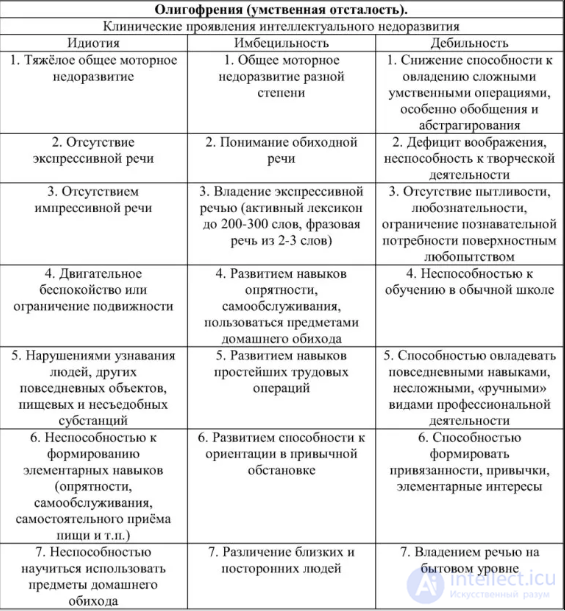
60. Choose one correct answer: Dementia is:
- a) a condition following an infectious disease;
- *b) acquired feeble-mindedness;
- c) intellectual disability.
61. Choose one correct answer: Primary impairments in oligophrenia are:
- *a) decreased intelligence;
- b) decreased hearing;
- c) decreased vision.
62. Complete the sentence: The Russian psychiatrist who conducted the most in-depth study of feeble-mindedness in the early 20th century was …
- S. Freud
- G.Ya. Troshin*
- Pavlov
- Durov
63. Choose the correct answer: The terms «developmental delay» and «oligophrenia» were first introduced by the German psychiatrist:
- *a) Emil Kraepelin;
- b) Wilhelm Griesinger;
- c) Karl Seguin.
64. Match the time periods with the activities of individual Western European scholars studying intellectual disability and related conditions:
a) 20th century = Philippe Pinel; 19th century = Jean-Étienne Dominique Esquirol, Jean Itard. 18th century = E. Kraepelin, J. Demoor.
b) 19th century= Philippe Pinel; 18th century = Jean-Étienne Dominique Esquirol, Jean Itard. 20th century = E. Kraepelin, J. Demoor.
c) 18th century = Philippe Pinel; 19th century = Jean-Étienne Dominique Esquirol, Jean Itard. 20th century = E. Kraepelin, J. Demoor.*
65. Choose the correct answer: Shelters for profoundly intellectually disabled children were first opened in Russia by:
- a) M.P. Postovskaya;
- *b) E.K. Gracheva;
- c) V.P. Kashchenko.
66. Complete the sentence: Intellectual disability is...
- a) a persistent, irreversible impairment predominantly of cognitive activity, as well as of the emotional-volitional and behavioral spheres, caused by organic damage to the cerebral cortex of a diffuse nature.*
- b) This person values the world of entertainment and information that television offers. Time spent in front of the screen becomes a unique opportunity for them to relax, enjoy their favorite programs, gain new knowledge, and immerse themselves in exciting stories.
- c) This person is in constant contact with the virtual world. They frequently check social media, refresh news feeds, and communicate with friends and family through messaging apps. The smartphone has become their main means of communication and connection with the outside world.
67. Choose the correct answer: According to the international classification (ICD-10), four forms of intellectual disability are distinguished:
- a) mild, moderate, profound, severe;
- b) mild, pronounced, moderate, profound.
- *c) mild, moderate, severe, profound;
68. Correctly match the methods of teaching intellectually disabled children with the means of their implementation:
- * Visual = demonstration, excursion, observation; technical teaching aids (TTA); Practical = making crafts, drawings, appliqué; Verbal = storytelling, conversation, dialogue.
- Practical = demonstration, excursion, observation; technical teaching aids (TTA); Visual = making crafts, drawings, appliqué; Verbal = storytelling, conversation, dialogue.
69. Complete the sentence: Practical methods are…
- exercises (oral and written), laboratory work, work in workshops, on the school plot*
- writing an essay on an abstract topic
70. Complete the sentence: Every lesson in a special (correctional) school addresses the following tasks... :
- developmental, approving
- didactic, educational, correctional *
- informative
71. Choose one correct answer: What types of lessons do didactics specialists recommend for a Type VIII special (correctional) school?
- *a) a lesson introducing new knowledge, a review-and-summary lesson, a lesson for forming and reinforcing skills (practical); a control-and-assessment lesson, a combined lesson;
- b) introductory, summarizing, control, propaedeutic, systematization and generalization of knowledge;
- c) a lesson for acquiring new knowledge, a lesson for monitoring and correcting knowledge and skills.
72 .Complete the sentence: Assessing students' knowledge performs the following functions…
- instructional function, educational, diagnostic-prognostic, evaluative*
- summarizing
73. Complete the sentence: Types of monitoring in a Type VIII special school…
- entry, exit, current
- current, periodic, final*
- primary, secondary, and final
74. Complete the sentence: Monitoring the knowledge of intellectually disabled children is carried out using the methods of…
- written testing
- long jump and marathon running
- oral questioning, written work, practical work, observation, programmed control*
75. Complete the sentence: Upbringing is…
- purposeful, substantive professional activity of the teacher that promotes the maximum development of the child's personality while in contact with surrounding reality in its various manifestations *
- this is the process where you, sitting on the couch with the remote in your hand, try to remember where you put your smartphone, while it is actually right in front of you.
- This is a sporting discipline requiring intense concentration and a high level of forgetfulness.
76. Complete the sentence: The main areas of educational work in a Type VIII special (correctional) school are…
- instilling in students a love for the political elite
- instilling in students civic and moral qualities, conscious discipline, social and legal protection; developing physical culture and a healthy lifestyle; aesthetic development, development of intellectual abilities *
- fostering patriotism and love for the Motherland
77. Complete the sentence: The principles of educational work with intellectually disabled schoolchildren…
- do no harm
- earn money for a watermelon
- optimistic outlook of the educational process, the principle of the correctional-developmental nature of upbringing, a comprehensive approach and productive analysis of data on the student, an individual and differentiated approach, demandingness combined with respect for the individual*
78. Match the content of the work with the researchers.
- 1. Psychometric approach to the study of intellectual deficiency = J. Philippe, P. Boncour; 2 Psychological-pedagogical and sociological approach to the study of intellectual deficiency = A. Binet, T. Simon. 3. Anatomical-morphological and etiological approaches to the study of intellectual deficiency = W. Griesinger, W. Ireland, B. Morel, E. Kraepelin
- 1. Psychometric approach to the study of intellectual deficiency =. W. Griesinger, W. Ireland, B. Morel, E. Kraepelin; 2. Psychological-pedagogical and sociological approach to the study of intellectual deficiency = J. Philippe, P. Boncour; 3. Anatomical-morphological and etiological approaches to the study of intellectual deficiency = . A. Binet, T. Simon.
- 1. Psychometric approach to the study of intellectual deficiency = A. Binet, T. Simon.; 2. Psychological-pedagogical and sociological approach to the study of intellectual deficiency = J. Philippe, P. Boncour; 3. Anatomical-morphological and etiological approaches to the study of intellectual deficiency = W. Griesinger, W. Ireland, B. Morel, E. Kraepelin *
79. Is the following correspondence between the persons and their contribution to the study of intellectual deficiency correct?
1. J. Itard = «The Wild Boy of Aveyron,» «The Education of a Savage»; «Medical-pedagogical intervention can provide effective help in the treatment of idiocy,» «First the development of the senses, and only then the development of other mental processes.»
2. Philippe Pinel – «A Treatise on Insanity,» Introduced the concept of idiocy.
3. J. Esquirol – Introduced the concepts of amentia and dementia to denote congenital or acquired feeble-mindedness. Was the director of the «Salpêtrière» asylum, and of the «Bicêtre» psychiatric hospital.
See Also
See also


Comments