
Lecture
Self-control — a preliminary activity that creates a discriminative stimulus for the reinforced behavior, that is, it facilitates access to it. Self-reinforcement — an activity that is discriminated relative to the reinforced behavior, that is, it increases its visibility.
Self-control is the ability to suppress an impulse in order to respond appropriately. We use self-control when we eat carrots instead of Krispy Kreme doughnuts, when we forgive rather than get irritated, and when we pay attention instead of paying the price for someone else.
Self-induction combines both concepts into one and blurs the boundary between triggers and consequences. An activity that facilitates access to the reinforced behavior simultaneously makes it more visible to others, and conversely, the more visible a behavior is to others, the easier access to it becomes.
The classic practice of self-reinforcement — telling others that the behavior is being carried out — is how self-induction acquires meaning in the period before the target behavior appears. The classic practice of self-control — packing a gym bag — is how self-induction becomes an important message for others.
Self-induction implies a pattern in which the preliminary activity:
To create sustainable self-management in someone's lifestyle, others must reinforce, in addition to the target behavior itself, the most noticeable variants of the preliminary activity.
The concept of induction highlights the paradoxical inefficiency of the usual notions of self-management. Economical ways of organizing one's lifestyle turn out to be far less noticeable compared to clumsy, irrational, and cumbersome ones. The more an activity implies chances of social isolation, the worse it reproduces. That is why the apparent disorganization observed in everyday life plays an important social role — it functions as an effective self-induction.
Discussing this phenomenon in functional-analytic terms is an instruction on how to build a more economical lifestyle so that new activities within it help maintain relationships with other organisms — so that the same levels of social activity fit into smaller time intervals. Without taking induction into account, an attempt at self-organization can turn into voluntary ostracism.
Reorganizing modes of induction in a social context can begin with discussing with others the practice of paying more extra attention to episodes of the desired activity — while keeping in mind that the discussion itself functions as an inductor. With that in mind, it becomes harder to slip into additional induction of alternative activities, into which time will be redistributed by the discussion itself — which in itself is not a problem, it's just that the same thing can be done more economically.
Behavior is controlled not by internal commands to oneself, by efforts of focused thought, or by awareness, but by the selection history of the body's interaction with objects in space through social consequences.
Understanding the mechanics of execution is not needed by the one performing the movements: talk about the movement and the movement itself occur in parallel, and both are controlled by the social context. The theorem is needed by others, who will induce the appearance of certain stages of the movement until it begins to reproduce as a whole, as a single pattern.
To improve execution or speed up its shaping, others should induce not additional rehearsal or talk, but a format of preparation in which the appearance of approximations of the final movement stands out noticeably compared to background activity. «Having more control over one's own body» describes a certain mode of induction in a social context.
Premack's theory of reinforcement can be used as a reference point for self-induction. In it, the pairing of a high-frequency activity with a low-frequency one raises the frequency of the latter. In other words, the relative frequencies of activities reflect the distribution of relative levels of attention in a social context.
Additionally pairing a high-frequency activity with a desired activity is self-induction, since it makes the desired activity more noticeable. On the other hand, the natural occurrence of high-frequency activities reminds of the existence of a certain frequency of the desired activity. In this case, unpaired activities — each controlled by its own context, but the temporal proximity of their occurrence, their apparent pairing, increases social visibility.
In a literal reading, talk about the «self» creates the problem of mentalism, since it places the cause of behavior inside the organism, which breaks the laws of physics — the cause of a phenomenon cannot be the phenomenon itself or a component of it. Such an explanation can be called mechanical, but not final.
Functional analysis of self-discourse runs parallel to the analysis of social solitude. Natural language creates the impression that some activities are not social — as if other people were not involved in them. The function of the self-narrative is to block some redistributions of resources in favor of others — if the social context is not mentioned, redistribution becomes impossible.
Historically, the «self» began to be used more often with the onset of modernity, when the density and dynamics of social interactions sharply increased, while the interactions themselves became almost imperceptible.
«Self-induction» is a view through the molar paradigm on «self-reinforcement», which in turn appeared as a relative of pop-psychological slang such as «self-control» and «self-management». Both terms imply other people, but if it is difficult to specify them, the «self» appears in their place.
Moreover, the structure of natural language makes it impossible to speak of activities as processes without implying a subject standing behind them — this is called cryptotypes. The problem of reifying social processes in the course of conversation is partly compensated for by the passive voice. But the problem is not reification as such, but the duplication of topographies, which creates the impression of new functions where none exist. The conceptual structure of technical language highlights the functions of social activity so that their repetition or absence stands out.
The passive voice or metaphors such as clay or a surgical machine are needed as a reminder that processes are constantly being reified. In themselves they carry no explanatory value, but they help explain operant conditioning: three processes participate in the workings of behavior — induction, correlation, and allocation. With their help, reification can be reversed. For example, «engagement» is the correlation of behavior with inductors in a variable regime under time constraints on alternative possible activities. The first description arises when observing behavior apart from context, after the fact of shaping. The second arises when observing behavior in its context. When the context is obvious, there is no longer any need to speak of objects.
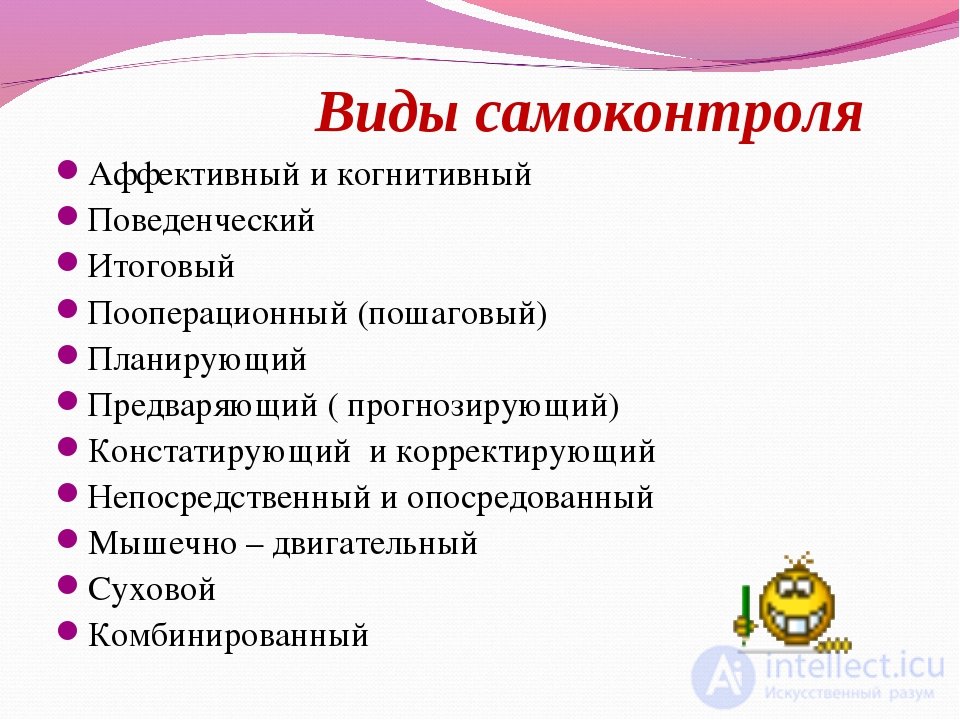
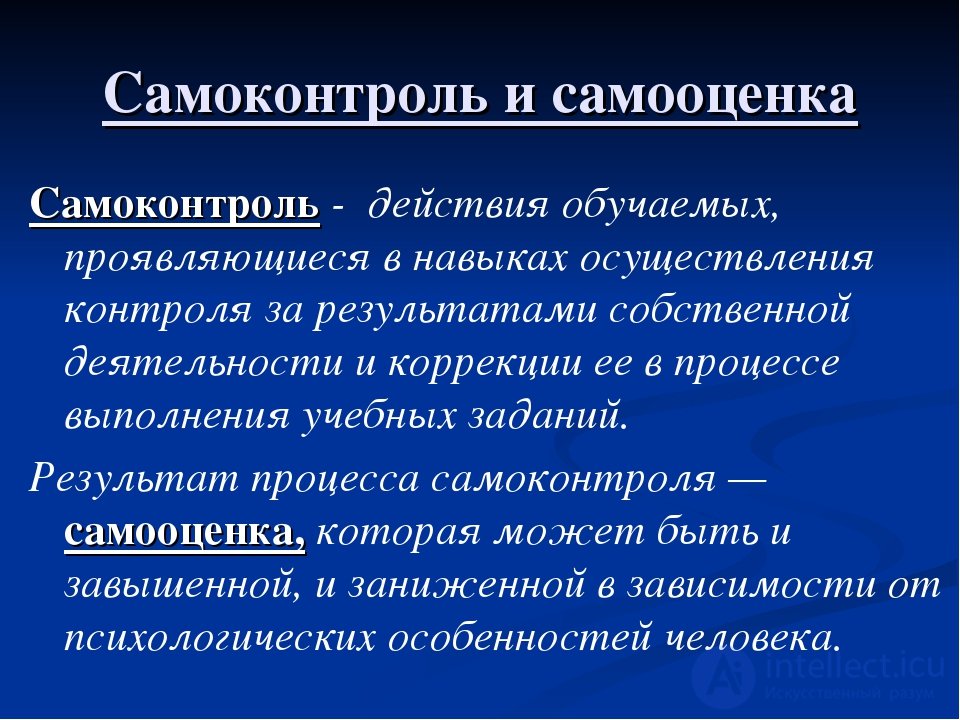
Students like to learn practical strategies they can use right now. Here are four tips they can use to improve self-control.

Comments