
Lecture
Social inhibition (Lat. inhibere — to stop, to restrain) — a decrease in the effectiveness of an individual's actions in the presence of outside observers. The observers may be real or imagined. The phenomenon is closely related to the facilitation effect, which has a completely opposite mechanism of influence, so researchers often examine both effects together, inseparably from one another.
The first research into how observers affect a person's behavior and psyche was conducted by the American psychologist Norman Triplet of Indiana University: as a cycling enthusiast, he was the first to notice that cyclists showed better times when competing in groups, whereas in solo races the same athletes performed worse. After conducting further research, Triplet concluded that the presence of a rival helps release latent energy not otherwise accessible. Other scientists' studies established that in the presence of observers, subjects perform simple actions more effectively. However, a number of subsequent experiments revealed that spectators do not necessarily have a positive effect on performance; moreover, a certain percentage of observations showed that the presence of outside observers, on the contrary, negatively affects the quality of the activity performed by the subjects .
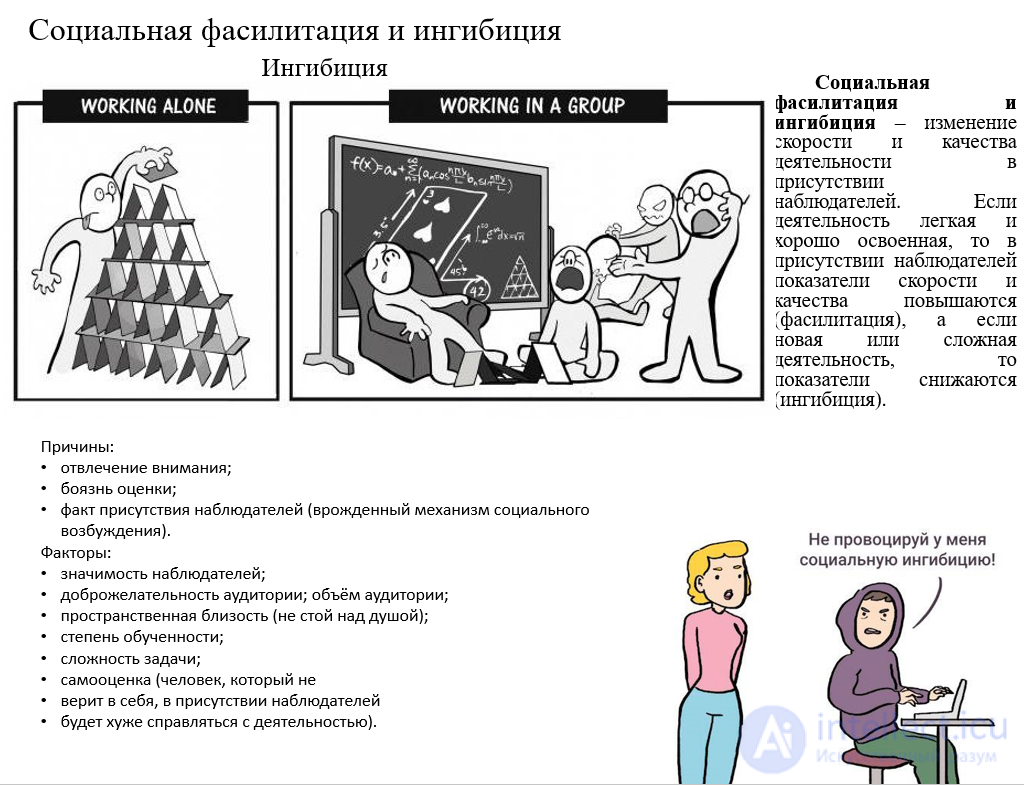
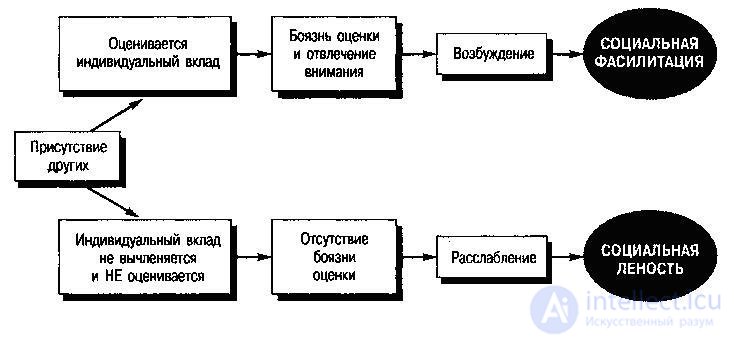
Much later, the social psychologist Robert Zajonc, who put forward a fundamentally new activation theory, suggested that both phenomena are activated through arousal. In particular, he established that the effects of social inhibition manifest themselves when solving intellectually complex problems: the effectiveness of performing simple actions is merely stimulated by the presence of observers, while during work on complex tasks with non-obvious solutions, the likelihood of error increases. In both cases, strengthening of the dominant response occurs because of arousal. Zajonc, together with his assistants, conducted about three hundred studies with tens of thousands of volunteers and backed up his theory with practical data.
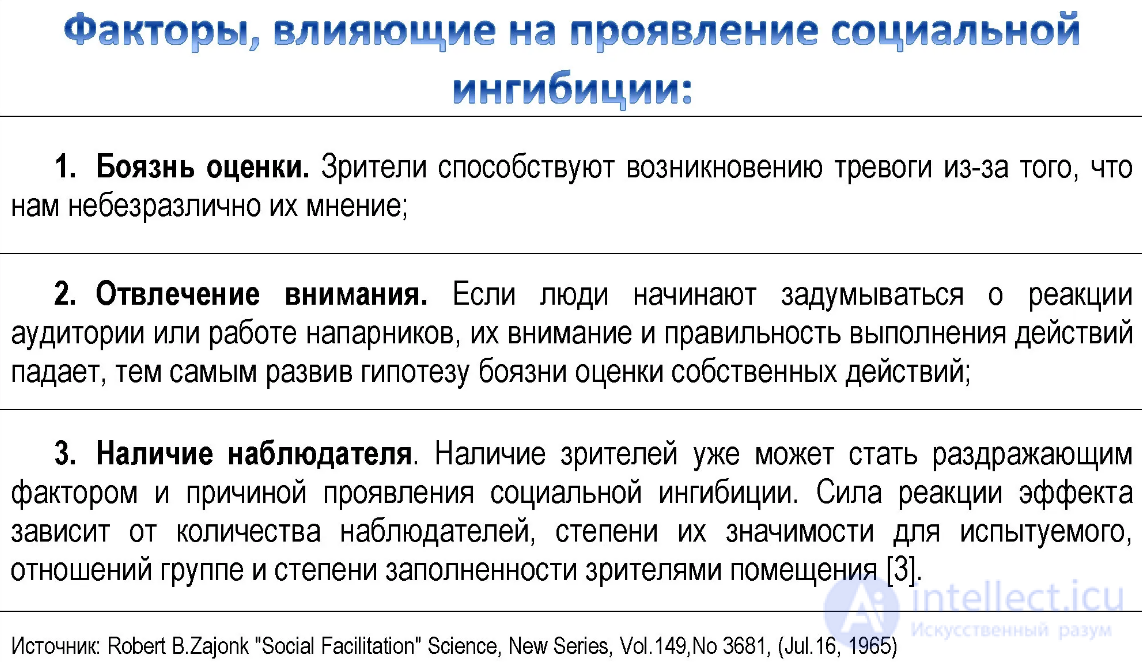
Generally, three main factors are identified that influence the manifestation of social inhibition:
For the most part, the effects of social inhibition or social loafing manifest themselves during group work.
Social restraint can develop throughout a person's entire life. Children can be withdrawn, adolescents may worry about social situations, and adults may find it hard to adapt to social situations they must initiate themselves. Being inhibited can change and look different for many people. In many cases inhibition can lead to other social disorders and phobias.
In infants and children, social inhibition is characterized by a temperament style in which children react negatively to and withdraw from unfamiliar people, situations, and objects. In addition to ceasing play, inhibited children may show prolonged latency in approaching a stranger, signs of fear and negative affect, and a tendency to seek safety. Avoidant behavior can be seen at a very young age. In one study, Fox and colleagues found that even at four months of age, some infants showed a negative reaction to unfamiliar visual and auditory stimuli. The study was longitudinal; thus, follow-up observations showed that half of the infants with high negative responses continued to display behavioral inhibition up to age two. Fox's longitudinal study showed that behavioral inhibition displays a degree of continuity. Over time, toddlers who were quiet and reserved continued that tendency into childhood, remaining cautious, quiet, and socially withdrawn. The uninhibited control group of the same age continued to interact easily with unfamiliar people and situations. [12]There is also a link between inhibition in childhood and social disorders in adolescence and adulthood. Schwartz and Kagan found in a longitudinal study spanning ages two to thirteen that 61 percent of adolescents who had inhibited traits in early childhood reported symptoms of social anxiety in adolescence, compared with 27 percent of adolescents who had not previously been inhibited. [13] However, not every child with withdrawn or inhibited behavior will become inhibited in adolescence or develop a social disorder. [11]
The caregiver alone is not solely responsible for inhibition in children; however, in some cases it can be a factor. Caregivers can influence their child's level of restraint by exposing the child to maternal stress in infancy and preschool age. In addition, in some situations a child may simply have an early manifestation of behavioral inhibition. [11] There does not appear to be a parenting style that researchers consider best for dealing with social inhibition. Park and Krznic say that sensitive, accepting, overprotective parenting is the best way to reduce negative behavior, because it allows the child to be themselves without judgment. [14] However, Kagan suggested that a firm parenting style is better suited to socially inhibited children.[15] Researchers who support sensitive parenting believe that an overly firm parenting style sends children a signal telling them they need to change.
Social inhibition has been widely studied in children; however, research on how it develops in adolescence and adulthood is not as common [11] [16], even though anxiety-related social problems are most often observed in adolescents. [17] Many behavioral traits in adolescence are the same as in childhood: withdrawal from unfamiliar people, situations, and objects. [11] Nevertheless, it has been shown that adolescents are more aware of their social standing and are more likely to be restrained in public settings. Researchers found that young people are more likely to distinguish between public and private settings when asking questions about potentially sensitive issues. [18]It is also thought that in childhood and adolescence, inhibition is largely dealt with simply because school promotes interaction with others. For an adult, the same favorable circumstances may not arise unless the person prompts them on their own. Guest argues that adults do not have as many incidental peer interactions and opportunities for friendship that guide and sustain relationships, unless they foster them themselves. [19] Studies of adolescents have also shown that social restraint is associated with a more negative emotional state in young men than in women. [19]
This contrasts with a study in which inhibition levels were measured based on self-reports from adolescents and their parents. West and Newman found that young Native American women and their parents reported higher levels of restraint than young Native American men; in addition, parental reports also predicted social anxiety in young Native American women more than in young Native American men. This same study examined the development of peer relationships over time. West and Newman stated that low levels of behavioral inhibition are associated with early social and school situations and are linked to higher levels of socially mediated anxiety, especially negative evaluation fear from peers. [17]This study then raises the possibility that adolescents and children who generally have positive social experiences will be more aware of the status of these positive relationships and will therefore worry more about failures in their social sphere. [17] Other studies have also discussed that in many cases early behavioral inhibition is a risk factor for the development of chronic inhibition in later school age and possible social anxiety disorder. [11] Although social inhibition can be a predictor of other social disorders, only a relatively small share of adolescents who develop an anxiety disorder also have a history of inhibition in childhood.
Bezich and Kerr believe that appearance may be a factor in social inhibition. In their study, they hypothesized that one way of coping with difficult situations involving behavioral inhibition is to create a repellent appearance. They studied «radical» crowds, such as those called goths and punks, and examined whether their appearance served a function in restraining them. They state that a radical style can be used to push social boundaries and relieve pressure or expectations associated with interacting in unfamiliar situations with unfamiliar peers. Another possibility is that a person may have a disability to ensure that they do not have to interact with unfamiliar peers. The results showed that radicals were significantly more inhibited than other groups. Nevertheless, there are also other inhibited individuals in other social classifications. The most highly inhibited radical was no more inhibited than the most highly inhibited individual in other groups.[20]
It is hard to find adult cases of social inhibition simply because many consider it something that happens during development. Although research is lacking, developmental considerations suggest there may be a stronger link between behavioral inhibition and peer relationships in adulthood. One researcher says this lack of information may be caused by the fact that adults do not find themselves in as many socially interactive situations that would help them cope with the situation. It would seem adults bear increased responsibility for initiating or structuring their own social relationships with peers; this is where social inhibition may play a more problematic role in adulthood than in childhood. [19]One study that contributed to adult research used questionnaires to examine both clinical and preclinical adults. It was found that, as in adolescence, behavioral inhibition is associated with anxiety disorders in adulthood. In addition, the study found that childhood inhibition was a definite factor in a lifetime diagnosis of social phobia. [16] Guest also measured adults' peer relationships and the degree of their positive and active social life. For example, researchers wanted to know whether they took part in any recreational activities with others, how often they met with others, and whether they had any close, trusting relationships. Participants were rated on a 5-point scale for each peer relationship they disclosed. Results showed that social inhibition had nothing to do with popularity, but it correlated with peer relationships in both sexes and with emotional stress only in men. [19]
A similar study found that some shy men had low professional status at age forty because they started their careers later in life. [21] However, another researcher commented on this, using this example, that perhaps staying at home longer allows young people to accumulate educational and financial resources before leaving and becoming more independent. [19] In addition, it was found that young people who were inhibited in childhood were less likely to leave their families. [19] There is also some discussion of inhibition across generations and children reflecting their parents. Results showed that children whose biological mothers met the criteria for a diagnosis of social phobia showed elevated levels of observed behavioral inhibition.[22] Social restraint can decrease with age due to cognitive deficits that can arise in old age. Age-related deficits affect older adults' ability to distinguish between public and private settings when discussing potentially awkward issues, prompting them to discuss personal problems in inappropriate public situations. This suggests that a deficit in inhibitory capacity leading to this mismatch is beyond the person's control. [18]
Schools can be a place where children are encouraged to engage in various social interactions; however, they can also reveal problems of social adjustment and adaptation to school. Coplan argues that Western children with inhibition problems may be at higher risk of developmental problems at school. [24] Although social inhibition may be a predictor of problems with social and school adjustment in children, Chen argues that the effect of social inhibition on school adjustment differs between Western and Chinese cultures. Chen found that in Chinese children, behavioral inhibition was associated with greater peer liking, social interaction, positive attitudes toward school and school competence, and fewer problems in further learning, which also differs from Western cultures. [23] In other studies, researchers such as Oysterman found that children experiencing inhibition have difficulties adjusting. In Western cultures, these difficulties are more visible because of the emphasis on social confidence and self-expression as traits valued in development. [25] In other cultures, children are sometimes expected to be restrained. This does not contrast with other cultures in which children are socialized and assert themselves. [26]Despite these differences, there are similarities between the sexes. Boys were more hostile in peer communication and seemed to have more problems with learning at school. Girls communicate with peers more readily and have a more positive attitude toward school. They became more sociable with peers and studied more fully at school.
Other researchers, such as Geng, sought to understand social restraint, effortful control, and attention at school. In Geng's study, gender played an important role in that girls with high levels of social inhibition were extremely aware of their surroundings and possibly paid too much attention to potentially anxiety-inducing situations. [28] From a large body of research it is well known that social inhibition has been linked to other anxiety disorders. However, Degnan and colleagues believe that the ability to regulate effortful control can help reduce the anxiety arising from inhibition. [29]Nesdale and Dalton examined the suppression of social group norms among schoolchildren aged seven to nine. In schools, as children grow older, the number of social «in» and «out» groups increases. In the course of this study, various in-groups or exclusive groups and out-groups or inclusive groups were created. The results showed that students in the inclusive group liked all the students more, while students in the exclusive group liked their own group but not other groups. This research could help promote school peer groups more effectively in the future. [30]
Social inhibition can manifest itself in all social situations and relationships. One place where we can see the effects of social restraint is the workplace. Studies have shown that social inhibition can actually affect how a person performs a given amount of work [31]. In one experiment, participants performed a task in laboratory conditions, regardless of whether another person was present in the room with the participants while they attempted to complete the task. The results showed that when another person was present in the room, the person focused on completing the experimental task reduced their body movements, hand movements, and vocalization, even when the other person did not speak to the participant or even look at them. [31]This suggests that the mere presence of another person in a social situation can inhibit a person. However, although the person responsible for performing the experimental task was socially inhibited by the presence of another person in the lab, there was no significant relationship between their social inhibition while performing the task and improvement in performing that task. [31] This evidence suggests that a person may socially inhibit themselves in the workplace if another person is also in the room, however such inhibition does not mean that the inhibited person actually carries out their assigned duties with greater accuracy or focus.
The link between social restraint and depression can be found in people who experienced socially inhibited behavior in childhood. Researchers from the United Kingdom conducted a study attempting to explain possible links between social restraint in infancy and later signs of depression. The researchers based their study on previous information from the literature, recognizing that there are social and non-social forms of inhibition, and that social inhibition is largely linked to early social fears. The researchers hypothesized that social restraint in childhood would be associated with higher levels of depression in later years. Participants filled out a series of questionnaires about their experiences of social inhibition in childhood and their current level of depression. The results showed a significant relationship between depression and memories of social fears or social restraint in childhood. In addition, the researchers linked their findings to another study conducted by Muris et al. in 2001, which found a link between social inhibition and depression in adolescents. The study compared adolescents who had no inhibition with adolescents who were inhibited, and found that «adolescents experiencing high levels of behavioral inhibition were more depressed than their peers who experienced moderate or low levels of behavioral inhibition».
Another study aimed to examine the link between social inhibition and depression, based on the premise that social inhibition (which they describe as part of a Type D or "distressed" personality) is associated with emotional distress. They explain that a key factor associated with social inhibition is that the inhibited person does not express their emotions and feelings [35], a factor the researchers cite as linking social inhibition and depression. Overall, the study's results show that social inhibition (as a Type D personality factor) predicts depression, regardless of a person's baseline level of depression. Notably, this study was conducted with young, healthy adults, unlike work with participants from self-help groups or people who already have a medical or psychological condition.
Social inhibition can be influenced by fear responses that arise in a person during the early years of life. In 2011, researchers Elizabeth J. Kiel and Kristin A. Buss studied «how attention to an angry gorilla mask in a room with alternative play opportunities in 24-month-old toddlers predicts social inhibition when children enter kindergarten». In the course of the study, the researchers specifically examined toddlers' attention to threat and their fear of novelty in other situations. The researchers focused on these two factors because of previous research suggesting that «sustained attention to presumably threatening novelty is associated with anxious behavior in the first 2 years of life». In addition, in earlier studies conducted by Buss and colleagues, it was found that regardless of individual differences, reactions to novelty in early childhood may be related to later social inhibition. These findings already link fear responses, especially in children, to social inhibition, primarily the kind of inhibition that manifests later in a person's life. Overall, the researchers based their experiment on the premise that the more attention a child pays to a new potential threat, the greater the chance they will have trouble regulating distress, which can predict anxious behavior such as social inhibition.
As part of a study aimed at further identifying and understanding the links between fear and later social restraint, researchers conducted a study in which they worked with 24-month-old toddlers. They placed toddlers in a room called the «risk room» [36], which has several play areas for toddlers to interact with, one of these areas containing a potentially dangerous stimulus, in this case a menacing-looking gorilla mask. The children are left alone, with only their primary caregiver sitting in the corner of the room, to explore the play areas for three minutes, after which the experimenter returns and instructs the toddler to interact with each of the play areas. The purpose of this was to allow other experimenters to code the toddler's reactions to the stimuli around him or her, paying particular attention to their attention to threat, their proximity to the threat, and their fear of novelty.
The results of this study show that attention to threat (the attention a toddler pays to fear-inducing stimuli) predicts social inhibition in kindergarten. [36] In addition, if the child approaches feared stimuli, the association with subsequent social inhibition is not significant. When the child's behavior consists of staying more than two feet away from the threatening stimulus, that behavior can be considered related to subsequent social inhibition. Another important factor the researchers found in predicting social inhibition is that the child pays considerable attention to dangerous or threatening stimuli even in the presence of other pleasant activities. [36]Basically, if the duration of a child's attention to threatening stimuli is significant, even when other pleasant activities are available to them, the link to later social inhibition is stronger because «younger children have improved motor skills and independence in exploring their surroundings, so they are able to use more sophisticated distraction methods, such as engaging in other activities» (Kopp, 1982, p. 199).
In another study focused on social inhibition and fear, researchers distinguished between different forms of inhibition. Focusing mainly on behavioral inhibition, the researchers divided the category into two subcategories: social behavioral inhibition and non-social behavioral inhibition. [45] The researchers cite an experiment conducted by Majdandzic and Van den Boom, in which they used laboratory conditions to try to induce fear in children. They did this using both social and non-social stimuli. [45] [46]What Majdandzic and Van den Boom found was variability in how children's fear arose when using social or non-social stimuli. Essentially, this study showed that there is a correlation between social stimuli triggering expressions of fear in children, whereas non-social stimuli are not associated with fear. [45] [46] This may be evidence of social inhibition arising from social stimuli that lead to expressions of fear in children.
The researchers of the current study took the findings from Majdandzic and Van den Boom's study and expanded on their work by examining the variability of fear expressions in both socially inhibited and non-socially inhibited children. They found that socially inhibited children mainly show effects such as shyness and inhibition toward peers, adults, and in achievement-related situations, as well as social phobia and separation anxiety. [45]The stronger link to fear response comes mainly from those children who were inhibited in non-social behavior. Although these findings run counter to previous findings, the researchers sought to state that «the normative development of fear in children has shown that many specific fears (such as fear of animals) decrease with age, whereas social fears intensify as children grow older». [45]
Social inhibition is linked to social phobia, since social inhibition in childhood can be viewed as a factor contributing to the development of social phobia later in life. Although social inhibition is also linked to social anxiety, it is important to point out the difference between social anxiety and social phobia. Social anxiety is characterized by a tendency to experience strong worry before social interaction, but does not involve avoidance of social activity associated with social phobia. Social phobia and social inhibition are linked in several different ways, one of which is physiological. When someone experiences extreme inhibition, they may suffer from symptoms such as a rapid heartbeat, elevated levels of cortisol in morning saliva, and tension in the vocal cord muscles. [47] These symptoms are also reported by people with social phobia, indicating that both social inhibition and social phobia interact with the sympathetic nervous system when a person faces a stressful situation. [47]
In addition, throughout the literature it is suggested that social inhibition in childhood is linked to later social phobia. Beyond this, studies have shown that continuity of inhibition plays an important role in the later development of social phobia. [47] Continuity of social restraint means that someone consistently experiences social inhibition over the course of several years. The study explains work done with young adolescents that showed that adolescents who were classified as inhibited 12 years earlier had a significantly higher likelihood of developing social phobia than young adolescents who were not classified as inhibited. [47]This research concerns the link between social restraint and general social phobia, not specific phobias. When considering the continuity of social inhibition, some studies offer arguments for why social inhibition may persist long enough to be a predictor of social phobia. Researchers have suggested that if relationships in early childhood are unsatisfactory, they may affect the child in ways that lead them to respond to situations in certain inhibited manners. [47] When this happens, it is often associated with poor self-esteem in the child, which can lead to increased social inhibition and social phobia. [47] In addition, if a child is neglected or rejected by their peers rather than by their caregiver, they often develop a sense of social failure, which frequently grows into social inhibition and then into social phobia. [47] The link between social inhibition and social phobia is somewhat exclusive, since when testing for a possible link between non-social inhibition and social phobia, no predictive elements were found. [47] Social phobia is linked to social inhibition.
Research also suggests that social inhibitions can be divided into different types of social fears, or that different patterns of inhibition can be seen in different individuals. Researchers suggest that certain patterns or certain social fears may be better predictors of social phobia than others. [47] Mainly, researchers suggest that there may be different patterns of social inhibition in relation to an unfamiliar object or encounter. [47] These specific patterns should be considered together with motivation and the psychophysiological response to the object or encounter in order to determine the specific patterns that are the best predictors of social phobia. [47]
Another study aimed at examining the link between social inhibition and social phobia also found that social phobia is associated with the ability of socially phobic individuals to recall their own encounters with social inhibition in childhood. Participants with social phobia were able to recall social and school-related fears from their childhood, but they were also able to recall sensitivity to sensory processing [32], which indicates that the study participants suffering from social phobia could recall having had heightened sensitivity to situations and behavior around them.
Another study explains that social phobia can manifest itself in several different ways. The study aims to understand the link between social restraint and social phobia, as well as depression in social phobia. [50] The study found an important link connecting the severity of social inhibition in childhood to the severity of social phobia and factors of social phobia in later years. [50] Strong social inhibition in childhood may be linked to lifelong social phobia. [50] In addition, the researchers note that childhood inhibition is largely associated with avoidant personality disorder in social phobia [50]as well as childhood inhibition being associated with major depressive disorder in social phobia, which extends throughout a person's life. [50] The main assumption associated with the study's findings suggests that although inhibition may be a general predictor of risk factors associated with social phobia, it may not be a specific predictor of social phobia alone. [50]
Social anxiety disorder is characterized by fear of criticism or disapproval from others. People believe that such a negative reaction will lead to rejection. People with social anxiety disorder experience a stronger sense of anxiety over a prolonged period and are anxious more often. [51] In many cases, researchers have found that social restraint can be a factor in the development of other disorders, such as social anxiety disorder. Inhibition does not mean that a person will develop another disorder; however, Klauss and colleagues conducted a study to measure the link between behavioral inhibition and social anxiety disorder. The study's results showed that 15% of all children display inhibited behavior, and about half of these children will eventually develop social anxiety disorder. [52]This is why behavioral inhibition is regarded as a more serious risk factor. In addition, Lim and colleagues examined the differences between early and late onset of social anxiety disorder and its link to social inhibition. Throughout the study, they found that those diagnosed with early onset had other complaints besides symptoms of social anxiety. People with early onset of the disorder often have more severe symptoms and higher levels of behavioral inhibition. Additional behavioral inhibition was more severe, especially in social and school situations, only with early onset. [53]Lorian and Grisham examined the relationship between behavioral inhibition, risk avoidance, and symptoms of social anxiety. They found that all three factors correlate with one another, and that risk avoidance is potentially a mechanism linked to anxiety pathology. [54]
Social inhibition can be reduced by several different factors, one of which is alcohol. Alcohol consumption reduces inhibitions in both men and women. Social inhibitions generally work to control or influence how a person behaves in a social environment. By lowering inhibitions, alcohol can improve social behavior in both negative and positive ways. It is important to remember that the higher the dosage of alcohol, the greater the damage it will do to inhibitory control.
By lowering inhibitions, alcohol can trigger social behaviors such as aggression, self-disclosure, and violent acts. [55] Researchers have suggested that situational cues used to suppress social behavior are not perceived the same way once someone has consumed enough alcohol to be classified as drunk: «interacting parties affected by alcohol are less likely to see justifications for the other's behavior, and are thus more likely to interpret behavior as arbitrary and provocative, and then, having less access to inhibitory cues and behavioral standards, are more likely to respond extremely harshly». [55]It is believed that this increase in extreme social behavior arises from the reduction of inhibitions after alcohol consumption. Alcohol can lower inhibitions for a number of reasons: it can reduce self-awareness, impair perception and cognitive functioning, allow peer pressure to have a greater influence on a person, and reduce the ability to recognize inhibitory social cues and standards of behavior. [55]
When attempting to examine the effect of alcohol consumption on social inhibition, researchers found that after provocation, sober people used inhibitory cues, such as the instigator's innocence and the severity of retaliation, to control their response to aggressive provocation. However, the researchers found that an intoxicated person did not have the same inhibitions, and as a result displayed more extreme retaliatory aggression in response to provocation without processing the information they would normally consider about the situation. On average, intoxicated people show more aggression, self-disclosure, risky behavior, and laughter than sober people. [55]Extreme behavior is not as common among sober people because they are able to recognize inhibitory cues and norms of social behavior that intoxicated people are less inclined to take into account. Thus, this kind of negative social behavior is the result of reduced social inhibitions.
Alcohol consumption can also positively reduce inhibitions. A study was conducted on how intoxicated people are more inclined to be helpful. [55] The researchers held the same view that alcohol lowers inhibitions and allows for more extreme forms of behavior, but they tested whether this holds true for more socially acceptable situations, such as helping another person. The researchers acknowledged that, generally, an impulse to help another arises, but then inhibitions cause the potential helper to weigh all the factors affecting their decision to help or not, such as lost time, boredom, fatigue, monetary costs, and the possibility of personal harm. [55]The researchers suggest that although a person may be inhibited and thus less likely to offer help when fully sober, after consuming alcohol enough damage will be done to their inhibitory functioning to actually increase helping behavior. [55] Although this assumption differs from the socially negative behavior observed after a reduction in social inhibitions, it is consistent with the idea that alcohol consumption can lower inhibitions and, as a result, cause more socially extreme behavior compared to a sober counterpart.
Alcohol consumption can reduce social inhibitions in both men and women, triggering social behavior not typical of people's everyday sober life. For example, in a social setting women will feel uncomfortable with sexual acts and provocations, as well as feel uncomfortable in social settings that tend to be male-dominated, such as strip clubs or bars. However, it has been observed that alcohol consumption reduces these inhibitions, making women feel freer and more willing to socially participate in events and behaviors in which they would normally feel inhibited if sober. [56] For example, women attending bachelorette parties typically consume copious amounts of alcohol at the event. [56]As a result, women feel less inhibited and are more likely to engage in behavior they would normally consider deviant or inappropriate. In studying bachelorette parties, it was found that when those present at the party had only had a couple of drinks, behavior minimally reflected alcohol consumption, suggesting that party guests were still socially inhibited and less inclined toward deviant behavior. [56] Likewise, «levels of intoxication correlated with the party atmosphere, such that parties with low or no alcohol were perceived as less "wild" than parties with heavier alcohol consumption». [56]Bachelorette parties likely show tendencies toward «wild» behavior after excessive alcohol consumption, which in turn reduces the inhibitions of those consuming it.
When surveyed, a number of women who attended a bachelorette party or had one held in their honor over the past year reported that their behavior while intoxicated differed from their behavior while sober. [56] One party guest reported: «People drink… to get rid of inhibitions and stuff… I would never do it sober. It lowers inhibitions - that's the whole point». [56] These reports suggest that «alcohol was used to reduce inhibitions around excessive sexuality, the risk of being perceived as promiscuous, or sexual behavior in public… drinking, flirting with male strangers, or dancing with a male stripper». [56] The body of research focused on women and their alcohol consumption in these settings provides examples of reduced social inhibitions with respect to excessive alcohol consumption.
Social inhibitions can also be reduced through means unrelated to any actual substance. Another way to reduce social restraint is by gaining power. [57] Studies have examined how increased or decreased power affects social interactions and well-being in social situations. Such research has shown a relationship between increased power and reduced social inhibitions. [57] This relationship between people with increased power and people with limited power can be seen in all forms of social interaction, and is characterized by the fact that people with increased power often have access to resources that people with limited power do not. [57]Reduced social inhibition is observed in people with increased power for two main reasons, one of which is that they have greater access to resources, providing them with comfort and stability. [57] The second reason is that their status as a high-power individual often gives the powerful person a sense of being above social consequences, allowing them to act in ways a person with limited power cannot. [57]
People with increased power will experience a reduction in social inhibition in various ways, including being more likely to approach another person rather than avoid them. [57] In addition, because of the reduced inhibition associated with powerful people, they are more likely to initiate physical contact with another person, enter their personal space, and more likely to show interest in intimacy. [57] Powerful people are generally socially disinhibited when it comes to sexual behavior and sexual concepts. [57] Consistent with this expectation, a study involving men and women found that when men and women felt equally powerful, they tended to interact with one another in a disinhibited manner. [57]
In addition, research suggests that as a result of reduced social inhibition, powerful people will be guided by behavior consistent with their personal traits in a social situation in which they feel powerful. [57] Similarly, laboratory studies have found that when one person in a group feels powerful, their reduced social inhibition can lead to a deterioration in manners. [57] The study found that when offered food, a powerful person is more likely to take more than other people in the room. [57] This can be seen as a powerful person demonstrating reduced social inhibitions, since they pay less attention to general social niceties such as manners and mutual consideration.
Certain factors can increase social restraint in people. Increased inhibition can arise in different situations and for different reasons. One of the main factors contributing to increased social inhibition is power. Reduced power is associated with a whole range of negative effects, one of which is increased social inhibitions. [57] Power in this case can be defined as a fundamental factor in social relationships that is central to interactions [58], influencing behavior and emotional expression. In addition, power is such an important factor in social relationships because power determines who gives and who receives in the exchange of rewards and resources. [57]Power is present in all social relationships, not just typical hierarchical structures such as work or school. Thus, power is associated with increased social inhibitions when a person feels they are in a powerless or restricted position. [57] Those considered to be high-power individuals tend to be richer in resources and freedom, and also have a lower level of social inhibition [57], whereas those considered less powerful generally have few resources, are restricted, and tend toward increased social inhibition. [57]
Research shows that people considered powerless are subjected to more social threats and punishments and generally have less access to social resources. [57] As a result, these people tend to develop greater sensitivity to criticism from others and are more receptive to acceptance when someone restrains them. These factors contribute to increased social restraint in these people. Similarly, research has shown that lack of power can intensify processes associated with social inhibition. [57]Experiments on the interaction between power and inhibition have shown that when participants are in a situation where they perceive more punishments and threats, their cognition and behavior will show more signs of affect associated with social inhibition. [57] An environment in which the differences between the powerful and the powerless are pronounced can lead to social inhibition in individuals with reduced power in response to their social interactions with individuals with increased power.
Some of the socially inhibited behaviors that a low-power person will experience in these social situations will be embarrassment and fear [57], and they may even go on to experience feelings of guilt, sadness, and shame [57] (C. Anderson, Langner, and Keltner). In addition, one can see how low-power people socially inhibit themselves in ways that ultimately may benefit high-power people. This can include withholding ideas, hesitating in normal speech, and even increasing facial muscle actions in order not to display emotion. [57]When low-power people are in a social situation with a high-power person, they also typically show social inhibition by suppressing postural expansiveness and reducing gestures [57] (Ellyson & Dovidio). Researchers have generalized these assumptions about the interaction between a high-power individual and a low-power individual to say that these manifestations of social inhibition are expected to extend to all areas of social interaction for the low-power individual. [57]In other words, low-power people will not only display social inhibition in the presence of a high-power person. They will continue to remain socially withdrawn in all social aspects of their lives because of their low status. In addition, low-power people tend to pay heightened attention to the actions and behavior of others.
Another possible explanation for increased social restraint relates to biological factors. A study of brain activity in those who score high on social restraint found that a number of brain regions are associated with increased inhibitions. In their study, researchers sought to find a link between socially inhibited people and excessive activation of the brain's cortical social network. [63] The researchers did this by examining the brain activity of people who score high on social inhibition as they responded to video clips of facial and body expressions that could be potentially threatening. The researchers found that those who score high on social inhibition show an overactive orbitofrontal cortex, left temporoparietal junction, and right extrastriate body area. When participants were shown activity related to threat, these brain regions showed increased activity compared to those who do not score high on social inhibition. The researchers suggest that in this case, hyperactivity of these brain structures does not mean better functioning. [63] In addition, «the orbitofrontal cortex is connected to areas that underlie emotional functions and empathy». This relates to a person's ability to simulate what another person feels through their own facial expression. Excessive activity and reduced function of these brain structures can affect people by increasing social inhibition and behavior related to social inhibition.
In addition, there is a suggestion that social inhibition can also be increased by a person's personality type and the behavior these people inherently display. Namely, those who are dependent and seek reassurance more often show increased social restraint.
Although social inhibition can occur as part of ordinary social situations, chronically high levels of social inhibition can lead some people to develop other social or anxiety disorders that will also need to be treated clinically. Clinical levels of social inhibition can be measured in childhood, adolescence, and adulthood. Social restraint can be a precursor to other social disorders that may develop in adolescence or adulthood.
There are many measures used for diagnoses of social inhibition; however, there are many economical ways of measuring and treating this social disorder. One measure that reliably assesses social inhibition traits is the seven-item Type D Scale – 14 inhibition subscale. Another measure is the Behavioral Inhibition Observation System (BIOS). In clinical trials, this measure is to be used for children, administered by parents, teachers, and clinicians. Other scales include the Behavioral Inhibition Questionnaire (BIQ), the Behavioral Inhibition Instrument (BII), the Behavioral Inhibition Scale (BIS), the Preschool Behavioral Inhibition Scale (P-BIS), and the Behavioral Inhibition Scale for children aged 3 to 6. There are also many versions of these scales designed specifically for parents, teachers, or even the child themselves, or possibly for a person with limitations. There are cases in which these measures are grouped together; in many cases, the Behavioral Inhibition System scale and the Behavioral Activation System scale are used together. These two measures are the most widely used, and together they consist of behavioral inhibition and behavioral activation scales, which address reward response and reward seeking. The Behavioral Paradigm System is an observational system that allows behavioral inhibition to be measured in a systematic natural setting. Using this system, researchers observe cessation of play and vocalization, prolonged latency in approaching a stranger, signs of fear and negative affect, and safety-seeking in settings such as classrooms, playgrounds, and at home. This paradigm was followed by many adaptations, one of which was an adaptation of the observation paradigm. In an additional study by Ballespi and colleagues, the paradigm was modified to be better suited to a school setting. The adapted paradigm met three important criteria: the tests had to be suitable for a school setting, there had to be test materials that could be easily transported, and observation of behavioral signs of inhibition had to be possible within a short time. [69]
Ballespi and colleagues discussed one of the most recent measurement systems, the Behavioral Inhibition Observation System. This new system will allow clinicians to quickly identify behavioral inhibition. This system is used at the first meeting with a child. At this first meeting, the child will find themselves in a strange, unfamiliar situation. The scale is then completed after the therapist has had time to observe the child during the interview. Researchers want to find a way to genuinely measure inhibition, but this is difficult. There is a difference in observations: a parent or teachers will observe the child over an extended period of time in several natural situations. Parents do not actually observe the child in the moment, but instead rate behavioral restraint based on the impressions they have formed of the child. The clinician will not have all this information and will base their initial assessment only on observations; they measure a state, while parents and teachers measure a trait. Here the differences show up to a certain degree, but after several visits, the ratings of clinicians, teachers, and parents become more similar.
The treatment used for social inhibition is primarily assertiveness training delivered through therapy. These treatments aim to teach the inhibited person to express and assert their feelings rather than suppress them. [70] Assertiveness training is an important tool for the behavioral therapist, as it can help with behavioral problems as well as interpersonal inadequacies and anxiety in adults. In some cases this training may go by another name, because assertiveness is sometimes classified alongside aggression, so it may also be called training in appropriate expression. [71]
In one study on assertiveness training, Ludwig and Lazarus identified irrational cognitive patterns that prevent people from coping, and ways to overcome them. The four patterns are self-criticism/perfectionism, unrealistic needs for approval, unrealistic labeling of aggression/assertive behavior, and criticizing others. There are three distinct phases that work to combat irrational cognitive patterns and inhibited behavior in social situations. These phases should be actively practiced. The person will receive homework assignments and will need to perform role-play exercises to overcome their inhibitions. The first phase discussed focused on talking more. Ludwig states that it cannot be just talking more, but also expressing and talking more about one's feelings. The point of this phase is to encourage the person to speak up, no matter how silly or trivial it may seem. The second phase concerns the reactions that arise as the conversation continues. When an inhibited person starts talking more, they may become embarrassed. However, with a positive reaction from others, they learn that embarrassment over certain comments made is not damaging, and in turn the person can speak and act more freely. In addition to positive feedback, the person will consider a particularly awkward moment to assess why they felt shy, to help combat these thoughts. If the inhibited person can understand the irrational thoughts, they will eventually become less embarrassed and act more freely. Role-playing is also a way to help a person understand different types of social behavior. Reflection is a way for the therapist to show the client their own behavior. The final phase addresses additional strategies that can help in social situations, such as expressing disagreement, handling interruptions, initiating more topics of conversation, and greater self-disclosure. Ludwig and colleagues also explain that no one should apply these behavioral techniques compulsively in every situation. A person should not overdo them; moreover, there are times when discussing certain topics further is inappropriate.
Group therapy using assertiveness is also used in treatment. Hedquist and Weinhold examined two group counseling strategies with socially anxious and unassertive college students. The first strategy is a behavior rehearsal group, whose goal is to help participants learn to respond more effectively to social situations. This was to be achieved by rehearsing several challenging social situations. The second strategy is a social learning group based on honesty in everything; any restrained behavior was considered dishonest. Another rule was that each person had to take responsibility for everything they said. The results of this study showed that both strategies significantly helped in treating anxiety and lack of assertiveness.
In the 2000s, an alternative hypothesis gained popularity — the distraction-conflict model — according to which, during any activity being observed, an individual's attention is torn between the audience and monitoring performance of the task. This kind of interaction can increase arousal and either improve or impair the effectiveness of the activity depending on whether the task is familiar to the person. Moreover, the strength of the phenomenon depends on a number of causes.
Another alternative view on questions of social inhibition is the overload hypothesis, according to which distracting factors lead not to increased arousal but to cognitive overload, during which a person has an excess of information in working memory. On complex tasks, a person's performance drops because they pay attention to extraneous factors, losing concentration on the main activity.
The phenomenon of social inhibition has not been fully studied and, with enviable regularity, attracts researchers' attention, repeatedly testing and re-testing various aspects of the process. The most recent major study was conducted in 2014, examining features of social inhibition in patients with autism. For now, what can be said for certain about the phenomenon overall is that it cannot be considered separately from the cases in which it manifests.
The effects of social inhibition and facilitation are among the main challenges of team management methodology. In collective work, the level of a group's development plays a significant role. For example, observation of teams that are highly developed both psychologically and socially has only a positive effect, especially with regard to complex tasks that have different possible solutions. In other words, building a strong team is the primary condition for working on such tasks.
Various figures in culture and art regularly implicitly depict the phenomenon of social inhibition. For example, in Chekhov's story «The Tutor», a high-school tutor complains to himself about the presence of his pupil's father during a lesson: «He's in the way, the brute, keeping me from working <…> Sits right over my soul here, keeping watch. I can't stand being supervised!» In Orwell's novel «1984», the effect of social inhibition is described across all spheres of the population's activity as a result of a universal surveillance system. A number of well-known comedy animated series, such as «The Simpsons», «Family Guy», and «South Park», also use the phenomenon of inhibition as a plot device for their episodes.

Comments