Basic concepts, definition, and structure of the subject of medical psychology
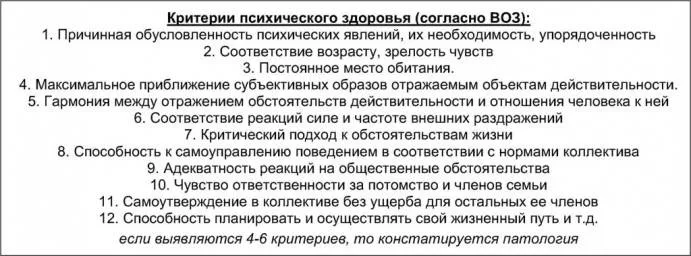
1. According to the WHO definition, mental health is:
- when nothing is bothering you
- the ability to perform different kinds of work
- the ability to cope with mental strain
- +: a state of complete well-being: physical, mental, and social
- the absence of mental disorders
2. Depth psychologists gained the right to practice psychotherapy in:
- the 18th century
- the 19th century
- +: the 20th century
- the 21st century
3. The author of the term "clinical psychology" is
- K. Jaspers
- V. Bekhterev
- +: L. Witmer
- S. Freud
4. Introduced the term "neurosis":
- P. Janet
- I.P. Pavlov - faintheartedness
- S. Freud
- +: W. Cullen
5. One of the criteria of mental health, according to the definition of the World Health Organization, is the correspondence of mental reactions to the _____ of environmental influences
6. Corresponds to the concept of "Psyche" among the ancient Greeks:
- Nervous system
- Superego
- Consciousness
- +: Soul
V3: The scope of application of clinical psychology; practical tasks and functions of clinical psychologists
7. Clinical psychology as a discipline studies various disturbances of the psyche and behavior using psychological methods, and can be applied:
- +: in educational institutions
- in medical institutions
- in counseling institutions
- in educational establishments
- +: all of the above
8. The main areas of focus of clinical psychology: diagnostic, expert, consultative, corrective, preventive, … .:
- diagnostic
- corrective
- expert
- preventive
- +: all of the above
V3: Pathopsychology, its subject, scientific foundations, and current issues
9. The definition of the subject matter of pathopsychology formulated by B.V. Zeigarnik in the statement::
- +: patterns of manifestations of disturbed mental activity in the clinical picture of internal and mental illnesses
- principles and patterns of creating experimental models of mental functions and their disorders
- patterns of disintegration of mental activity and personality traits compared with the patterns of formation and course of mental processes in normal conditions
- patterns of normal psychic functioning under extreme models of psychopathology
10. The emergence of pathopsychology as a psychological discipline in Russia is associated with the names of two scientists:
- I.P. Pavlov and I.M. Sechenov
- V.M. Bekhterev and S.S. Korsakov
- +: B.V. Zeigarnik and S.Ya. Rubinstein
- M.I. Astvatsaturov and A.R. Luria
11. The definition of pathopsychology is the following statement::
- the psychology of experiencing illness
- +: a branch of clinical psychology that studies the patterns of disintegration of mental activity and personality traits under conditions of illness
- a branch of general psychology that studies the influence of value orientations on coping with illness.
- experimental psychometrics
12. One of the important requirements for a pathopsychological experiment is that it be constructed in such a way as to
- allow corrective functions to be carried out during the experiment
- ensure reproducibility of results when the subject's mental state changes
- +: reveal the structure not only of the impaired but also of the preserved forms of mental activity
- avoid recourse to non-parameterizable phenomena and processes
13. The method of constructing a pathopsychological study that implements L.S. Vygotsky's concept of the "zone of proximal development" takes into account::
- those mental functions and traits whose development is expected at the next stage - a quantitative measure of the progress of mental development in the event of successful treatment
- +: the child's potential abilities, not revealed independently but realized with the help of an adult
- experimental psychometrics
14. According to B.V. Zeigarnik, a pathopsychological study includes the following actions::
- +: experiment
- identification and analysis of resistance and defenses
- +: conversation
- +: observation of behavior during the study
V3: Experimental and testing methods of examination
15. Proposed the study of memory using the pictogram method:
- T. Ribot
- +: A.R. Luria
- B.V. Zeigarnik
- S.Ya. Rubinstein
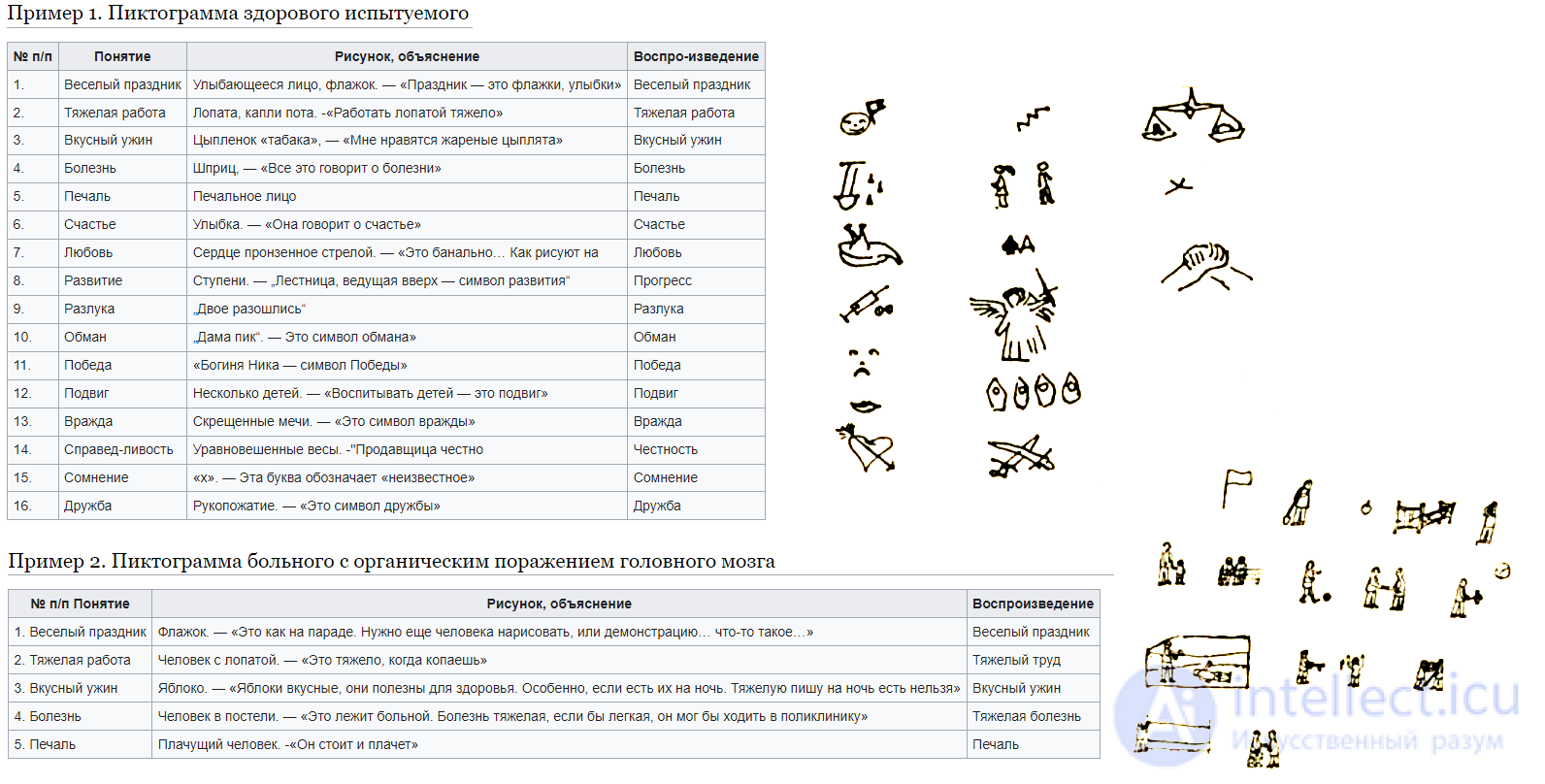
16. Unlike psychological testing, pathopsychology relies on:
- especially careful standardization
- a psychophysiological conception of personality
- +: modeling specific situations in which the mental activities under study manifest themselves
- standardization of norms according to nosological criteria
- the psychologist's intuition
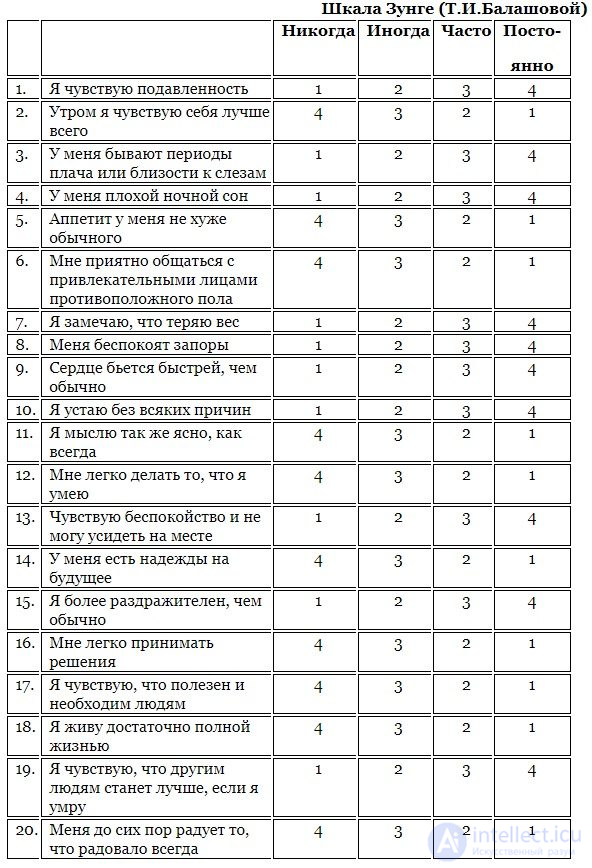
17. The purpose of the differential diagnosis of depressive states is served by:
- the Strelau Questionnaire
- EPI – the Eysenck test
- +: the Zung Scale
- the Buss-Durkee Inventory
- all of the above
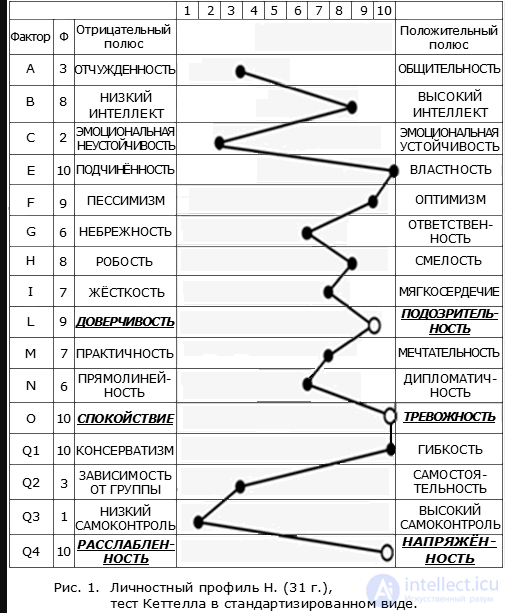
18. The purposes of studying extraversion and neuroticism are served by:
- the Zung Scale
- the Buss-Durkee Inventory
- EPI – the Eysenck test
- +: the Cattell test
Neuroticism is a personality trait characterized by emotional instability, anxiety, low self-esteem, and sometimes autonomic disturbances. Neuroticism should not be equated with neurosis, since neurotic symptoms may also be found in a healthy person. Neuroticism is usually measured using special scales or personality questionnaires.
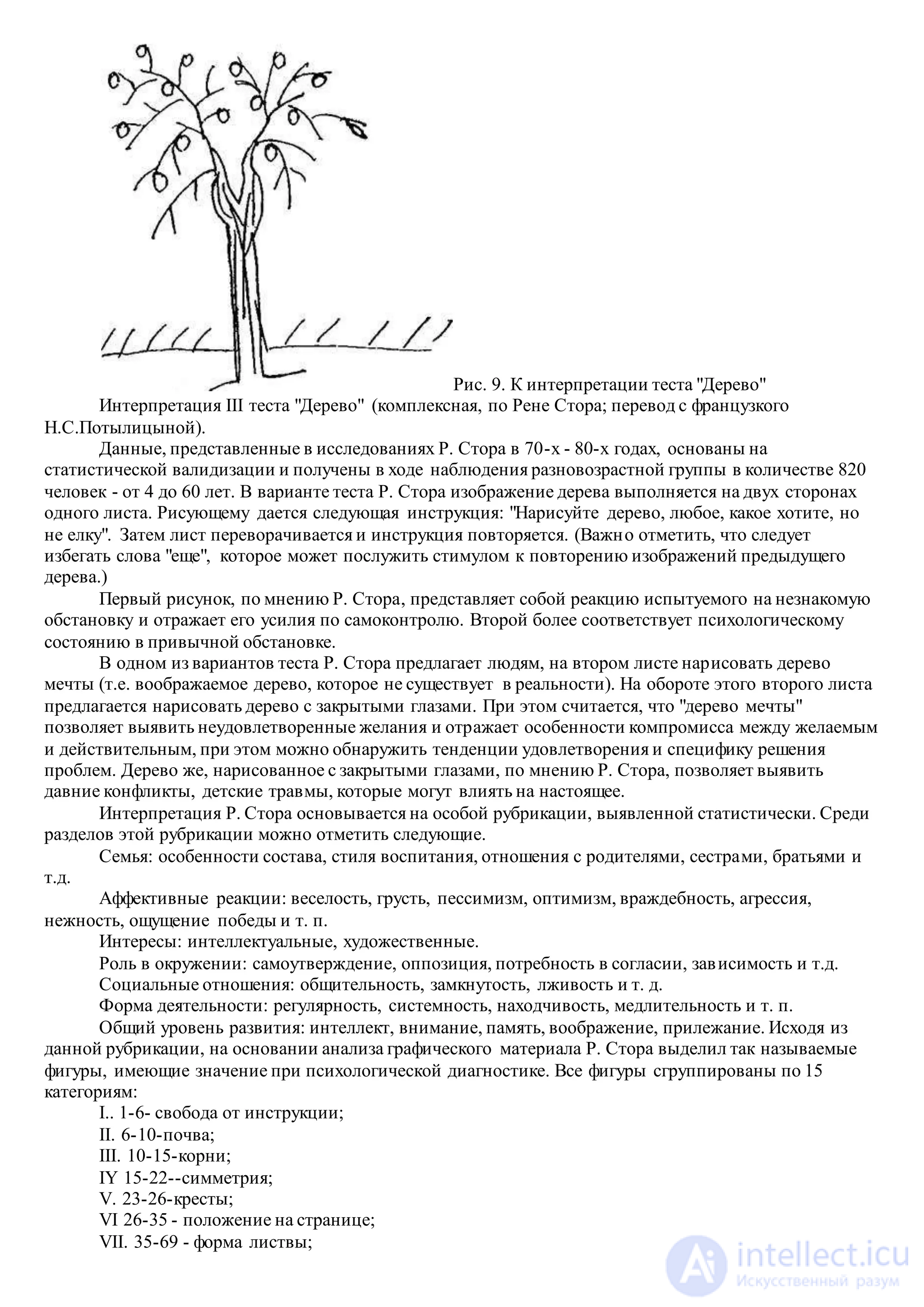
19. The field in which the "Tree Test" by K. Koch is typically used::
- +: in neuropsychology
- in working with prisoners
- +: in working with children
- in career guidance
20. The Sacks-Levy Sentence Completion Test belongs to the group of:
- standard questionnaires
- unstructured interviews
- +: neuropsychological techniques
- +: projective tests
- all of the above are correct


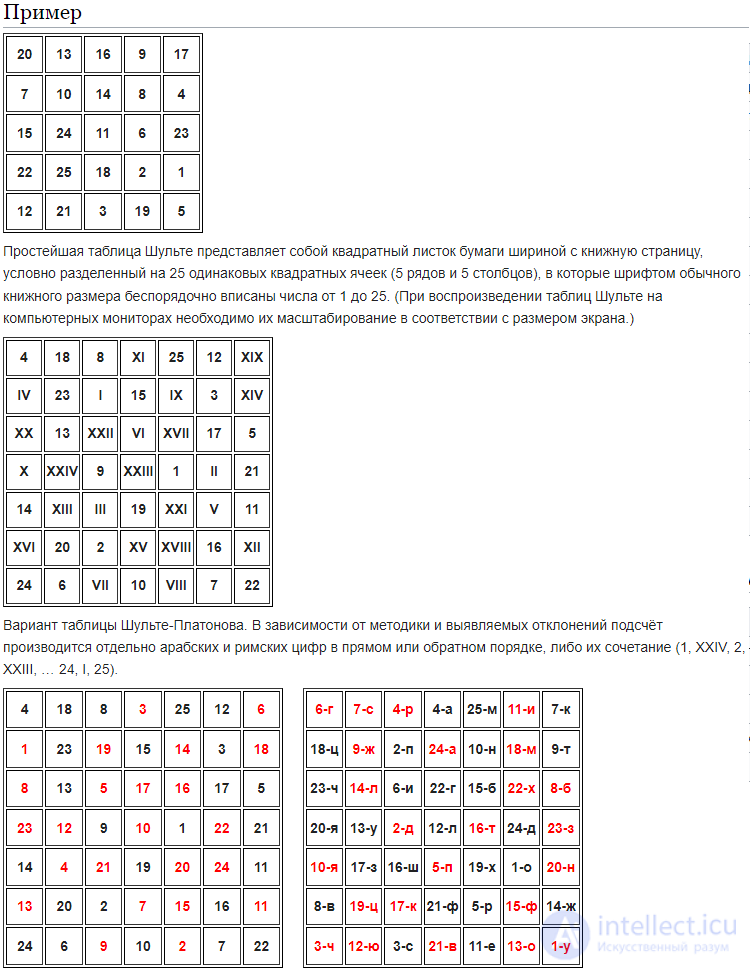
21. The Schulte Tables are intended for studying:
- memory
- intelligence
- +: mental performance capacity
- +: attention
- thinking
22. The Bekhterev Institute Personality Questionnaire (TOBOL) is intended for diagnosing::
- Types of personality character
- +: Types of attitude toward illness in patients with chronic somatic diseases
- Communicative attitudes
- The level of anxiety and depression
23. The Rorschach test, Machover's "Draw-a-Person" test, the locus of control questionnaire, the TAT, and the MMPI are intended for studying:
- Intelligence
- Psychopathological syndromes
- Social attitudes
- all of the above
- +: Personality
24. You need to study long-term memory. Which technique would you choose to work with the patient?:
- +: memorizing 10 words
- the Benton test
- pictograms
- the exclusion technique
- the Rorschach test
25. When using the "4th odd one out" technique, some of the patient's answers showed a distortion of the generalization process. Which technique could you use to further identify this disorder.
- pictograms
- +: classification
- Koos block design
- MMPI
- the Benton test
26. You need to study the characteristics of a client's thinking. Which of the listed techniques can provide the most information in this area.
- +: 4th odd one out
- MMPI
- pictograms
- the Wechsler test
- the Dembo-Rubinstein technique
27. You are studying a patient's memory. Which of the listed techniques can be excluded from the experiment.
- pictograms
- memorizing 10 words
- the Benton test
- +: 4th odd one out
- clinical-psychological interview
28. To study thinking, you would choose all of the listed techniques except:
- complex analogies
- pictograms
- interpretation of proverbs
- +: the Benton test
- classification
29. When examining a subject, thinking disorders of the distorted-generalization type are revealed. This type of task performance may indicate the disease :
- hysterical neurosis
- +: schizophrenia
- manic-depressive psychosis
- oligophrenia (intellectual disability)
- epilepsy
30. According to Ribot-Jackson's law, in progressive amnesia, memory is lost:
- from the specific to the general
- +: from more recently to earlier acquired information
- from complex psychological acts to simple ones
- from less to more emotionally significant
- from the general to the specific
31. At a patient's initial visit, the task arises of studying his cognitive functions. Which tests would you choose:
- +: the Benton test
- +: Koos block design
- +: pictograms
- the Luscher test
- +: 4th odd one out
32. In a counseling situation, the subject often "avoids" the line of conversation,
this phenomenon can be objectively identified as a thinking disorder using the technique:
- TAT
- MMPI
- +: pictograms
- the Luscher test
- the Schulte tables
33. When examining a patient, diffuseness of thinking is clinically detected. Which techniques would confirm this finding:
- +: classification and pictograms
- figure assembly and object exclusion
- pictograms and figure assembly
- +: classification and object exclusion
- classification and figure assembly
34. A patient complains of an obsessive sensation of the smell of rotten apples. Irritation of which brain structures is associated with this olfactory disorder
- the outer surface of the temporal lobes
- the occipital lobes
- +: the medial portions of the temporal lobes
- the parietal regions of the cerebral hemispheres
- +: the pole of the frontal lobes
35. A patient complains of impaired understanding of speech addressed to them: "I hear that something is being said to me, but I can't make it out. This is
- motor aphasia
- acoustic noise
- +: sensory aphasia
- amnestic aphasia
36. A patient complains of visual impairment in the outer fields on both sides. He underwent surgery for a pituitary adenoma. What is this visual impairment called.
- binasal hemianopsia
- +: bitemporal hemianopsia
- quadrant hemianopsia
- optic-spatial agnosia
- object agnosia
37. A patient suffered a stroke, after which a speech disorder and weakness in the right arm remained; he understands speech addressed to him but cannot answer, and signals with gestures: What is this speech disorder called
- amnestic aphasia
- +: motor aphasia
- acoustic-mnestic aphasia
- sensory aphasia
- mutism
38. An elderly woman is brought in for an appointment; the outpatient chart states the diagnosis: Korsakoff syndrome. What does this diagnosis mean:
- hallucinations
- impairment of semantic memory
- +: gross impairment of short-term memory
- impairment of long-term memory
- impairment of visual-spatial functions
39. The choice of techniques for a pathopsychological examination is influenced by:
- the purpose of the study
- the client's education and life experience
- the state at the time of the examination
- the differential diagnosis
- +: all of the above are correct
40. The psychologist should become familiar with materials on the patient's life and medical history:
- +: before the examination
- this information is not important at all
- after the examination
- only from conversation with the patient
- all of the above are correct
41. The essence of the "Zeigarnik effect":
- +: unfinished actions are best remembered and reproduced
- completed actions are best remembered and reproduced
- the relationship between anxiety and attention
- memory impairment in oligophrenia
- all of the above are correct
42. Which item lists the techniques that are best suited to reveal thinking disorders
- TAT and CAT
- the Rorschach test
- the family drawing
- +: classification and object exclusion
- the Cattell test
43. The "Relating proverbs, sayings, and phrases" technique is aimed at diagnosing:
- +: the zone of proximal development
- attention
- thinking
- speech
- all of the above are correct
44. Intermediate, mixed, and amalgam types of character accentuation were identified by:
- Freud
- +: Lichko
- Rogers
- Luria
- Rubinstein
45. All of the following belong to the methods of investigation in clinical psychology except one:
- pathopsychological examination
- clinical interviewing
- neuropsychological examination
- testing of individual psychological characteristics
- +: amytal-caffeine disinhibition
46. The pictogram method is used for studying:
- +: memory
- attention
- intelligence
- emotions
- consciousness
47. The combination of behavioral, motivational, and cognitive features of a patient's mental activity, expressed in psychological terms, is called:
- a psychopathological symptom
- a psychopathological syndrome
- +: a pathopsychological syndrome
- a pathopsychological symptom
- a pathopsychological phenomenon
48. Emotional-volitional disorders, disruption of the structure and hierarchy of motives, inadequate self-esteem and level of aspirations, thinking disorders in the form of "relative affective dementia," and impaired prognosis and reliance on past experience are part of the structure of:
- schizophrenic symptom complex
- neurotic symptom complex
- +: psychopathic symptom complex
- organic symptom complex
- oligophrenic symptom complex
49. Which is not one of the primary colors of the Luscher test:
- yellow
- red
- blue
- green
- +: brown
50. Reliance in thinking on latent features revealed while carrying out the "pictogram" technique indicates the presence of:
- +: schizophrenic symptom complex
- neurotic symptom complex
- psychopathic symptom complex
- organic symptom complex
- oligophrenic symptom complex
51. The Luscher test is used to assess:
- the degree of mnestic (memory) impairment
- the degree of intellectual development
- thinking characteristics
- clarity of consciousness
- +: emotional experiences
52. A study aimed at assessing the state of higher mental functions and the features of hemispheric asymmetry functioning is called:
- +: neuropsychological
- pathopsychological
- psychopathological
- psychiatric
- psychosomatic
53. The satiation phenomenon is associated with the following:
- +: attitude toward the task
- warming up to the task
- practice effects
- exhaustibility
- rigidity
54. The ability to recognize presented objects by touch is called:
- tactility
- +: stereognosis
- empathy
- reflection
- agnosia
55. The Minnesota Multiphasic Personality Inventory allows one to reveal:
- neuropsychological symptoms
- +: pathopsychological phenomena
- +: a personality profile
- temperament traits
- intellectual abilities
56. Assessment of affective rigidity according to MMPI data is done using:
- scale 1
- scale 3
- scale 5
- +: scale 6
- scale 9
57. All the following techniques are related to methods for studying attention, except one:
- +: pictogram
- the Schulte test
- the proofreading (cancellation) test
- the Raven test
- the Munsterberg technique
58. The evaluation of the effectiveness of psychological methods of influence on a person includes all of the following criteria except one:
- +: the criterion of the degree of symptomatic improvement
- the criterion of the degree of awareness of the psychological mechanisms of the illness
- the criterion of the degree of change in disturbed personal relationships
- the criterion of the degree of improvement in partner (sexual) relationships
- the criterion of the degree of improvement in social functioning
59. A patient's verbal and nonverbal intelligence can be revealed using:
- +: the Wechsler test
- the Rorschach test
- +: the Cattell test
- the Raven test
- the Eysenck test
60. The right (non-dominant) hemisphere of the brain is associated with:
- arithmetic abilities
- logical thinking
- +: perception of body image and visual-spatial orientation
- speech
- vision
61. Deep lesions of the frontal lobes lead primarily to impairment of:
- +: voluntariness and purposefulness of activity
- vision
- hearing
- +: motor skills
- sensitivity
Beginning of form
62. which of the criteria listed below is one of the most significant diagnostic criteria for distinguishing psychotic from non-psychotic mental disorders:
- the duration of the disorders
- the subjective severity of the disorders
- +: lack of critical awareness of the disorders
- the connection of the disorders with individual psychological characteristics
- the resistance of the disorders to therapy
63. Mental reactions, states, and developments caused by hereditary-constitutional causes belong to one of the following types of mental response:
- exogenous
- +: endogenous
- psychogenic
- personal
- mixed
64. With introversion, in contrast to autism, the following is generally observed:
- +: critical awareness of one's own withdrawal/closedness
- less pronounced withdrawal
- absence of hallucinations
- absence of delusional ideas
- lack of critical awareness of one's own withdrawal/closedness
65. All of the following belong to disturbances of the emotional sphere except one:
- depression
- explosiveness of emotions
- euphoria
- +: reasoning/rationalization (resonerstvo)
- stress
66. Exclude the item in which a pathopsychological syndrome is NOT listed:
- schizophrenic
- oligophrenic
- psychogenic-neurotic
- +: neuropsychological
- exogenous-organic
67. In the course of working with a patient, the psychologist may use:
- leading questions:
- prompting
- approval
- demonstrating the solution to similar tasks
- +: all of the above are correct
68. The Zeigarnik effect relates to which psychological process:
- attention
- +: memory
- emotions
- thinking
- will
69. The minimum magnitude of a stimulus that causes a barely noticeable sensation is called:
- the absolute upper threshold of sensation
- +: the absolute lower threshold of sensation (threshold of sensitivity), the pain threshold
- the differential threshold of sensation
- the operative threshold of sensation
70. As a result of perception, all of the following properties of an image are formed except:
- objectivity
- categoriality
- wholeness
- +: uniqueness
- constancy
71. Attention possesses all of the following properties except:
- stability
- concentration
- distribution
- +: duration
- span/volume
72. The subjective attitude toward an illness is called:
- anosognosia
- +: the internal picture of the illness
- hypochondria
- reflection
- egocentrism
73. The pain sensitivity threshold is lower:
- +: in women
- in men
- no differences are found
- in women with predominant feminine traits
- in women with increased masculinization
74. Dysmorphomania belongs to mental experiences specific to:
- adults
- the elderly
- children
- +: adolescents
- all of the above are correct
75. A.R. Luria gives an example of a patient looking at an image of glasses (spectacles) – he is confused and doesn't understand what is depicted: "A circle…and another circle…and a stick…and a crossbar…it must be a bicycle…". This is an example of a disorder of:
- confusion
- +: visual agnosia
- fragmentation of speech
- disorders of voluntary memory
76. With disorders of higher mental functions, symptoms:
- directly indicate the localization of functions in the nervous apparatus
- do not allow one to draw a direct conclusion about the localization of functions
- allow a conclusion about localization only on the basis of psychological analysis of the symptoms themselves
- always represent the simplest atomic psychological phenomena
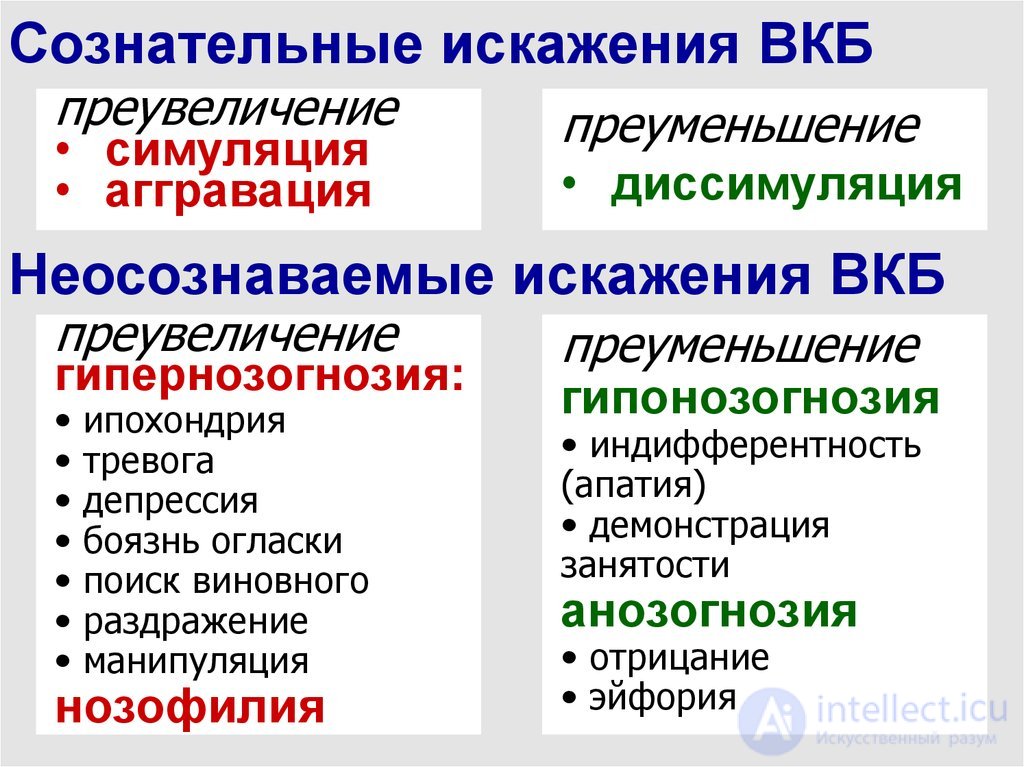
77. The absence of awareness of one's own defects and illnesses is: ____
- +: anosognosia
- apathy
- abulia
78. The restructuring of functional systems through specially designed rehabilitative training to restore higher mental functions was developed by:
- L.S. Vygotsky
- +: A.R. Luria
- V.M. Bekhterev
- E. Kraepelin
79. The theory of brain blocks belongs to:
- B.V. Zeigarnik
- I.M. Sechenov
- +: A.R. Luria
- V.M. Bekhterev
80. Massive lesions of the frontal lobes lead primarily to disruption of those complex forms of regulation of conscious activity that:
- are not connected to voluntary intentions
- are deeply entrenched in individual experience
- +: are directed by the activating influence of motives formed with the help of speech
- realize instinctive urges
81. "Flashback effects" in post-traumatic stress disorder are most likely associated with:
- : -mechanisms of the left hemisphere
- +: mechanisms of the right hemisphere
- mechanisms of reticular activation
- frontal paroxysms
82. According to A.R. Luria, three main blocks can be identified that participate in any mental activity:
- +: the block that ensures the regulation of tone or wakefulness
- +: the block for receiving, processing, and storing information coming from the external world
- the block for receiving, processing, and storing information coming from the internal world
- +: the block for programming, control, and regulation of mental activity
V3: Psychological studies in the clinic of somatic illnesses
83. The statement that correctly describes the differences between somatoform disorders and psychosomatic illnesses:
- somatoform disorders are more severe than psychosomatic illnesses
- somatoform disorders fit within nosological frameworks, while psychosomatic ones fit within syndromic frameworks
- somatoform disorders are mental disorders that include somatic symptoms, while psychosomatic illnesses are somatic disorders that include mental disturbances
- +: in somatoform disorders, there are no corresponding morphological changes, while in psychosomatic illnesses objective changes are found, in whose origin a psychological factor participates
84. Special studies give grounds to suppose that stress can cause a somatic disorder:
- through conversion mechanisms
- by reducing the activity of the sympathetic divisions of the autonomic nervous system
- +: by stimulating the production of hormones that reduce the activity of the immune system
- by blocking the production of testosterone
85. The theory of psychosomatic illnesses in which the bodily "self" is regarded as a "projection" of mental problems onto the bodily sphere is called
- +: psychoanalytic
- neurophysiological
- neurobiological
- alexithymic
86. The classification of disorders considered psychogenic in ICD-10 is based primarily on:
- features of etiopathogenesis
- clinical-physiological criteria
- +: clinical phenomenology
- prognostic criteria
87. People with Type "A" behavior are at risk of developing:
- oncological diseases
- +: coronary heart disease
- bronchial asthma
- peptic ulcer disease
88. The internal picture of illness of the ergopathic type belongs to
- normal illness perception (normonosognosia)
- overestimation of illness (hypernosognosia)
- +: denial of illness (anosognosia)
- underestimation of illness (hyponosognosia)
89. The internal picture of illness of the melancholic type belongs to
- normonosognosia
- +: hypernosognosia
- anosognosia
- hyponosognosia
90. The formation of the internal picture of illness is influenced by:
- age
- social status
- severity of the illness
- the patient's awareness about the illness
- +: all of the above
V3: Psychological counseling, correction, and psychotherapy
91. Following S. Freud, R. May defined the main quality of a good counselor as:
- +: the capacity for empathy
- the ability to attract people
- the ability to learn from practice
- professional training
92. If we analyze what is common among psychotherapists of different schools and orientations, it turns out to be:
- the role of empathy
- working with transference
- +: the development of a collaborative relationship between the therapist and the client
- suggestion as the basis of the effect
93. A combination of individual and group psychotherapy:
- +: is useful due to their mutual complementarity
- is advisable since they perform a function of mutual control
- is inadvisable due to the differences in their mechanisms of action
- is indicated for a very limited circle of patients
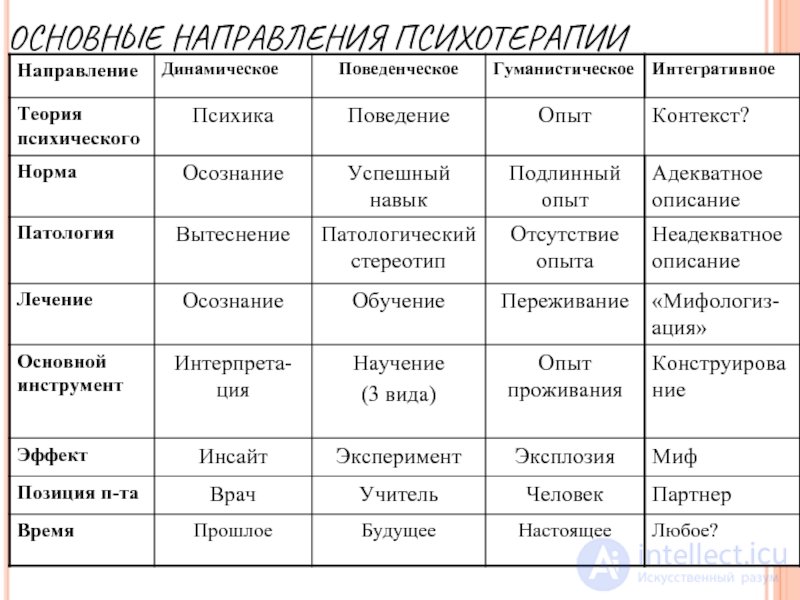
94. Formulated and developed the person-centered approach:
- A. Ellis
- K. Horney
- S. Freud
- +: C. Rogers
- R. May
95. The approach asserting that indirect reinforcement can influence behavior:
- systemic family therapy
- +: social learning theory
- humanistic therapy
- psychoanalysis
96. The direction in psychotherapy represented by A. Beck:
- behavioral therapy
- person-centered therapy
- +: cognitive therapy
- psychodynamic therapy
97. The direction in psychotherapy represented by F. Perls:
- behavioral therapy
- person-centered therapy
- +: gestalt therapy
- psychodynamic therapy
98. The direction in psychotherapy represented by Ellis:
- behavioral therapy
- person-centered therapy
- cognitive therapy
- +: rational-emotive therapy
99. The direction in psychotherapy represented by S. Grof:
- behavioral therapy
- person-centered therapy
- +: transpersonal therapy
- psychodynamic therapy
100. The direction in psychotherapy represented by C. Jung:
- behavioral therapy
- person-centered therapy
- cognitive therapy
- +: psychodynamic therapy
101. A psychotherapist tries to help a young man develop rational alternatives to the thought that, ever since his girlfriend left him, all women feel hatred toward him. The psychotherapist is acting within the framework of:
- +: cognitive therapy
- behavioral therapy
- psychodynamic therapy
- humanistic therapy
102. Representatives of the direction in psychotherapy interested in determining the functional links between external events and a patient's behavior:
- psychodynamic
- +: behavioral
- existential
- -cognitive
TESTS
Variant 1
1. The choice of techniques for a pathopsychological examination is influenced by:
- a) the purpose of the study
- b) the client's education and life experience
- c) the state at the time of the examination
- d) the client's diagnosis
- e) all of the above are correct
2. The psychologist should become familiar with materials on the patient's life and medical history:
- a) before the examination
- b) this information is not important at all
- c) after the examination
- d) only from conversation with the patient
- e) all of the above are correct
3. The patient's attitude toward the examination…… (exclude the incorrect option)
- a) affects the results of the work
- b) should be taken into account when interpreting the results
- c) affects the course of the examination
- d) is always clearly visible
- e) affects contact with the examiner
4. The purpose of using psychological examination in clinical work is most accurately described in the item:
- a) for selecting medications
- b) for working with the patient's relatives
- c) for choosing the dose of medication
- d) for diagnostic purposes
- e) all of the above are correct
5. Which type of examination is most appropriate for studying behavior, memory, perception, thinking, and emotion
- a) standard interview
- b) self-report
- c) tests
- d) projective techniques
- e) all of the above are correct
6. A decrease in the level of generalization is possible with all of the following disorders except….
- a) mental retardation
- b) epilepsy
- c) the consequences of traumatic brain injury
- d) neuroses
- e) imbecility
7. The essence of the "Zeigarnik effect":
- a) unfinished actions are best remembered and reproduced
- b) completed actions are best remembered and reproduced
- c) the relationship between anxiety and attention
- d) memory impairment in oligophrenia
- e) decreased intelligence
8. Which statement formulates the most precise definition of the subject of pathopsychology (according to B.V. Zeigarnik):
- a) the patterns of normal psychic functioning
- b) the patterns of manifestations of disorders of mental activity in childhood
- c) the principles and patterns of creating experimental models of behavior
- d) the patterns of disintegration of mental activity and personality traits compared with the patterns of formation and course of mental processes in normal conditions
- e) carrying out diagnostic work
9. One of the fundamental principles of pathopsychological examination is:
- a) quantitative analysis of individual functions
- b) systemic, qualitative analysis of the disorders of mental activity under study
- c) analysis of personality traits
- d) analysis of thinking
- e) all of the above are correct
10. Who proposed studying memory and thinking using the "Pictogram" method:
- a) Rubinstein
- b) Luria
- c) Zeigarnik
- d) Ribot
- e) Leontiev
11. The Schulte Tables are intended for studying:
- a) perception
- b) attention
- c) thinking
- d) speech
- e) vision
12. Which item lists the techniques best suited to reveal thinking disorders:
- a) TAT and CAT
- b) the Rorschach test
- c) the family drawing
- d) classification and object exclusion
- e) the Kraepelin counting test
-
13. The "Relating proverbs, sayings, and phrases" technique is aimed at diagnosing:
- a) the zone of proximal development
- b) attention
- c) thinking
- d) speech
- e) writing
14. "Attitude toward illness" can also be called:
- a) the internal picture of illness
- b) experiencing illness
- c) position toward illness
- d) realism in perceiving symptoms
- e) all of the above are correct
15. Intermediate, mixed, and amalgam types of character accentuation were identified by:
- a) Freud
- b) Lichko
- c) Rogers
- d) Luria
- e) Shmishek
16. Which of the colors in the Luscher test is not a primary color:
- a) blue
- b) green
- c) brown
- d) yellow
- e) red
17. Examination of the psychological state includes all items except…
- a) medical history
- b) state of intellect
- c) state of consciousness
- d) state of the affective sphere
- e) state of motivation
18. Which of the following is NOT a manifestation of normativity in a psychological examination situation:
- a) the tendency to give socially desirable answers
- b) precise compliance with task instructions
- c) performing tasks in accordance with one's own idea of the "norm"
- d) the motive of expertise
- e) all of the above are incorrect
19. Which of the following phenomena is the satiation phenomenon most often associated with:
- a) attitude toward the task
- b) warming up to the task
- c) practice effects
- d) exhaustibility
- e) rigidity
20. In healthy people, the introduction of mediation operations…..
- a) worsens memorization
- b) does not affect memorization
- c) improves memorization
- d) leads to forgetting
- e) speeds up thinking
21. A tendency to worry about various matters on the MMPI questionnaire will produce high scores on the…. scale
- a) psychasthenia
- b) schizophrenia
- c) hypomania
- d) paranoia
- e) hypochondria
22. The Luscher test is used to assess:
- a) the degree of mnestic (memory) impairment
- b) the degree of intellectual development
- c) thinking characteristics
- d) clarity of consciousness
- e) emotional experiences
23. The validity of the MMPI personality profile is determined by the scale:
a) the validity scales
- b) hypochondria
- c) anxiety
- d) psychasthenia
- e) hypomania
24. Which test has three validity scales and 10 clinical scales?
- a) the Wechsler test
- b) the Rorschach test
- c) MMPI
- d) the Cattell test
- e) the Rosenzweig test
25 A client's verbal and nonverbal intelligence can be revealed by:
- a) the Rorschach test
- b) the Wechsler test
- c) the House-Tree-Person test (HTP)
- d) the Cattell test
- e) classification
26. Reliance in thinking on latent features revealed while carrying out the "pictogram" technique indicates the presence of:
- a) schizophrenic symptom complex
- b) neurotic symptom complex
- c) psychopathic symptom complex
- d) organic symptom complex
- e) oligophrenic symptom complex
27. Assessment of affective rigidity according to MMPI data is done using:
- a) scale 1
- b) scale 2
- c) scale 5
- d) scale 6
- e) scale 9
28. All the following techniques relate to methods for studying attention, except one:
- a) pictograms
- b) the Schulte test
- c) the proofreading (cancellation) test
- d) the Raven test
- e) the Munsterberg technique
29. According to Svyadoshch's definition, suggestion is:
- a) imposing one's will on another person
- b) indirect persuasion
- c) the transmission of information that is perceived without criticism and influences the course of mental processes
- d) information intervention
- e) hypnotic influence
30. All of the following belong to the methods of investigation in clinical psychology, except one:
- a) pathopsychological examination
- b) clinical interviewing
- c) neuropsychological examination
- d) testing of individual psychological characteristics
- e) amytal-caffeine disinhibition.
Variant 2
1. Which does NOT belong to disturbances of the emotional sphere
- a) Depression
- b) Explosiveness of emotions
- c) Euphoria
- d) Reasoning/rationalization (resonerstvo)
- e) lability
2. Exclude the item in which a pathopsychological syndrome is NOT listed.
- a) schizophrenic
- b) oligophrenic
- c) psychogenic-neurotic
- d) neuropsychological
e) catatonic
3. In the course of working with a patient during a pathopsychological examination, one may use:
- a) leading questions
- b) prompting
- c) demonstrating the solution to similar tasks
- d) assistance
- e) all of the above are correct
4. Which does NOT belong to techniques for studying attention and sensorimotor functions:
- a) the Kraepelin counting test
- b) the Schulte tables
- c) the TAT technique
- d) the proofreading (cancellation) test
- e) the Munsterberg technique
The Thematic Apperception Test (TAT) is a projective psychodiagnostic technique developed in the 1930s at Harvard by Henry Murray and Christiana Morgan. The purpose of the technique was to study the driving forces of personality — internal conflicts, drives, interests, and motives. After World War II, the test came into wide use by psychoanalysts and clinicians for working with disturbances in patients' emotional sphere.
Henry Murray himself defines the TAT as follows: "The Thematic Apperception Test, better known as the TAT, is a method by which one can reveal the dominant drives, emotions, sentiments, complexes, and conflicts of a personality, and which helps to determine the level of latent tendencies that the subject or patient conceals or cannot show due to their being unconscious"
— Henry A Murray. Thematic apperception test. — Cambridge, Mass: Harvard University Press, 1943
5. Inference belongs to:
- a) mental operations
- b) mental processes
- c) mental factors
- d) mental types
- e) mental mechanisms
6. Attention possesses all of the following properties except:
- a) stability
- b) concentration
- c) distribution
- d) duration
- e) span/volume
37. Enthusiasm for gambling is called:
- a) workaholism
- b) fetishism
- c) karting
- d) surfing
- e) gambling addiction
7. Especially pronounced emotional states of a person, accompanied by significant changes in behavior, are called:
- a) stresses
- b) frustrations
- c) feelings
- d) affects
- e) psychological traumas
8. The process of a subject's self-knowledge of internal mental acts and states, as well as the formation of an idea of how others truly relate to the subject, is called:
- a) self-actualization
- b) self-esteem
- c) attribution
- d) hypochondria
- e) reflection
9. When performing the Benton test to study memorization, the subject is asked to:
- a) copy the drawings after being shown them
- b) compose a story
- c) answer questions
- d) divide the drawing into parts
- e) find the missing fragment of the displayed image
10. When performing tests, "organic"-type errors include all of the following except
- a) exhaustibility
- b) uneven pace of work
- c) inattentiveness
- d) thinking disorders of the type of distortion of the processes of generalization and abstraction
- e) thinking disorders of the type of reduction of the processes of generalization and abstraction
11. The Zeigarnik effect relates to which psychological process:
- a) attention
- b) memory
- c) emotions
- d) thinking
- e) will
12. Failure to understand the hidden, figurative meaning of proverbs and sayings is most often found with the following disorder:
- a) Neurosis
- b) mental retardation
- c) Phobia
- d) depression
- e) character accentuation
13. Which of the descriptions given corresponds to euphoria?
- a) lowered mood
- b) apathy
- c) split personality
- d) carefree, untroubled contentment, an experience of well-being
- e) agitated anxiety
14. The use of persuasion in the correction of neuroses can be attributed to …
- a) gestalt therapy
- b) rational psychotherapy
- c) art therapy
- d) dance therapy
- e) body-oriented therapy
15. Dysphoria is:
- a) a feeling of sadness in depression
- b) a gloomy, irritable, lowered mood
- c) an unstable mood
- d) indifference
- e) apathy
16. A father tells his child, "Turn off the radio," and the child repeats back: "Radio." This is an example of:
- a) logophasia
- b) euphoria
- c) echolalia
- d) reaction
- e) projection
17. Reasoning/rationalization (resonerstvo) and diffuseness of thinking are characteristic of…
- a) schizophrenia
- b) epilepsy
- c) mental retardation
- d) neuroses
- e) childhood autism (early infantile autism)
49. The subjective attitude toward an illness is called:
- a) anosognosia
- b) the internal picture of the illness
- c) hypochondria
- d) reflection
- e) egocentrism
18. Filling gaps in memory with fabricated things and events is called:
- a) falsification
- b) confabulation
- c) regression
- d) autism
- e) illusion of perception
51. For children, adolescents, and young people, the most psychologically difficult conditions turn out to be:
- a) sexual disorders
- b) illnesses that alter one's appearance
- c) cancer
- d) heart attack
- e) stroke
19. The inability to recognize familiar objects while the ability to distinguish their basic elements is preserved is:
- a) apraxia
- b) gnosiopathy
- c) stereotypy
- d) agnosia
- e) phobia
20 Aphasia is:
- a) a speech disorder
- b) the inability to recognize familiar things
- c) a sleep disorder
- d) a thinking disorder
- e) a perceptual disorder
21. Alexia is:
- a) poverty of vocabulary
- b) the inability to find the right word
- c) a reading disorder
- d) a disorder of consciousness
- e) none of the above is correct
22. The patient understands well the request to touch the tip of the nose with the index finger, but cannot carry it out. This is:
- a) hypoxia
- b) apraxia
- c) agnosia
- d) phobia
- e) anosognosia
23. The term "dementia" means:
- a) a profound degree of feeble-mindedness (debility)
- b) acquired intellectual decline
- c) a profound degree of oligophrenia
- d) traumatic brain injury
- e) motivational disorders of thinking
24. Minor epileptic seizures, known as Petit Mal, are called
- a) absence seizure
- b) stupor of consciousness (obnubilation)
- c) coma
- d) delirium
- e) catatonia
25. Which does NOT belong to types of dysontogenesis:
- a) mental underdevelopment
- b) delayed mental development
- c) abnormal development
- d) disharmonious mental development
- e) distorted mental development
26. Which does NOT belong to the causes of oligophrenia:
- a) chromosomal pathology
- b) infections during the mother's pregnancy
- c) illnesses suffered before the age of 3
- d) illnesses suffered during adolescence
- e) the effects of radiation exposure
27. A pathological, irresistible urge to wander is called:
- a) dipsomania
- b) dromomania
- c) kleptomania
- d) pyromania
- e) bulimia
28. In intellectual disability, according to the definition of most scientists, the leading disorder is
- a) total underdevelopment of all mental functions
- b) inattentiveness
- c) disorders of self-esteem
- d) speech disorder
- e) character accentuation
29. Tests for determining character accentuation were developed by:
- a) Eysenck and Wechsler
- b) Luscher and Freud
- c) Rorschach and Luscher
- d) Shmishek and Lichko
- e) Luria and Vygotsky
30. Pathological polysemanticism, in which words begin to acquire multiple meanings and the semantic structure of a word is often loosened, occurs more often in:
- a) neurotic disorders
- b) personality (psychopathic) disorders
- c) schizophrenic disorders
- d) epileptic disorders
- e) dementia
31. The patient answers questions asked of them as if "half asleep," often without grasping the content, is slowed in movement, indifferent, and silent. This disorder of consciousness is called:
- a) clouding/obtundation
- b) delirium
- c) coma
- d) oneiroid state
- e) stupor
32. The branch of medical psychology that studies the influence of psychological factors on the occurrence of somatic illnesses
- a) neuropsychology
- b) psychosomatics
- c) psychohygiene
- d) deontology
- e) pathopsychology
33. When performing the "Exclusion" technique, the subject makes generalizations based on non-essential, formal, latent features - this is characteristic of:
- a) mania
- b) depression
- c) neurosis
- d) schizophrenia
- e) oligophrenia
34. Cancerophobia is:
- a) an obsessive fear of getting cancer
- b) an obsessive fear of getting any illness
- c) an overvalued idea that one has a cancerous tumor
- d) a dominant idea that one has a cancerous tumor
- e) all of the above are correct
35. Which of the following characteristics does NOT describe "resonerstvo" (empty reasoning):
- a) loss of purposefulness
- b) verbosity
- c) torpidity of thinking
- d) inadequacy in the choice of the object of discussion
- e) inadequate pathos in statements
36. The uniqueness of the combination of various traits and qualities of a person is denoted by the term:
- a) temperament
- b) character
- c) personality
- d) individual
- e) individuality
37. Increased suspiciousness combined with a tendency to form overvalued ideas is part of the structure of:
- a) hysterical character traits
- b) schizoid character traits
- c) psychasthenic character traits
- d) paranoid character traits
- e) epileptoid character traits
38. In the "Classification" technique, the subject groups together "wardrobe, a shoe with a shoelace" with the words: "Similarity! These are objects with a hole, with nails and screws." Responses of this type are characteristic of:
- a) manic-depressive psychosis (MDP)
- b) schizophrenia
- c) epilepsy
- d) oligophrenia
- e) neurosis
39. Increased suspiciousness combined with a tendency to form overvalued ideas is part of the structure of:
- a) hysterical character traits
- b) schizoid character traits
- c) psychasthenic character traits
- d) paranoid character traits
- e) epileptoid character traits
40. The concept of a harmonious personality includes all of the following except:
- a) kindness
- b) responsibility
- c) independence
- d) morality
- e) autonomy
41. A tendency toward increased neatness is part of the structure of:
- a) hysterical character traits
- b) schizoid character traits
- c) psychasthenic character traits
- d) paranoid character traits
- e) epileptoid character traits
42. Mental reactions, states, and developments caused by hereditary-constitutional causes belong to one of the following types of mental response:
- a) exogenous
- b) endogenous
- c) psychogenic
- d) personal
- e) neurogenic
43. Similar in terms of emotionality (impressionability) are:
- a) choleric and phlegmatic
- b) choleric and sanguine
- c) melancholic and sanguine
- d) choleric and phlegmatic
- e) sanguine and phlegmatic
44. The subject has an elevated mood and sense of well-being, psychomotor agitation, talks constantly, jokes, and is excessively distractible - this is characteristic of:
- a) mania
- b) depression
- c) inconsistency
- d) delusion
- e) hallucination
45. Phenomena of inertia of thinking are most often observed in…..
- a) schizophrenia
- b) epilepsy
- c) mania
- d) neurosis
- e) manic-depressive psychosis
46. Which does NOT correspond to inertia of thinking:
- a) difficulty switching from one task to another
- b) slowed pace of work
- c) depression
- d) thoroughness of judgments
- e) difficulty concentrating attention
47. The loss of control over one's own actions and the absence of error correction is:
- a) impairment of generalization
- b) impairment of critical judgment
- c) impairment of perception
- d) impairment of memory
- e) impairment of behavior
48. Functional disorders of mental activity arising as a result of psychological trauma and amenable to correction are
- a) schizophrenia
- b) epilepsy
- c) psychogenic reactions
- d) oligophrenia
- e) paranoia
49. Insufficient satisfaction of certain needs is called:
- a) acceleration
- b) deprivation
- c) autism
- d) isolation
- e) mutism
50. Increased emotional sensitivity is:
- a) sensitivity (heightened emotional sensitivity)
- b) anxiety
- c) autization
- d) lability
- e) euphoria
51. Insufficient control and supervision of a child's behavior is characteristic of the ….. type of upbringing
- a) hypoprotection (neglectful upbringing)
- b) hyperprotection (overprotective upbringing)
- c) heightened moral responsibility
- d) strict control
- e) autonomy
52. The psychological component of individuality is considered to be:
- a) temperament
- b) character
- c) personality
- d) morphophenotype
- e) archetype
53. Which does NOT belong to types of neuroses:
- a) hysterical
- b) neurasthenia
- c) schizophrenic
- d) hypochondriacal
- e) paranoid
54. Repeated repetition of the same movements is:
- a) stereotypy
- b) atony
- c) paraphrasia
- d) schizophasia
- e) aphasia
55. A state that occurs before the onset of a convulsive seizure, in which unusual sensations or hallucinations are possible, is:
- a) stereotypy
- b) abulia
- c) aura
- d) paraphrasia
- e) absence seizure
56. The patient presents complaints: "I'm like a dead person, I don't understand whether I'm alive or not, I've become someone else, it's me and not me at the same time." This state is called …..
- a) amnesia
- b) acalculia
- c) depersonalization
- d) disorientation
- e) aphasia
57. People of this type of accentuation are always in a good mood, with high activity and a high level of vitality:
- a) hyperthymic
- b) dysthymic
- c) cyclothymic
- d) sensitive
- e) epileptoid
58. Extreme changeability of mood, whose swings occur for the slightest reason - this is a characteristic of accentuation of the ….. type
- a) hyperthymic
- b) dysthymic
- c) labile
- d) epileptoid
- e) schizoid
59. Indecisiveness, a tendency toward excessive deliberation, anxiety, and apprehensiveness - this is a characteristic of accentuation of the ….. type
- a) hyperthymic
- b) hysteroid
- c) psychasthenic
- d) epileptoid
- e) unstable
60. Withdrawal, emotional coldness, restraint, and difficulties in communication are characteristic of the …..….. type of accentuation
- a) hyperthymic
- b) dysthymic
- c) schizoid
- d) epileptoid
- e) hysterical
61. The desire to always be the center of attention, egocentrism, and a tendency toward theatricality and posturing are characteristic of the ……… type of accentuation
- a) hyperthymic
- b) dysthymic
- c) labile
- d) hysteroid
- e) epileptoid
62. The type of upbringing that includes excessive attention and control on the part of adults, imposing their opinion on every issue, dictating every step, shielding from dangers, and cultivating caution, is denoted as:
- a) "family idol"
- b) overprotection
- c) "iron fist" (harsh discipline)
- d) neglect
- e) paradoxical communication
63. In accentuation of this type, inertia of mental activity, a tendency to accumulate emotions and explosiveness, and a very strong force of instincts are observed:
- a) dysthymic
- b) labile
- c) sensitive
- d) epileptoid
- e) hyperthymic
64. Not characteristic of neuroses is:
- a) preserved critical awareness of one's own condition
- b) pronounced, persistent impairment of intelligence
- c) amenable to correction and treatment
- d) dependence on psychogenic factors
- e) retreat into illness
65. An intense, irresistible fear of something is:
- a) abulia
- b) alexia
- c) phobia
- d) bulimia
- e) frustration
66. An obsessive fear of gaining weight and a conviction of being excessively overweight are characteristic of…
- a) phobia
- b) anorexia nervosa
- c) panic
- d) abulia
- e) aura
67. A 15-year-old girl considers herself "too fat, clumsy, and unattractive," although there are no external defects - this is a manifestation of:
- a) aphasia
- b) dysmorphophobia
- c) panic
- d) depersonalization
- e) phobia


Comments