
Lecture
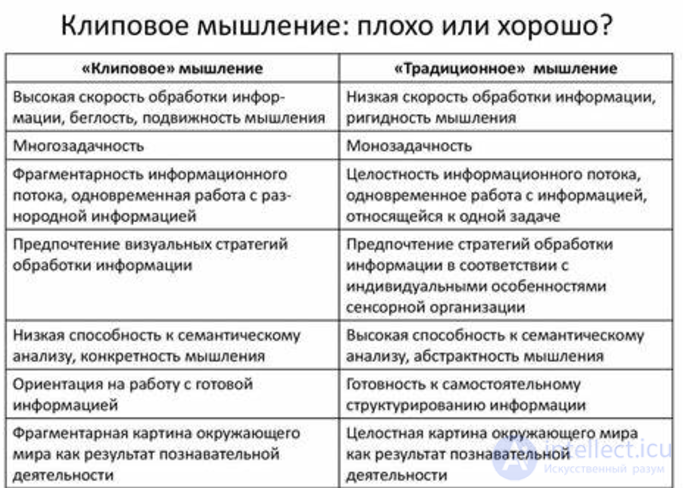
Clip thinking — is an acquired trait that forms on the basis of changing living conditions and the pace of life — a perception of the world through short, vivid images, while being unable to concentrate on information and unable to analyze it. Clip thinking is a modern phenomenon characterized by fragmentary, superficial perception of information, which emerged in the era of digital technology and mass communications. The term "clip thinking" comes from the word "clip," which denotes a short, often bright and dynamic video message that grabs the viewer's attention for a brief period of time.
Modern social networks, TV series, films, and cartoons are created for the clip-oriented consumer. Scenes in them come in small blocks, often replacing one another with no logical connection. News feeds and the press are filled with short texts in which authors merely outline the contours of problems. YouTube and television present news items that are unrelated to one another, followed by ads whose clips also have nothing to do with each other. As a result, a person moves on to consuming another topic without having made sense of the first.
The world of a person with clip thinking turns into a kaleidoscope of disjointed facts and fragments of information. The person becomes accustomed to a constant change of messages and demands new ones. There is a growing desire to seek out catchy headlines and viral videos, to listen to new music, to "chat," to edit photos, and so on.
Fragmentary perception: People with clip thinking tend to perceive information as short, unconnected fragments. This is expressed in a preference for short news items, social media posts, and clips rather than long articles, books, or lectures.
Rapid shifts in attention: Clip thinkers often switch from one source of information to another without lingering long on any one piece of material. This leads to a superficial absorption of knowledge and an inability to analyze the information received in depth.
Predominance of visual information: Clip thinkers prefer visual formats – video, images, infographics – which reflects the abundance of such content on the Internet and social media.
Multitasking: Often accompanied by attempts to process several sources of information simultaneously, which reduces concentration and the quality of perception.
The development of digital technology: Constant access to the Internet, smartphones, and social networks has led to an increase in the volume and speed of incoming information, which contributes to the development of clip thinking.
Information overload: Modern society faces enormous volumes of information, which requires rapid processing and leads to fragmentary perception.
Changes in educational methods: Modern teaching methods increasingly include visual and interactive formats, which also contributes to the development of clip thinking.
SIGNS OF CLIP THINKING
If a person has the ENTIRE set of signs listed below, then it can be said that clip-based thought predominates in their consciousness and they are no longer capable of thinking and analyzing deeply. The presence of just one such sign does not yet indicate this. Therefore, we conducted a small cluster analysis, singling out one category for a "benefit-harm" analysis of clip thinking. Accordingly, "benefits" include positive features that are useful to a person, while the "harm" category includes the undesirable effects of clip-based consciousness. So, grouped by cluster, here is the set of distinctive features of clip (truncated) consciousness (which are also its negative sides):
Decline in depth of knowledge: Fragmentary perception of information hinders the deep absorption of knowledge and critical thinking.
Decline in concentration and attention: Constant switching between sources of information makes it difficult to carry out lengthy tasks and to engage in focused work.
Increased vulnerability to manipulation: Superficial perception of information makes people more susceptible to fake news and manipulation.
Special training programs are conducted to eliminate the shortcomings of clip thinking.
Time planning: Setting clear time limits for working with information and for rest helps increase concentration and the depth of knowledge absorption.
Developing critical thinking skills: The ability to analyze and critically evaluate information promotes a more conscious perception.
Reading long texts: Regularly reading books, articles, and scholarly works helps develop the capacity for deep analysis and concentration.
Examples
Critical thinking is thinking characterized by self-improvement: this type of thinking is scientific in its very essence. It is precisely scientific thinking, constantly improving itself, that drives scientific-technological and social progress. Confirmation of this can be found in the decision of the 2016 Davos Forum, which determined that critical thinking would become one of the most necessary skills for a successful future.
Pedagogical activity is ultimately aimed at building an ideal society, and in this sense, even a single school class taught the fundamentals of critical thinking is a step toward achieving greater goals.
In conclusion, clip thinking is a reflection of the modern information environment and digital technology. To preserve and develop the skills of deep analysis and critical thinking, it is important to approach the consumption of information consciously and to develop skills of concentration and critical perception.

Comments