
Lecture
Information metabolism, sometimes called energy-information metabolism, is a psychological theory of the interaction between biological organisms and their environment, developed by the Polish psychiatrist Antoni Kępiński.
Kępiński described his psychological theory in several books, but the most detailed account is given in his 1974 book «Melancholia» (Polish: «Melancholia»). To explain the psychological phenomena found in humans, he borrowed many concepts from the field of cybernetics, which had gained popularity in Poland at the time thanks to the work of Marian Mazur (the father of the Polish school of cybernetics). Kępiński begins by examining the most basic organisms and how they differ from non-living matter. First of all, any organism can be regarded as an autonomous but open system, separated from its environment by a boundary (skin or a cell membrane). As an open system, it is engaged in constant exchange with its surroundings. This exchange can be regarded as twofold, i.e., energetic and informational. For the purposes of analysis, energy metabolism and information metabolism can be treated as separate processes. Kępiński postulates that life is sustained if both metabolisms occur, and ceases if one of them stops.
The concept of energy metabolism is relatively easy to understand. The body's molecules are constantly being replaced. Catabolic and anabolic processes occur in cells. Information metabolism is the other side of the same process, but it concerns the structural aspect (that is, how matter and energy are organized) and how control is exercised. During energy exchange, an organism strives to maintain its characteristic order (negentropy) and projects this order onto its environment. Because of this, the order of the environment is disrupted. In contrast, non-living matter has no way to increase or even maintain its negentropy, because spontaneous natural processes are always accompanied by the generation of entropy.
A person's socionic personality type is determined through Model A, which explains how our psyche processes information. Information metabolism, broadly speaking, describes the workings of our thinking. However, for a deep understanding of the process, it is not enough simply to give it a name — it is necessary to break it down into stages and study them.
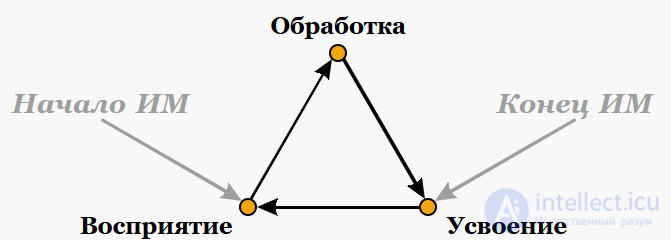
Information metabolism includes three key stages: perception, processing, and assimilation of information. First we register incoming data, then we analyze it, and after that we integrate it into the already existing picture of the world. At each stage, the socionic type actively influences the process, determining the particulars of our thinking and the way we interact with various kinds of information.
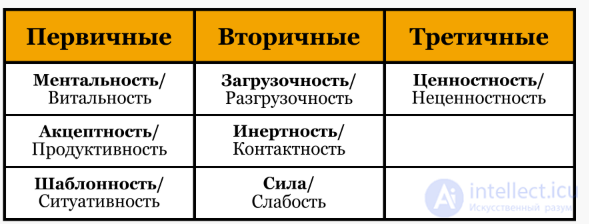
Socionics describes this process through eight functions of Model A. Each function works with a particular kind of information, perceiving, processing, and assimilating it in accordance with its own inherent characteristics. These properties are grouped by stage of working with information:
In addition, the property of «valued/unvalued» encompasses the entire thinking process as a whole, influencing our perception of information more globally.
Information metabolism can generally be regarded as an exchange of signals between an organism and its environment, but also as the processing of signals originating from the organism. These signals must be interpreted in relation to certain goals. For all organisms, these goals are based on two biological laws: the first law states that the organism must be oriented toward its own survival. The second law states that the preservation of the species is equally important. Kępiński noted that these goals are contradictory. Conflict between the two biological laws is often a source of ethical dilemmas. There are moments when an organism must sacrifice its life to save its offspring. Sometimes it is forced to fight members of its own species to defend itself. The first biological law is selfish and associated with withdrawal from reality (flight, destruction of reality, etc.). The second biological law is altruistic and requires engagement with reality (sexual reproduction requires union with a partner).
In the case of humans, the connection between the goals of various everyday actions and the two biological laws is less direct; nevertheless, these laws still motivate us. People are capable of projecting themselves into the future, of thinking abstractly and consciously, and therefore their goals may have a transcendent and symbolic character. This fact is usually expressed as belief in a higher good or an afterlife.
It is impossible to track all the information generated by the various processes taking place in reality. Since organisms strive to fulfill the two biological laws, the correct selection of signals becomes a central problem. According to Kępiński, a hierarchy of values is necessary for the integration of information. In humans, this hierarchy consists of three levels: biological, emotional, and sociocultural. The first two levels are processed subconsciously. The third level, in contrast, is associated with consciousness. From a biological standpoint, the number of processes occurring simultaneously in the organism and its physical surroundings is practically infinite. There is also an infinite number of ways in which these processes can be framed. This complexity must be reduced, since only selected signals can be received and processed by the nervous system. Moreover, signals must be ordered according to their present and future significance. The structure of the body and the arrangement of various receptors are evolutionarily adapted to ensure the isolation of the most significant signals from the environment. The internal structure of the body is regulated to ensure the proper integration of information. Of all the signals collected by the receptors, only the most important reach the level of subjective experience. At the level of signals reaching the sphere of subjective experience, attention is actively directed (with the help of emotions) toward those connected with the two biological laws. Perception is not passive and inclusive, but anticipatory and selective. Above the biological and emotional levels of signal interpretation lies the framework of the social and cultural norms of the community, which serves as a point of reference for conscious decisions. The sociocultural background plays a significant role in people's lives.
The division of information metabolism into two phases is broadly based on an analysis of the orienting reaction. Information metabolism is initiated by the perception of a change in the internal or external environment of the organism. In the first phase, the organism strives to obtain direct information about the perceived phenomenon. Because of this, it must direct its attention «outward» toward reality. The perceived phenomenon is then subconsciously evaluated. The result of this evaluation manifests as an emotion. The sign of the emotion evoked can be positive or negative. This emotion, arising quickly and automatically, serves as the backdrop for the second phase of information metabolism.
In the second phase, the organism performs a locomotor response to the phenomenon. Movement toward the source of the stimulus is carried out if the stimulus signifies a positive opportunity. If the stimulus was evaluated negatively in the first phase, then the response performed is likely to take the form of flight, fight, or immobilization. In the second phase, the organism is mainly occupied with its own actions. It observes their effect and makes adjustments (which forms a feedback loop). Despite the feedback, its connection to reality is less intense than during the first phase. Detachment from reality in the second phase of information metabolism is greater in more complex animals and reaches its maximum in humans.
The term functional structure was used by Kępiński to denote two phenomena. First, this term was used to denote an organism's response to a stimulus. Second, it denoted the model of reality generated in consciousness during the second phase of information metabolism. In the case of humans, the number of possible functional structures associated with the first phase of information metabolism is limited. These include, for example, endocrine responses of the autonomic nervous system and basic locomotor patterns.
The range and complexity of the functional structures generated in the second phase are much broader. Humans have the ability to generate many possible models of reality in response to a newly perceived phenomenon. Functional structures can be relatively complex. They include predictions about the behavior of objects in the environment, as well as a planned sequence of actions by the individual. Usually, several functional structures are generated in the second phase of information metabolism, but only one is embodied (executed). Those that were generated but rejected gradually fall into the unconscious and form a Jungian shadow. If a particular structure is embodied, the probability of its being selected in the future increases. Forgotten structures may surface at the least expected moment. Such a situation is known as possession by the Shadow. Kępiński mentioned that the embodied response is a signal for other organisms. It always takes the form of movement (or its absence). In the case of humans, this can be speech (according to Kępiński, speech is the highest form of movement).
Emotional coloring manifests itself in the first phase of information metabolism. It denotes the organism's general attitude toward the stimulus. This attitude can be either positive or negative. It depends on the nature of the stimulus and on the physical state of the organism at the moment of perception. The individual has very little conscious control over the feeling that arises. It is selected at lower levels of neurophysiological functioning. The choice of attitude in the first phase (positive or negative) constrains the character of the functional structures generated in the second phase. Although there are usually many possible ways of responding, they are limited by the emotional background that appears in the first phase.
Reality is not static but constantly evolving, although some patterns and laws can be identified. In this connection, the effort involved in organizing the world according to our own needs continues throughout life. It cannot be stopped, because of the second law of thermodynamics. To reduce its own entropy and the entropy of its immediate surroundings, an organism must expend energy. This is subjectively experienced as a feeling of difficulty, effort, or burden. Integrative effort is inherent to life. This effort is rewarded with a positive emotional state – a feeling of satisfaction associated with overcoming obstacles and progressing toward important goals. In contrast, negative feelings such as anxiety or fear signify danger. In the case of anxiety, this danger is generally distant in time and space and not precisely known. Fear, on the other hand, signifies a close and definite threat to the integrity of the organism.
In healthy people, the balance between negative and positive emotions tips toward the positive. They participate more readily in the exchange of information with the environment and carry out tasks involving integrative effort. In contrast, depressed patients withdraw from reality, which reduces their rate of information metabolism. In many cases, a predisposition to depression is caused by the absence of a warm and friendly maternal environment in childhood. The presence of a friendly and safe maternal environment in childhood is crucial for developing a generally positive attitude toward the environment. If the childhood environment is hostile, then the attitude of withdrawal is reinforced and becomes automatic.
Life can be viewed as a conflict between two orders – the order of the individual and the order of the environment. As a process placed between these two orders, information metabolism becomes an instrument for establishing the correct balance of power («I am in control» versus «I am being controlled»). In pathological cases, an individual may strive to achieve absolute control over their environment or, conversely, complete submission to some external force (e.g., their partner, a political group, etc.). The need for absolute control cannot be satisfied, so it often takes the form of a fantasy that sometimes becomes indistinguishable from reality (e.g., in schizophrenia). Many people submit to revolutionary movements promising a utopian future, and to social ideologies that offer simple answers to complex life problems. They give up their individual responsibility in order to find relief from the burdens of life. In his reflections on information metabolism, Kępiński attempted to explain the psychological mechanisms that made the atrocities of the Second World War possible.
It is traditionally assumed that the functional structures associated with the subjective experience of emotions and moods (the first phase of information metabolism) are controlled by phylogenetically older parts of the brain (the diencephalon and the rhinencephalon), whereas those generated in the second phase of information metabolism and subjectively perceived as thoughts are associated with the neocortex.
The mathematical character of information metabolism is twofold. Receptors, acting as inputs for metabolized signals, function similarly to analog electronic devices. Signal processing in the rest of the nervous system is binary (a neuron's response can be one of two states: zero – no response, or 1 – when an action potential is fired). Because of these characteristics, organisms can be considered analogous to digital systems.
Kępiński's books are considered classics of Polish psychiatric and philosophical literature. Because of the interest in his work, his most important books have been reprinted several times (most recently in 2012–2015 by Wydawnictwo Literackie). Kępiński's work has been assessed by reviewers as insightful, comprehensive, and unique. Nevertheless, his concept of information metabolism has been criticized as controversial by some scholars. The controversy has been related to the fact that some elements of the theory cannot be verified by the scientific method, since it is difficult to design appropriate experiments. In response to these objections, psychiatrist Jacek Bomba pointed out that information metabolism was never intended as a scientific theory, but rather as an anthropological model that precisely integrates the findings of neurophysiology, psychology, the social sciences, and medicine.
Philosopher Jakub Zawiła-Niedźwiecki noted that a contemporary reading of Kępiński must correct his work, which is largely pre-scientific and predates the era of evidence-based medicine, contemporary philosophy of mind, and cognitive psychology. He listed two of Kępiński's propositions that are now considered incorrect, namely the proposition that information metabolism has its own control center (the homunculus argument) and the view that the brain is used only to 30% of its capacity. Nevertheless, as Zawiła-Niedźwiecki noted, these concepts were not central to Kępiński's theory and can be safely rejected. He also recalled that Kępiński was skeptical of methods lacking a solid scientific foundation, such as psychoanalysis, and rejected magical thinking in general.
During his lifetime, Kępiński mentioned that his model of information metabolism was not complete. Work on it was interrupted by his illness and death. Some researchers have taken up his work and developed their own theories based on it. Kokoszka used the concept of information metabolism as the basis of his model of states of consciousness. Struzik suggested that the theory of information metabolism could be used as an extension of Brillouin's negentropy principle of information.
Building on Kępiński's writings and Jungian typology, the Lithuanian economist Augustinavičiūtė proposed her own pseudoscientific theory of information metabolism in the human mind and society, known as socionics.

Comments