
Lecture
Political psychology — an interdisciplinary science at the intersection of psychology, political science, and sociology. The main task of political psychology − is to study the regularities of political behavior and consciousness. The subject of political psychology's study is the psychological components of human political behavior, relating to issues of both foreign policy (war, terrorism, political decisions, ethnic conflicts, perception of negotiating partners) and domestic policy (political participation, discrimination against minorities, the formation of political orientations), the study of which allows psychological knowledge to be applied to explaining politics. The methods used in political psychology are oriented predominantly toward the analysis of individual behavior (content analysis, interviews, focus groups, tests, expert assessments).
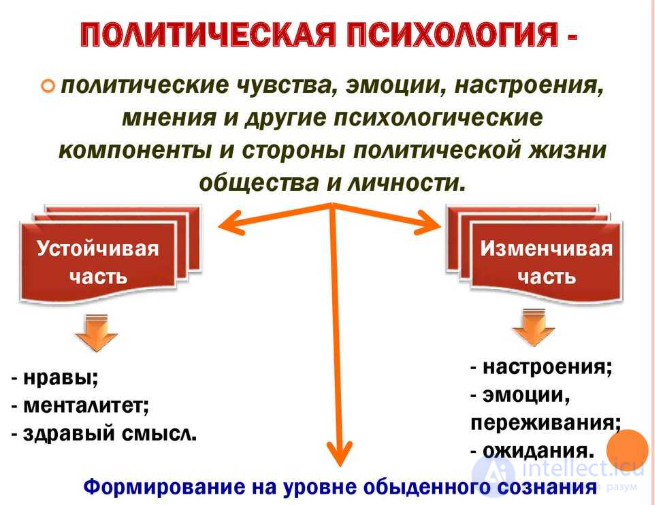
Political psychology was recognized as a promising field of research in world political science almost immediately. Even in domestic literature, despite ideological taboos, the first developments appeared as early as the years of the Khrushchev «Thaw» (the second half of the 1950s), although its official recognition as a component of political science took place only in the 1990s — the years of perestroika.
Political science showed comprehensive interest above all in developing problems connected with the subjective side of the political process and directly related to the field of political psychology: the values of political cultures, the moods and expectations of voters, the psychological features of political leadership and elites, the characteristics of the national character of various peoples and ethnic groups, the causes of the emergence and resolution of political conflicts, the formation of the image of political figures, and others.
Political psychology arose in Western Europe, in France, where it was closely linked to the emergence of new disciplines and paradigms, as well as to the precise social and political context in various countries. The discipline of political psychology was officially introduced during the Franco-Prussian War and the socialist revolution caused by the rise of the Paris Commune (1871). The term political psychology was first introduced by the ethnologist Adolf Bastian in his book «Man in History» (1860). The philosopher Hippolyte Taine (1828–1893), founder of the School of Free Political Sciences, applied Bastian's theories in his works «The Origins of Contemporary France» (1875–1893) to ideas about the founding and development of the Third Republic. The head of the School of Free Political Sciences, Émile Boutmy (1835–1906), was a well-known researcher of the social, political, and geographical concepts of national interactions. He contributed to various works on political psychology, such as «The English People: A Study of Their Political Psychology» (1901) and «The Americans; Elements of Their Political Psychology» (1902). [5] The author of crowd theory, Gustave Le Bon (1841–1931), proposed that the activity of the crowd suppresses the will and pollutes rational thought, leading to uncontrolled impulses and emotions. He suggested in his works «The Psychology of Socialism» (1896) and «Political Psychology and Social Defense» (1910) that in an uncontrolled crowd state, people are more vulnerable to submission and leadership, and suggested that the adoption of nationalism would correct this.
Meanwhile in Italy, the Risorgimento (1870) provoked various social reforms and electoral rights. The great division into social classes during this period prompted the jurist Gaetano Mosca (1858–1914) to publish his work «The Ruling Class: Elements of Political Science» (1896), in which he theorized the existence of ruling and governed classes in all societies. Vilfredo Pareto (1828–1923), inspired by Mosca's concepts, contributed to the discipline of political psychology in the works «The Rise and Fall of Elites» (1901) and «The Socialist Systems» (1902–1903), theorizing about the role of classes and social systems. His work «Mind and Society» (1916) offers a sociological treatise.] The texts of Mosca and Pareto on the Italian elite contributed to the theories of Robert Michels (1875–1936). Michels was a German socialist fascinated by the difference between the parliament, largely governed by the lower class in Germany, and the parliament governed by the upper class in Italy. He wrote «Political Parties: A Sociological Study of the Oligarchical Tendencies of Modern Democracy» (1911).
A major psychoanalytic influence on the discipline of political psychology was exerted by Sigmund Freud (1856–1939). His texts «Totem and Taboo» (1913) and «Group Psychology and the Analysis of the Ego» (1921) linked psychoanalysis to politics. Freud and Bullitt (1967) developed the first psychobiographical explanation of how the personality characteristics of US President Woodrow Wilson influenced his decision-making during the First World War. Wilhelm Reich (1897–1957), inspired by the consequences of the Second World War, was interested in whether personality types differ depending on era, culture, and class. He described the bidirectional influence of the group, society, and environment on personality. He combined Freudian and Marxist theories in his book «The Mass Psychology of Fascism» (1933). He also edited the «Journal of Political Psychology and Sexual Economy» (1934–1938), which was the first journal to present political psychology in a Western language. [9]
In Germany, the political changes brought by newcomers and fascist control during the Second World War spurred research on authoritarianism by the Frankfurt School. The philosopher Herbert Marcuse (1898–1979) raised questions concerning freedom and power in his book «Reason and Revolution: Hegel and the Rise of Social Theory» (1941), where he proposed that groups compromise on individual rights. Theodor W. Adorno (1903–1969) also studied authoritarian personalities and antisemitism. His report «The Authoritarian Personality» (1950) attempts to define a personality type susceptible to following fascism and antidemocratic propaganda. The Nazi movements during the Second World War also prompted controversial psychologists such as Walter Poppelreuter (1932) to lecture and write about political psychology that identified itself with Hitler. The psychologist Erich Jaensch (1883–1940) contributed to the racist book «The Antitype» (1933).
At the turn of the century, Oxford University and Cambridge University introduced disciplinary courses in political psychology, such as «Human Sciences», and also founded the Psychological Society (1901) and the Sociological Society (1904). The Oxford historian G. P. Gooch (1861–1948) marked out political psychology (1917) as a subdiscipline of history. Motivated by social and political behavior during the First World War, he considered the new branch of historical science to be «the psychology of people acting in masses». He referred to the science as a means of clarifying erroneous beliefs about intention. The intellectual Graham Wallas (1859–1932) implied the importance of studying psychology in politics in his work «Human Nature in Politics» (1908). Wallas emphasized the importance of educating politicians and the public about psychological processes in order to raise awareness of exploitation, while at the same time developing control over one's own psychological intellect. In his work «The Great Society» (1917) he suggested that recognizing such processes could help create a more functional humanity.
Across the Atlantic, the first American to be considered a political psychologist was Harold Lasswell (1902–1978), whose research was likewise stimulated by sociological fascination with the First World War. His work «Propaganda Technique in the World War» (1927) discussed the use of psychological theories to improve propaganda technique. Soon after, Lasswell moved to Europe, where he began linking the personality theories of Freud and Adler to politics and published «Psychopathology and Politics» (1930). His main theories concerned the motives of politically active people and the connection between propaganda and personality.
Another factor contributing to the development of political psychology was the introduction of psychometrics and «Attitude Measurement» by Thurstone and Chave (1929). The methodological revolution in the social sciences gave quantitative grounds and, consequently, greater credibility to political psychology. Research on political preferences during campaigns was spurred on by George Gallup (1901–1984), who founded the «American Institute of Public Opinion». The elections of the 1940s in America attracted great attention in connection with the start of the Second World War. Gallup, Roper, and Crossley initiated studies of Roosevelt's chances of re-election. Lazarsfeld, Berelson, and Gaudet (1944) also conducted the well-known panel study «The People's Choice» on the election campaign of the 1940s. These studies drew attention to the possibility of measuring political methods using psychological theories. The US entry into the Second World War spurred extensive research in areas such as military technology, propaganda, group morale, psychobiography, and cultural conflict, to name just a few, with the US Army and Navy recruiting young psychologists. Thus, the discipline developed rapidly and gained international accreditation.
Hadley Cantril and L. A. Free founded the Institute for International Social Research in order to concentrate «attention primarily on the psychological changes that affect political behavior in ways that have a substantial impact on international relations». They studied «governments and why, from the point of view of psychological variables, they behave the way they do, rather than otherwise, with respect to international problems».
McGuire identifies three main stages in the development of political psychology. These three stages are: (1) The era of personality research in the 1940s and 1950s, dominated by psychoanalysis. (2) The era of political attitudes and voting-behavior research in the 1960s and 1970s, characterized by the popularity of assumptions about «rational man». (3) The era from the 1980s and 1990s, which focused on political beliefs, information processing, and decision-making, and dealt in particular with international politics.
The founder of the Petersburg school of political psychology was Alexander Yuriev, professor of the Department of Political Psychology at St. Petersburg State University. The department was founded on September 25, 1989.
The emergence of any academic department is a product of the needs of the time, shaped by political decisions. The emergence of political psychology was brought about by the perestroika begun by Mikhail Gorbachev in 1985. Perestroika created the conditions for the psychological study of political man, which had been cut short with V.M. Bekhterev. Just as cosmonautics significantly influenced the development of [engineering psychology], so perestroika provoked a demand for research into the psychological foundations of the political events taking place. Many psychologists became interested in these questions and discussed them in private conversations. The content of such conversations became known to the leadership of the Leningrad Regional Committee of the CPSU. As a result, Alexander Yuriev was invited to the Smolny for an explanation, which resulted in a proposal to conduct a psychological study of the personnel reserve of the Leningrad Regional Committee of the CPSU, consisting of thousands of future politicians, by analogy with the psychological studies of cosmonaut candidates.
To carry out this work, a student research detachment (SND) was formed, as an analogue of the student construction detachment (SCD). Psychological methods were adapted for this purpose. During the summer of 1985, young people from the personnel reserve of the Leningrad Regional Committee of the CPSU underwent psychological testing. In addition to testing, practical sessions were held at the base of the boarding house of the Vyborg Shipbuilding Plant. By autumn this work was completed and handed over to the secretary of the Vyborg City Committee of the CPSU, V.A. Shlyakhtov. Psychological-political profiles for each of the thousand candidates surveyed for promotion were submitted. Moreover, each profile was encoded in accordance with the psychologist's Code of Ethics, so the documents were accompanied by a cipher notebook that had to be kept separately.
The creation of the theoretical and methodological basis of political psychology continued after another invitation of Alexander Yuriev to the Smolny, to the first secretary of the Regional Committee of the CPSU, Yu.F. Solovyov. Alexander Yuriev reported his opinion on the prospects of the political situation in the country from a psychological point of view: according to psychological-political forecasts, the days of the existence of the CPSU and the USSR were limited to 1990. Solovyov demanded scientific proof of these forecasts. It was this meeting, in Alexander Yuriev's opinion, that marked the beginning of the legalization of domestic political psychology.
The Regional Committee of the CPSU allowed the creation of a working group at the Higher Party School in the Tauride Palace to develop entirely new programs for working with political cadres. The group was headed by V.V. Tsalobanov, head of the Department of Party Construction of the Higher Party School.
The future faculty of the Department of Political Psychology chose as its theoretical and methodological foundation the developments of V.M. Bekhterev, set out in "Collective Reflexology" and his other works, the interdisciplinary approach to the study of the human psyche of B.G. Ananyev, the systemic descriptions in psychology proposed by V.A. Ganzen, and the analysis of the psychology of activity by G.V. Sukhodolsky.
The Leningrad school of political psychology was based on the theoretical foundations of its founder – academician B.G. Ananyev – and the development of his ideas in the works of Professor V.A. Ganzen, the work of Boris Gerasimovich, «Essays on Psychology», published in 1945 in Leningrad, and the monograph by Vladimir Alexandrovich, «A Systemic Description of Psychology», published almost 30 years later (1984), the work of G. Tarde ("The Crimes of the Crowd", 1903), V.K. Sluchevsky ("The Crowd and Its Psychology", 1893), I.I. Dobrovolsky's "The Psychology of the Criminal Crowd" (1894); as early as 1893 the works of S. Sighele's "The Criminal Crowd", G. Le Bon's "The Psychology of Peoples and Crowds", and others were translated into Russian.
The classical human being, as understood in the Leningrad school of psychology, had to be regarded as [«political man»]. At the time we were unaware that the concept of «political man» had already been introduced in foreign psychology by S. Lipset (Lipset S. Political Man. The Social Bases of Politics. The Johns Hopkins Univ. Press, 1959/1988; Political Man: The Social Bases of Politics. Garden City, NY: Doubleday, 1960).
The core idea of political psychology was to replace the concept of «development» with the concept of «change». Change was understood as globalization, which the USSR could neither control, nor manage, nor forecast. By calculation, the USSR had already been out of the world political process for some 15 years and could take its place in world politics at the cost of enormous losses, to which it was necessary to psychologically adapt the country, and its leaders first of all.
An account of how politics influences a person was consistently presented in the monographs of A.I. Yuriev, "Introduction to Political Psychology" (Leningrad, 1992), «A Systemic Description of Political Psychology» (St. Petersburg, 1997), and in the collective monograph of the department's staff edited by A.I. Yuriev, «The Strategic Psychology of Globalization: The Psychology of Human Capital» (St. Petersburg, 2006).
The proposal of the Leningrad Regional Committee of the CPSU to carry out psychological-political retraining of party cadres for the global changes in the country and in the world took shape as the creation of an «informal party school» outside the walls of the Higher Party School, at the regional committee's boarding house «Dyuny» near Sestroretsk in 1987. There was no prior experience of such work. The most acute issue was finding staff who understood the essence of the matter and were capable of working practically around the clock toward a very concrete result – modifying the political behavior of the trainees.
The methodology of work at the school of political psychology in «Dyuny», and later in the training of future Presidential Representatives, candidates for governor of the Russian Federation, and other trainees, consisted in replacing their «psychological defense mechanisms» with «psychological mechanisms of political action». The «mechanisms of action» being formed were aimed at effective, rational behavior under conditions of global change in the country. It was necessary to exclude reactions of stress, stupor, and manifestations of hysteria or neurosis in response to innovations of any kind. For this purpose, preliminary fundamental psychological testing was carried out (M.A. Konovalova), medical examinations, observation of trainees in the course of training (E.V. Koblyanskaya, E.B. Labkovskaya, O.V. Amosenko), work in evening discussion sparring sessions (V.K. Vasilyev, T.V. Anisimova), and individual psychological counseling (M.A. Konovalova).
After the classes ended, there was a final project in the form of a public sparring discussion recorded on camera. On one side were the graduates of the group, who had been trained by the department's staff; on the other side were their convinced, even hate-filled political opponents from rallies near the Kirov Stadium, the «Lokomotiv» stadium, the Mikhailovsky Garden, the Rumyantsev obelisk, and so on.
The practical value of this work manifested itself at the most difficult moments for the city: during the bloody days of 1991 and 1993 in Moscow, not a single drop of blood was shed in Leningrad: those who made the decisions had known, long before the coup, what would happen to them and to the country, and how it would happen. Political psychology confirmed its right to strategic forecasting without knowledge of any operational or stolen information.
Only after nine years of practical work, once the real benefit of political psychology had been demonstrated in practice, did the question arise of creating a Department of Political Psychology at Leningrad State University. This required obtaining permission from the Planning Commission of the Leningrad City Executive Committee to introduce staff positions for lecturers and researchers for the new department. Yu.F. Solovyov, G.I. Barinova (head of the propaganda department), and Yu.A. Denisov (secretary of the Leningrad Regional Committee of the CPSU for ideology) helped with this.
Within the university, the creation of the Department of Political Psychology was supported by the rector of Leningrad State University, S.P. Merkuriev, and later by his successor, L.A. Verbitskaya. Then correspondence began between the leadership of the Ministry of Higher Education of the RSFSR and Leningrad State University, and only after that was permitting documentation obtained from the Ministry of Higher Education of the Russian Federation. On the basis of these documents, the university's leadership made the decision to organize the department and laboratory of «political psychology». And only once this path had been completed was the specialization «political psychology» opened at the Faculty of Psychology of Leningrad University on September 25, 1989 (minutes No. 7 of the meeting of the Academic Council of Leningrad State University «on the organization of the department and laboratory of ‘political psychology’», signed by S.P. Merkuriev and V.A. Zubkov).
After the opening of the Department of Political Psychology at Leningrad State University, the research team received an invitation to the World Congress of Political Psychologists (ISPP) in the USA in July 1990. The reports of domestic psychologists were translated by Ernest Borisovich Shiryaev. He later became a member of the Department of Political Psychology at George Washington University and now heads The Center for Global Studies (CGS) at George Mason University (was founded to promote multidisciplinary research on globalization and international affairs).
After participating in the congress of political psychologists, it became clear to us that without a careful study of how things were organized at American universities, the teaching of political psychology could not be properly established. Therefore all the department's lecturers were sent for an internship in the USA at Hofstra University, which was the department's scientific partner.
At Hofstra, the lecturers mastered the computer (we had almost none at the time), their technology of experimental research, and the forms and procedures of teaching that had not been adopted in Russia.
With the help of the dean of the psychology faculty of Hofstra University, Professor Howard Kassinove, the entire bibliography on political psychology was found in the university library and printed out, and photocopies were made of key textbooks on political psychology in English.
Later, Alexander Yuriev, as a consultant to the head of the Government of the Russian Federation, and M.A. Konovalova took part in another international conference of political psychologists in Spain, in the city of Santiago de Compostela. Along with them, two more consultants of V.S. Chernomyrdin were sent to the congress, who were very surprised by what they saw and heard. For example, a report by Professor Betty Glad confirmed assumptions about the direct participation of American political psychologists in developing US political strategy, including strategy toward Russia.
The reports of the staff of the Department of Political Psychology of Leningrad State University at ISPP conferences (Washington, 1990; Santiago de Compostela, 1995; Washington, 1993, and others) were accepted by the international community of political psychologists, and the teaching and research plans of the Department of Political Psychology were approved by the Academic Council of the Faculty of Psychology. Thus domestic specialists in political psychology were accepted into a professional community that was new for them.
The department was created in 2000 in the political science division of the Faculty of Philosophy of Lomonosov Moscow State University. In 2008, the department became part of the Faculty of Political Science and was renamed the Department of Sociology and Psychology of Politics. In 2008, the educational program «Political Communication Studies» was opened on the basis of the department. Throughout its entire period of work, the department has been headed by Elena Borisovna Shestopal, Doctor of Philosophical Sciences, Professor.
The department was created under the leadership of Professor Anatoly Derkach.
Fundamental and systematic theoretical developments in the psychology of politics began in the 1960s in the USA under the influence of the «behavioral movement». At that time, a group was created at the American Psychiatric Association to study problems of international politics, which was transformed in 1970 into the Institute of Psychiatry and Foreign Policy. In 1968, a Research Committee in Political Psychology was founded within the American Political Science Association, on the basis of which the International Society of Political Psychology (ISPP) was organized in 1979, having already acquired international status (International Society of Political Psychology, ISPP, archived copy from January 12, 2013, on the Wayback Machine). This Society publishes its journal, Political Psychology. At present, publications devoted to political-psychological topics appear in all the most prestigious journals on political science and psychology. ISPP now has more than 1,000 members from practically every continent; annual meetings are held that examine the most pressing theoretical problems — such as, for example, «Psychological Aspects of the Politics of Change» and «Nation-Building and Democracy in Multicultural Societies». In 1999, the annual meeting, convened in Amsterdam, was devoted to the theme «Global or Local Century? Conflict, Communication, Citizenship», and in 2001 the annual meeting, held in Cuernavaca (Mexico), was devoted to the theme «The Language of Politics, the Language of Citizenship, the Language of Culture». In 2002, the theme of the annual meeting was «Language and Politics». Although political psychology has gained genuine international recognition, the majority of researchers still live and work in the USA or Canada. Let us name just a few of the major scholars, such as M. Hermann, R. Sigel, D. Sears, S. Renshon, F. Greenstein, A. George, R. Tucker, J. Post, B. Glad, R. Christie, S. McFarland, K. Monroe, and others.
Today in Russia, dozens of researchers are conducting both fundamental and applied research, engaging simultaneously in analytical and consulting work. These specialists are especially in demand during elections, during which they are able to calculate the situation not by eye but using specialized scientific instruments. Special scientific units in the field of political psychology have been created in Moscow and St. Petersburg. The Department of Political Psychology at the Faculty of Psychology of St. Petersburg University marked its tenth anniversary in 1999. In 2000, a Department of Political Psychology opened in the political science division at Lomonosov Moscow State University. Lecture courses are taught at many domestic universities. The first textbooks on political psychology have been published. In 1993, the Russian Association of Political Psychologists was created, which is a collective member of ISPP. The subject «political psychology» is now included in the state standard for training political scientists. In this specialty, the Higher Attestation Commission awards academic degrees in two sciences: psychology and political science. Thus, it can be said that this discipline has gained institutional recognition and is gradually completing the initial stage of its formation.
The study of personality in political psychology focuses on the influence of a leader's personality on decision-making and the consequences of mass personality for the boundaries of leadership. The main approaches to personality used in political psychology are psychoanalytic theories, trait-based theories, and motive-based theories.
Sigmund Freud (1856–1939) made a significant contribution to the study of personality in political psychology through his theories of the unconscious motives of behavior. Freud suggested that a leader's behavior and decision-making ability are largely determined by the interaction within his personality of the id, ego, and superego, as well as by his control over the pleasure principle and the reality principle. The psychoanalytic approach has also been widely used in psychobiographies of political leaders. Psychobiographies draw conclusions from personal, social, and political development, beginning in childhood, in order to understand behavior patterns that can be used to predict motives and decision-making strategies.
Traits are personality characteristics that display stability over time and across different situations, creating predispositions to perceive and respond in a certain way. Gordon Allport (1897–1967) carried out trait research, introducing central, secondary, cardinal, and common traits. These four distinctions suggest that people display traits to varying degrees, and moreover, that there is a difference between individual and common traits that should be recognized in society. Hans Eysenck (1916–1997) contributed three basic traits. At present, however, the most widely accepted are the «Big Five» personality dimensions of Costa and McCrae (1992): neuroticism, extraversion, agreeableness, openness to experience, and conscientiousness. Theories in political psychology suggest that the combination of these traits in a person has consequences for leadership style and ability. For example, people who score high on extraversion demonstrate superior leadership skills. The Myers-Briggs Type Indicator (MBTI) is a personality assessment scale commonly used in the study of political personality and for position profiling.
From the standpoint of political psychology, motivation is regarded as goal-directed behavior driven by the need for four things: power, affiliation, intimacy, and achievement. These categories were grouped by Winter (1996) from the twenty general human goals proposed by Murray (1938). The need for power influences the style in which a leader performs. Winter and Stewart (1977) suggested that leaders with high power motivation and low affiliation-intimacy motivation needs become the best presidents. Leaders motivated by affiliation, in turn, tend to cooperate for joint efforts in the absence of a threat. Finally, achievement motivation has demonstrated an inconsistency with political success, especially if it is higher than power motivation (Winter, 2002). The motivation between a leader and those he governs must be aligned for success. It has been shown that motives correlate more with the situation and the time since the last goal was achieved than with stable character traits. The Thematic Apperception Test (TAT) is commonly used to assess motives. However, in the case of assessing leadership, this test is harder to implement, so more applicable tests, such as content analysis of speeches and interviews, are often used instead.
The authoritarian personality is a syndrome theory developed by researchers Adorno, Frenkel-Brunswik, Levinson, and Sanford (1950) at the University of California. The American Jewish Committee subsidized research and publications on this theory, since it revolved around ideas developed during the events of the Second World War. Adorno (1950) explained the authoritarian personality type from a psychoanalytic point of view, suggesting that it is the result of a strictly controlled and traditional upbringing. Adorno (1950) explained that people with an authoritarian personality type were behind in developing the ability to control the sexual and aggressive impulses of the Id. This led to fear of them and, thus, to the development of defense mechanisms to avoid confronting them. Authoritarian personality types are people described as oscillating between dependence on authority and simultaneously rejecting it. It has been suggested that the syndrome encompasses nine characteristics: conventionalism, authoritarian submission, authoritarian aggression, anti-intraception (opposition to subjective or imaginative tendencies), superstition and stereotypy, power and toughness, destructiveness and cynicism, sexual preoccupation, and projectivity. The authoritarian personality type is proposed to be viewed as: ethnocentric, ego-defensive, mentally rigid, conformist and conventional, hostile to anything unusual, and holding conservative political views. The book «The Authoritarian Personality» (1950) introduces several scales based on various authoritarian personality types. These are: the F-scale, which measures where and to what degree fascist attitudes develop, an antisemitism scale, an ethnocentrism scale, and a political-economic conservatism scale. However, the F-scale is the only scale expected to measure implicit authoritarian personality tendencies.
Bob Altemeyer (1996) deconstructed the authoritarian personality using trait analysis. He developed the Right-Wing Authoritarianism (RWA) scale, based on the traits of authoritarian submission, authoritarian aggression, and conventionalism. Altemeyer (1996) suggested that those who scored high on the F-scale have a low capacity for critical thinking and are therefore less able to contradict authority. Altemeyer's theories also include a psychodynamic perspective, suggesting that authoritarian personality types were taught by their parents to believe that the world is a dangerous place, and that therefore their impulses lead them to make impulsive, emotional, and irrational decisions. It is suggested that the beliefs and behavior of the authoritarian person are easily manipulated by authority rather than being based on internal values. Altemeyer also suggested that leaders with an authoritarian personality type are more prone to the fundamental attribution error. Many weaknesses are associated with this syndrome and the F-scale. It was perhaps more relevant in the period when it was created, shortly after the Second World War. The authoritarian personality tends to be associated with the image of fascism; however, it has been proposed for use in explaining the behavior of people across all political ideologies.
Trait-based frameworks, aside from the Freudian approach, were proposed by James Barber (1930–2004) in his work «The Presidential Character» (1972), which emphasized the importance of psychobiography in the analysis of political personality. Barber suggested that a leader's personality includes three dimensions: «character», «worldview», and «style». Barber also suggested that leadership typology follows a pattern originating from a person's first political success, and that it includes two variables: the effort the leader puts in and the personal satisfaction the leader derives. This typology is fairly limited in its dimensions.
Etheredge (1978) suggested the importance of the traits «dominance», «interpersonal trust», «self-esteem», and «introversion-extraversion» for views on leadership and policy formation. In the course of research on leaders in the Soviet Union, Etheredge found that those who scored high on dominance were more likely to support the use of force in dispute settlement. He found that the trait of introversion could lead to a lack of cooperation, while extraversion usually led to cooperation and negotiation. He further suggested that interpersonal trust and self-esteem were closely related to non-compliance with demands backed by force.
Margaret Hermann (1976) presented the Leadership Trait Analysis (LTA) and advocated for the development of Profiler-Plus. Profiler-Plus is a computerized system used to code spontaneous interview responses on seven core characteristics: need for power, conceptual complexity, emphasis on interpersonal relations, self-confidence, locus of control, distrust of others, and ethnocentrism. This method can profile large bodies of text related to leadership while removing any subjective bias from the content analysis. It is efficient and has high reliability. Hermann and Preston (1994) proposed 5 different leadership-style variables: their involvement in policy formulation, their willingness to tolerate conflict, the level and reasons for their motivation, their information-management strategies, and their conflict-resolution strategies.
An alternative approach is the operational code method, introduced by Nathan Leites (1951) and restructured by Alexander George (1979). The code is based on five philosophical beliefs and five instrumental beliefs. The Verbs in Context System (VICS), used through the Profiler-Plus computer program, again allows for subjective analysis of significant volumes of written and spoken speech, interviews, and essays. The method attempts to predict behavior by applying knowledge of various beliefs.
Although political behavior is governed by and represented through the leader, the leader's subsequent influence largely depends on the context in which they find themselves and the political climate in which they operate. For this reason, group behavior also plays an important role in understanding the socio-political environment.
Group behavior is key to the structure, stability, popularity, and ability of political parties to make successful decisions. Individual behavior deviates significantly in a group setting, so it is difficult to determine group behavior by looking solely at the individuals who make up the group. The form and stability of a group are based on several variables: size, structure, the purpose the group serves, group development, and influence on the group.
Group size has various consequences. In smaller groups, people are more committed (Patterson and Schaeffer, 1997), and lower turnover is observed (Widmeyer, Brawley, and Carron, 1990). Larger groups show a higher level of divergence (O'Dell, 1968) and less conformity (Olson and Caddell, 1994). Group efficiency also decreases with increasing size due to reduced coordination and free-riding. Thus, the size of a political party or nation can have indirect consequences for its ability to coordinate and progress.
Group structure changes under the influence of member diversity, which significantly affects its effectiveness. Individual diversity within a group has been found to show less communication and, consequently, increased conflict (Maznevski, 1994). This has implications for political parties based in strongly colonial or multiracial countries. Diversity of members has implications for: status, role distribution, and role strain within the group, all of which can cause disagreements. Thus, maintaining group cohesion is a key factor. Cohesion depends on several factors: the amount of time members spend in the group, the degree of liking members have for one another, the size of the reward offered by the group, the size of the external threat to the group, and the level of warmth offered by leaders. These factors should be taken into account when attempting to form an effective political group. The effectiveness of presidential decision-making, for example, depends on the degree to which members of the advisory group have hierarchical status, and on the roles assigned to each member.
Studying the purpose for which a group is formed, whether it is fulfilling a «functional» purpose or a purpose of «interpersonal attraction» (Mackie and Goethals, 1987), has implications for political popularity. People often join groups to satisfy certain survival, interpersonal, informational, and collective needs. A political party that provides stability, clear information, offers individuals power, and satisfies a sense of belonging will gain popularity. Schutz's (1958) theory, «The Fundamental Interpersonal Relations Orientation», suggests that groups satisfy the need for control, affection, and inclusion. Groups are also formed due to natural attraction. Newcomb (1960) argues that we are drawn to others who are similar in socioeconomic status, beliefs, attitudes, and appearance. Thus, similarity in certain respects may be related to how attracted a person is to joining one group as opposed to another.
Group development generally occurs in several stages: forming, storming, norming, performing, and adjourning (Tuckman, 1965). Group awareness of these stages is important so that group members recognize that a process is occurring, and that certain stages, such as storming, are part of progress and should not cause discouragement or fear of instability. Awareness of group development also allows models to be implemented for manipulating the various stages. External influences on a group will have different consequences depending on which stage the group is at in its course. This has implications for how open a group should be depending on the stage of development it is at and its strength. Consistency is also a key aspect for success within a group (Wood, 1994).
The application of conformity is key to understanding a group's influence on political behavior. Decision-making within a group depends largely on conformity. In theory, this occurs on the basis of two motives: normative social influence and informational social influence (Asch, 1955). The likelihood of conformity depends on several factors: increasing group size, but only up to a certain degree at which it plateaus, and the degree of unanimity and commitment to the group. Consequently, the degree of popularity of a political group may be influenced by its existing size and the perceived unanimity and commitment of the public's already existing members. The degree to which a group conforms overall may also depend on the degree of individuation of its members. [29] In addition, conformity within political groups may be related to the term political coalition. People represent groups as if a special category of individual existed. For example, for cognitive simplicity, ancestral groups anthropomorphize each other because they have similar thoughts, values, and historical background. Even if a group member has irrational or incorrect arguments on a political issue, there is a high probability that other group members will hold to them simply because they are in the same coalition.
Power is another influential factor within a group or between separate groups. The «bases of power» developed by French and Raven (1959) identify the following types of power as the most successful: reward power, coercive power, legitimate power, referent power, and expert power. The way power is exerted on a group can have reflective results for popularity. Referent power leads to greater popularity for a political group or leader than coercive power (Shaw and Condelli, 1986). This has implications for leaders wishing to manipulate others into identifying with them rather than imposing subsequent punishment. However, if coercive power is imposed, success and a trusted leader (Friedland, 1976) are necessary in order to prevent group conflict from escalating. [32] External punishment and reward are also thought to detract from intrinsic motivation. The group needs to promote a sense of freedom. [32]
Decision-making is an important political process that influences a country's policy course. Group decision-making is significantly influenced by three rules: «majority rule», «truth-wins rule», and «first-shift rule». Decision-making is also driven by conformity. Irrational decisions are usually made in emotionally charged periods. For example, an unpopular political party may gain more votes during a period of actual or perceived economic or political instability. However, conflicting research by George Marcus (2003) implies that a high level of anxiety may actually cause a person to analyze information more rationally and thoroughly, leading to more informed and successful decisions. [34] However, the psychology of decision-making should be analyzed according to whether it occurs in a leadership context or an intergroup context. The implementation of successful decision-making is often improved by group decision-making (Hill, 1982), especially if the decision is important to the group and when the group has been working together for an extended period of time (Watson, Michaelsen, and Sharp, 1991). However, groups can also hinder decision-making if the correct answer is unclear. Janis (1972) introduced the concept of groupthink, which posits an increased likelihood of flawed decisions being made by groups under several conditions: strong group cohesion, isolation of the group's decision from outside review, the presence of a directive leader in the group, and a high level of stress. Group polarization (Janis, 1972) suggests that group decision-making is often more extreme, regardless of whether it is riskier or more cautious. Groupthink refers to «a mode of thinking that people engage in when they are deeply involved in a cohesive group, when the members' strivings for unanimity override their motivation to realistically appraise alternative courses of action».
Methods have been proposed for establishing more effective decision-making skills in political settings. Hirt and Markman (1995) argue that including a separate person in a group to search for flaws and criticize will allow group members to establish alternative viewpoints. George (1980) proposed «multiple advocacy», whereby a neutral person analyzes the pros and cons of various advocates' proposals and thereby reaches an informed decision.
Applied psychology theories for improving the performance of political groups include the introduction of methods such as «team building», «quality circles», and autonomous work groups.
Evolutionary psychology plays an important role in understanding how the current political regime arose. It is an approach that focuses on the structure of human behavior, asserting its dependence on the social and ecological environment. Developed through natural selection, the human brain functions so as to respond adequately to the environmental challenges of coalitional conflict, using psychological mechanisms and adaptations. An example of political conflict may be state aggression, such as war. Psychological mechanisms work to process what is taken from internal and external information regarding the current habitat, and to project this into the most appropriate form of action, such as acts of aggression, seeking, dominance, submission, and so on.
To draw conclusions and predictions about behavior concerning voting decisions, certain key social influences must be taken into account. These influences include the role of emotions, political socialization, political sophistication, tolerance of diversity of political views, and the media. The influence of these factors on voter behavior is best understood through theories of attitude formation, beliefs, schemas, knowledge structures, and information-processing practices. The degree to which a voting decision depends on internal systems for processing political information versus external influences changes the quality of genuinely democratic decision-making. Perception of external events, such as terrorist attacks, government warnings, and shifts in racial demographics, can lead to shifts in political attitudes (Jost, 2017).
Some prominent scholars in this field include Dr. Chadly Daniel Stern, who currently works in the Department of Psychology at the University of Illinois at Urbana-Champaign. His research focuses on answering social-cognitive questions about how a person's political beliefs shape their perception of the world and their everyday interactions.
In 2006, scientists reported a connection between personality and the political views of left- and right-leaning Americans as follows: «Preschool children who 20 years later were relatively liberal were characterized as: developing close relationships, self-reliant, energetic, somewhat dominant, relatively undercontrolled, and resilient. Preschool children who later, at age 23, were relatively conservative were described as: feeling easily victimized, easily offended, indecisive, fearful, rigid, inhibited, and relatively overcontrolled and vulnerable».
The amount of research conducted on children and the influence of their childhood on their political views or identity is limited. However, a growing body of empirical work on children and their environment can be quite revealing regarding how their political awareness and views develop at a very early stage (Reifen-Tagar & Cimpian, 2020).
Applying psychology to understand conflict and extreme acts of violence can be understood in both individual and group terms. Political conflict is often a consequence of ethnic inequality and «ethnocentrism» (Sumner, 1906).
At the individual level, participants in conflict situations may be perpetrators, bystanders, or altruists. The behavior of perpetrators is often explained by the authoritarian personality type. Individual differences in levels of empathy have been used to explain whether a person chooses to confront authority or ignore conflict. Rotter's (1954) locus-of-control theory in personality psychology has also been used to determine individual differences in response to conflict situations.
Group behavior during conflict often influences the actions of the individual. The bystander effect, introduced by Darley and Latané (1968), shows that group behavior causes people to monitor whether others consider it necessary to respond in a situation, and thus base their own behavior on that judgment. They also found that people are more likely to diffuse responsibility in group situations. These theories can be applied to situations of conflict and genocide, in which people remove personal responsibility from themselves and thereby justify their behavior. Social identity theory explains that during the Holocaust of the Second World War, political leaders used Jews as outsiders to increase in-group cohesion. This allowed perpetrators to depersonalize the situation and diffuse their responsibility. Outside groups were kept within separate boundaries and dehumanized to help insiders distance themselves from relationships.
Research by Dan Kahan showed that people resist adopting new political views even when presented with evidence that challenges their views. The research also found that if a person was required to write a few sentences about something they had experienced, or to spend a few minutes affirming their self-worth, they were more likely to adopt a new political position.
Although somewhat unusual, evolutionary psychology can also explain conflicts in politics and international society. A journal article by Anthony C. Lopez, Rose McDermott, and Michael Bang Petersen uses this idea to put forward a hypothesis explaining political events. According to the authors, instincts and psychological characteristics developed over the course of evolution still exist in modern humans. They propose viewing humans as «adaptation executors» — people shaped by natural selection — rather than as «utility maximizers» — people who strive for utility in every moment. Although a group of people, perhaps those within the same political coalition, may appear to be pursuing a common maximization of utility, it is difficult to generalize the theory of «utility maximizers» to a national representation, since people evolved in small groups. This approach helps scholars explain seemingly irrational behavior, such as aggressiveness in politics and international society, because «irrational behavior» would be the result of a mismatch between the modern world and evolutionary psychology.
For example, according to evolutionary psychology, coalitional aggression is more common in men. This is related to a psychological mechanism developed since ancestral times. In those times, men could gain more by winning wars, compared to women (they had a greater chance of finding a partner, or even many partners). In addition, victorious men had a greater chance of reproduction, which ultimately led to the inheritance of aggressive, war-prone DNA. As a result, the authors hypothesize that countries with a larger number of men will tend to display a more aggressive policy, thereby having more opportunities to provoke conflicts within states and especially between them.
Indeed, some exceptions to this theory exist, since it is merely a hypothesis. However, it is viable enough to be a testable hypothesis for explaining certain political events, such as war and crisis.
At the individual level, terrorism has been explained in terms of psychopathology. Terrorists have displayed narcissistic personality traits (Lasch, 1979; Pearlstein, 1991). Jerrold Post (2004) argues that narcissistic and borderline personality disorders are found in terrorists, and that terrorists use mechanisms such as splitting and externalization. Others, such as Silke (2004) and Mastors and Deffenbaugh (2007), refute this view. Crenshaw (2004) showed that some terrorist groups are in fact cautious and do not recruit those who display pathology. Authoritarian personality theory has also been used as an explanation for terrorist behavior in individuals.
In terms of explaining why people join terrorist groups, motivational theories are proposed, such as the need for power and the need for affiliation-intimacy. Festinger (1954) explained that people often join groups in order to compare their own beliefs and views. Joining a terrorist group can be a method of eliminating individual uncertainty. Taylor and Louis (2004) explained that people strive for meaningful behavior. This can also be used to explain why terrorists seek such radical beliefs and demonstrations. Research on children in Northern Ireland conducted by Fields (1979) showed that exposure to violence could subsequently lead to terrorist behavior, implying the effect of developing acceptable norms within groups. However, this view has also been criticized (Taylor, 1998). Other theories suggest that goal frustration can lead to aggression (Dollard, Doob, Miller, Mowrer, and Sears, 1939) and that aggression can lead to frustration (Borum, 2004). Group settings can become a cause for the manifestation of social identity and terrorist behavior. Methods such as dehumanization make it easier for people to distance themselves from moral responsibility, and group influence increases the likelihood that people will yield to conformity and obedience. Manipulation of social control and propaganda can also be a tool of terrorist activity.
In fact, a strategic model has been proposed for studying the political motives of terrorists. The strategic model, the dominant paradigm in terrorism research, views terrorists as rational actors who attack civilians for political purposes. According to this view, terrorists are maximizers of political gain. The strategic model rests on three main assumptions, which are: (1) terrorists are motivated by relatively stable and consistent political preferences; (2) terrorists assess the expected political benefits of the options available to them; and (3) terrorism is adopted when the expected political benefit exceeds the benefits of alternative options. However, it turns out that terrorists' decision-making process does not fully align with the strategic model. According to Max Abrahms, author of the book «What Terrorists Really Want: Terrorist Motives and Counterterrorism Strategy», there are seven common tendencies that pose important empirical puzzles for the strategic model, running counter to the conventional view that terrorists are rational actors.
продолжение следует...
Часть 1 Political Psychology
Часть 2 - Political Psychology

Comments