
Lecture
Delusions of grandeur, megalomania (from Ancient Greek μεγάλως «grand», μέγας «great, huge», and Ancient Greek μανία «passion, madness»), megalomanic delusion, expansive delusion (from Latin expando «to expand, spread, extend»), also (incorrectly) called grandiosity mania — is a delusional type of self-awareness and behavior of a person, expressed in an extreme degree of overestimation of one's own importance, fame, popularity, wealth, power, genius, or political influence, up to and including omnipotence. It is often mistakenly referred to in everyday speech as «megalomania» , whereas in psychiatry, mania refers to an inadequately elevated mood characterized by increased motor activity and accelerated thinking and speech.
A person suffering from delusions of grandeur may indeed be an important figure, as in the case of the outstanding mathematician John Nash, who turned down a prestigious academic post on the grounds that he was to be crowned Emperor of Antarctica
. 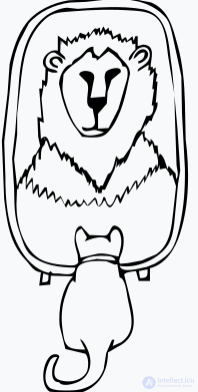
A cat looking at itself in the mirror and seeing a lion — a delusion of grandeur |
|
| ICD-11 | MB26.05 |
|---|
Delusional ideas of grandeur are a group of disorders that includes delusions of special origin, of genius, of invention, of wealth, of reformism, and of erotomania (being loved).
In delusions of special origin, the patient is convinced of belonging to a noble lineage known to the entire country or even the whole world. They may believe themselves to be, for example, the son of a popular movie star or an important statesman. One patient claimed to be the last descendant of Dante, since supposedly one of Dante Alighieri's relatives had lived in the same place as she did (in Crimea). Another patient was convinced that he was a descendant of an illegitimate son of Nicholas II, and for this reason laid claim to the Russian throne.
Delusions of wealth are the patient's erroneous conviction that they are rich. This type of delusion can be plausible — for example, when a homeless person claims to have 50,000 rubles in a bank account — or absurd, when a person believes they own several houses made of gold in various countries, or that all the diamonds in the world belong to them.
Delusions of invention are the patient's conviction that they have made an outstanding discovery, derived a formula for eternal youth, found a cure for all incurable diseases, and so on. One patient, after spending two hours in a line for meat, invented a formula for «artificial meat» — C₃₈H₂O₁₅. Such molecules were supposedly present in the air, and so he proposed «stamping out meat directly from the atmosphere» in order to «solve the problem of hunger on Earth once and for all.»
In erotomanic delusion, the patient is convinced that a popular or high-ranking person (a statesman, an outstanding athlete, a performer) has fallen in love with them.
In reformist delusion, the patient seeks recognition for an economic, social, or political «theory» they have developed, which claims to bring about revolutionary changes that will transform the existing world and benefit humanity. One patient claimed that hydrogen bombs needed to be detonated simultaneously at the Earth's north and south poles. After this, the Earth's rotation speed would supposedly change, and Siberia (where the patient was from) would have a tropical climate where peaches and pineapples would grow.
In modern psychiatry, delusions of grandeur are not considered a separate mental disorder, but are regarded as a manifestation of various mental disorders — for example, as a component of the paranoia symptom complex or a component of manic syndrome (in which certain delusional ideas are possible when mania reaches a severe degree — so-called mania with psychotic symptoms). Delusions of grandeur occur in manic states in general paresis, schizophrenia, and in the manic phase of bipolar affective disorder. In schizophrenia, mainly at its paraphrenic stage, delusions of grandeur are grandiosely fantastic. In general paresis, they are grandiosely absurd.
According to the DSM-IV-TR diagnostic criteria for delusional disorders, symptoms of grandiosity include exaggerated beliefs about:
For example, a person with extraordinary beliefs about their power or authority may consider themselves a reigning monarch who deserves to be treated as royalty. There are substantial differences in the degree of grandiosity associated with delusions of grandeur across different people. Some patients believe themselves to be God, the Queen of the United Kingdom, the son of the president, a famous rock star, and various other examples. Others are less expansive and consider themselves to be skilled athletes or great inventors.
Expansive delusional ideas may be reinforced by auditory hallucinations that tell the patient they are significant, or by confabulations, in which, for example, the patient gives a detailed description of their coronation or marriage to a king. Grandiose and expansive delusional ideas may also be part of a fantastic hallucinosis, in which all forms of hallucination occur.
Grandiose delusions often serve a very positive function, sustaining or boosting a person's self-esteem. As a result, it is important to consider the consequences for self-esteem of eliminating a grandiose delusion when attempting to alter it in therapy. In many cases of grandiosity, it is advisable to resort to partial rather than complete modification, allowing those elements of the delusion that are central to self-esteem to be preserved. For example, a person who believes themselves to be a senior secret service agent derives a great sense of self-respect and purpose from this belief; therefore, as long as this sense of self-respect cannot be obtained from another source, it is better not to attempt to alter it.
In a study involving more than 13,000 non-clinical and nearly 3,000 clinical participants, Isham et al. found that the main sources of meaning derived from grandiose delusions were:
Schizophrenia is a mental disorder characterized by a loss of contact with reality and the emergence of psychotic behavior, including hallucinations and delusions (unreal beliefs that persist even in the presence of evidence to the contrary). Delusions may include the false and persistent idea that a person is being followed or poisoned, or that their thoughts are being broadcast so that others can hear them. Delusions in schizophrenia often develop as a response to a person's attempts to explain their hallucinations. Patients who experience recurring auditory hallucinations may develop the delusion that other people are plotting against them and are being dishonest when they say they do not hear the voices that the deluded person believes they hear.
In particular, grandiose delusional ideas are common in paranoid schizophrenia, in which a person has an extremely exaggerated sense of their own significance, identity, knowledge, or power. For example, a person may declare themselves the owner of a major corporation and graciously offer to write a hospital staff member a check for $5 million, if only they will help them escape from the hospital. Other common grandiose delusional ideas in schizophrenia include religious delusions, such as the belief that one is Jesus Christ, or the end-times Mahdi in Muslim societies.
Bipolar I disorder can lead to severe affective dysregulation or mood states that fluctuate from extremely low (depression) to exceptionally high (mania). During hypomania or mania, some patients with bipolar disorder may have grandiose delusional ideas. In its most severe manifestation, days without sleep, auditory and other hallucinations, or uncontrollable racing thoughts can intensify these delusional ideas. In mania, this illness affects the emotions and can also lead to impulsivity and disorganized thinking, which can serve to reinforce feelings of grandeur. Defense of this delusion can also lead to extreme irritability, paranoia, and fear. Sometimes their anxiety can become so inflated that they believe others envy them and are thus undermining their «extraordinary abilities» by persecuting them or even plotting to seize what they already have.
The overwhelming majority of patients with bipolar disorder rarely experience delusions. Typically, when they experience or exhibit the stage of heightened excitability called mania, they may experience joy, rage, and other intense emotions that can spiral out of control, as well as thoughts or beliefs that are grandiose. Some of these grandiose thoughts may be expressed as strong beliefs that the patient is very wealthy or famous, or possesses superhuman abilities, or may even lead to serious suicidal thoughts. In its most severe form, in what used to be called megalomania, a patient with bipolar disorder may hear voices that support these grandiose beliefs. In their delusions, they may believe that they are, for example, a monarch, a creative genius, or even someone who can eliminate poverty in the world through their extreme generosity.
Psychologists and psychiatrists have proposed several theoretical explanations for grandiose delusions:
Empirical evidence largely supports emotion-consistent models but also suggests additional factors, such as reasoning biases. Grandiose delusional ideas are usually associated with high self-esteem and a self-serving attributional style, as well as low levels of depression, anxiety, and negative self-esteem. Moreover, there is evidence from neurotypical people that repeated positive self-affirmation can produce a temporary increase in (non-delusional) grandiose ideas of one's own superiority, importance, or uniqueness. A functional magnetic resonance imaging (fMRI) study of patients with bipolar disorder showed that such thinking is associated with exaggerated connectivity between the medial prefrontal cortex and the anterior cingulate cortex (brain regions involved in processing information relating to the self).
Qualitative studies also show that grandiose delusions arise not only against a backdrop of negative self-esteem, but also lend a sense of uniqueness, purpose, and belonging, and give additional meaning to adverse events.
The defense hypothesis bears a strong resemblance to the psychodynamic model of a mask over non-delusional narcissistic grandiosity, which is likewise unsupported by evidence.
Grandiose delusion may be associated with frontal lobe damage. Temporal lobe lesions have mainly been reported in patients with delusions of persecution and guilt, whereas frontal and frontotemporal lobe damage has been described in patients with delusions of grandeur, Cotard's syndrome, and delusional misidentification syndrome.
Some studies show that grandiose delusions are associated with abnormalities in dopaminergic reward pathways and other limbic structures involved in reward and emotional processing. Grandiose delusions appear to be associated with disrupted connectivity between the left middle temporal gyrus and more dorsal regions of the left temporal lobe — areas forming a central node of the default mode network and mediating various cognitive functions (namely social and linguistic ones).
Patients with a wide range of mental disorders that disrupt brain function experience various kinds of delusions, including delusions of grandeur. Delusions of grandeur commonly occur in patients with syndromes associated with secondary mania, such as Huntington's disease, Parkinson's disease, and Wilson's disease. Secondary mania can also be induced by substances such as L-DOPA and isoniazid, which alter monoaminergic neurotransmitter function. Vitamin B12 deficiency, uremia, hyperthyroidism, and carcinoid syndrome have also been found to be causes of secondary mania and, consequently, of delusions of grandeur.
The MacArthur-Maudsley delusions assessment scale is used to diagnose delusions and assess the patient's condition.
In patients with schizophrenia, grandiose and religious delusional ideas have proven to be the least responsive to cognitive-behavioral interventions. Cognitive-behavioral intervention is a form of psychological therapy originally used for depression, but now applied to various mental disorders in the hope of providing relief from distress and disability. During therapy, grandiose delusional ideas were linked to patients' underlying beliefs through a chain of inference. [jargon] Here are some examples of interventions carried out to improve a patient's condition: focusing on specific themes, clarifying the patient's neologisms, and thought linkage. During thought linkage, the therapist repeatedly asks the patient to explain their jumps in thought from one subject to a completely different one.
It has been found that patients with mental disorders who experience grandiose delusional ideas have a lower risk of suicidal thoughts and attempts.
In a study of more than 1,000 people from a wide range of backgrounds, Stompe and colleagues (2006) found that megalomania remains the second most common delusion after persecutory delusion. The prevalence of delusions of grandeur among patients with schizophrenia also varies by culture. In a study conducted by Appelbaum and colleagues, it was found that grandiose ideas occurred more often in patients with bipolar disorder (59%) than in patients with schizophrenia (49%), followed by patients with substance abuse disorder (30%) and patients with depression (21%).
A connection has been claimed between the age of onset of bipolar disorder and the occurrence of grandiose delusions. According to Carlson et al. (2000), grandiose delusional ideas appeared in 74% of patients who were 21 years old or younger at the onset of the illness, while they occurred in only 40% of individuals who were 30 years old or older at onset.
Studies show that the severity of delusions of grandeur is directly related to higher self-esteem and inversely related to the severity of depression and negative self-esteem. Lukas et al. found in 1962 that there are no significant gender differences in the establishment of delusions of grandeur. However, the specific content of religious delusions of grandeur varies by gender, with men more likely to believe themselves to be God, while women are more likely to believe themselves to be saints. Lukas et al. also noted that delusions of grandeur are more common among people with higher levels of education. Similarly, the presence of delusions of grandeur is greater in people who are the eldest than in those who are the youngest among their siblings.

Comments