
Lecture
Combat stress is a continuum of adaptive reactions and behavioral patterns exhibited by a service member in response to the stressors of combat conditions. A critical analysis of existing approaches to understanding stress makes it possible to identify the following types (Fig. 4.1).
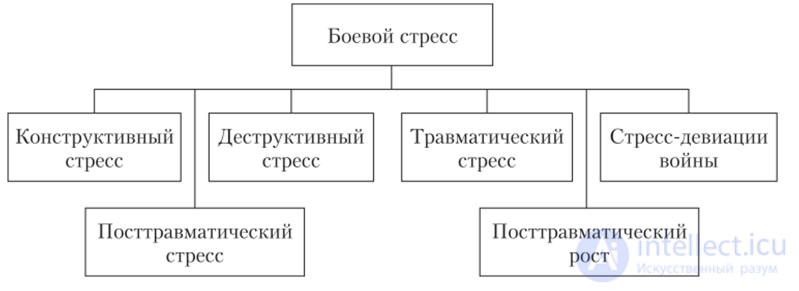
Fig. 4.1. Types of combat stress
Figure 4.1 shows that constructive, destructive, and traumatic stress, as well as stress deviations, can be distinguished. Such a gradation of combat stress may reflect both the possible negative dynamics of stress — from constructive to traumatic stress and stress deviations — and the specific stress states of individual soldiers.
Why do soldiers react differently to the same combat stress factors? This is a fairly complex question. Today it can be said that the basis of this difference is a different level of psychological resilience among soldiers — that is, their ability to actively withstand the impact of combat stress factors without losing combat effectiveness and combat activity. Such resilience can be compared to a kind of «psychological body armor» that protects the soldier from adverse external influences, giving them numerous degrees of freedom and allowing them to act fearlessly and selflessly. Just as there are body armor vests of various classes protecting a person from bladed weapons, shrapnel, bullets, fire, and so on, a specific person's «psychological body armor» is likewise designed to protect against quite specific psychological troubles. One such armor allows a person to endure truly inhuman trials, while another cannot withstand even minor difficulties.
The most reliable body armor is composite, that is, made up of several layers of different qualities. Generalizing the results of a number of military-psychological studies makes it possible to identify the main protective layers of the «psychological body armor» — the components of a soldier's psychological resilience.
The components of the psychological resilience of a combatant are: motivational, cognitive, emotional-volitional, operational, and regulatory.
1. The motivational component of psychological resilience includes the motives and personal meaning behind a soldier's participation in combat operations.
Psychologist M. I. Dyachenko identified the main groups of combat motives :
Each soldier develops their own unique system of combat motivation, which gives the person the opportunity to find meaning in combat existence and in their mission as a value within the context of their current life situation, real needs, and self-preservation.
It is precisely the personal meaning of participating in the fight against the enemy that forms the most powerful layer of the «psychological body armor». The Austrian scholar V. Frankl, highlighting meaning as the most important regulator for preserving a person's emotional integrity, proposed a distinctive formula reflecting the nature of the connection between meaning and such deep negative experiences as despair and suffering :
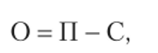
where D is despair, S is negative experience (suffering), and M is meaning.
This formula shows that the more meaningful a soldier's activity is, the lower the likelihood of despair arising in them, and the lower their susceptibility to destructive psychological impacts, even at high levels of suffering, fear, and so on. This formula is derived from the well-known idea of F. Nietzsche: «He who has a why to live can bear almost any how.»
It was precisely the profound meaning that our soldiers invested in victory in the Great Patriotic War that fostered mass self-sacrifice and heroism. The importance of investing soldiers' participation in deadly battles with meaning was also recognized in other armies. Thus, J. Appel and G. Beebe, studying the limits of combat capability in soldiers during the Second World War, established that British soldiers were able to maintain combat stability and remain in the combat zone more than twice as long as American soldiers (400 and 180 days respectively), because, unlike the Americans, they were «fighting for survival» .
Thus, pronounced motivation and a sense of meaning in participating in combat operations form the first layer of the soldier's «psychological body armor». They make it possible to screen out a huge number of external combat-environment influences as insignificant, while giving significant influences a non-traumatic meaning.
In his time, I. P. Pavlov pointed out that it is not the strength of a stimulus but its novelty that triggers a protective reaction. This proposition can be illustrated using P. V. Simonov's information theory. The author of the theory proves that in order to satisfy a need that is current at any given moment, a person must perform quite specific actions, and therefore needs information about the objects and conditions that satisfy that need. Simonov cast these propositions into a distinctive formula:
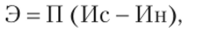
where E is emotion, its strength and sign, N is the strength and quality of the current need, In is information about the means prognostically necessary to satisfy the existing need, and Ia is information about the means the person actually has at a given moment.
This formula shows that if Ia is equal to or greater than In, the emotional reaction will be positive or neutral. The smaller Ia is compared to In, the stronger the negative emotion will be expressed. Emotions will also be more strongly expressed when the need being satisfied by the activity is acute .
The workings of this formula can be traced in the following example. A group of service members is to operate behind enemy lines. The need to accomplish the combat mission and to know the circumstances of its execution is very high. Consequently, the service members must be well acquainted with the specifics of the enemy's tactics, psychology, and level of combat training, the concrete characteristics of the terrain, and the order, forces, and means for accomplishing the mission. If this knowledge is sufficient for effective action, no negative emotions arise in the soldiers. If, however, the information is insufficient, the soldiers may experience anxiety, apprehension, and fear.
It is no accident that a number of studies by domestic and foreign psychologists note that soldiers fear most the enemy they cannot see. An invisible enemy seems stronger and is endowed with qualities it does not actually possess. This phenomenon is captured in Suvorov's famous aphorisms: «To surprise is to conquer» and «Fear has big eyes.» Specialists point out that to be caught by surprise by the enemy means to lose the means of controlling fear;
— effective coping strategies — ways of dealing with an unfavorable situation. According to the theoretical propositions of A. Ellis's rational-emotive therapy, a thought lies between a stimulus and an emotional reaction: «People are disturbed not by things, but by the views they take of them.» This means that a correct view of objects and events, and correct decisions, determine correct emotions.
Consequently, knowledge about combat, about the stress factors of battle, about one's own reactions to them, and the formation of a firm connection between correct knowledge and correct emotions, are the most important defense a soldier has against the psychotraumatic effects of the combat environment, forming the second layer of their «psychological body armor».
3. The emotional-volitional component of psychological resilience manifests itself as combat readiness, emotional energy mobilized and directed toward accomplishing the combat mission, resolve, firmness, persistence, and composure. It has been established that a favorable emotional state increases the effectiveness of activity by approximately 20%, muscular strength by up to 90%, sensitivity of vision and hearing by 35–65%, reduces the number of errors and inaccuracies among certain specialists by a factor of 5–10, and contributes to increased attention and quick-wittedness while reducing fatigue. A low psychological state reduces the effectiveness of activity by 15% .
It follows that a high combat morale enables a soldier to achieve superiority over the enemy in muscular strength, intellect, and will, protects against errors and loss of strength, and ensures the achievement of the ultimate goal of combat activity, which forms the third layer of their «psychological vest».
4. The operational component of psychological resilience
consists in a soldier's combat mastery, confidence in handling weapons and combat equipment, the ability to navigate terrain, conduct observation, «read» and listen to the battlefield, provide first aid and self-aid for wounds, and survive on the battlefield. War experience shows that the better soldiers are professionally trained, the less susceptible they are to combat stress even in high-intensity combat operations.
Accuracy, speed, and reliability of actions allow a soldier to achieve the set goal (the acceptor of the action's result), which is accompanied by a further increase in morale and combat capability.
5. The regulatory component of psychological resilience is represented by the trained state of the stress-response apparatus, the service member's ability to promptly regulate their mental states, to quickly bring themselves into optimal emotional states, to create the necessary volitional tension, to increase confidence in their own strength, to relieve pain sensations by non-pharmacological means, to quickly enter states of wakefulness and sleep, and to obtain full-fledged rest in a short period of time.
This is especially important in cases where combat-environment factors manifest suddenly, with overwhelming force, cumulatively, when intermediate results of actions do not correspond to the intended goal, and when the final goal is not achieved. In this case, mental self-regulation can become the most important factor of psychological defense and prevention of frustration, fear, and despair developing in the service member.
The level of psychological resilience formed in each soldier, and the unique combination of its components, act as a kind of «transformer» converting the high intensity of battle into energy for the soldier's combat activity.
If a soldier has active combat motivation, considers their participation in combat operations a matter of honor and duty to their country, has formed an accurate picture of the upcoming combat operations, has developed a high combat morale, and has developed combat skills and means of self-managing their psyche and behavior, they respond to the stress factors of battle with constructive combat stress. The characteristics of constructive stress have largely been described above. Its main function is to create optimal combat tension in the soldier, allowing them to effectively accomplish combat missions and survive on the battlefield.
In this case, according to combat practitioners, the impact of the combat environment can foster a sense of meaning in the mission, faith, increased vigilance, growth in strength and endurance, increased tolerance (of hardship, discomfort, pain, and wounds), heroic acts, courage and self-sacrifice, increased cohesion among service members, and the strengthening of comradeship in arms and the combat traditions of units and subunits.
If the components of psychological resilience are not sufficiently developed, and external resources that help cope with unfavorable circumstances are lacking, the soldier responds to the stress factors of battle with destructive stress (distress), which provides a certain level of adaptation to the combat environment through overstrain of the mechanisms of reactive self-regulation, intensive energy expenditure, and reduced effectiveness in the functioning of bodily systems and mental activity. Such an extreme mode of functioning can exceed the capacity of these mechanisms and lead to exhaustion of the organism. Formed combat motivation and a sense of meaning in military activity keep the soldier on the battlefield and prompt combat activity, but the instinct of self-preservation and fear begin to counteract them. The adaptation mechanisms function at their limit and become overstrained.
This can be illustrated by returning again to stress, using the metaphor of a besieged fortress — one must acknowledge that the capabilities of its defenders are not limitless. Supplies of water, food, and ammunition gradually run out, the ranks of the defenders thin, strength is depleted, faith fades, hopes go out. The enemy is still outside, beyond the fortress walls, but coping with them is only possible through supreme effort.
Distress manifests itself in one of the following forms of maladaptive behavior:
Among the symptoms (subsyndromes) of destructive stress, it is customary to distinguish:
Distress is a transient form of stress. The accumulation of distress symptoms can reach a «critical mass» and push the service member's state up to the level of traumatic stress.

Comments