Special psychology (also corrective psychology) — is a branch of developmental psychology that studies special states arising mainly in childhood and adolescence under the influence of various groups of factors (of organic or functional nature), manifesting as a slowdown or pronounced distinctiveness in a child's psychosocial development, which complicates the child's socio-psychological adaptation, inclusion in the educational environment, and subsequent professional self-determination. According to E. L. Goncharova, special psychology is «a branch of developmental psychology that studies the developmental problems of people with physical and mental impairments, which determine children's need for special conditions of education and upbringing and adults' need for special forms of psychological support».
The name «Corrective psychology» is recorded in the list of scientific specialties of the Higher Attestation Commission of the Russian Federation. Code 19.00.10.
Special psychology originally developed within defectology as an applied discipline that ensured the optimal solution of tasks in the corrective pedagogical process, as well as diagnostic methods for determining the specific features of a child's mental development and the child's need for alternative routes of learning.
Historically, the first areas of special psychology to emerge were the psychology of the blind (typhlopsychology), the psychology of the deaf (surdopsychology), and the psychology of the mentally retarded (oligophrenopsychology). Over its nearly century-long history, special psychology has significantly expanded the scope of its research and practical application. It now also addresses children with delayed mental development, speech disorders, early childhood autism, children with motor impairments, complex defect structures, and others.
Special psychology studies various forms of pathology in mental development, and problems of distortion in mental development caused by congenital physical illnesses and defects. For example, it has been found that a primary defect (such as deafness) causes numerous secondary changes — changes in mental development (secondary defect), a restructuring of one's outlook on life, of one's system of relationships with others, of thinking, perception, and so on (tertiary deviations).
The data of special psychology forms the basis for building systems of education and upbringing for people with abnormalities in mental development, as well as for professional counseling and professional selection.
The main task of special psychology is to shape an adequate personality through the application of special methods and techniques of upbringing and education, through which impaired functions are replaced and restructured.
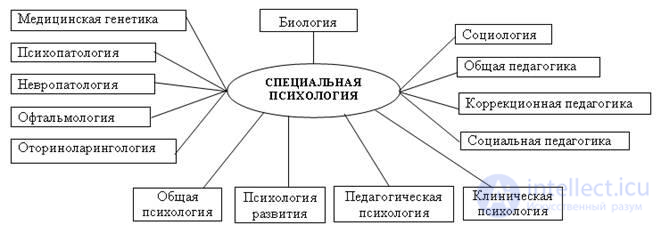
Object and subject of special psychology
The object of special psychology as a science is a person with developmental disorders, that is, a person existing in a state of deprivation (insufficiency).
The subject of special psychology is the various forms and aspects of psychological development under unfavorable conditions.
Tasks of special psychology
Task 1 — Uncovering the patterns of development and manifestations of the psyche that are common to typically developing children and children with developmental disorders.
Task 2 — Investigating the patterns of development and manifestations of the psyche that are specific to children with developmental disorders.
Task 3 — Studying disorders in the development and formation of specific forms of mental activity and mental processes in various groups of atypical children.
Task 4 — Identifying the ways, means, and methods of compensating for developmental disorders in children.
Structuring the science of special psychology:
- Establishing the boundaries of competence
- Defining the object of study
- Refining the system of concepts
- Differentiation from other sciences
- Integration with other sciences
- Prospective problems.
Subject area of special psychology:
- Developmental disorders and the patterns of their manifestation:
- Research into the psychological mechanisms of developmental disorders in relation to brain activity
- Establishing the patterns underlying positive and negative atypicalities of development
- Classification of disorders in mental development
- Developing methods for identifying disorders in mental development and determining their structure
- Patterns of acquiring sociocultural experience:
- Research into the specific features of acquiring sociocultural experience
- Developing methods for assessing the acquisition of sociocultural experience
- System of support for people of different age groups with developmental atypicalities:
- Scientific grounding of the content of educational programs
- Scientific grounding and development of socialization methods
- Public attitudes toward people with developmental atypicalities and developing a system for influencing these attitudes:
- Scientific grounding and development of methods that promote the social acceptance of people with developmental atypicalities
- Finding ways to shape public consciousness with regard to people with atypical development.
Practice-oriented tasks of special psychology:
- Developing technologies of psychological assistance for children with developmental disorders and their families
- Substantiating and developing psychological and social measures that positively affect the quality of life of people with developmental atypicalities
- Developing technologies for shaping public opinion with regard to people with atypical development
- Professional training of special psychologists
- Raising the psychological competence of the general population and of professionals at various levels.
Organizational tasks of special psychology:
- Determining the strategy, direction, and ways of organizing a system of support for people with atypical development in contemporary society
- Developing the strategy and tactics of interaction between parallel services.
Branches of special psychology
- typhlopsychology — the psychology of people with visual impairments;
- surdopsychology — the psychology of people with hearing impairments;
typhlo-surdopsychology — the branch dealing with people who have both visual and hearing impairments;
- oligophrenopsychology — the psychology of the mentally retarded;
- logopsychology — the psychology of people with speech disorders;
- the psychology of people with deficits in the emotional-volitional sphere (mainly early childhood autism);
- the psychology of people with musculoskeletal impairments (mainly cerebral palsy);
- the psychology of people with delayed mental development;
- the psychology of people with complex defects.
Special psychology, like special pedagogy, is part of defectology — a comprehensive scientific discipline that studies the developmental features of children with physical and mental impairments and the patterns of their upbringing and education.
Abnormal development – development on a defective basis.
A defect (from the Latin defectus — deficiency) in one of the functions disrupts a child's development only under certain circumstances.
Methods of special psychology
Special psychology has no special research methods of its own. As in general, child, and educational psychology, it employs:
- Individual and group laboratory psychological experiment — the researcher's active intervention in the subject's activity in order to create conditions that reveal some psychological fact.
- Observation — the purposeful perception of the object of study, consisting of recording manifestations of behavior and forming judgments about subjective mental phenomena (for example, monitoring-based diagnosis).
- Study of the products of activity (for example, analysis of children's written work, study of their drawings, of objects they produce during vocational training, etc.).
- Questionnaires — a group of psychodiagnostic techniques in which tasks are presented as questions or statements designed to obtain data from the respondent's own words.
- Projective techniques (designed to diagnose personality):
- Structuring techniques — forming stimuli and giving them a certain meaning.
- Constructing techniques — creating a meaningful whole out of parts.
- Interpretation techniques — interpreting certain events or situations.
- Completion techniques — for example, sentence completion.
- Expression techniques — drawing.
- Catharsis techniques — play activity under specially organized conditions.
- Impression techniques — preferring some stimuli over others.
- Formative (teaching) experiment — a form of natural experiment characterized by the fact that the study of certain mental processes takes place through their purposeful formation. This method reveals not so much the current state of knowledge, skills, and abilities as the specific features of how they develop.
- Conditioned-reflex techniques
- Functional analysis of behavior is the analogue of a natural-science experiment in which systematic relationships are studied between dependent variables (in this case, behavior that requires explanation and is described in measurable form) and independent variables. The technology of applied behavior analysis, based on this method, combines the capabilities of a research method with those of corrective intervention.
Each of the techniques of special psychology is applied for specific purposes and with regard to the individual characteristics of the object of study.
See also
- [[b11956]]
- Psychological correction
- Neuropsychological correction
- speech
- general psychology
See also


Comments