
Lecture
Music psychology (German: Musikpsychologie, English: Music psychology) — a scientific discipline concerned with studying the various psychological aspects of musical language and the structure of musical works, and which investigates the patterns of psychological perception of music and its effect on various structural components of the human psyche.
Music psychology is an interdisciplinary science, belonging simultaneously to the field of musicology and to the field of applied psychology. Therefore, developments in the sphere of music psychology may include, among others, various specialized studies in the field of musical acoustics, psychoacoustics, the neuropsychology of perception, the psychophysiology of hearing and movement, aesthetics, cultural studies, pedagogy, and so on.
The main areas of scientific research in music psychology are the following:
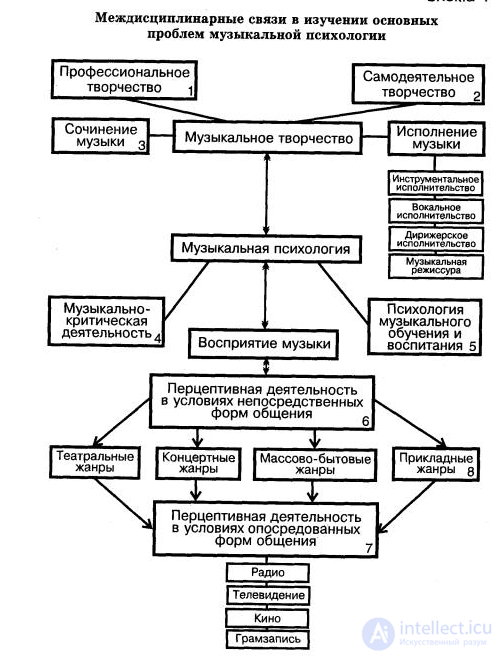
Diagram 1. Interdisciplinary connections in the study of the main problems of music psychology:
Cultural studies, praxeology, theory of the arts, sociology of art, musical paleography, semiotics, hermeneutics, history of music, the psychology of musical creativity, the psychology of cognition, the physiology of higher nervous activity, aesthetics, axiology, maieutics. Cultural studies, the psychology of art, the psychology of creativity, the theory and history of performance, the sociology of music, social psychology, music pedagogy, club studies, specific methods of teaching singing and instrumental playing, theory of art. General psychology, the theory of harmony, polyphony. Aesthetics, theory of the arts, hermeneutics, maieutics, cultural studies, the psychology of music-critical activity, the psychology of propaganda, the sociology of music, the history of art, axiology, the theory of musical interpretation, ethnopsychology, the theory of harmony, polyphony. Comparative pedagogy, the history and theory of culture, pedagogy, methods of teaching music, social psychology, the sociology of education, developmental psychology and physiology, the psychology of management, theory of the arts, theory of music, praxeology. Cultural studies, the psychology of musical perception, general psychology, developmental and educational
psychology, theory of the arts, the sociology of music, the sociology of theater, the sociology of cinema, social psychology, ethnopsychology, acoustics, hermeneutics, maieutics, analysis of musical works, aesthetics, cybernetics, information theory. Cultural studies, art history, technical aesthetics, differential psychology, theory of the arts, the psychology of labor, medical psychology, the psychology of everyday life, advertising, theatrical psychology, aesthetics, psychotherapy, club studies. "Spatial music," light music, sound stenography, chamber music, the aestheticization of the sound environment, the application of music in industry and medicine, ritual music.
The problems of music psychology as such have been considered at all stages in the development of musical art, starting from the earliest antiquity.
Of considerable interest from the standpoint of the development of music psychology is the Theory of Affects, which arose in the Baroque era, whose main developers were Johann Quantz, Marin Mersenne, Athanasius Kircher, Johann Walther, Claudio Monteverdi, Johann Mattheson, Giovanni Bononcini, and Christian Spiess. According to the Theory of Affects, the purpose of a composer's creative work is to arouse affects, with particular groups of affects being tied to specific musical styles and other means of compositional writing. According to Athanasius Kircher, the transmission of affects was not reducible to any purely craft-based techniques, but was a kind of magical act of controlling the "sympathy" that "arises between man and music." In this connection, it should be noted that many composers of that era specifically studied magic, including the greatest of them — Claudio Monteverdi.
But it was precisely as an independent scientific discipline that music psychology began to take shape from the middle of the 19th century. The main impetus for this came from research in the field of experimental psychophysiology and the development, directly connected with that research, of a scientific theory of musical-auditory perception, which was formulated in its complete form in the works of Hermann Ludwig Ferdinand von Helmholtz. Helmholtz developed the resonance theory of hearing, according to which auditory sensations arise in a person owing to the resonance of the internal organs of hearing in response to external stimuli. Another innovative idea of Helmholtz's was the proposition that a single tone is itself a kind of chord, whose sound is based on quite definite laws of acoustics. In his "theory of consonance and dissonance," Helmholtz explained many important phenomena in the field of psychoacoustics through the occurrence of beats between partial and combination tones: the greatest number of such beats is observed in dissonant intervals (seconds, tritones, sevenths), and the fewest in consonant ones (octaves, fifths).
Helmholtz's research touched on various scientific and practical questions related to problems of perception, creativity, the diagnosis of abilities, and methods of musical education, which gave a powerful impetus to the development of almost all areas of music psychology.
Many of Helmholtz's ideas were later taken up, and his work creatively reconsidered, in the writings of C. Stumpf, O. Abraham, M. Meyer, and E. Mach.
Carl Stumpf viewed music as a unique cultural phenomenon, and therefore, as against the results of experiments conducted by psychologists trained in the introspective analysis of consciousness (the school of W. Wundt), he considered the testimony of expert musicians to be more trustworthy.
One of the main concepts of Stumpf's psychology of sound is the "fusion" of tones: the multiplicity of tones that form a single, integral consonance in the listener's mind. In this approach, dissonance is regarded as the "individuation" of tones out of this unity.
Stumpf made the largest contribution after Helmholtz to research in psychological acoustics. But, unlike Helmholtz, Stumpf opposed "objective methods" of research, thereby asserting the idea that a rigid distinction between physical and mental phenomena is impossible, which implied the need to study whole psycho-physical complexes within psychoacoustics.
C. Stumpf laid the foundations of the concept of the "two components of musical pitch," according to which a change in a single physical parameter of a tone — the frequency of its vibrations — simultaneously changes two psychological properties of the tone: its timbre and its pitch.
A significant contribution to the development of music psychology was also made by W. Wundt (who enriched music psychology with the methodological tools of experimental psychophysiology), W. Köhler (who brought into music psychology the fundamental principles of Gestalt psychology ), G. Révész (who thoroughly investigated the phenomenon of musical giftedness), and other well-known scholars.
Various questions and problems related, primarily, to the psychology of musical perception and musical ear were then thoroughly developed in the works of such well-known Soviet musicologists and psychologists as B. V. Asafiev, S. N. Belyaeva-Ekzemplyarskaya, B. M. Teplov, V. V. Medushevsky, E. V. Nazaykinsky, T. S. Tarasov, L. L. Bochkarev, B. L. Yavorsky, Y. N. Tyulin, L. A. Mazel, M. V. Blinova, E. A. Maltseva, N. A. Garbuzov [10], A. A. Volodin, and Y. N. Rags. The first textbooks on music psychology for students of conservatories and institutes of arts and culture were written by Leonid Lvovich Bochkarev (Psychology of Musical Activity — Published by the Institute of Psychology of the Russian Academy of Sciences, 1997, 352 pp.; reissued by the Klassika-XXI publishing house in 2006, 2007, and 2008), Valentin Ivanovich Petrushin (Music Psychology — Moscow, 2004); Arnold Lvovich Gotsdiner (Music Psychology — Moscow, 2003); G. V. Tsypin, Psychology of Musical Activity — Moscow, 2004; Galina Petrovna Ovsyankina (Music Psychology — St. Petersburg, 2004); and Marina Sergeyevna Starcheus (Music Psychology — Moscow, Moscow State Conservatory, 1999; Musical Ear — Doctoral dissertation — Moscow, 2005).
Fig. 1. Basic categories of the concept of talent
The foundation of the structural model of musical talent is the concept of intonational hearing, responsible for the meaningful
and emotional reading of a sound message, and serving as the psychological basis
of musical motivation. Built upon intonational hearing is analytical hearing —
the musical-linguistic operator of talent, responsible for the pitch-and-rhythm differentiation
of musical elements and their combination into structures of a language-like type. At the summit of talent
is musical creativity, consisting of architectonic hearing — the operator of the
wholeness of the text — and musical-productive ability. The clearest and most important differences lie between the psychological properties and qualities aimed at learning
and the acquisition of knowledge and skills (competencies), on the one hand, and psychological properties and qualities underlying discoveries, creative projects, new ideas, works, inventions, etc., on the other. From a business point of view, it is hard to imagine a more
profitable "business project" than raising human capital's efficiency to its maximum
degree by offering each person the occupation for which they were intended by
Nature itself. The cost of research turning this dream into reality is truly
negligible compared to any technological or industrial project. Perhaps
the time has really come to take the first step toward a super-efficient society,
in which happy, self-actualized individuals manage to apply
their varied talents to the common good?
Why do we need to know more about giftedness? Is it by chance that individual differences
in the capacity for creativity, for problem-solving,
and for expanding knowledge continually serve as material for debate and research? And this
scientific debate continues, even though many
regard the very possibility of inequality in psychological resources — implying limits
on professional choice — as tantamount to undermining the foundations of society,
which has invested too much
in achieving social
peace to allow the "concept of talent"
to threaten it. It is therefore not surprising that
for some psychologists "hard work"
appears to be the most reliable road to excellence, more reliable than anything
else, including "talent"1. However, it is quite tempting to hold on to the dream of an ideal professional choice, exactly matching
our inclinations: everyone hopes
to realize their natural potential,
to become who they were truly meant to be — those who manage to find and develop their
talent to its highest limit are, above all,
the ones who achieve happiness and recognition. It is hard even
to imagine how great the achievements
of a society would be in which everyone knew, from an early age,
in which direction to focus their efforts so that they would bring the greatest effect; perhaps
it would be a society in which no one was disappointed by their professional results?
And is it not the task of psychological science
to provide real help to each person in finding work in which they
could achieve the greatest success?
As scientists often say, there is nothing more
practical than a good theory. Do we have
a "theory of talent" resting on reliable scientific data? No. Here is one typical
admission from a scholar working on this subject:
"For two thousand years the greatest minds of Europe
have tried to penetrate the mystery of talent, to study its
nature and structure, its origin and development. So it has been since antiquity, from Plato
and Aristotle to the outstanding minds of our own day —
the psychologists Sternberg, Csikszentmihalyi, Gardner,
Heller, and others. But despite their efforts, the problem of talent is far from being resolved. Despite
a flood of publications and conferences, the very
concept of talent has not become any clearer."1
One of the leading researchers in this field, Francoys
Gagné, noted that the terms
and definitions within the theory of talent and giftedness now being born before our
eyes are as numerous as the scholars
formulating them themselves — the seventeen chapters of a famous book on this
subject [Conceptions of giftedness. Ed. R. Sternberg,
J. Davidson. New York: Cambridge University Press,
1986. 467 p.] offer seventeen different approaches to terms and definitions. In this book
no author accepts another's terms:
each prefers to create their own. All the conceptions develop in parallel,
while their differences and contradictions
are never addressed."2
And Francoys Gagné is entirely right, since for several decades now
the situation he described has remained unchanged (nor
should we forget that the author's reproaches, published in 2004, are not so
far removed from us either). Everyone will agree that terms
such as "abilities," "giftedness," "intelligence,"
"creativity," "talent," and some others
denote human potential that leads
to great success and the highest achievements
in science, art, business, sport, and other fields
of activity. However, the interdependencies and relationships between these named psychological
categories remain unclear. In other words,
a structure or model of talent that arranges all the psychological components in the proper order
and relation to one another — that is a matter for the future.
Let us present the structure of talent as it
appears today. Psychologists agree
that the clearest and most important differences lie
between the psychological properties and qualities
aimed at learning and the acquisition of knowledge
and skills (competencies), on the one hand, and psychological properties and qualities on which
discoveries, creative projects, new
ideas, works, inventions, etc. rest, on the other
hand.3 "The results of a considerable number of empirical studies point to a weak correlation between these two types of giftedness."4
Some researchers also agree
that motivation, or the desire to succeed, is so important
that it must become an integral part of the structure
of "talent."5 If we were to draw a diagram, keeping
in mind current notions of talent, this
diagram would look as follows (Fig. 1).
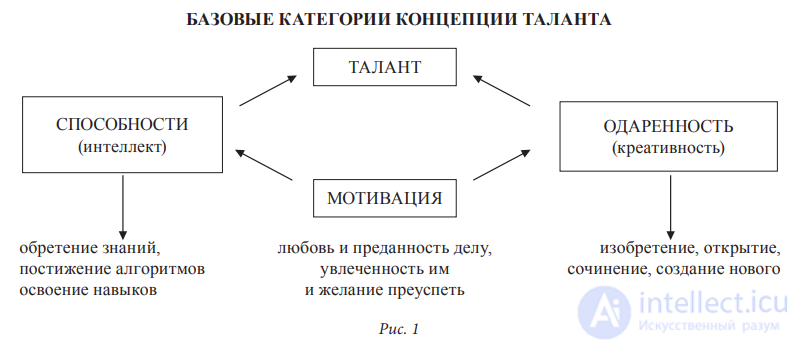
Presumably, talent in any field
in one way or another corresponds to the model presented above, consisting of three relatively independent
"ingredients" — abilities, responsible
for the educational part in any field, giftedness, responsible for the creative
part, and motivation, responsible for the desire to improve in a chosen field. However, it is hard
to expect real help from such a model
in professional choice. Like the idea of IQ, the intelligence quotient, or like the idea
of creativity (creative potential as such), this model is also non-specific and offers no key
to testing that would help determine
in which professional direction a child, adolescent, or young person should best develop.
How does one construct tests, for example, for future
engineers or information-technology
specialists; how can one know whether a person's professional
path will be connected with law, or, perhaps,
with medicine, or with choreography? To answer such questions, one needs to combine psychological abstractions with specific mental
operations, ways of thinking, and modes of action
that are essential and necessary for one type
of activity or another.
Do we have any specific
model of talent for any specific
type of activity? Here we mean a model
that uses particular psychological
categories while at the same time explaining how
this model might work in practice.
The answer is yes. There is one attempt
at building such a model, and that is a model of musical talent. It is already being used to
predict the musical future of children and adolescents.1
It is no surprise that the model of musical talent appeared first: in music,
universal equality of gifts has never been asserted
and the possibility of everyone becoming a
famous composer or performer has never been discussed. Within the musical community, the very
idea of exceptional ability has never been
taken off the agenda. And was it not musicians
who first attempted to predict a successful musical career, later having the opportunity
to compare these predictions with reality? With regard to musical
art, the corresponding branches of psychological science are the most developed: these are the cognitive
psychology of music and musical neuropsychology — it is precisely on these that one can rely
when investigating the various aspects of the interaction
between human consciousness and music, including the outstanding abilities of composers and performers.
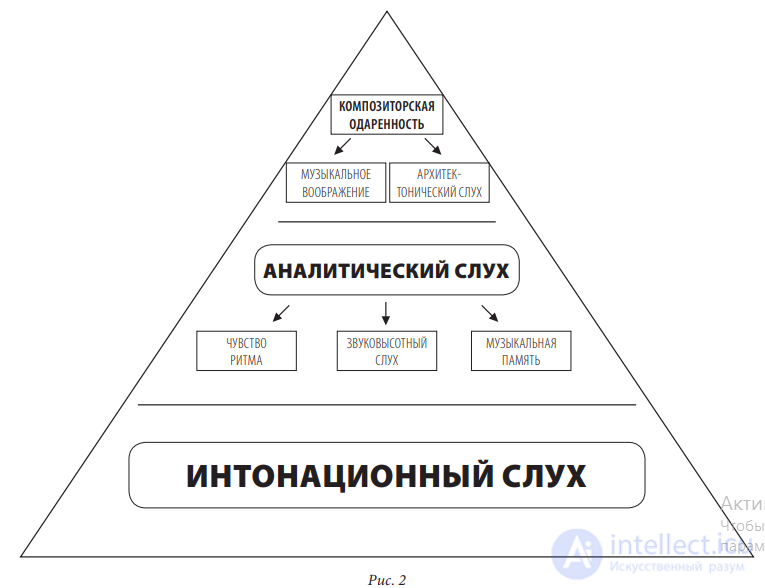
Fig. 2 presents the structure of musical talent. This model includes all three
components necessarily present
in the structure of any talent. Intonational
hearing (from Asafiev's "music — the art of intoned meaning") here embodies
motivation — a special property of perception, whereby
the meaning of a musical message and its emotional content evoke
sympathy and understanding in the listener. Abilities (or musical intelligence) are represented in a fairly traditional way: sense of rhythm, sense of pitch,
and musical memory. Musical abilities
as a whole, including their component parts, are conveniently
called analytical hearing owing to its
function: to analyze musical material,
sensing the role of each element within a given
system of sound organization both in time
(sense of rhythm) and in space (sense of pitch). And, finally, compositional giftedness
(or creativity) is a necessary part
of any musical talent, including that of a performer, comprising two "blocks":
architectonic hearing, which preserves the integrity and aesthetic perfection of a musical
text, and musical imagination, which brings to life
the various musical elements — sounds, motifs, and phrases — that appear before the judgment
of architectonic hearing to be accepted
or rejected.
What does this more detailed model give us?
It shows how the levels of musical talent differ, i.e., the psychological
predisposition needed by an amateur musician in contrast to a mere listener, or,
in other words, what the differences are in a person's musical
potential between someone ready for domestic music-making versus a person showing promise
as a professional
performer, singer, or composer. In particular,
for a mere listener, intonational hearing alone is enough to empathize with music and enjoy it; an amateur musician, alongside intonational hearing, will already need analytical
hearing, allowing them to operate with the various
components of the musical whole and to remember musical structures. A professional,
however, also needs the "upper floors" of talent:
they must be able to think musically, to generate
new musical texts (even at a student level),
and to possess a refined taste that allows them to distinguish the appropriate from the inappropriate, both
in musical works themselves
and in performance practice.
In the course of the experimental study of musical talent and its components, several
kinds of testing instruments have been
created, which have by now already been put
into practice and recognized as useful by teachers
and students. During testing, subjects
listen to fragments of musical works, compare them, and make their choice (all the tests
are conducted in groups, take 10–15 minutes,
and require no special education either from those
who take them or from those who evaluate them).
As a result of such testing, it has become possible to:
1) recognize in a child a future music lover and invite him/her
to a music
school (a longitudinal study conducted
from 2001 to 2009 with 10,000 first- and second-grade students in Moscow schools showed that children who successfully pass the intonational-hearing test
practically never quit music lessons1;
2) recognize a subject's professional musical
potential and give them the opportunity to realize it, if they have such a desire [18,19];
3) identify the leading group in a music
competition before it begins; 4) predict the future
success or failure of musical prodigies
in childhood [7,13].
As a result of applying tests for various
aspects of musical talent, additional conclusions can be drawn. It turned out, in particular, that:
1) the structure of musical talent represents
an indirect reflection of the process of phylogenesis —
the components of talent that lie "lower" in the talent
model are older than those that lie "higher" — intonational hearing arose much earlier in the course
of human evolutionary development than analytical hearing, and the most sophisticated components
of talent — architectonic hearing and musical
imagination — are at the same time the
latest, the most "young";
2) the "lower"
a given component of talent is placed in the structural model, the more people possess it:
there are far more people ready to become
devoted listeners than people actively making music as amateurs, and, at the same time, people
whose musicality is sufficient for active
amateur music-making are far more numerous than those who
could count on a successful musical
career. The proportional distribution of these
groups relative to the total population
is roughly as follows: about 12% of people are ready to become
devoted listeners of music, feeling
a constant need for it; 7% of people could
happily make music, delighting themselves and their
friends, and only 2.4% of people could count
on a musical career (it is clear that the realization
of any potential whatsoever, including musical potential, depends on many circumstances, including the family environment, educational opportunities, personal traits, etc., which cannot
all be listed; that is, in reality, taking into account
incidental conditions, significantly fewer people are able to become amateur musicians, let alone professionals,
than those who are psychologically
predisposed to it).
3) each stage in the development of
talent includes the preceding stages —
amateur musicians appear among those who
love music, and professional musicians must
possess the entire set of psychological properties
and qualities that characterize the preceding stages — alongside compositional giftedness they
need, correspondingly, both intonational
and analytical hearing;
4) the natural development of musicality must pass through the same
stages that humanity has passed through on its way
to highly developed musical talent — the knowledge
and skills characterizing the lower stages of
talent development must appear first
in the course of its formation and development in the musical-educational process, while the higher
stages of talent will follow later, in the same
order in which they appeared
in the course of evolution.
With the help of a battery of tests based
on the structure of musical talent, it is possible to predict how likely musical success is for a given
person, be it a child, an adolescent, or an adult. It is quite possible that the model of musical talent, already having undergone testing, could
serve as an example for creating analogous models
for other kinds of giftedness, helping people better recognize their strengths and assess their
possibilities.
In speaking of "other kinds of giftedness," we do not mean
an endless string of "talents"
needed for an endless number of professions.
Understanding and studying them would take
centuries, not to mention that each generation faces new professions that
appear thanks to new technologies, new
requirements, and new prospects. However, modern psychology can answer a question
that at first glance seems unsolvable: just
how many kinds of giftedness, how many talents does humanity possess? Practically only
nine. Such is the answer of Howard Gardner, author of the book
"Frames of Mind," who proposed a new
philosophy of giftedness "beyond IQ" [20,
21]. He was the first to proclaim the principle of "multiple intelligence," or, in the original, "multiple intelligences."
The essence of his approach lies in recognizing that all human talents are based on nine different kinds of intelligence, none of which can be equated with the so-called "general abilities," "intelligence in general," "creativity," or any
other psychological categories. Human potential as a whole — mental, physical,
and emotional — breaks down into the following kinds:
bodily-kinesthetic, spatial, naturalistic, linguistic, logical-mathematical, musical, spiritual, interpersonal,
and intrapersonal.
Just as countless shades of color are born from a few colors of the basic spectrum (or the "colors of the rainbow"), all our
talents are formed from the nine kinds of intelligence discovered by H. Gardner. It is enough to know the structure of just one of them, for example, the musical one,
in order to picture the structure of the rest, presumably built along similar lines. In this way, it becomes possible to clarify the psychological
requirements for virtually any type of activity, based on the blending and joint action of several of Gardner's "intelligences."
Like all creations of Nature, Man is subject to the laws of Harmony: symmetry, analogy, correspondence, equivalence, isomorphism, and so on underlie the Universe. From this point of view, musical talent is analogous to every other kind, and all of them include similar structural elements to perform similar functions. Where, for example, should we look for Motivation, the energetic center of every talent, its engine,
the stimulating mechanism that makes talent work? In music, intonational hearing arose thanks to sound signals that helped ancient humans exchange emotionally important information with those close to them.
Can we, by analogy, see the circumstances that gave rise to other talents? In other words, how did the activity underlying a talent (not a musical one this time) contribute to the survival of our distant ancestors? What psychological tools were necessary
when a given type of activity was just beginning its civilizational path? These are the questions that must be posed and resolved in order to
uncover the motivational center of every talent. The second "floor" of musical talent is analytical hearing, which is its operational center. Would it not be logical to picture the operational center of other talents as a functional analogue of analytical hearing?
Musical ear (sense of pitch) and sense of rhythm lie at the basis of the formation of musical language: here we mean the segmentation
of the musical stream and the combination of segments into larger structures, in which sense of rhythm mainly comes into play; the emergence of sound-organizing systems — modes and keys, differentiating the functions of tones and consonances within the musical whole, in which "sense of pitch" mainly operates, as well as various "patterns" and "gestalts" — stable pitch-rhythmic formations, musical-linguistic units out of which a musical utterance is composed. Do other types of activity not form their own "languages"?
In most cases, the answer to this question is yes. If so, what should the psychological apparatus that masters these "languages" be like? How does our consciousness master these "quasi-linguistic" processes in other types of
activity and fill them with meaning — these are the questions that need to be answered in the search for an analogue of analytical hearing in the structure of other talents.
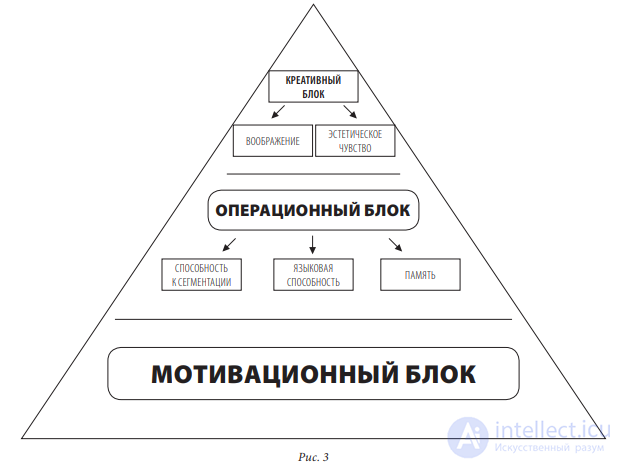
And, finally, the third and highest "floor" of musical talent consists of two "blocks": one creates new melodies, sound complexes, phrases, and so on, while the other assesses their conformity or non-conformity with the artistic intent of a given piece, in order to accept those that fit the style of the piece and reject those that violate its aesthetic integrity. What can be said here about other talents? Does some idea of the whole exist when an airplane is built, a suit is sewn, or a lecture is delivered? Certainly, yes. Beyond music or the visual arts, human imagination creates a multitude of new elements and their pattern-combinations, necessary for any construction from a novel to a computer program, and, just as in music, there exists psychological machinery ensuring the integrity of the final product, preventing it from turning into an ugly "mess." Everywhere and always, a talented person seeks and finds harmony, beauty, and perfection, which come about through the strict selection of the necessary elements
out of a much larger number of unsuitable and inappropriate ones. Can there be any doubt that talents outside of music also carry within them a "creative block" with the same two "operators," one of which is in charge of production, or, in other words, imagination, and the other of proportion and harmony?
One can attempt to outline a preliminary structure for every talent, bearing in mind that its structural elements and their functions are understood to one degree or another, though much remains to be clarified (Fig. 3).
When the structure of each of Gardner's "intelligences" is uncovered, when more is known about the motivational, operational, and creative components of each of them, the time will come to create tests for the same purposes as in music, that is, to determine
whether each of these talents is our "cup of tea," as the English say, or whether it would be better offered to someone else… Music psychology allows us to think that this task could be solved as early as childhood — roughly before age 10.
A universal battery of tests for all nine of Gardner's kinds of giftedness — could there be a more tempting task for psychological
science? From a business standpoint, it is hard to imagine a more profitable "business project": to raise the efficiency of human capital to its maximum degree by offering each person the occupation for which they were intended by Nature itself. The cost of research turning this dream into reality is truly negligible compared to any technological or industrial project. Perhaps
the time has really come to take the first step toward a super-efficient society, in which happy, self-actualized
individuals manage to apply their varied talents to the common good?
Music psychology is of scientific and practical interest in several respects:
— the pedagogical, which concerns the upbringing and training of musicians;
— the musicological, which is primarily related to problems of how reality is reflected in music and how artistic meaning takes shape in the course of a musical work;
— the socio-psychological, which pertains to the various patterns of how music exists within public consciousness;
— the psychological proper, which interests scholars from the standpoint of the most general tasks of studying the human psyche, its aesthetic needs, and its creative manifestations.
In the strictly musicological sense, the field of application of music psychology encompasses all types of musical activity: composing music, performing music, perceiving music, music-theoretical analysis, and music education.

Comments