Это окончание невероятной информации про системы деловой осведомленности.
...
verdana, arial, sans-serif; font-size: 12px;">
One of the main purposes of a data warehouse is to accumulate data from various sources for analytical processing and to separate report generation and data mining from the enterprise's operational data processing systems in order to increase performance.
Thus, data warehouses are very large repositories of historical data, while business intelligence systems are an interconnected (or not) set of applications for the business analysis of that data.
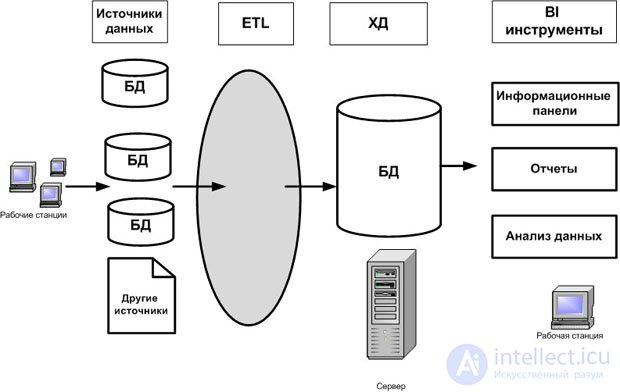
Fig. 4.6 below shows how a business intelligence system interacts with a data warehouse.
enlarge image
Fig. 4.6. Interaction of a business intelligence system with a data warehouse
Developers of business intelligence systems are essentially publishers. They gather data from various sources, edit it to ensure quality and consistency, and ensure trust in the published information. Their success is judged by end business users: analysts, managers at various levels, and the organization's leadership.
The data warehouse supports business intelligence systems, serving as their information foundation.
- Querying and reporting:
- Finding exceptions:
- Visualization, boundary determination, comparison, alerting.
- Cause-and-effect analysis:
- Modeling potential solutions:
- Tracking the outcomes of decisions made.
From this point of view, the data warehouse helps solve the core tasks of supporting business intelligence systems.
- Maximizing the value of intellectual capital:
- applying knowledge in a specific subject domain;
- demonstrating intuition in simple actions;
- making decisions;
- achieving mutual understanding among all decision makers;
- while simultaneously minimizing costs:
- development;
- administration (standard operations, small surprises, big surprises);
- obvious costs (staff, hardware and software);
- hidden costs (missed opportunities, deviations).
Fig. 4.7 shows how data warehouses drive business intelligence systems.
enlarge image
Fig. 4.7. How data warehouses drive business intelligence systems
In practice, data warehouses operate under the following conditions.
- Decentralized, incremental development.
- Various technologies that are not compatible at the most basic level.
- Rapid development.
- A constantly changing environment / constantly changing priorities.
- Potentially incompatible data marts.
- Immediate response.
- Atomic data, real-time data, continuous history.
- A comprehensive view of the customer.
- Tracking, storing, and predicting behavior.
Thus, through the data they store, data warehouses drive business intelligence systems and influence the quality and effectiveness of the decisions made. For data to support quality decisions, it must be well organized. Organizing data in a data warehouse is provided by the data model. The following lectures will be devoted to developing such data models, and now let us briefly sum up this lecture.
Summary
The field of business intelligence systems is developing rapidly and dynamically. This is because, under modern conditions, information is becoming a genuine production resource. At present, the following main types of business intelligence systems can be identified.
- Analytical and managerial reporting. The most widespread, universal, and at the same time effective systems for obtaining information at various levels of company management. Unlike standard reporting systems, they include rich capabilities for building queries, creating reports, visualizing data, and easily processing the results obtained directly by managers and analysts who are not IT specialists.
- Online Analytical Processing (OLAP). OLAP systems are intended for managers and analysts who need constant interactive engagement with information.
- Dashboards. KPI/BSC. Intended for displaying and monitoring key company performance indicators. As a rule, they are used in enterprise management systems based on KPI/BSC.
- Systems for nontrivial data analysis and knowledge discovery. These are based on data mining technologies, which can be used to solve problems that are difficult to formalize.
Business intelligence systems and data warehouses ensure the completeness, reliability, and relevance of the information needed for making management decisions, and reduce the load on transactional systems by redistributing reporting functions.
Business intelligence systems make it possible to solve a whole range of tasks relevant to a modern enterprise:
- consolidate information from heterogeneous sources (internal operational data systems, external sources) into a data warehouse, with preliminary cleaning, transformation of data, and bringing information into a common enterprise data model;
- calculate required indicators and statistical characteristics based on retrospective information from the data warehouse; determine relationships among indicators (perform statistical hypothesis testing, clustering, etc.);
- produce clear graphical and tabular representations of computation results and available information (data visualization);
- automatically obtain predefined report types, and generate custom reports based on the data model created;
- conduct experiments with mathematical models describing the behavior of complex systems ("what if...?" type problems), which makes it possible to assess the validity and business effectiveness of particular steps. Apply simulation, management, optimization, and statistical modeling and forecasting methods.
Продолжение:
Часть 1 Business Intelligence systems and data warehouses
Часть 2 The Microsoft Solution - Business Intelligence systems and data warehouses
Часть 3 Summary - Business Intelligence systems and data warehouses



Comments