Streaming data is data that arrives continuously in real time or with minimal delay. Unlike batch processing, where data first accumulates and is then processed, the streaming model lets you react to events as soon as they occur.
Such data is widely used in modern systems: from server and IoT device monitoring to financial transactions and real-time chats.
What is streaming data
Streaming data is a sequence of events arriving over time. Each event can contain:
- timestamp (time)
- payload (data)
- metadata (source, type, etc.)
Example sources:
- IoT sensors
- user clicks on a website
- transactions in payment systems
- chat messages
- application logs
Advantages of stream processing
- Minimal latency (low latency)
- Real-time response
- Scalability
- Suited for big data
Disadvantages and complexities
- Architectural complexity
- Error handling and retries (idempotency)
- Managing event order
- Infrastructure requirements
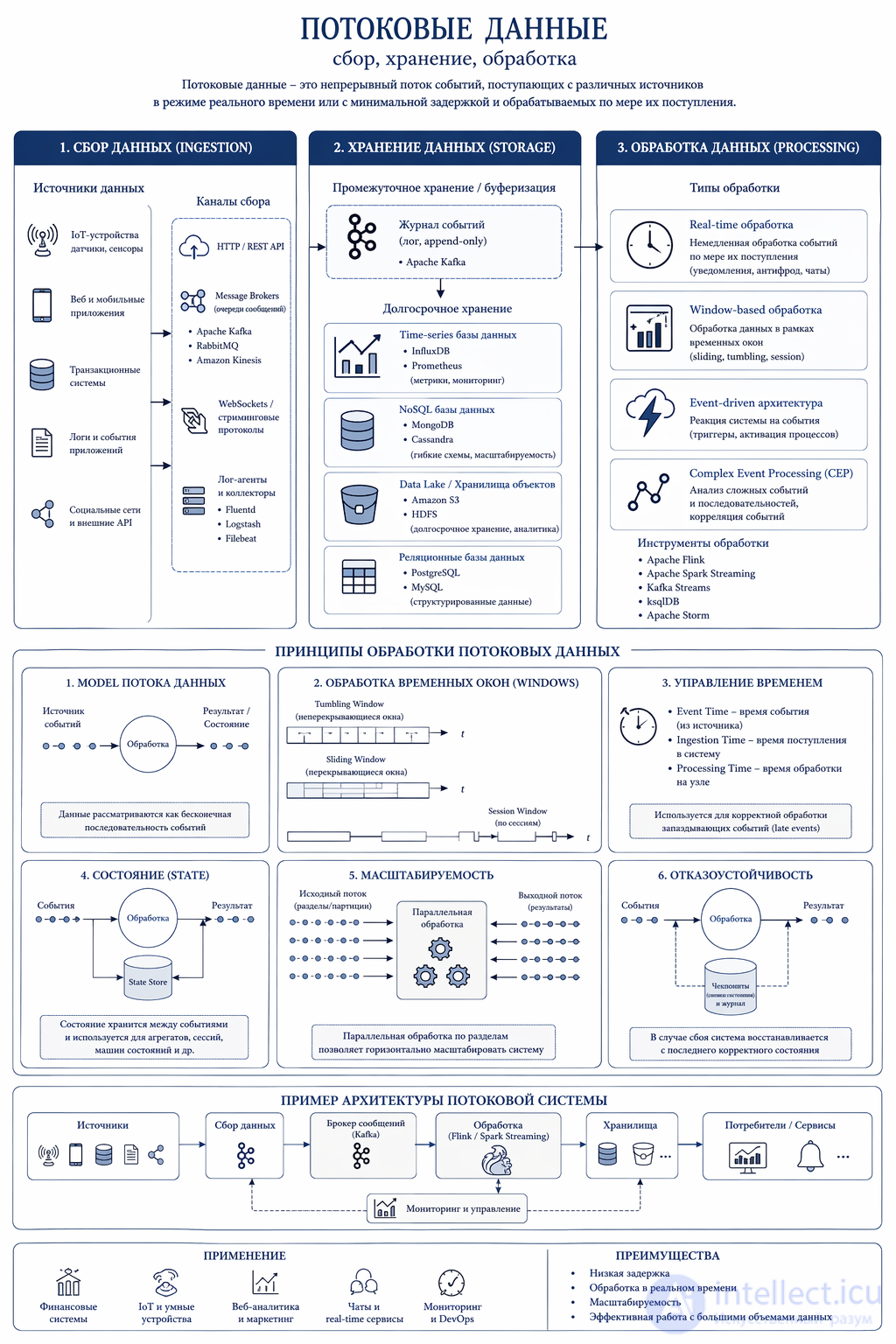
Collecting streaming data (Ingestion)
Ingestion is the first stage, where data enters the system.
Main approaches:
- HTTP / REST API
Clients send events via POST requests.
- Message Brokers (message queues)
Specialized systems for accepting and buffering streams:
- Apache Kafka
- RabbitMQ
- Amazon Kinesis
- WebSockets / Streaming protocols
Used for two-way real-time interaction (e.g., chats).
- Log agents and collectors
Storing streaming data
Streaming data is rarely stored “as is” — usually it is:
- buffered
- aggregated
- saved to specialized storage
Storage options:
1. Event queues and logs
- Apache Kafka
Stores the stream as an append-only event log
2. Time-series databases
Ideal for metrics and monitoring
3. NoSQL databases
Suited for large volumes and horizontal scaling
4. Data Lake / storage
Used for long-term storage
Processing streaming data
Processing is the key stage where data is turned into useful information.
Main processing types:
1. Real-time processing
Data is processed immediately upon arrival
Examples:
- notifications
- anti-fraud systems
- chat messages
Tools:
- Apache Flink
- Apache Spark Streaming
2. Window-based processing
Processing data over “time windows”:
- sliding window
- tumbling window
Example: average temperature over the last 5 minutes
3. Event-driven architecture
The system reacts to events:
- user places an order → notification trigger
- payment goes through → status update
4. Complex Event Processing (CEP)
Analysis of complex events:
- sequences of actions
- event correlation
Features of processing streaming audio and video data
Processing streaming audio and video differs greatly from ordinary streaming data (logs, events). Here requirements are added for timing, quality, and playback continuity.
When video and audio count as streaming data
Video/audio is considered streaming if it:
- is transmitted as a continuous stream
- plays back as it loads, rather than after fully loading
- is split into small chunks (segments)
- has a time-based nature (time-based data)
Examples:
- a YouTube stream
- online radio on Spotify
- video calls (Zoom, WebRTC)
- IP cameras (RTSP stream)
Here the data flows as a stream of events:
[chunk1] → [chunk2] → [chunk3] → ...
When video and audio are NOT streaming data
If a video or audio file:
- is downloaded in full (e.g., an MP4 file)
- is stored as a file and read in its entirety
Then it is ordinary (batch) data, not streaming.
Types of streaming media
1. Live streaming (real time)
- broadcasts
- webinars
- game streaming
Key feature: minimal latency
2. On-demand streaming
- Netflix, YouTube
- the user chooses what to watch
Key features:
- buffering is present
- seeking is possible
How this relates to classic data streaming
A video/audio stream is a special case of streaming data:
| Data type |
Example |
Feature |
| Events |
clicks, logs |
small messages |
| Metrics |
CPU, temperature |
numeric values |
| Media (A/V) |
video, audio |
large continuous stream |
A video/audio stream is usually:
- encoded (H.264, AAC)
- split into segments (HLS, DASH)
- transmitted over HTTP/WebRTC
Yes, video and audio are streaming data if:
- they are transmitted and processed in real time or in parts
But:
- as soon as they become a complete file — it is no longer streaming, but ordinary data
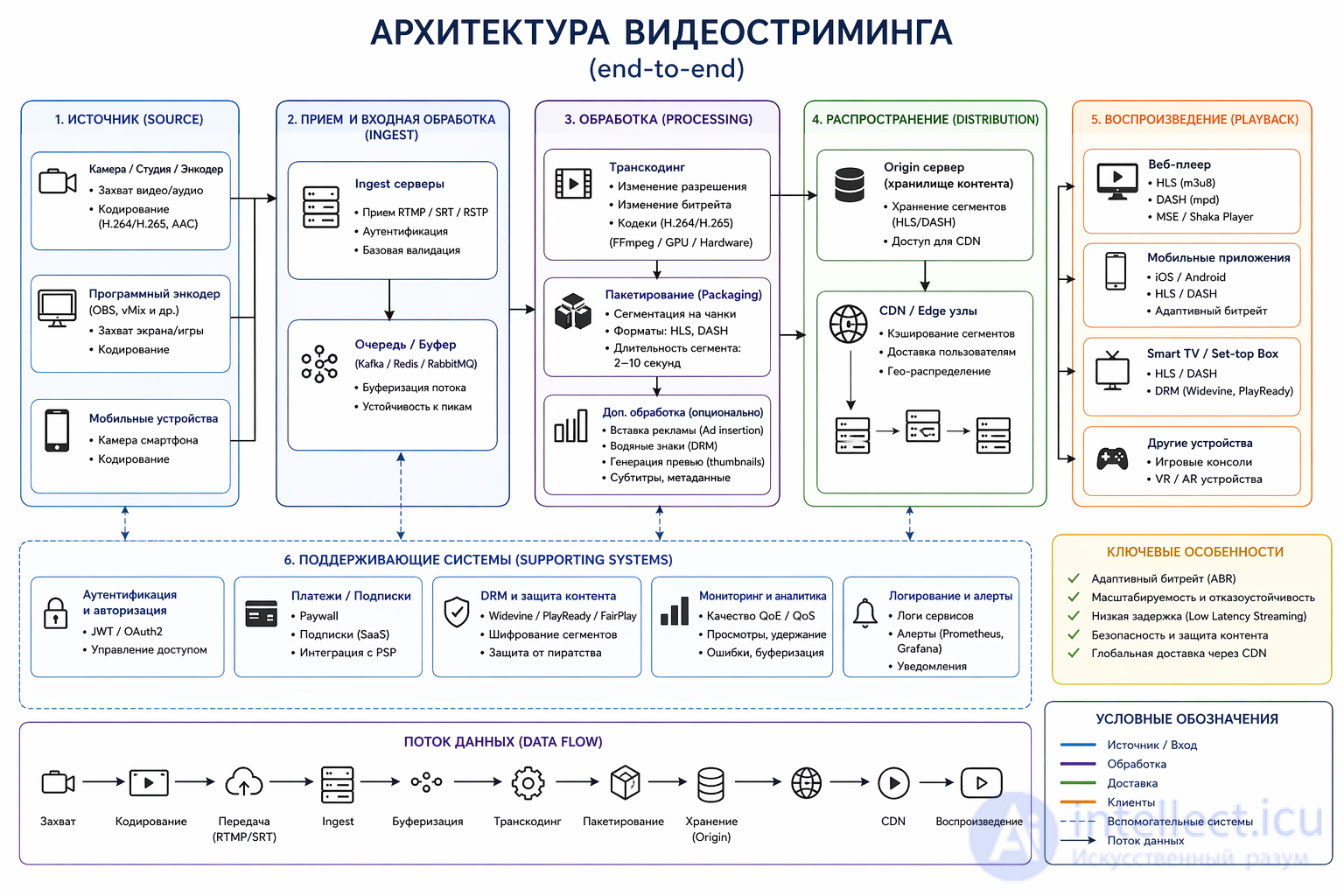
Figure: Architecture of streaming video processing
Let's break down the key features
1. Time sensitivity (real-time constraints)
For media, when the data arrived matters, not just what arrived.
- latency is critical
- data quickly becomes “stale”
- a dropped frame is better than a delay
Example:
- video call → a delay > 300 ms is already noticeable
- a stream → buffering of 2–10 seconds is acceptable
Unlike logs, which can be processed later, this requires near-instant processing
2. Processing by time frames
Video and audio are split into:
Processing happens not by events, but by a continuous time sequence.
Example:
frame1 → frame2 → frame3 → ...
Important:
- order is strictly required
- events cannot be “shuffled”
3. Encoding and decoding
Before processing, data goes through:
- encoding (encoder)
- decoding (decoder)
Popular formats:
- video: H.264, H.265
- audio: AAC, Opus
This adds:
- CPU/GPU load
- latency (encoding latency)
4. Buffering
To avoid lags, a buffer is used:
- the client preloads several seconds of data in advance
- network hiccups are compensated for by the buffer
Balance:
- large buffer → stability, but latency
- small buffer → low latency, but risk of lags
5. Adaptive Bitrate Streaming
Stream quality changes in real time:
- poor internet → low quality
- good internet → HD / 4K
Protocols:
The system dynamically switches the stream
6. Data loss tolerance (lossy tolerance)
Unlike business data:
- losing some packets is acceptable
- the main thing is to preserve smoothness
Example:
- 1 frame is dropped → the user will barely notice
- a 2-second delay → will be noticed immediately
7. Processing “on the fly” (in-stream processing)
Media can be processed directly in the stream:
- transcoding (format conversion)
- compression
- ad insertion
- subtitles
- speech recognition (speech-to-text)
8. Stream synchronization (audio + video sync)
Important:
- audio and video must stay in sync
Issues:
- desync → poor UX
- timestamps must be taken into account
9. Scaling (CDN and edge)
Video streaming almost always uses:
- CDN (Content Delivery Network)
- edge servers
Example:
This reduces latency and load
10. Transmission protocols
Different scenarios → different protocols:
| Scenario |
Protocol |
| Video calls |
WebRTC |
| Video streaming |
HLS / DASH |
| Cameras |
RTSP |
| Live low-latency |
WebRTC / LL-HLS |
11. Stateful processing
Unlike ordinary events:
- state must be maintained:
- buffer
- current bitrate
- playback position
12. Resource constraints
Media streaming:
- requires a lot of bandwidth
- loads the CPU/GPU
- requires optimization
Summary comparison
| Characteristic |
Ordinary streams (logs) |
Media streams (video/audio) |
| Latency |
not critical |
critical |
| Data loss |
unacceptable |
acceptable |
| Order |
matters |
strictly required |
| Data volume |
small |
very large |
| Processing |
events |
frames/signals |
| Buffering |
rare |
mandatory |
Processing streaming audio and video is:
a balance between latency, quality, and stability
Unlike classic data streams:
- time continuity matters here
- data loss is acceptable
- complex infrastructure is used (codecs, CDN, buffers)
Use cases
1. Financial systems
Payment systems (e.g., transaction processing):
- real-time fraud detection
- payment confirmation
2. IoT (Internet of Things)
Sensors transmit data:
Applications:
3. Web applications and analytics
- click tracking
- user behavior
- A/B testing
4. Chats and real-time systems
Related to WebSocket architecture:
- instant message delivery
- UI updates
5. Monitoring and DevOps
- application logs
- CPU, RAM metrics
- alerts
6. Online audio and video broadcasts
Conclusion
Streaming data is the foundation of modern real-time systems. It allows companies to react to events faster, improve user experience, and make decisions based on up-to-date information.
As data volumes grow and processing speed requirements increase, streaming becomes not just an option but a necessity for most high-load systems.
Streaming data is a continuous flow of events that:
- is collected via APIs and message brokers
- is stored in specialized systems
- is processed in real time
It underpins:
- financial systems
- IoT
- analytics
- real-time applications


Comments