
Lecture
Unfortunately, the definition of metadata often found in computer science literature — that it is "data about data" — tends to confuse the interpretation of the term "metadata" more than it clarifies its meaning. The figurative definition "metadata is the "shadow of the data", coined by B. Inmon and well understood by data warehouse IT specialists, also does not add much clarity.
Let us try to clarify the meaning of the term "metadata". Metadata exists in any information system with a database, whether it is an OLTP system, a data warehouse, or a corporate portal. To grasp this fact, one needs to recall that any information system implements a "question-answer" relation over a finite alphabet [62]. Metadata allows users to understand which questions a given information system can answer.
From a technical standpoint, metadata is a set of specifications and data that, taken together, answer questions such as how thoroughly the information system covers its subject domain, what data it contains, what the system's architecture is, and so on.
In particular, metadata contains the semantic interpretation of the data elements circulating in the information system. But that is far from all. Metadata also includes a description of the computing environment, the subject domains, information security, and much more that directly affects how effectively the system is used, primarily by end users and developers.
Going forward, metadata will be understood as the set of data elements and specifications that describe an information system's data and the processes that process it.
The ambiguity in interpreting the term "metadata" stems from the fact that it must satisfy the technical and semantic needs of every group of users of an information system. Each user group has its own requirements for metadata.
For instance, company management (the primary users of executive information systems) wants to know what it can get from the system, how quickly it can get an answer to a question of interest, and preferably in terms understandable to decision-makers. Management does not have time, nor does it see why it should study voluminous operating manuals for the system (which is entirely correct, since management deals with the organization's strategic and tactical objectives, not with the professional task of implementing automated information systems).
At the same time, the organization's specialists, such as users of accounting systems, want such a system to "speak" their professional language, to the point that developers of such systems (for example, 1C:Accounting) equip their systems with a special formal language understandable to accountants. It should be noted that accountants are unlikely to study SQL in any depth.
Company analysts are concerned with more complex questions, in particular the origin and reliability of data. Management requires information from them to support well-founded decisions. The cost of an error can be high: significant losses or lost contracts.
Application developers are interested in information about the information system's data model in order to build or deploy additional business applications. They want to know what is stored in the system's database tables and in what format.
Reflecting such a diverse range of interests in metadata gives rise to a large number of elements that make up the metadata. Designing and developing metadata is one of the most complex and labor-intensive tasks in designing and developing an information system.
Metadata development can be classified as belonging to the IT discipline known as "data management". Data management tasks are often assigned to data administrators, who should not be confused with database administrators or network administrators.
It should be noted that some data management principles differ significantly between data warehouses and OLTP system databases. For example, a principle characteristic of OLTP systems — that there exists only one definition of data that correctly reflects its semantics at any given time — does not hold for data warehouses. This is due to the different time horizons of data in data-warehouse-based systems.
When designing metadata, the data warehouse designer's task is to:
This whole complex of issues that the data warehouse designer must resolve when designing metadata requires fairly careful work on them starting already in the early stages of design. Data warehouse design should begin with metadata design and end with it as well.
Let us examine the main functions of metadata and its composition as it applies to data warehouses.
The role of metadata is considerably more important for a data warehouse than for operational data processing systems. In operational data processing systems the interface is tuned to the business procedures used by specific specialists in data processing and becomes clear to them after special training, whereas the interface of data warehousing systems is built to answer, among other things, unpredetermined (ad hoc) questions. As a rule, such questions are formulated in terms of the subject domain and business processes, and moreover by specialists for whom IT is not their primary profession: analysts, and middle- and senior-level managers.
Thus, one of the main aspects of using metadata in a data warehouse is its subject-area orientation. The primary questions metadata must answer are: what data is represented in the system, and how to obtain it in the form needed for data analysis.
The first main function of metadata in a data warehouse is representing the correspondence between source data and data-warehouse data. As a rule, this description consists of recording the relationships between the attributes of the source data and the attributes of the data-warehouse data, the rules for transforming the former into the latter, changes in data naming, in their physical characteristics, and so on.
Such information makes it possible to identify the data sources for the data warehouse and to assess the correctness and accuracy of the data it contains.
The second main function of metadata in a data warehouse — is managing data over time. The lifetime of data in a data warehouse is typically 5-10 years, sometimes more. For operational data processing systems, on the other hand, the data lifetime is from several days to several months. After that, the data is archived if necessary.
Thus, the time horizon of data in a data warehouse is much greater, and this circumstance fundamentally changes certain data management principles. For example, in operational data processing systems, only one correct definition of data exists at any given time. This is not the case for a data warehouse.
The data structure (schema or data model) in operational data processing systems changes over time, i.e., data in such systems has different representational forms at different times. The history of such changes must be recorded in the data warehouse.
Thus, several data schemas, corresponding to different periods in the evolution of the data sources, may coexist in a data warehouse at any given time. A record of such structural changes is kept in the data warehouse's metadata. On the basis of these records, analysts obtain answers about what data and for what periods they have available.
The third, and quite important, function of metadata in a data warehouse is support for versioning. This function is closely tied to managing data with a large time horizon. Metadata must reflect changes in the internal structure of source data and, consequently, must itself change in order to ensure continuity in the history of changes to the data warehouse's data structure.
Thus, support for metadata versioning makes it possible to provide a correct description of the data model at any given moment in the past, and gives analysts the ability to know what data entered the data warehouse, when, and how.
The fourth main function of metadata in a data warehouse is interpreting data in the terms used by business users. Metadata must support terminology in queries that is understandable to the user, regardless of whatever attribute-naming rules the data warehouse designer used.
The fifth main function of metadata is ensuring the openness (accessibility to other information systems) of the data warehouse system so it can be integrated with the organization's other analytical systems. Querying the data warehouse's metadata from another system lets that system determine the data warehouse's data structure and support data exchange between the systems.
Fig. 14.1 summarizes the main functions of metadata for a data warehouse.
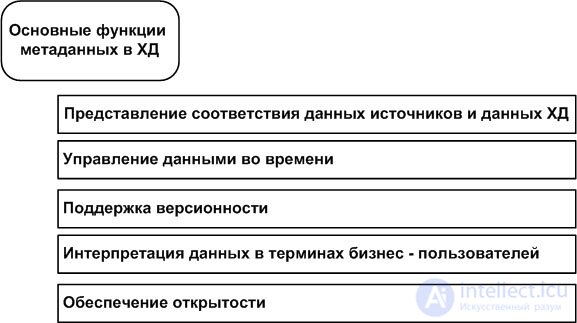
Fig. 14.1. Main functions of metadata for data warehouses
At present there are no strictly defined requirements for the composition of metadata in information systems, including those that use a data warehouse. We will discuss the proposed metadata standards, in particular for data warehouses, a bit later. For now, let us focus on the list of elements or components of metadata that must necessarily be present in a data warehouse.
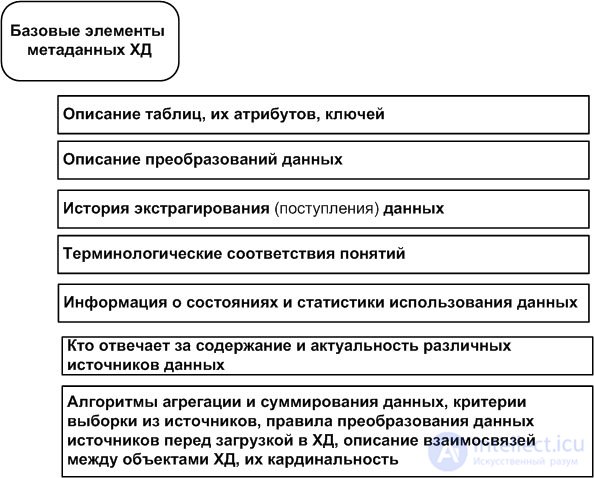
The basic components of data warehouse metadata do not differ greatly from the basic components of operational data processing systems. This is the description of tables, their attributes, keys, and so on. A significant difference for a data warehouse is support for metadata versioning. The basic components tell us what data is stored in the data warehouse.
The next group of metadata components, characteristic of data warehouses, is the description of transformations. As a rule, the description of data transformations for a data warehouse includes:
Transformation components tell us how the data in the data warehouse was obtained.
An important component of data warehouse metadata is the history of the data's arrival into the warehouse. The metadata component — the data extraction history — tells us when the data entered the data warehouse, and also allows us to judge how completely the data is represented in the warehouse. For conducting data analysis this information is very important, since it is the basis on which users' assertions about the correctness of the analysis and the reliability of its results are formed.
Information about synonyms, or terminological correspondences between concepts, is yet another component of data warehouse metadata. It includes alternative names (aliases) for data warehouse data. Such information typically makes the data warehouse more "user-friendly".
The next important component of metadata is information about the state and usage statistics of the data warehouse's data. This information forms the basis for optimizing the data warehouse's performance and includes data such as the number of rows in tables, the rate of table growth, statistical profiles of table usage (average and maximum number of queries per day), archiving and deletion statistics, table indexing, the frequency with which indexes are used in queries, and so on.
Another component of data warehouse metadata consists of data aggregation and summarization algorithms, source selection criteria, the rules for transforming source data before loading it into the data warehouse, descriptions of the relationships between data warehouse objects, and their cardinality, and so on. Such information plays an important role in conducting data analysis and is often needed by analysts to assess the reliability of the analysis results.
Information about who is responsible for the content and currency of the various data sources makes up another metadata component. This information matters to the data warehouse support team and makes it possible to organizationally address the quality, accuracy, and reliability of the data in the warehouse.
Metadata often includes components that describe data access patterns (when and how data migrated to another storage tier). These are also used to optimize the physical flow of data in the data warehouse and to optimize performance.
Sometimes the data processing algorithms in a data warehouse use information about objects from external systems — so-called extension tables (code tables and electronic reference directories). In such cases, the data warehouse's metadata must record a description of such tables and the history of their changes, since if the codes change, corresponding changes need to be made in the data warehouse's data processing so as not to lose the historical relationships in the data.
Data warehouse designers often include additional information in the metadata that they consider important.
From what has been said, it is clear that designing data warehouse metadata is a rather complex and creative task for the data warehouse designer, one whose solution often requires literary skill, knowledge of the data warehouse's subject domain, and a lot of time.
Fig. 14.2 shows the main elements of metadata for a data warehouse.
Let us look at how metadata can be described using the example of a data mart intended for analyzing the sales of some hypothetical company. Suppose the company manufactures and sells its own products. The data mart is used by the company's analysts to study in detail the relationship between the company's expenses and revenue from product sales, and to prepare sales reports for management.
Let us assume that our hypothetical company has opened a network of points of sale (retail and wholesale warehouses) and organized a chain of stores, i.e., it has expanded its operations. Company management wants to assess the effectiveness of this expansion and to have more detailed information about the relationship between sales and production in terms of costs and revenue.
Let us further assume that the company produces about 200 kinds (models) of some product. Each product has a base set of components. Additional components are used to create a specific product model. The company's market policy is structured so that the number of models produced remains constant. This means that the number of new models is roughly equal to the number of models discontinued.
For each model of each product, a flexible discount system is applied depending on demand. As a rule, the discount size for buyers of large batches of product is determined by the retail warehouse manager.
When a decision is made to discontinue production of a given model, information about it is kept in the company's database for 6 months after all remaining stock of that product has been sold or written off. Data about the product is deleted at the moment when the data about the last model of that product is deleted.
The company supports two sales channels: through a wholesale store and through a retail store. The wholesale store sells goods only to wholesale buyers. A buyer is considered wholesale if they purchase more than 20 batches of goods per year. A wholesale buyer may submit an invoice either directly to the wholesale store or by fax to the company's central office. Any buyer may purchase from several of the company's stores.
The retail store sells for cash. Regardless of any discounts offered, the price of the goods varies. Although an invoice is issued for every product sale, the company does not track buyers in retail sales.
Our company's data mart is designed to solve problems in analyzing cost and revenue indicators. The typical queries that the system should be able to answer are as follows.
The data source for the data mart is a fragment of the company's operational data processing system database. One possible data-mart structure, obtained as a result of the design process, is shown in Fig. 14.3.
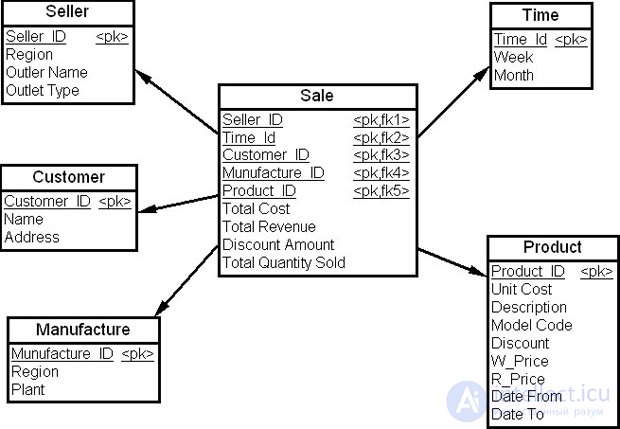
Let us examine a description of the metadata for such a data mart. Note that the description given is an example of one of several possible approaches and should not be considered complete or final.
This section provides logical schemas of metadata for the data warehouse in our example. The example does not claim to be exhaustive, but it gives a clear picture of the approaches to describing metadata.
The logical structure of the metadata model may be as follows.
| Name: | Sales. |
| Definition: | The metadata model contains a meta-description of the company's sales data for each product type, corresponding to each paid invoice, on a daily basis. |
| Purpose: | The purpose of this model is to give the company's analysts and management the ability to analyze sales. |
| Person responsible for data correctness: | Regional sales manager. |
| Dimensions: | Customer, Manufacture, Продукт (Product), Продавец (Seller), and Время (Time). |
| Facts: | Продажа (Sale). |
| Metrics: | Total cost, Total revenue, Total quantity sold, and Discount amount. |
The logical structure of fact metadata may be as follows.
Name: Продажа (Sale).
Definition: This fact contains sales data for every order recorded in the operational order-processing system for each retail and wholesale warehouse.
Alternative name: None.
Load frequency: Daily.
Data load statistics
Data usage statistics
Data archiving rules: Data will be archived after 36 months, on a monthly basis.
Archiving statistics:
Data deletion rules: Data will be deleted after 48 months, on a monthly basis.
Deletion statistics:
Data quality: Staff errors in filling orders are possible. However, the records represented in the database are accurate.
Data accuracy: The metrics of this fact are 100% accurate, since they represent sales that have already occurred.
Granularity of the "Time" dimension: The metrics of this fact represent the sale of a given product under a given order.
Key field. The key for the sale fact is the combination of the dimension keys: Customer, Manufacture, Product, Seller, and Time.
Key generation method: The time portion of the key is simply the date of the product sale. The product key, manufacturer key, seller key, and customer key are selected from the operational database's reference directories.
Sources
Metrics: Total cost, Total revenue, Total quantity sold, and Discount amount.
Dimensions: Customer, Manufacture, Продукт (Product), Продавец (Seller), and Время (Time).
Employee responsible for the data: Manufacturing plant director.
Let us illustrate the logical structure of dimension metadata using the "Customer" and "Time" dimensions as an example. It may be as follows.
For the "Customer" dimension
Name: Customer.
Definition: A customer is any individual or legal entity that purchases the company's products. A customer may purchase goods at several of the company's points of sale.
Alternative name: none.
Dimension hierarchy: Data along this dimension can be summarized at two levels. The first (lowest) level of summarization is the shipping address of the goods to the customer. Data for each legal entity's address can later be summarized by customer.
Change rules: Shipping addresses for each legal entity are inserted as new rows in the dimension. Changes to existing customer addresses are made by updating the dimension table directly.
Load frequency: Daily.
Load statistics
Usage statistics
Archiving rules: Data for this dimension is not archived.
Archiving statistics:
Deletion rules: Customers who have not purchased the company's products in the last 5 years are removed from the dimension table on a monthly basis.
Deletion statistics:
Data quality: When a new customer is added to the dimension, a lookup is performed to determine whether that customer has already had sales recorded at a different address. Regardless of whether such sales exist, the customer with the new shipping address is inserted as a new row.
Data accuracy: A five-percent margin of error is permitted in determining the relationships between a customer and their shipping addresses.
Dimension key: A system-generated number that identifies the customer.
Key generation method: When a customer record is copied from the source system, a check is performed to see whether the customer is already present in the data warehouse. If that customer is not in the data warehouse, a new identifier is generated and the record is inserted into the dimension.
Sources
Attributes
Facts: Sale.
Metrics: Total cost, Total revenue, Total quantity sold and Discount amount.
Data steward: Vice President of Sales and Marketing.
For the "Time" dimension
Name: Time.
Definition: The "Time" dimension contains the points in time when the company records sales data.
Alternative name: None.
Dimension hierarchy: The lowest level of data summarization is the day. Data for a given day can be summarized either by week or by month.
продолжение следует...
Часть 1 Metadata in data warehouses
Часть 2 Metadata standards - Metadata in data warehouses
Часть 3 Summary - Metadata in data warehouses

Comments