
Lecture
Database optimization is an important process for improving the performance and efficiency of databases. There are several database optimization methods that can help achieve this goal.
All the methods listed below relate to organizing and managing data in information systems and databases, and in large high-load projects (for example, messengers, payment systems, etc.). Here are their common features and interrelations:
Database optimization: All of these methods and techniques are used to optimize the storage and processing of data in databases or information systems.
Performance and scalability: Many of these methods, such as indexes, buffer tables, sharding and partitioning, are used to increase the performance and scalability of databases, allowing them to handle large volumes of data and queries more efficiently.
Fault tolerance: Data replication and sharding are also related to ensuring fault tolerance and data availability. Replication makes it possible to have copies of data on different servers, while sharding distributes data across different nodes.
Managing data structure: Denormalization, partitioning and sharding can affect the structure of data, since they change the way data is organized within a database.
Big data processing: Many of these methods, such as MapReduce and data replication, are applied in systems that process large volumes of data, such as big data analytics systems and data warehouses.
Caching and query optimization: Indexes, buffer tables and lazy loading are used to speed up data queries by caching query results or creating indexes for fast lookup.
The goal of improving performance and data availability: All these methods share a common goal — improving the performance, availability and management of data in information systems.
Although each of these methods solves specific problems and can be applied in different contexts, together they represent a set of tools and strategies for working effectively with data across various information systems and databases.
Here are some ways to optimize high-load systems:
Indexes:
Data normalization:
Query optimization:
Partitioning:
Data cleanup and archiving:
Using a cache:
Hardware-level optimization:
Monitoring and tuning:
It's important to note that database optimization is a continuous process, and there is no universal recipe for every situation. Specific optimization methods can vary depending on the specific requirements and characteristics of your database.
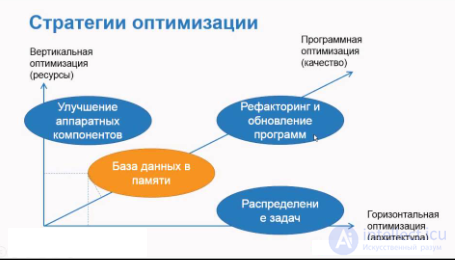
Improving query performance: Denormalization can reduce the number of table joins, which can speed up the execution of complex queries. This is especially useful in cases where read queries are performed frequently.
Reducing load on the database server: Since queries become less complex with denormalization, this can reduce the load on the database server and allow it to handle more queries simultaneously.
Reducing application code complexity: Denormalization can simplify application code, since there is no need to perform many complex table-join queries.
However, denormalization also has its drawbacks:
Data redundancy: With denormalization, data can be duplicated in different parts of the database, which can lead to data integrity problems.
More complex insert, update, and delete operations: Denormalization makes insert, update, and delete operations more complex, since data may be stored in several places.
Loss of flexibility: Denormalization complicates changes to the data structure, since changes may require updating data in several places.
Loss of normalization benefits: Denormalization can lead to the loss of the benefits of normalization, such as storage space savings and data integrity guarantees.
Denormalization should only be used after careful analysis and evaluation of the specific requirements and characteristics of your database. It is an optimization tool that should be used with caution and in line with the specific needs of your application.
Relational databases (RDBMS): This is the most common type of data storage. They use structured tables and SQL queries to store and access data. Examples of such DBMSs include MySQL, PostgreSQL and Microsoft SQL Server.
NoSQL data stores: NoSQL databases provide a more flexible data schema and are often used to store unstructured data. These include MongoDB, Cassandra, and Redis.
Columnar databases: This type of data storage is optimized for analytics and data processing. Examples include Apache HBase and Apache Cassandra.
Graph databases: These are designed for storing and processing data as graphs. Examples include Neo4j and Amazon Neptune.
Time-series storages: These databases are designed for storing time-series data, such as logs, metrics, and events. Examples include InfluxDB and OpenTSDB.
Cloud data storages: These are data storages provided by cloud providers, such as Amazon Web Services (AWS) S3, Google Cloud Storage, and Microsoft Azure Blob Storage.
XML and JSON storages: These are designed for storing and processing data in XML and JSON formats. Examples include BaseX and CouchDB.
Object-oriented data storages: These storages provide a mechanism for storing objects while preserving the relationships between them. Examples include db4o and Versant.
Operational data warehouses (Data Warehouses): These systems are designed for storing and analyzing data, and are typically used to support business intelligence. Examples include Amazon Redshift and Google BigQuery.
Other specialized data storages: There are other specialized data storages as well, such as temporal databases, columnar data stores, and so on.
The choice of a particular data storage depends on the project's requirements, data volume, access speed, data structure, and other factors. It's important to choose the right data storage to ensure effective data management and access in your application or organization.
Data caching: Buffer tables can be used to cache frequently requested data in RAM. This reduces data access time, since the data is already in memory and there's no need to access long-term data storage.
Temporary storage of intermediate results: Buffer tables can be used to temporarily store query results or intermediate computations. This makes it possible to optimize complex queries or algorithms, speeding up execution.
Join optimization: When performing joins (JOIN) between multiple tables, buffer tables can hold intermediate join results, which can significantly speed up query execution.
Minimizing access to long-term data storage: If read queries are performed frequently, buffer tables can be used to reduce the load on long-term data storage, such as a relational database or file system.
Materialized views: Buffer tables can be used to create materialized views, allowing query results to be stored as tables for subsequent fast access.
Buffer tables are usually created in RAM and have a limited lifetime. They can be created and removed automatically, or managed programmatically depending on the specific needs of the system. Their purpose is to improve performance and optimize data queries, reducing the load on persistent storage such as a hard drive or database.
Lazy and eager loading are two different approaches to loading data in information systems, such as applications working with databases. They are used to optimize data access and reduce overhead when executing queries. Here are their main characteristics:
Lazy loading:
Eager loading:
The choice between lazy and eager loading depends on the specific requirements of the application and data usage scenarios. In some cases, it may be useful to use a combination of both methods to optimize performance and save resources. It's important to configure data loading correctly to avoid unnecessary load on the database and speed up operations when accessing data.
Data replication is the process of creating and maintaining copies of data from one data source (the master server) on one or more remote servers (replicas) in order to ensure data availability, increase performance, and provide protection against failures. Data replication is an important part of a high-availability and fault-tolerance strategy in information systems. Here are some key aspects of data replication:
Replication models:
Master-Slave: In this model, one server (the master) holds the primary data source, and one or more other servers (slaves) hold copies of it. Writes are typically performed on the master server, and data is replicated to the slaves for reading. This is often used to distribute load and increase read performance.
Master-Master: In this model, two or more servers act as masters and can perform both write and read operations. This provides fault tolerance and load distribution, but requires more complex data synchronization.
P2P (Peer-to-Peer): In the P2P model, there is no master or slaves. Each server has full copies of the data and can perform read and write operations. This provides maximum fault tolerance, but also requires more complex synchronization.
Synchronous and asynchronous replication:
Synchronous replication: In this case, write operations don't complete until the data has been replicated to all replicas. This ensures data consistency, but can slow down write operations.
Asynchronous replication: Here, write operations complete independently of data replication to the replicas. This increases the performance of write operations, but can create a small delay in data consistency between the master and the replicas.
Goals of replication:
Availability: Data replication can ensure data availability even if the master server fails.
Performance: Replication can be used to distribute load and speed up read operations.
Backup: Replicas can be used to create data backups.
Protection against failures: Data replication provides protection against data loss due to server failure, since copies of the data reside on other servers.
Data conflicts: When using replication, especially in a master-master model, data conflict issues may arise that need to be managed and resolved.
Why this is needed
Load distribution
OLTP: reads go to replicas
OLAP: heavy analytics on a separate replica
Taking a backup from a separate replica
Failover / High Availability
Can be manual or automatic
Delayed replication
Does not replace backups!
Streaming (or physical) replication
Essentially, this consists of transmitting the WAL over the network;
Asynchronous
Fast, but data can be lost;
Synchronous
Slower (not by much within a data center), but more reliable. It's advisable to have two replicas;
There's also a cascading variant (had to mention it somewhere)
Streaming replication:
Doesn't work between different architectures;
Doesn't work between different PostgreSQL versions;
Logical replication
Available out of the box starting with PostgreSQL 10;
Older approaches: Slony, Londiste, pglogical;
Not recommended, because they are slow and/or work poorly;
9 of 24
Why do we need yet another type of replication?
Replicating part of the data, not everything;
Zero-downtime updates;
On the replica you can use temporary tables, and in fact write anything at all, including to replicated tables;
A single replica can pull data from two masters;
In theory, you could set up a multimaster configuration;
And other scenarios where physical replication wasn't a good fit;
Data replication is a powerful tool for ensuring data availability, performance, and fault tolerance. However, configuring and managing it can be a complex task, requiring careful planning and alignment with your system's requirements.
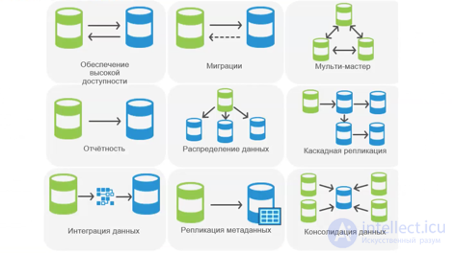
Sharding is a horizontal data-partitioning strategy used to improve the performance and scalability of databases. Instead of storing all data in a single database, data is split into small fragments (shards) that are stored on different servers or nodes. This allows the load to be distributed evenly and increases the database's ability to handle large volumes of data and queries. Here are some key aspects of sharding:
Shards:
How to choose a shard:
Advantages of sharding:
Disadvantages of sharding:
Applications of sharding:
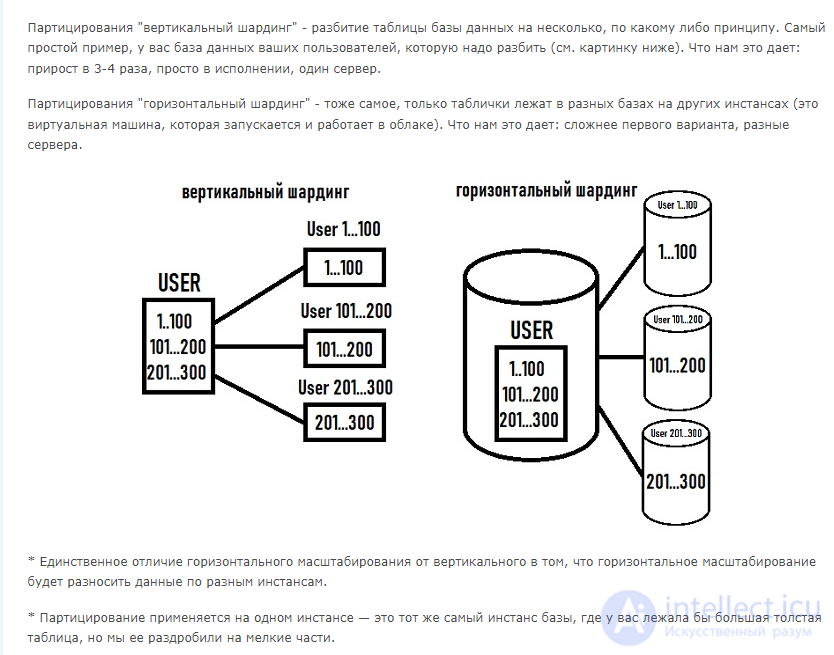
Sharding is a powerful tool for optimizing database performance and scalability, but it also requires careful design and management to avoid complications and problems when reconciling data across shards.
MapReduce is a method for processing and aggregating large volumes of data across a cluster of servers, in order to parallelize and speed up computation. Let's explain this in simple terms with an example:
Imagine you have millions of books and you want to find out how many times each word appears in these books. This is a big data processing task that can be solved using MapReduce.
Map: In the first stage, each server (or "mapper") takes a portion of the books and splits it into individual words. It then counts how many times each word occurs in its portion. For example, a server might find that the word "apple" occurs 100 times.
Shuffle and Sort: After all the servers have finished their work, the results are grouped and sorted. All occurrences of the word "apple" are combined together and sorted.
Reduce: At this stage, other servers (or "reducers") take the sorted list of words and count the total number of occurrences of each word. For example, all mentions of the word "apple" are counted, and you find out that it occurs 1000 times across all the books.
So, MapReduce breaks a large task down into many small tasks that are processed in parallel on different servers, and then collects and aggregates the results. This approach makes it possible to efficiently process and analyze huge volumes of data, which is especially important in big data analytics and data processing at large companies and projects.
Preliminary load testing of a database is a process in which the database is subjected to experiments and tests simulating different levels of load and traffic, in order to identify bottlenecks and performance problems and optimize its operation before deployment to production. In the context of database optimization, load testing plays an important role:
Identifying bottlenecks and performance problems: Load testing helps reveal how a database responds to different levels of load and traffic. This makes it possible to identify bottlenecks where performance degrades, and problems such as slow queries, locks, or conflicts.
Optimizing structure and indexing: Based on the results of load testing, you can optimize the database structure and indexes. You can determine which tables, fields, and indexes need optimization so that queries run faster.
Tuning the database server: Performance problems identified during load testing may require tuning the database server. This can include changing server parameters, optimizing buffers, or reallocating resources.
Scaling the database: If load testing shows that the database cannot handle the current level of load, this may require scaling the database, for example by adding replicas or sharding.
Preventing failures and overloads: Load testing can help prevent database failures and overloads that could make the application unavailable. It allows you to determine how much load the database can withstand and to plan contingency measures.
Evaluating performance under changes: If you're planning to make changes to the database structure or queries, load testing lets you assess how these changes will affect performance before they are implemented.
Thus, load testing is an important stage in database optimization, since it allows performance problems to be identified and resolved before they start affecting application operation. This helps ensure stable, high performance for the database and, as a result, for the entire application.
If you know of other methods, techniques, or approaches for optimizing database performance, please write about them in the comments.

Comments