
Lecture
Это продолжение увлекательной статьи про буддизм.
...
psychomental and psychophysical processes through the development of continuous awareness. The chief methods here are shamatha (the calming of consciousness, the cessation of the agitation of the psyche, freeing oneself from afflictions and psychomental instability) and vipashyana (analytical contemplation, involving the cultivation of states of consciousness that are wholesome, from the Buddhist point of view, and the cutting off of unwholesome ones).
3. Right Concentration, or right trance. The attainment of samadhi proper, the ultimate form of contemplation, in which the distinctions between the contemplating subject, the contemplated object, and the process of contemplation disappear. The Buddhist tradition describes numerous kinds of samadhi, some of which do not lead to nirvana. Correct practice of samadhi ultimately brings the monk to liberation, and he becomes an arhat («worthy one»; the Tibetan etymology of this word, «conqueror of enemies», i.e., of the afflictions – kleshas, is not philologically correct).
All religions struggle with limitation – with the impermanence and imperfection of human life. Buddhism designates this problem with a single word: suffering (duhkha). To be born is suffering; to grow up is suffering; to fall ill is suffering; to grow old and to die is suffering. Besides physical pain, there exists a subtler form of suffering: dissatisfaction, unhappiness caused by the fact that we have what we do not want and lack what we do want. Anxiety (mental suffering) is present even in moments of enjoyment and contentment: we know, or at least fear, that they will not last long. There is the fear of losing something: one’s position, the respect of others, one’s loved ones, one’s possessions. And at the very depth lies a vague and gnawing foreboding of death, which not only takes life away but also deprives it of all meaning. It is precisely this mortal anxiety that motivates human efforts, it is precisely this that drives the world.
The definition of existence as suffering implies something more than mere physical pain. Duhkha is a state of «unease, dissatisfaction, when everything falls out of one’s hands and goes awry». It describes human life as impermanent, devoid of an unchanging «self». In other words, the chief property of the personality is changeability. Everything that exists is transient, fleeting, and subject to ceaseless change. With regard to the natural world this fact is confirmed by modern science. Earlier we spoke of particles in motion – of matter and energy; now we speak of fields of energy. What looks like a whole and unchanging object is in fact a process in which molecules, electrons, protons, and so on are involved, which themselves are not whole and unchanging bodies but processes, weavings of interacting energies.
What is true with regard to nature as a whole is also true with regard to human existence. Buddhism defines the human personality as a complex of interacting moments (in the physical sense of the word) of material form, consciousness, perception, and volitional acts. These weavings of energies are called the «five skandhas». The skandhas, i.e., groups of elements, are no more whole and unchanging than molecules and electrons. Everything a person experiences can be represented as the interaction of these five phenomena.
Let us briefly define the concept of «dharma» itself. This word itself is formed from the Sanskrit root dhr – «to hold», i.e., dharma is a «holder» or «bearer». Bearer of what? Of its own quality. Thus, dharma is an indivisible element of our psychophysical experience, or an elementary psychophysical state. Can dharma be considered a substance? Again, no, and for two reasons at once. First, according to the Indian understanding of substance and substantiality, held for example by the Brahmanical school of Nyaya, one of the principal ideological opponents of Buddhism – a substance is always the bearer of a multiplicity of qualities, which are connected to it by various relations, whereas in Buddhism each dharma carries only one quality, its own. Second, the Indian substantialists asserted the principle of the distinction between the bearer (substance) and the borne (accident, quality), which was expressed in the formula dharma–dharmin bheda, where dharma is the borne quality and dharmin is its substantial bearer. Buddhism, however, asserts that dharma and dharmin are identical, that the bearer and the quality borne by it coincide. There is also a third fundamental difference: the substances of the Brahmanists are, as a rule, eternal, whereas dharmas are momentary. But we shall speak of this in more detail later.
Speaking of dharmas, one further important circumstance should be noted, to which the contemporary St. Petersburg Buddhologist V.I. Rudoy paid close attention. The fact is that in many (though not all) Buddhist schools dharmas are regarded, on the one hand, as dravya sat, i.e., as elements endowed with ontological status, real elements, and, on the other, as prajnapti sat, i.e., as merely conceived, or conventional, units of the language for describing experience. Our experience is constituted by dharmas, but the dharmas themselves we also describe in terms of dharmas. A somewhat crude example may be given here: our speech consists of words, but we describe words too by means of words. This peculiarity of the Buddhist understanding of dharmas brought them close to a resolution of the so-called paradox of psychic processes, which European psychology came to recognize only in the twentieth century: we always describe consciousness not in immanent terms (terms reflecting properties inherently belonging to it itself), but in terms either of the external world or of another consciousness. By introducing the concept of dharma both as an ontologically relevant element of consciousness and of experience in general and as an element of the language for describing consciousness (and experience), the Buddhists, in essence, found one of the possible variants of a language of description immanent to consciousness itself. In this lies Buddhism’s undoubted contribution to Indian and world philosophy.
Almost all schools of classical Indian Buddhism did not doubt the existence of a world outside the perceiving subject's consciousness, and the Vaibhashika–Sarvastivadins were even confident that it was quite accurately and adequately reflected in human consciousness in the process of perception. But this objective world in itself was of absolutely no fundamental interest to Buddhists. The world of Buddhist cosmology is a psychocosm, that is, a world already reflected in human consciousness and thereby included within it, or, more precisely, within the dharmic stream that forms it, having become, as it were, part of what may be called a «personality». For only the things of this world, once assimilated and appropriated by the subject, can be desired; only toward them can one feel aversion or have any affective states at all.
Unlike the Abrahamic religions (Judaism, Christianity, Islam), Buddhism has no:
Some of these tenets distinguish Buddhism from Hinduism and Brahmanism. Hinduism also recognizes the doctrine of karma, but Buddhism became the first religion to declare that some people cannot be superior to others on account of their origin, social status, occupation (caste), or sex. In general, as the Buddhologist V. P. Androsov notes, Buddhism, Hinduism, and Jainism developed their philosophies «in conditions of mutually enriching polemics».
Despite the denial of God in Buddhism, Buddhists themselves and some researchers do not recognize Buddhism as an atheistic teaching and prefer to use the term non-theism, which in Russian-language literature is usually translated as non-theism, or the term non-theistic religion. The question of the extent to which Buddhism corresponds to the Western understanding of the concept of religion remains a matter of debate among Buddhologists. According to the Buddhologist A. V. Paribok, Buddhism is not uniform in this respect. For example, Paribok considers the Nichiren and Pure Land schools to be absolutely religious schools, the Soto Zen and Dzogchen schools to be absolutely non-religious, while most of the remaining schools Paribok considers to combine religious and non-religious elements in varying proportions
The world as an objective reality is completely indifferent to us, abiding «in tranquility» and inaccessibility beyond our consciousness and our interest. At the same time, Buddhists understood perfectly well that this world appears completely differently to different types of living beings: the world as «abode» correlates precisely with the level of unfolding of consciousness of different living beings, and one and the same world in itself turns out to be completely different psychocosms for different living beings. As one Mahayana thinker would later say, what is the Ganges River for a human being will be a stream of pus and filth for a hungry preta-spirit, and a stream of ambrosia-amrita for a deva-deity. And only the Buddhists of the Yogacara school did not consider it possible to assert that behind these subjective «Ganges Rivers» there lies some objective, «correct» Ganges.
An example from modern philosophy may be given here. The Estonian biologist and philosopher von Uexküll specifically studied the problem of the relationship between the bodies of animals and their perception of their environment. Here is an elementary example from his reasoning. A pine tree grows. For a forester, this is a tree that should either be protected or used for firewood. For a fox, the pine is a home and shelter, because beneath the pine's roots lies its den. And what the pine is for the bark beetle, which lives in the pine and simultaneously feeds on it, one can only guess. But whereas for the Estonian scientist the bodies of animals adapt to their environment, for Buddhists, on the contrary, the environment is, as it were, formed around the given species of living being.
Thus, Buddhist cosmology describes not the physical universe, but the psychocosm, above all the psychocosm of the human being. What, then, does this psychocosm look like?
In their reasoning about the nature of the person, dharmas, momentariness, and other similar questions, the Buddhists thought in an entirely logical, rational,
and discursive manner, but their reasoning about cosmology is clearly permeated by archaic mythologism, refracted, however, through the prism of the general worldview premises and doctrines of Buddhism. Buddhists, in essence, did not create a new cosmology but borrowed it from the pan-Indian cultural heritage, slightly modifying it in accordance with the principles of their teaching. However, Buddhists never attached any exceptional worldview significance to their picture of the world and quite calmly transformed it in the regions where Buddhism spread, under the influence of local conceptions and cosmological systems. Such an authoritative figure of contemporary Buddhism as the 14th Dalai Lama once even said that if being a Buddhist means believing in the world-mountain Sumeru, the continents located around it, and the hell situated underground, then he is not a Buddhist at all.
The traditional Buddhist conceptions of the world – the psychocosm – are as follows: the universe is by its nature threefold (recall the archaic notions of the three worlds – the lower, the middle, and the upper); it consists of three levels, or three worlds (loka; cf. Latin locus – «place») – the world of desire (kamadhatu), the world of form (rupadhatu), and the world of formlessness (arupadhatu). Because of this three-layered structure, this universe is often called the «triple world,» or «tricosm» (trailokya). The world of desire (kamadhatu) is the place where (or which is experienced by) almost all living beings dwell, with the exception of certain higher deities
and extremely advanced yogins. In the world of desire dwell the inhabitants of the hells, hungry ghosts, animals, humans, and most of the Gods. At the center of the flat earth stands Mount Sumeru, soaring to an inconceivable height, around which are located the palaces of the thirty-three Gods of the world of Brahma. Mount Sumeru is surrounded by several rings of mountains formed of various metals. Beyond them extends the expanse of the world ocean, in which lie four continents, one of which is «our» continent (its name is Jambudvipa; in medieval sources this name is usually applied to India). Underground are the abodes of the pretas and a system of ten («cold» and «hot») hells, the lowest and most terrible of which is called «Niraya» («without deliverance»), since the term of residence there is incredibly long, though nevertheless finite.
Worlds-tricosms similar to ours are immeasurably numerous; they exist according to the same laws, as it were, in parallel with our world.
Cosmic time is cyclical and beginningless, i.e., none of the cycles can be regarded as the first. The world was created by no one; the idea of divine creation is rejected by Buddhism in principle, for a whole range of considerations both ethical (a benevolent God could not have created a world whose essence is the suffering of living beings) and metaphysical (these will be discussed in the lecture devoted to Buddhist philosophy). The cause of the existence of worlds is the energy of the collective karma of the living beings of the previous world cycle (just as the future life of a being is conditioned by the karma it possesses at the moment of death).
After the destruction of one universe, there exists only infinite space (akasha), in which at a certain moment certain breezes begin to stir, gradually growing stronger and turning into a most powerful hurricane, which gradually condenses to a state of «adamantine hardness» and takes on the shape of a circle. This circle of hardened wind forms the foundation of the new world. And it is nothing other than the objectified energy of the collective karma of the living beings of the destroyed universe (compare this with objectified will as the physical basis of phenomena in the philosophy of A. Schopenhauer, especially his work «On the Will in Nature»). The further formation of the world proceeds from top to bottom. At first a heavenly palace suddenly appears with the God Brahma upon his throne; after this, around him appear the other thirty-three Gods of the heavens of the world of desire. They see Brahma and exclaim: «This is Brahma! He is eternal, he has always existed! He created all of us!» – thus arises belief in a Creator God. The golden-hued clouds billowing on high begin to pour down rain, which floods the disk of wind below and gradually forms the world ocean. From the sediment dissolved in it, the continents and Mount Sumeru are formed. The hells appear last.
People who appear on the earth after the formation of the continents are at first divine and resemble the Gods of the world of form; their lifespan equals 84,000 years. At this time the earth is covered with a special earthen cake exuding an incomparable aroma. People need not eat at all, but this aroma attracts them so strongly that they begin to eat the earthen cake, and gradually eat it all up. Meanwhile their lifespan gradually shortens, their bodies coarsen, digestive organs form, and by the time the whole cake covering the earth has been eaten, people can no longer do without food. They have no choice but to begin growing rice, but there is not enough rice for everyone, and so people begin to draw boundaries, separating their plot from another’s, and property appears. However, since there is less and less rice, some people begin to violate the boundaries of others’ fields and steal rice. Disorder reigns, and clashes begin between people. Then people decide that the time has come to establish order, and they resolve to elect the most worthy among their number to maintain order. Thus appears the first king. He selects the most respected people as his assistants, so that they might directly maintain order. The estate of the kshatriyas (warriors and rulers) arises. At this time Buddhas begin to be born in the world.
Speaking of the social doctrine of Buddhism, it should once again be emphasized that it rejects the doctrine of the divine nature of the caste system and is exclusively oriented toward secular royal power. It is interesting that all the major pan-Indian empires of the pre-Muslim period (the states of the Mauryas and the Guptas) were either Buddhist or patronized Buddhism. It is interesting, too, that beyond India, in the countries of Southeast Asia, monarchs, in strengthening central secular power, systematically displaced Brahmanism and the priesthood, establishing Buddhism and the Buddhist conception of the state (this process has been especially well studied in the example of Thailand). Against the Brahmanic idea of the «divine king» (deva raja), Buddhism set the idea of a king ruling on the basis of Dharma, the principles of the Buddhist teaching (dharma raja).
Let us return to cosmology. Gradually human morals degenerate more and more, and selfishness becomes so great that people literally cannot bear even the sight of one another. As this moral degradation proceeds, the lifespan also shortens, gradually reaching ten years (this does not mean that people die as children – the entire life cycle unfolds within ten years, as with a cat or a dog). Finally people scatter into the forests, trying to avoid one another, and, when they do meet, immediately try to kill each other. And then, during the most terrible moral degradation, there arises a person who conceives the thought that one cannot live like this any longer, that the attitude toward one’s fellows must change. He goes to other people and teaches them friendliness. After this, morals begin to improve, and the lifespan gradually increases to eighty-four thousand years, after which a period of degradation begins again. The period of decreasing lifespan and moral degradation has been called the «period of decrease,» while the opposite phase of the cycle is the «period of increase.» These stretches become a conventional measure of time for the entire cosmic cycle, even for those of its periods when there were neither people nor other living beings. The whole mahakalpa («great period»), i.e., the cosmic cycle, is divided into four minor kalpas: emptiness (from the destruction of one world to the beginning of the formation of another), formation, abiding (when the cosmos stably persists), and destruction. Each of these four kalpas consists of twenty periods of increase and decrease, i.e., the duration of the entire world «eon» equals eighty periods of increase and decrease.
During the kalpa of the world’s abiding, Buddhas and chakravartins appear in the world. The chakravartin (the Sovereign Who Turns the Wheel) is a world-ruler, a perfect universal monarch endowed with the same thirty-two marks as the Buddha (recall the life story of Siddhartha Gautama – Buddha Shakyamuni – and the prediction of the astrologer Asita), though these are expressed more weakly. A Buddha and a chakravartin cannot appear simultaneously. Chakravartins differ according to the type of chakra (literally – «wheel,» here meaning a war throwing-disc), which is their attribute: all people themselves ask the chakravartin with the golden chakra to rule them; the chakravartin with the silver chakra begins to gather an army to conquer the world, but before he manages to gather it, all states recognize his authority; the chakravartin with the iron chakra moves his troops on campaign, but his enemies surrender without a fight: non-violent rule is the distinguishing feature of the chakravartin.
After twenty periods of increase and decrease of human life, the accumulated bad karma leads to the world gradually beginning to be destroyed. The first sign of this is the cessation of birth in the hells, since the hells are destroyed first (perhaps, Buddhists say, at this time no deeds are committed that lead to birth in hell, or perhaps people possessing such karma are born in the hells of other world systems). Finally all beings perish, and the world-vessel is engulfed in fire. The last to perish is the blazing palace of Brahma, and the world ceases to exist, giving way to the kalpa of emptiness; in this emptiness breezes again begin to stir, and the whole cycle repeats itself.
Subsequently, already within the framework of Mahayana Buddhism, disputes arose among Buddhists as to whether it could ever happen that all living beings attain nirvana and samsara ceases to exist once and for all. Opinions on this question were divided: some Buddhist schools acknowledged such a possibility, while others considered it impossible, adopting the doctrine not only of the beginninglessness but also of the endlessness of samsara.
All that has been said characterizes the «lower» world of Buddhist cosmology. What, then, are the other two worlds – the worlds of form and formlessness?
The world of form is so called because the group of the sensible (rupa) is represented there considerably more weakly than in the world of desire. These are pure forms, without gross materiality. The world of form is inhabited by higher Gods who do not interfere in the affairs of the world of desire. The duration of their existence is extremely great, since the world of form (and formlessness) is not subject to destruction and recreation.
The world of formlessness (similar to the hells according to the teaching of the Yogacharins) represents pure states of consciousness without corresponding abodes. Here there is neither time nor space, neither perception nor non-perception. And yet this is not nirvana, but a part of samsara. An ordinary living being cannot be born in the world of formlessness. Only yogins who, already during life, have developed their consciousness at this level can manifest here after death; one should in no way strive for this – the term of «life» here is so long that even the duration of a great kalpa is nothing in comparison with it. But afterward the force of karma and samskaras will inevitably manifest itself, and the yogin who has «landed» here will again inevitably be reborn at lower levels of samsara, having gained nothing but having lost precious time that could have been used to attain nirvana. Therefore «birth» here is considered just as unfavorable as birth in hell. This means that Buddhism does not approve of purely technically sophisticated psychopractice devoid of orientation toward liberation. It is worth recalling here that even the Buddha entered final nirvana not from the highest level of the eighth stage of contemplation, but from the fourth level.
The forms of the cult in Buddhism are very diverse. This is because, as it spread in various countries, Buddhism widely assimilated local cults and incorporated into its ritual practice customs rooted among a given people. The Buddhist clergy gave these rites a new interpretation, linking them to the dogmas of Buddhism and to mythical events from the life of the Buddha, his disciples, and prominent figures of the Buddhist church. We shall dwell only on those rites and holidays that have survived among the Buddhists living on the territory of the USSR, i.e., among the Buryats, Kalmyks, and Tuvans who profess Lamaism.
Dzul-khural is the name given to the «rite of lamps,» performed in late autumn. The datsan temples are illuminated outside and inside with many candles, by whose light believers, before images of the Gods, repent of all instances of poor treatment of domestic animals. Poor feed, beatings, and excessive labor that cause animals to suffer are grave sins believed to bring about a bad rebirth. For, according to Lamaist beliefs, a reincarnated deceased relative of the believer may dwell in any domestic animal. Repentance is meant to free the believer from guilt before the deceased. It is possible that in its origins dzul-khural goes back to the Indian cult of «sacred» animals.
Naidani-khural is a rite dedicated to hermits (naidans) elevated to the rank of deities. It, too, is performed in autumn. By hanging up images of the naidans, emphasizing their decrepitude, their indifference to everything sur-
-rounding them, the lamas tell believers that the naidans were once ordinary worldly people but, having gone into seclusion, earned «salvation.»
Obo is a rite borrowed by Lamaism from shamanism. In Buryatia it is usually performed in summer, before the start of haymaking. Near a pile of stones heaped on the top of a hill, on a mountain slope, or at a mountain pass, lamas and believers recite prayers in which they beg for help from the spirits – the «masters of the locality.» On the stones they leave an offering – food, coins, silk scarves (khadaks). Prayers near the obo are especially intense during droughts, since the lamas assure that rain is sent by the «masters of the locality.» During the performance of obo, livestock is often slaughtered. There are also obo dedicated to deities of the Lamaist pantheon.
In Kalmykia, a rite close to obo, usu tyalgan, i.e., a sacrifice to the spirit – the «master of the water» – is occasionally observed. To increase the catch of fish, with a large gathering of members of the fishing artel on a specially built raft towed out to sea, a kid goat is slaughtered, its blood flowing, to the recitation of spells, into a cauldron of freshly cooked fish soup.
In a number of places in Buryatia, Kalmykia, and Tuva there are sites declared «sacred» by the lamas. Believers make pilgrimages to them. Especially famous are Mount Alkhanai in the Aginsky Buryat Autonomous National Okrug of Chita Oblast and Arshan in the Tunkinsky aimag of Buryatia. It is usually believed that magical healing help is provided by springs (arshans), as well as by rocks and stones of unusual shape. Thus, on the slope of Alkhanai there is a rock with a small opening through which pregnant women crawl, believing that this will bring them a safe delivery. Help is often sought at «holy» places for infertility, chronic illnesses, and so on.
In every dwelling of a believing Buryat, Kalmyk, or Tuvan, a small cabinet with a shelf in front of it is placed in a place of honor. Inside stand metal, clay, and wooden sculptural images of deities of the Buddhist pantheon (burkhans); small icons painted on cloth, silk, or wood hang there, and various «sacred» objects lie about. On the shelf stand bronze cups for offerings, incense candles, and flowers. The manufacture of icons and statuettes of deities was monopolized by the lamas and brought them large incomes.
Prayers addressed to the bodhisattvas were usually simply memorized by believers, since their language (Tibetan) remained incomprehensible. In addition to prayers, believers had to memorize a great many spells (tarni) in order to protect themselves from the action of evil spirits and various misfortunes. Those who wished could keep «count» of the prayers and spells recited with the help of special rosaries. Some especially devout believers would collect these rosaries in a bag and give them to someone traveling to venerate the holy sites of Tibet, so that the Gods might learn more precisely of the believer’s piety.
Alongside this, Lamaism introduced a peculiar «mechanization» of prayer. Prayer texts are placed inside so-called khurde – hollow, usually metal, cylinders. The cylinders come in a great variety of sizes: from a few centimeters to several meters in diameter and height. An axis passes through the centers of the lid and bottom of the cylinder, around which the whole structure can rotate. It is believed that one turn of the cylinder is equivalent to the reading of all the prayers and sacred texts contained within it.
Bu – a talisman – is worn by almost all Lamaists. It consists of a piece of paper or cloth on which are inscribed texts of prayers and spells – for long life, for protection from illness or violent death, and so on. The folded text is sewn into leather and worn on a cord around the neck. Considered more effective is the gu – a small statuette of the Buddha or a piece of clothing of a «living God,» also worn on the neck in a small wooden or silver case decorated with chasing. After the rite performed when a name is given to a newborn, the lama ties paper talismans to the child’s neck, arms, and legs, meant to ward off illness and misfortune from the newborn.
Any event in the life of a Lamaist prompts him to seek the advice of a lama-zurkhachin, i.e., a diviner-astrologer. The latter indicates to the believer which rites and spells must be performed for a successful migration to another place, when buying livestock or giving a daughter in marriage, in the case of illness or the funeral of a relative, and so on. In this, the Indian calendar adopted in Buddhism plays no small role. In it the years are named after the signs of the zodiacal circle: mouse, ox, tiger, hare, dragon, snake, horse, sheep, monkey, rooster, dog, pig. These names are combined with one of the five «elements» – wood, fire, earth, iron, water. This produces sixty-year cycles, counted from 1027 CE. We are currently in the 16th cycle. It is precisely this calendar, usually called the Japanese calendar, that formed the basis of certain neo-mystical notions that have become widespread in recent years. The months, too, are named after signs of the zodiac or simply by ordinal numbers. The days of the week are named after the seven luminaries. Having calculated all the «data,» the lama-astrologer draws up a horoscope for the newborn in which, based on the qualitative features of the year of birth («fire dragon,» «water rooster,» etc.), the day and month of birth, and so on, he «predicts» what and when the one setting out on life’s path should beware of, which spells to utter, whom he may marry, and so forth.
In less serious cases, divination is performed by the cracks that form when a heated sheep’s shoulder blade is lowered into cold water, by dice (shoo), and so on. When the «cause» of an illness, theft, or natural disaster has been «established,» a special lama-exorcist (abaralchin, or gurumchin) performs an often complex and costly rite – gurum, or abaral. Especially many gurums are connected with the notion of evil spirits as the cause of human illness and death, livestock mortality, and so on. One of the popular gurums is aminzolik, which formerly, if prescribed by a lama, was performed by the believer without fail, even though it could lead to total ruin. The lama would make a straw effigy in the yurt, dressing it in the patient’s best clothing. Then, by means of spells, he would «drive» into it the evil spirits that had caused the illness, after which he would carry the effigy out into the steppe together with the payment for the gurum. The gurum «zhaldoi» required the construction, on a special table, of images of people or animals molded from dough or clay, to whom «help» must be rendered. They are surrounded by a fence of sticks, sabers, and arrows. Evil spirits are likewise driven in here. During the gurum «ukhedel darakha,» the lamas supposedly catch demons and can even conquer death.
In his dying hours, according to Lamaist custom, a lama must be summoned to the dying person to perform the rite of last instruction – zurdain-sudur – during which the lama relates in detail what the soul, having parted with the body, will encounter on its path. After death occurs, one of the relatives asks the zurkhachin who may prepare the deceased for burial, which khurals must be performed, on what day to bury him, at what hour and in which direction to carry out the body, and by what method to bury it. If all the instructions are not observed and all the measures not taken, further deaths in the family are to be expected. The funeral specialist – buyanchi – arranges the deceased in the necessary posture, washes and dresses the body, sews shut the eyelids, and so on. According to the rules, the body must be given over to one of the five «elements» – earth, water, fire, air, or wood. In practice, however, the corpse was usually simply left in the steppe, where it was devoured by dogs or wolves. After the funeral, «purifying» rites, prayers, and rites protecting the living from misfortune are performed. For seven weeks after death, measures are taken to «ensure» a good rebirth for the deceased. The death of livestock, injury to a child, or theft occurring after the death indicate that the soul «has a reverse attraction to the family» and must again be «driven away» with prayers, rites, and offerings.
There are comparatively few holidays in contemporary Lamaism. However, they are celebrated with great pomp and accompanied by elaborate rituals. The ministers of the cult do everything possible to exert the strongest emotional influence on believers.
Tsagalgan (tsagan sara, i.e., the white month) is one of the best known and still observed holidays of Lamaism. It is timed to the beginning of the new year according to the old Mongolian (lunar) calendar. Over the course of the 16 days of this holiday, a whole series of rites is performed, dedicated, according to the lamas, to the «twelve miracles of the Buddha.» However, the shamanistic origin of these rites is easily established. Most of them are connected with the expectation of the appearance of Lhamo and are directed against unbelief and heterodoxy. The lamas ceremonially cut into 12 pieces a figure of a naked man (linga) molded from dough, personifying the «enemies of the faith.» The lamas construct out of wood, paper, and dough a kind of likeness of a huge arrowhead crowned with a skull (dugjuba, or sor) and, chanting prayers, throw their creation into a straw hut set on fire in the steppe, which is likewise supposed to bring about the destruction of the «enemies of the faith.»
The circumambulation of Maidari, or Maidari-khural, is the most magnificent of the holidays currently held in the datsans. It usually takes place amid a large gathering of believers, who are told that the holding of this holiday is meant to hasten the coming of the future Buddha to earth and the establishment by him of a «happy and joyous life.» The holiday is held in the summer months, at the height of agricultural work. Throughout the whole festive day a solemn procession moves slowly across the steppe around the datsan. At the center of the procession is a chariot bearing a large gilded image of Maidari, sacred books, incense candles, censers, and so on.
An effigy of an elephant or horse is harnessed to the chariot, pulled by long straps by lamas. The chariot is surrounded by musicians of the datsan orchestra, whose sound is drowned out by the roar of enormous horns (ukhyr-bure), supposedly imitating the voice of a heavenly elephant. The procession is guarded by lamas armed with whips, fiercely driving away believers who dare to approach the chariot. Each of the believers leaves some offering at the datsan
– money, clothing, or provisions, which in the evening will be divided among the monks by the datsan treasurer.
If we speak of the confessional status of Buddhism, in most Eurasian countries it is associated with tradition and cultural-political conservatism, and is regarded as part of the religious establishment. In several cases this status is constitutionally enshrined: in Cambodia Buddhism is directly proclaimed the state religion; in Sri Lanka Buddhism is granted a preferential status («the foremost place»), and Buddhists react rather painfully to attempts by the government, in accommodating the Tamil minority, to disavow the corresponding constitutional privileges; in Thailand the state status of Buddhism is closely linked to the constitutional order through the institution of the monarchy; in Laos such a status of Buddhism likewise raises no doubts. Taiwan, Japan, South Korea, and Mongolia, after democratic changes, adhere to a policy of religious pluralism, while the communist countries – China, North Korea
and Vietnam – pursue the usual policy of equal distance and state control, which as a rule amounts to the encouragement of «obedient» and «patriotic» organizations belonging to so-called traditional confessions.
Russia, in a certain sense, belongs to this latter category as well: here Buddhism is legislatively classified among the traditional religions (confessions), alongside Orthodoxy, Islam, and (sometimes) Judaism, which, according to official policy, bear a defining relation to Russian national identity. On these grounds, Buddhism, in the person of the Buddhist Traditional Sangha of Russia, is permanently represented in the Interreligious Council created by Metropolitan Kirill (Gundyaev). In Kalmykia (more so than in the other «Buddhist republics» – Buryatia and Tyva) Buddhism is actively
and openly supported by the local authorities, though within the framework of a general policy of religious pluralism; nevertheless the Buddhist establishment, following the initiatives of the Orthodox bishop (Zosima), participates in efforts to prevent the growth of «non-traditional religions.»
In a number of countries Buddhism comes into contact with Islam and Christianity, and its interaction with these two largest world confessions deserves attention. Large Muslim minorities exist in such Buddhist countries as Sri Lanka (about 9%), Thailand (7%), Burma (4%), Cambodia (2%), and tension arises from time to time between these minorities and the ruling regimes (but almost never with the Buddhist population). Conversely, Buddhist minorities in predominantly Islamic countries (about 7% in Malaysia, 1% in Indonesia) experience rather strong inter-communal pressure from Muslims, though more for ethnic than religious reasons: most Buddhists there are Chinese. In turn, some Christian minorities, especially members of small unregistered churches connected with abroad, encounter rather harsh opposition from the authorities in some Buddhist countries – such as Burma and Laos. However, here too Buddhism as such plays no role, and I am not aware of cases where the initiative in restricting Christian missions comes not from the authorities but from Buddhist institutions and leaders. The freedom of Christian preaching in South Korea, Taiwan, Kalmykia, Tyva, and Mongolia confirms the general thesis of a certain Buddhist indifference to direct institutional competition with other confessions.
On the basis of Mahayana conceptions, Buddhism is often divided into Hinayana (the «Lesser Vehicle») and Mahayana (the «Greater Vehicle»)[, and separately from the latter Vajrayana (the «Diamond Vehicle») is also often distinguished]. Hinayana can also be divided into the vehicle of the shravakas and the vehicle of the pratyekabuddhas, thus forming, together with Mahayana, the Three Vehicles according to a different principle.
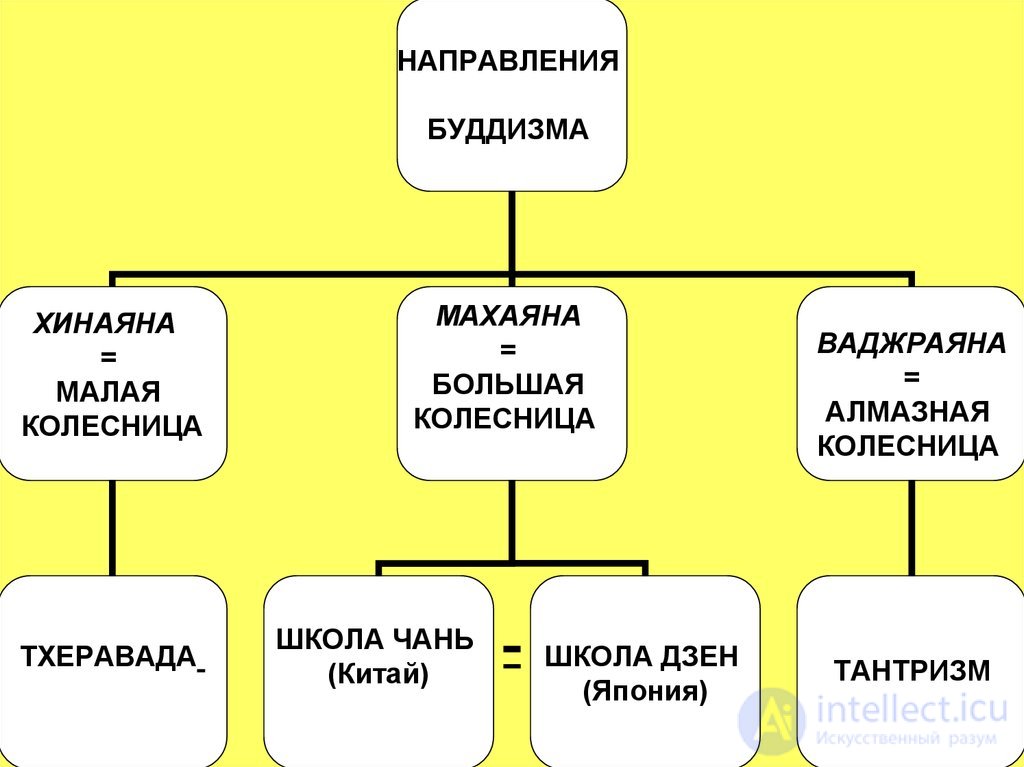
The designation of contemporary Theravada by the term «Hinayana» offends the followers of this school, for which reason some] contemporary Buddhologists have abandoned the use of the word «Hinayana» in their works. Those followers of Buddhism whose representatives arrived at the sixth Buddhist council, held in the mid-20th century, and concluded an agreement on the non-use of the term for Theravada, likewise abandoned the use of this term[. Given that the followers of Hinayana themselves do not consider themselves part of this tradition, contemporary Buddhologists use a number of neutral names to designate this non-Mahayana direction: «southern Buddhism,» «traditional Buddhism,» «classical Buddhism,» «mainstream Buddhism,» Abhidharma, Nikaya, Theravada]. Thus contemporary Buddhism is sometimes divided into Mahayana (the «great vehicle»), to which belong the Tibetan and Far Eastern schools, and Theravada (the «teaching of the elders»)[ — the only surviving Nikaya school of early Buddhism.
Some Buddhists, especially Theravada Buddhists who consider themselves adherents of the original teaching, as well as the first Buddhologists, regard the process of the development of Buddhism as a process of degradation of the Buddha’s teaching. At the same time, V. G. Lysenko notes that all Buddhist directions and schools preserve the foundations of the teaching, and that the spread of the teaching is entirely consistent with the principle of upaya kaushalya, according to which «the Buddha’s teaching is not truth but only an instrument for attaining truth, which is higher than all teachings.» The Buddha explained this by comparing his teaching to a raft, which can carry those in need across a turbulent river, but after the crossing it should be left behind.
Throughout the entire period of the existence of Buddhism, a process of mutual interpenetration continued between the vehicles. A distinct division of Buddhism into vehicles began during the period when Buddhism spread from India to other countries and continued after the disappearance of Buddhism in India.
A detailed diagram of the schools and branches of Buddhism is collected in the article «Schools of Buddhism.»
Buddhism, widespread among a certain part of the laity and differing significantly from the Buddhism preached in the monastic milieu by the presence of various superstitions and pre-Buddhist local beliefs, bears the name of popular (folk) Buddhism.
Currents that «include elements of Buddhist doctrine and practices» but are not part of traditional Buddhism are designated as neo-Buddhism.
There also exists secular Buddhism, which holds that Buddhism in its essence is not a religious teaching, denies any faith, and pays considerable attention to Buddhist meditation[
The period of time separating Hinayana and Mahayana is not so great as to allow one to equate Hinayana with early Buddhism, or to regard Mahayana as an exclusively late phenomenon in Buddhism
and thereby to align oneself with the orthodox Theravadin position.
The time of the formation of Hinayana can justifiably be considered to be 80 BCE, when on Lanka the written fixation of the Theravadin Canon – the Pali Tipitaka – first took place. Approximately during this same period the first Mahayana sutras also began to appear: the earliest canonical Mahayana text – the Ashtasahasrika Prajnaparamita Sutra («The Sutra on the Perfection of Wisdom in Eight Thousand Lines») – dates precisely to the 1st century BCE.
What, then, are the fundamental differences between Hinayana and Mahayana? Let us examine this question on the basis of two basic aspects of both traditions: 1) their conceptions of the ideal person and the goal of the Buddhist path
and 2) their teachings on the nature of the Buddha.
The ideal person of Hinayana is the arhat. This word means «worthy» (the Tibetan etymology of this word as «destroyer of enemies,» i.e., of the afflictions – kleshas – is erroneous and may be regarded as folk etymology). The arhat is a holy monk who has attained, through his own efforts, the goal of the Noble Eightfold Path – nirvana – and has left the world forever. On the path to nirvana the monk passes through a series of stages: 1) the stage of the «stream-enterer,» i.e., one who has irrevocably set out on the path; the «stream-enterer» can no longer degrade or leave the path; 2) the stage of the «once-returner,» i.e., a person whose consciousness must return once more, in one further birth, to the level of the world of desire; and 3) the stage of the «non-returner,» i.e., a saint whose consciousness will henceforth always abide in a state of meditative concentration at the level of the worlds of form and formlessness. The practice of the anagamin culminates in the attainment of the fruit of arhatship and entry into nirvana «without remainder.»
According to the teaching of Hinayana, before his awakening the Buddha was an ordinary human being, only endowed with great virtues and holiness attained through perfection over the course of many hundreds of lives. After awakening (bodhi), which from the point of view of Hinayana was nothing other than the attainment of the fruit of arhatship, Siddhartha Gautama ceased to be a human being in the proper sense of the word, becoming a Buddha, i.e., an enlightened «being» liberated from samsara (this word must here of necessity be placed in quotation marks, since Buddhists call «beings» only
the «inhabitants» of the triple world of samsara, not Buddhas), but in no way a God or any other supernatural entity. If we, being monks (Hinayana emphasizes that only a monk who observes all the vows of the Vinaya can become an arhat and attain nirvana), come to follow in all things the example of the Buddha and his teaching, then we shall attain the very same thing that he attained. The Buddha himself has gone into nirvana; he is not in the world, and for him there is no world, and therefore it is meaningless to pray to him or ask him for help. All veneration of the Buddha and offering of gifts to his images are needed not by the Buddha but by people, who thereby pay a debt of remembrance to the great Liberator (or Victor – Jina, one of the epithets of the Buddha) and exercise themselves in the virtue of giving.
It is clear that Hinayana is a strictly monastic form of Buddhism. Strictly speaking, within this tradition only monks can be considered Buddhists in the proper sense of the word. Only monks can realize the goal of Buddhism – the attainment of the peace of nirvana; only to monks are all the instructions of the Blessed One open; and only monks can practice the methods of psychopractice prescribed by the Buddha. All that remains for the laity is the improvement of their karma through the performance of good deeds and the accumulation of merit gained through supporting and maintaining the sangha. Thanks to this merit, laypeople too may, in one of their subsequent lives, become worthy of taking monastic vows, after which they too will set out on the Noble Eightfold Path. Therefore the Theravadins never sought to engage in especially active missionary activity or to involve the laity in the life of the sangha and various forms of religious activity.
Owing to all these circumstances, Hinayana spread only in countries whose culture, even independently of Buddhism, was formed under the strongest influence of Indian culture, i.e., in the countries of South and Southeast Asia (with the exception of Vietnam, whose historical fate was closely intertwined with the fate of China, as a result of which a Buddhist tradition formed in Vietnam on the basis of the forms of Chinese-Far Eastern Mahayana). It is true that Hinayana Buddhism was for a time (from the first centuries BCE until the Muslim conquests of the 7th–8th centuries CE) rather widely spread on the territory of Central Asia (present-day Uzbekistan, Tajikistan, the northwestern territories of the present-day PRC), where it successfully competed with the autochthonous religion of the Iranian-speaking peoples inhabiting these lands – Zoroastrianism (Mazdaism). But this is explained above all by the fact that a significant part of these territories, at the turn of our era, formed part of the Kushan Empire, which united northern India and part of Central Asia under its rule; it should be noted, however, that the Kushan monarchs were above all patrons of Mahayana.
As for Mahayana, its approach to the doctrinal questions outlined above was completely different.
First, the ideal person for the followers of the Great Vehicle was not the arhat who had attained nirvana, but one striving to attain the state of
Buddha for the benefit of all living beings – the bodhisattva. Second, no longer nirvana but awakening (enlightenment – bodhi) becomes the goal of the Buddhist path within this direction. Third, for the Mahayanists the Buddha is by no means simply a human being. The Buddha henceforth is a metaphysical reality, the true nature of all dharmas, merely manifested to people in the form of a human being – the Teacher, Buddha Shakyamuni – just as it was manifested earlier in the images of other Buddhas and as it will be manifested many times again later – in the future Buddhas of our and other kalpas.
Already the earliest Mahayana texts (sutras devoted to the Transcendent Perfection of Wisdom – prajnaparamita) proclaim the view according to which the nirvana to which the Hinayanists aspire is not the true and highest nirvana. Yes, say the Mahayanists, the followers of the Lesser Vehicle emerge from samsara, freed from the agonizing round of births and deaths, but the highest truth remains inaccessible to them, for, having freed themselves from the afflictive obstructions, they still remain in the power of obstructions connected with incorrect knowledge – so to speak, obstructions of an epistemological character – which can be overcome only on the path of Mahayana, leading to perfect and complete awakening, i.e., to the attainment of the state of a Buddha, who was not simply the first arhat, but a great being finally and completely awakened. And this state of awakening is much higher than the nirvana of the Hinayana arhat. Moreover, the Mahayana texts are by no means inclined to call the Hinayana saints arhats; their usual designation in these works is shravakas and pratyekabuddhas.
Shravakas («hearers of the voice») are disciples of the Buddha who have not fathomed all the depths of the Tathagata’s teaching and have become attached to the idea of nirvana as individual liberation, as well as their disciples and followers. In short, this is a synonym for a Hinayana monk. Shravakas attain nirvana through comprehending the essence of the Four Noble Truths. Pratyekabuddhas are a rather enigmatic category, and it is still not entirely clear which historically existing social groups or types of personality may be assigned to it. The expression itself means a «solitary» or «separated» Buddha, a «Buddha for himself.» It was supposed that pratyekabuddhas attain nirvana independently, through their own efforts, without connection to the sangha and without reliance on the Buddha’s teaching. Having attained the goal, they do not preach the Dharma to people, remaining in seclusion and complete detachment from the world. In essence, Mara, in tempting the Buddha with the call to remain under the Bodhi Tree and not go forth to preach, was trying to turn Shakyamuni into a pratyekabuddha, which, as we know, he did not succeed in doing. It is believed that the awakening of pratyekabuddhas consists in their comprehension of the principle of dependent origination (pratitya samutpada).
In general, the idea of bodhi, the true awakening of the Buddha, is so important for Mahayana that it is often called Bodhisattvayana, i.e., the Vehicle of the Bodhisattvas, of Beings striving for Awakening. So then, who are the bodhisattvas?
In early Buddhism, as we recall, a bodhisattva was the name given to the future Buddha before he attained awakening, i.e., before he actually became a Buddha. In Mahayana, a bodhisattva is any person, monk or layperson, endowed with bodhichitta (chitta – consciousness, mind; in this case – an orientation toward something, or the intention to achieve something), i.e., the intention to attain bodhi, to awaken, to become a Buddha. Thus, in early Mahayana, the goal of Buddhist practice changes as compared with Hinayana. Later its motivation changes as well.
Somewhat later, in texts devoted to the ideal of the bodhisattva, a new overtone begins to sound ever more loudly, gradually becoming the principal and most important one. This is the new motive of striving for awakening, usually formulated as follows: «May I become a Buddha for the benefit of all living beings.» This phrase is now considered the standard formula expressing the essence of bodhichitta – the aspiration to attain the state of Buddha. Bodhichitta is the ability to see all living beings as one’s «mothers» (for if we have all been in the round of samsara since beginningless time, then we have already been in every possible relationship with all beings, including each of them having already been our mother at some point). And since a good son or daughter cannot indifferently watch their mother suffer in samsara, and cannot strive for nirvana while leaving their mother to suffer in the round of cyclic existence, it is their sacred duty to renounce their own salvation until they succeed in saving their mother. This is precisely how bodhichitta is described in the writings of classical, or mature, Mahayana and in the sermons of its contemporary representatives.
In mature Mahayana, the two chief and defining qualities of the bodhisattva become Wisdom (prajna) and Compassion (karuna).
The texts assert that it is impossible to become a Buddha without possessing these two qualities in perfection, with compassion coming to be understood in a practical mode – as a set of «skillful means» or methods by which the bodhisattva, moved by compassion, gains the ability to help living beings free themselves from the bonds of samsaric existence. Just as a bird cannot fly on only one wing, the texts say, so too the state of Buddha cannot be attained by wisdom alone or by skillful means alone: wisdom without means is passive, means without wisdom are blind. Later, within tantric Buddhism, wisdom began to be symbolically depicted in the
продолжение следует...
Часть 1 5. Buddhism: history, concept and features, and the Amidism and Nichiren schools
Часть 2 4. Distinctive Features of the Buddhist Teaching on the Gods,
Часть 3 7. Amidism and Nichiren. Features of Buddhism in China and

Comments