
Lecture
Это окончание невероятной информации про нетрадиционная религия.
...
classical, Vedic, and Eddic traditions.
The Complete Collection of Russian Chronicles is being reprinted, along with the pre-revolutionary studies mentioned above. As a consequence, from the late 1980s onward, a surge of interest in folk tradition has been observed in cities, mainly among the engineering-technical intelligentsia.
The emergence in the early 1990s of Russian "fantasy"—a direction of speculative fiction built on a Nature-based worldview (for example, M. Semyonova's novel "Wolfhound")—contributed to the popularization of paganism (see also: Dorofeev S. The Mythopoetic Image of the Pagan and the Phenomenon of Paganism in the Cycle of Novels by the Science-Fiction Writer Yuri Nikitin "Three from the Forest" // Bulletin of Traditional
Culture. Issue 2. Moscow, 2005, pp. 144-148).
A. V. Platov made an enormous contribution to the revival of the Slavic Tradition through his works on the reconstruction of ancient Slavic runic writing (Monuments of Runic Art among the Slavs // Myths and Magic of the Indo-Europeans; "Slavic Runes," etc.)
Patriarch Alexy II, at the opening of the 2004 Bishops' Council, called the spread of neo-paganism in his address one of the main threats of the 21st century, placing it on a par with terrorism and "other pernicious phenomena of our time." In response, the international public movement "Circle of the Pagan Tradition" sent an open letter to the Holy Synod of the Russian Orthodox Church, stating the inadmissibility of statements offending the honor and dignity of pagans and violating the Law on Freedom of Conscience and Religious Associations and the Law on Countering Extremist Activity. In a subsequent statement by the Communications Service of the Department for External Church Relations of the Moscow Patriarchate, the "equal sign," allegedly placed between terrorism and neo-paganism, was explained as a misinterpretation of the patriarch's words by journalists, while the statement emphasized that the Russian Orthodox Church, nonetheless, assesses paganism as "a threat to man's spiritual condition, to his temporal and eternal life" and believes that paganism "outlived itself many centuries ago."
Parody religiosity (English: parody religion) or mock religiosity (English: mock religion) is a system of beliefs that challenges the spiritual beliefs of other people, often employing humor, satire, and/or burlesque. Often, to achieve a specific goal, a parody religion is created that is connected to another belief system, one that may parody several religions, sects, gurus, cults, and/or new religious movements at once, but which may also at the same time be a parody of some specific religion, or of the concept of religious belief in particular. In some such religions the emphasis is placed on fun or pleasant pastime among like-minded people, for example the Church of the Subgenius. Other parody religions are directed against a specific religion, sect, guru, cult, or new religious movement.

One approach of parody religiosity is aimed at highlighting the flaws in pro-religious arguments—the idea being that if a given argument can be used to support a parody religion, then the original claim is flawed.
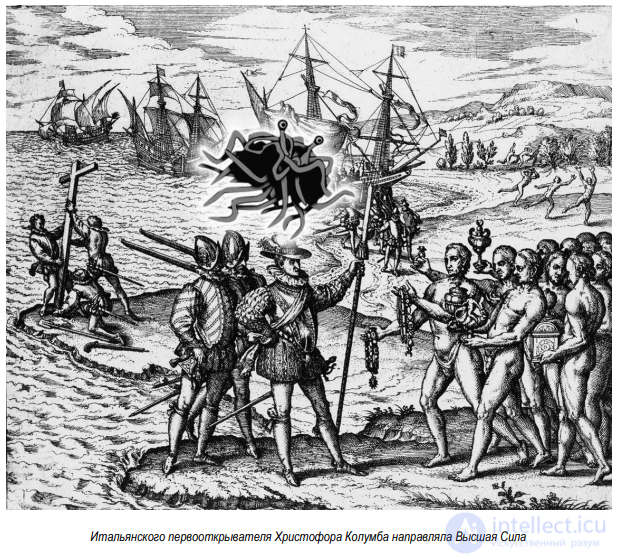
Several religions classified as parodies have a number of relatively serious followers who perceive the absurdity of these religions as spiritually meaningful. Thus, in Discordianism, "serious" followers may take part in an even bigger joke. This joke, in turn, may be part of a great path to enlightenment.
The Invisible Pink Unicorn is the deity of one of the recently emerged parody religions, intended to mock theistic beliefs. The Invisible Pink Unicorn is paradoxically invisible and pink.
The religions listed below were created as parodies of particular worldviews:
| Religion | Description | Notes |
|---|---|---|
| Eventualism | A parody based on Scientology-like religions that appeared in the film "Schizopolis." | |
| Invisible Pink Unicorn |
A parody of theistic definitions of God. It also emphasizes the arbitrary and unfalsifiable character of religious belief, in a manner similar to Russell's Teapot.
|
|
| Kibology | A parody religion that arose on Usenet | |
| Landover Baptist Church | A parody of Christian fundamentalism. | |
| Last Thursdayism | A jocular version of omphalism, which claims that the Universe was created last Thursday. It was created to highlight the problems with unfalsifiable beliefs. There is also another variant of Thursdayism—Next Wednesdayism (Next Wednesdayism), created inspired by John Landis's film See You Next Wednesday. | |
| Tarrasque-ism | A parody religion invented by British comedians Peter Serafinowicz and Robert Popper for the television show "Look Around You," based on the training religious videos of the same Scientologists and Christians. Peter Serafinowicz and his Look Around You co-author Robert Popper created a fake new religion on the internet.
Tarrasque-ism claims that there are two universes, that octopuses are holy, and that everyone in this universe has an invisible guardian from the other universe. The pair are working on a comedy series about the religion for the American network Adult Swim. But Popper said: "In the meantime we thought it was time to start spreading the whole religion online. Everyone seems to have gone a bit crazy..."
|
|
| First Church of the Last Laugh (English: First Church of the Last Laugh) |
A fictional religion used in the Saint Stupid's Day parade, held in San Francisco.
|
|
| Pastafarianism = Church of the Flying Spaghetti Monster |
A parody of intelligent design, creationism, and religiosity in general, as well as another variant of Russell's teapot.
|
The religions listed below may be sophisticated parodies of "real" religions:
| Religion | Description | Notes |
|---|---|---|
| Bokononism |
A fictional religion set forth by Kurt Vonnegut in the book "Cat's Cradle." The founder of this religion is Bokonon. Bokononism openly states that all of its teachings are lies. According to Bokononism, humanity is broken up into groups that carry out God's will without knowing what they are doing.
|
|
| Church of the Subgenius |
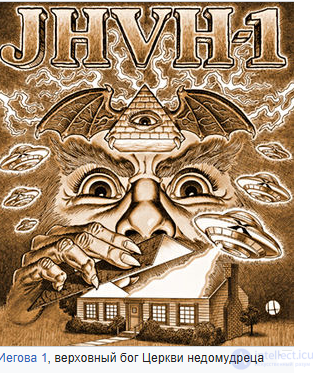
Founded in 1979. Often regarded as a parody of religion in general. It has elements of fundamentalist Christianity, Zen, Scientology, new religious movements, and pop psychology.
|
|
| Dudeism |
A religion widespread on the internet, whose basic teachings correspond to the philosophy and life principles of the fictional character "the Dude," the main character of the film "The Big Lebowski," made by the Coen Brothers in 1998. Followers of Dudeism consider this religion to be a modern form of Taoism.
|
|
| Discordianism |
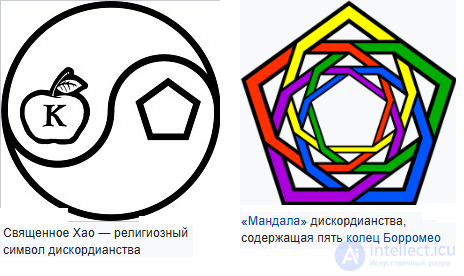
Unlike traditional religions, which preach harmony, Discordianism deifies chaos. The chief deity of Discordianism is Eris, the ancient Greek goddess of discord, who threw the apple of discord at the wedding feast of Peleus.
|
|
| "Church of Maradona" |
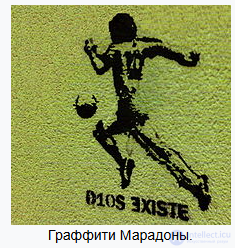
This was a form of an Argentine association of fans of the footballer Diego Armando Maradona. Members were initiated into the club through a sparring ritual, in which the goal referenced the "Hand of God" of 1986.
|
|
| Jediism |
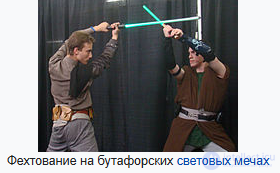
A new religious movement based on the ideas of George Lucas's fantastical film epic "Star Wars."
|
|
| Kopimism |
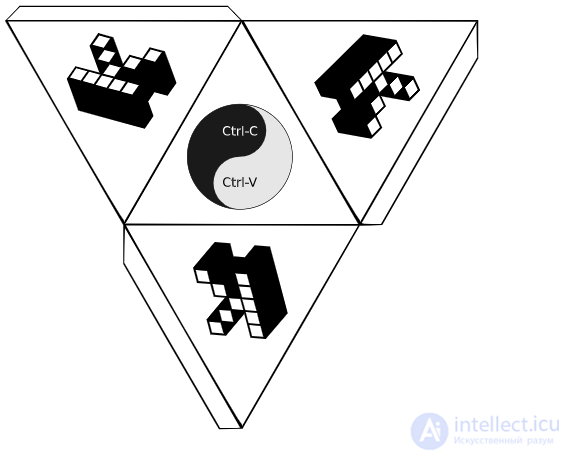
Based on the belief that file-sharing is a sacred virtue that should remain protected. Officially recognized as a religion by the government of Sweden in January 2012. The Missionary Church of Kopimism (from English copy me) is a community advocating free file-sharing, in which the sharing of knowledge is considered sacred. Founded in Sweden and, in accordance with Swedish law, officially recognized as a religion, the Church of Kopimism was founded in 2010 by a 19-year-old philosophy student at Uppsala University, Isak Gerson, who is the head and spiritual leader of the Church of Kopimism. Although Kopimism is a religion, the Church of Kopimism does not believe in gods or supernatural forces.
The Holy Kopyramid. Kopiramide. Pyramide of Kopimi. A template for folding |
|
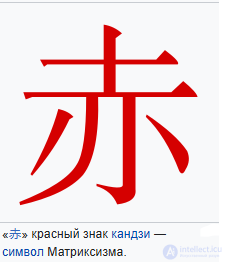
| Matrixism |
A new religious movement inspired by the 1999 film "The Matrix." It appeared on the internet in 2004. Followers of this religion declare their belief in the multilayered nature of subjective reality and the return of a prophet.
|
|
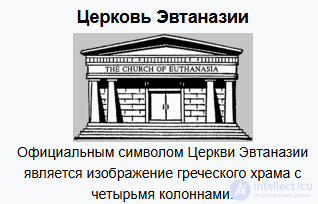
| Church of Euthanasia |
The main goal of the Church of Euthanasia is "to restore balance between humans and the other species inhabiting the Earth." The Church of Euthanasia employs sermons, music, theatrical rallies, and direct-action campaigns. The Church of Euthanasia has also gained notoriety because of conflicts with the Christian anti-abortion movement in the United States.
|
A New Religious Movement (abbr. NRM, English: New Religious Movement (NRM)) is a religious or religious-like group/organization that has appeared relatively recently (the oldest no earlier than the mid-19th century) and that has substantial differences in doctrine from "traditional" ("mainstream") religious traditions (very often in the form of religious syncretism). At present there are no generally accepted criteria for distinguishing NRMs from other religious traditions. The term "new religious movement" was popularized by the British sociologist Eileen Barker.
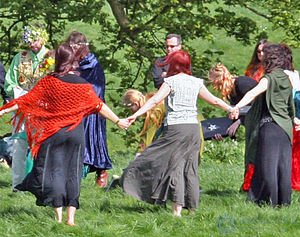
A ritual of British Wiccans
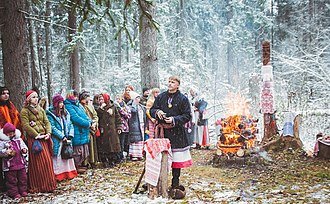
Festival of the goddess Mokosh among Rodnovers (SSO SRV)
Russian religious studies accepts the following classification of NRMs: neo-Christian (for example, Mormonism, the charismatic movement/neo-Pentecostals, the Unification Church), neo-Orientalist (neo-Buddhism, neo-Hinduism, the Roerich movement), neo-pagan (neo-shamanism, Rodnovery), "New Age" (exclusively syncretic), as well as of Russian, Western, or Eastern origin[32]. Many new religious movements are considered to belong to the "umbrella" trend of "New Age," within which they exchange ideas and concepts and provide each other with a certain degree of support; at the same time, a number of new religious movements have a negative attitude toward New Age.
Margaret Thaler Singer (psychologist)
Ronald Enroth (sociologist)
Michael Langone (psychologist)
I contend that we are both atheists. I just believe in one fewer god than you do. When you understand why you dismiss all the other possible gods, you will understand why I dismiss yours.
Original text (English)
I contend that we are both atheists. I just believe in one fewer god than you do. When you understand why you dismiss all the other possible gods, you will understand why I dismiss yours.
— Stephen F. Roberts
Many atheists, including Richard Dawkins in the book "The God Delusion," using parody religions such as Pastafarianism and belief in the Invisible Pink Unicorn, as well as ancient gods such as Zeus and Thor, as modern versions of Russell's Teapot, argue that the burden of proof lies with the believer, not with the atheist.
Dawkins has also created a parody of criticism of atheism under the term athorism (English: athorism), as the firm assertion that Thor, the ancient Scandinavian god, does not exist. The goal is to emphasize that atheism is not a form of religious belief, but is simply a denial of these beliefs. A common problem in opposing atheism is the idea asserting that atheism is a form of "faith," faith without evidence. Believers might say: "No one can prove that God does not exist, so the atheist is exercising faith by claiming that God does not exist." Dawkins says that the burden of proof lies with the person who believes in the supernatural, not with the person who considers it improbable or impossible.
Часть 1 12. The evolution of religion in the modern world: new, contemporary, non-standard and alternative religious
Часть 2 1. The main trends in the evolution of religion. -
Часть 3 7. Parody religiosity - 12. The evolution of religion in
 The Saint Stupid's Day Parade is an annual parade in San Francisco held on April 1. It was founded by Ed Holmes (Bishop Joey of the First Church of the Last Laugh) in the late 1970s on the understanding that one of the unifying bonds in society is foolishness. If April 1 falls on a weekday, the parade begins at the foot of Market Street and follows a route through the Financial District. If April 1 falls on a weekend, the parade begins at the Transamerica Pyramid, continues along Columbus Avenue, and ends at Washington Square. The parade begins at noon. The parade includes a free lunch, confetti, flags, and costumes.


Comments