
Lecture
TTM — is the time that passes from the moment your product is created until it is ready to be sold. This usually includes the time needed to develop the product idea, the design and testing cycle, sourcing suppliers and the audit process, manufacturing and order fulfillment, shipping, and everything else that has to be done before the product is ready to be shipped to the customer.
Reducing time to market (TTM) means shortening the time required to bring a product to market, from the moment of its conception to its actual commercial release. Understanding time to market (TTM), also called speed to market (S2M), and its impact on your business is critically important.
TTM is a key metric for many companies, especially in fast-moving industries such as information technology, e-commerce and mobile applications. Reducing TTM can give a company a significant edge over its competitors, since it can quickly bring to market new products or services that match consumer needs.
Lean Time To Market (L-TTM) — is the time that passes from the creation of a product until it goes on sale. L-TTM matters in industries where products become obsolete quickly. It is commonly believed that L-TTM is most important for first-of-their-kind products, but in reality the leader can often afford the luxury of time, while for the followers the clock is clearly ticking.
In other words, L-TTM is a structured and optimized set of tools and work assignments for developing and launching a product to market, rather than a collection of personal practices.
Thanks to these optimized processes, pre-launch development costs can be lower, launch time can be shortened, and market share growth can happen faster and reach its maximum, as shown below.
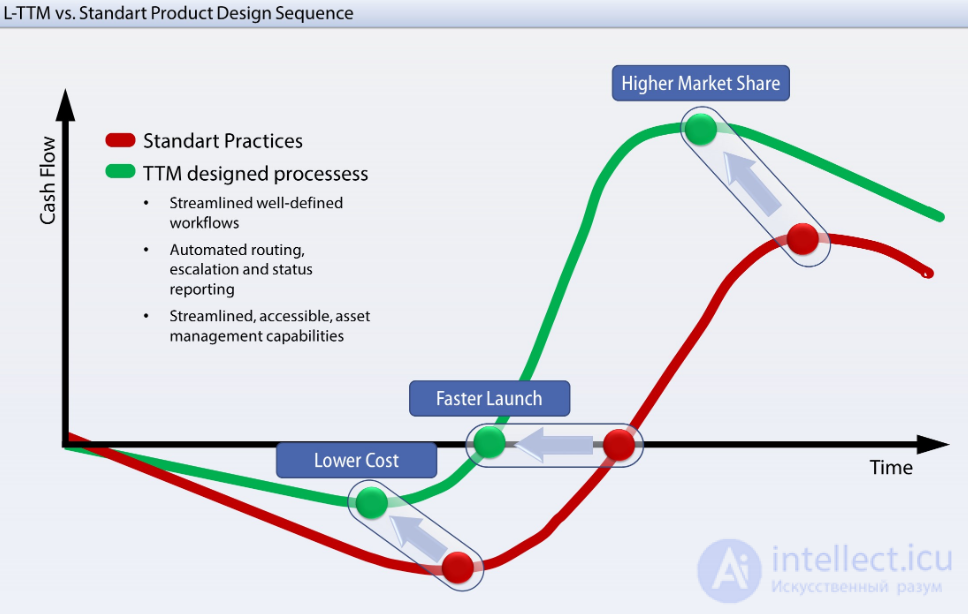
During the product development process leading up to market launch, L-TTM provides:
| - | A clear understanding of customer needs at the start of the project and stability of product requirements or specifications; |
| - | A distinctive, optimized product development process; |
| - | A realistic project plan based on that process; |
| - | Availability of the resources needed to support the project and the use of dedicated, full-time staff; |
| - | Early involvement and rapid staffing ramp-up to support concurrent product and process design; |
| - | Virtual product development, including digital assembly modeling as well as early analysis and simulation to minimize the time spent on physical mock-ups and testing; |
| - | Design reuse and standardization to minimize the design content of the project. |
Reducing TTM can help a company:
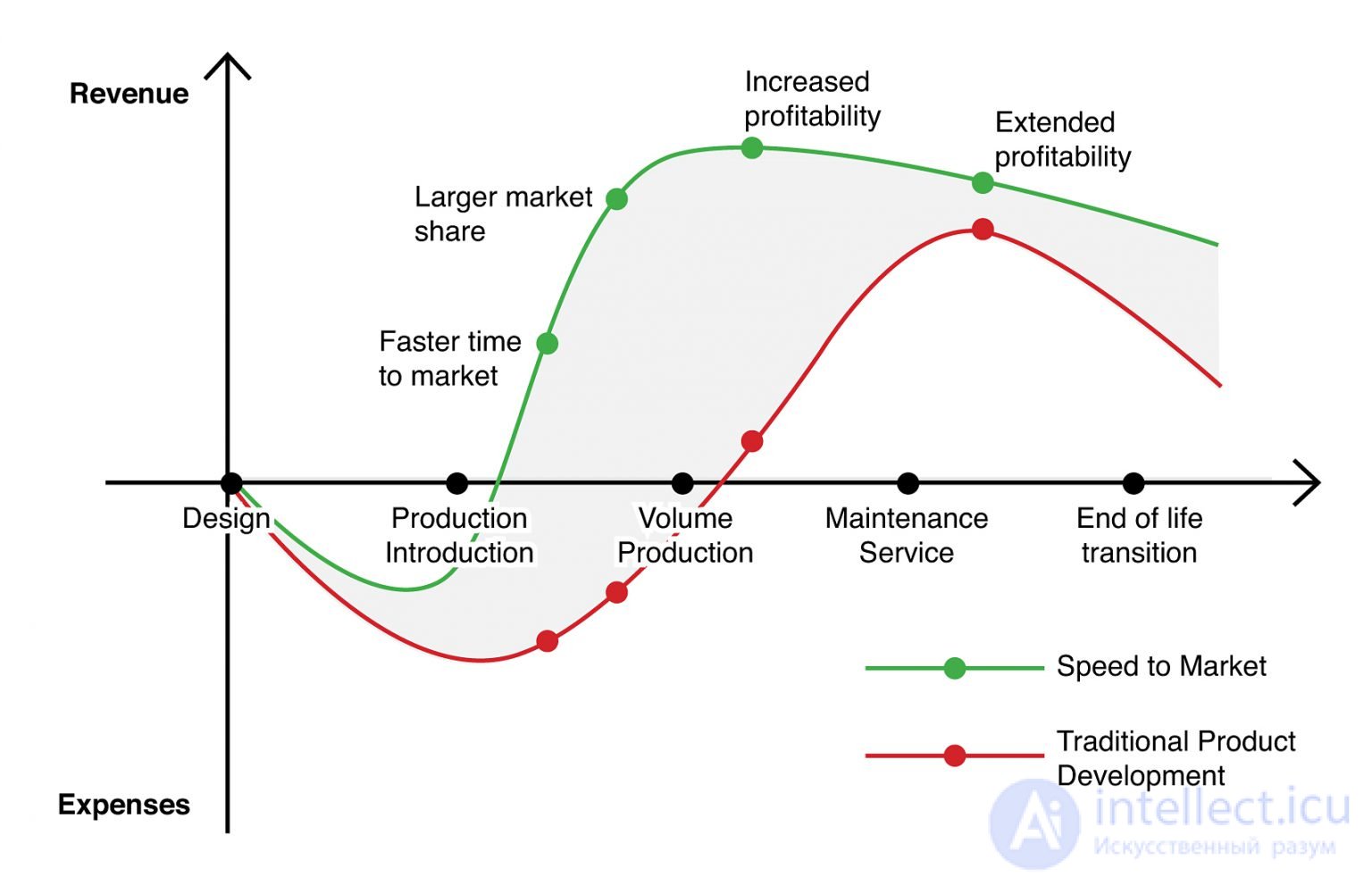
There are several methods and techniques that can help reduce the time required to bring a product to market (time to market, TTM). Some of the most popular include:
1. Agile software development methodologies: Agile methodologies such as Scrum, Kanban and Extreme Programming (XP) help speed up the software development process, reduce risk and improve product quality. Agile methodologies such as Scrum and Kanban can be used to accelerate the product development process and reduce the time spent on getting to market.
2. MVP (Minimum Viable Product): This method consists of building the minimum necessary product functionality, which makes it possible to enter the market quickly and get feedback from users. This helps reduce development time and cut costs.
3. Continuous Integration/Continuous Delivery (CI/CD): This method helps automate the process of building, testing and deploying the product, which makes it possible to speed up development and time to market.
4. Lean methodologies: This is a methodology that focuses on eliminating redundant operations and optimizing the production process. It can help reduce the time spent on manufacturing and improve product quality. Methods such as Lean Startup, Lean Manufacturing and Lean Six Sigma are used to optimize production processes and eliminate excess costs, which makes it possible to reduce the time spent on development and market entry.
5. Outsourcing: Some companies may turn to third-party firms that offer software development and testing services, which can help reduce development time and cut costs.
6. Design for Manufacturing and Assembly (DFMA): This method helps improve the product design process so that the product is better suited to manufacturing and assembly. This can reduce production time and lower costs.
7. Quick Response Manufacturing (QRM): This method helps shorten production time and improve process flexibility. It focuses on improving communication between the company's various departments and reducing the time spent on decision-making.
8. Six Sigma: This is a methodology that helps optimize production processes and reduce the number of defective items. It can reduce production time and improve product quality.
9. Internet of Things (IoT) technologies: Using IoT technologies can improve manufacturing processes and reduce production time. It can help automate certain processes and optimize resource use.
10. Cross-functional teams: Creating cross-functional teams that include employees from different departments of the company can help reduce production time and improve product quality.
11. Business process reengineering - Although reengineering and TTM reduction are two different concepts, they can interact within a company's business strategy. For example, business process reengineering can help reduce production time, which in turn can lead to a shorter TTM. Changes in business processes can also speed up product development, which will likewise lower TTM.
Overall, reducing TTM depends on many factors, including project complexity, team qualifications, the methods and techniques used, and the available resources. A combination of different methods and techniques can help accelerate development and market entry and increase the product's competitiveness. Reducing the time spent bringing non-food products to market depends on many factors, such as product complexity, team qualifications, the methods and techniques used, and the availability of resources and technologies. Therefore, depending on the specific situation, various methods and techniques may be used to reduce the time to market of non-food products.
Thus, reducing TTM is an important factor for a business, helping companies remain competitive and successful in the market.
The ability to speed up the launch of new products to market is a key differentiator of high-performing sellers of goods and providers of services. This is because the novelty and profitability of any new product declines rapidly if it is not launched on time or when it is expected, so releasing innovative products to your customers ahead of your competitors is critically important for increasing profit, growing market share and boosting customer loyalty.

Comments