
Lecture
"Easter Egg" is a term widely used in computer culture to denote hidden, often humorous content or a feature inside software, games or other media products. Such "Easter eggs" may remain invisible to the user until certain conditions are met or certain actions are performed.
An «Easter egg» (from the English Easter Egg) is a secret placed in a computer game, film or piece of software by its creators. What distinguishes an Easter egg in a game from an ordinary in-game secret is that its content, as a rule, does not fit the overall concept, looks implausible or absurd in context, and is often an external reference. Easter eggs serve as a kind of joke for attentive players or viewers, but they can also be used to protect copyright.
Most often, obtaining an Easter egg requires performing a complex or unusual sequence of actions, which makes accidental discovery unlikely. The name comes from the «egg hunt», a family event popular in the USA and the former British colonies and held on the eve of Easter, in which participants must use clues to find as many eggs hidden around the area as possible.
According to Warren Robinett, the first «Easter egg» was hidden in the computer game Adventure. The game was released in 1979 by Atari, and since at that time it was not customary at Atari to credit authors' names in programs, the programmer Warren Robinett decided to hide a mention of himself inside the game. To reach the room with the developer's name, you had to find an invisible dot in one part of the maze and carry it to the other end of the level. Since many of the Amiga developers had previously worked at Atari, this phenomenon appeared in AmigaOS and later in other operating systems. However, there are earlier games containing Easter eggs, for example Video Wizball of 1978 for the Fairchild Channel F. In that game, an improved version of Pong, a player who fulfilled certain conditions could reveal the name of the game's developer: «REID-SELTH».
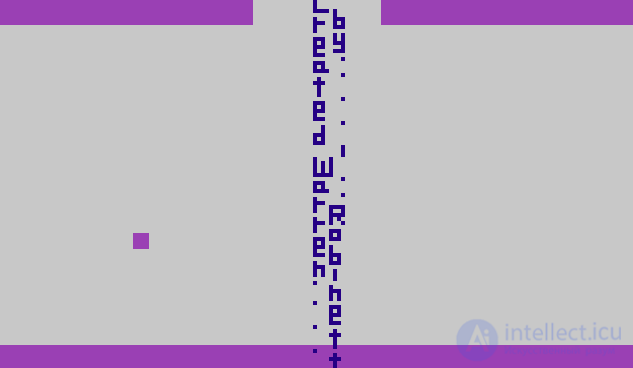
The secret room in the game Adventure, created by Warren Robinett. Adventure is usually considered one of the first video games with an Easter egg.
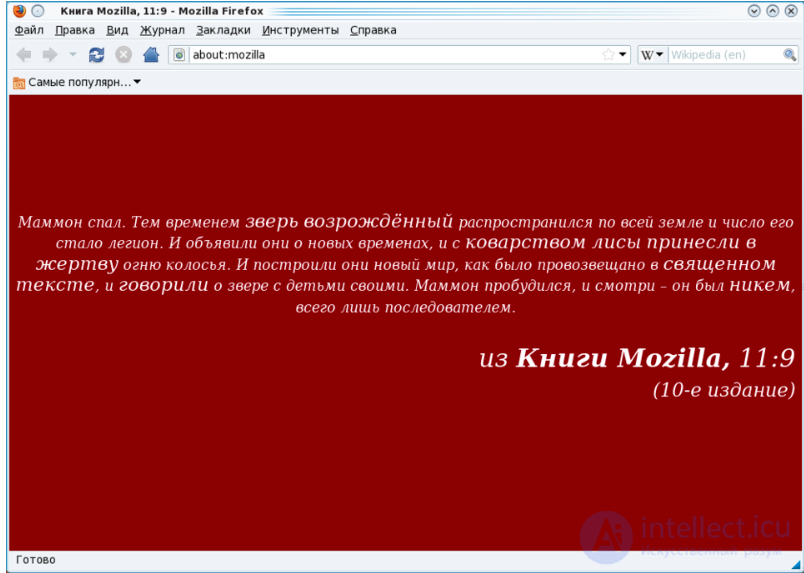
The Book of Mozilla in Mozilla Firefox 3
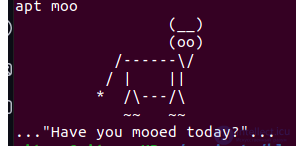
apt moo: type this command in the terminal. You will get an ASCII picture of a cow and the message: "There is no Easter Egg in this program".
Try apt --help and then apt moo — it is a reference to old Debian jokes.
Later, «Easter eggs» spread beyond games into other software as well, be it embedded systems, cell phone firmware or movie DVDs.
Secrets can be found in software products from Adobe, Microsoft, Corel and ABBYY, in WinRAR, Winamp, uTorrent and many others . In Android, tapping the OS version number several times opens a hidden game (even in newer versions of the system).
In computer software, Easter eggs are secret responses produced by an undocumented set of commands. The results can range from a simple printed message or image to a page with information about the programmers or a small video game hidden inside serious software.
In the TOPS-10 operating system (for the DEC PDP-10 mainframe) a command is used to invoke the TECO editor to create a file. If a file name argument is given so that the command reads, it pauses and replies before creating the file. The Easter egg was added somewhere between October 1967 and October 1968 by William F. Weiher of the Stanford Artificial Intelligence Laboratory to the COMPIL program for the PDP-6, which was then used in the TOPS-10 operating system, making it the first Easter egg in a program. The same happens in the RSTS/E operating system, where TECO gives such a reply. Other Unix operating systems respond to « » with « » (a reference to The Prisoner in Berkeley Unix, 1977).makelovemake lovenot war? whywhy not
Some versions of the DEC OpenVMS operating system have hidden exit status codes, including a reference to the parody from «Monty Python's Dirty Hungarian Phrasebook»; " " returns the message "%SYSTEM-W-FISH, my hovercraft is full of eels", and " " returns a reference to an early internet meme: "%SYSTEM-F-GAMEOVER, all your base are belong to us".exit %xb70exit %x34b4
Easter eggs in the 1997 version of Microsoft Office include a hidden flight simulator in Microsoft Excel and a pinball game in Microsoft Word. Since 2002, Microsoft has not permitted hidden or undocumented code as part of its Trustworthy Computing initiative.
The apt-get package tool of the Debian operating system contains an Easter egg showing a cow in ASCII art when the options are entered into the shell. apt-get moo
An Easter egg is present in every Microsoft Windows operating system up to XP. In the 3D Text screensaver, entering the text «volcano» displays the names of all volcanoes in the USA. Microsoft removed this Easter egg in XP but added others. In Windows Vista and later, running a screensaver executable (introduced in Windows Vista) from the command line with the /p65552 flag — for example, running the «bubbles» screensaver with the bubbles.scr /p65552 command line parameter — launches it as desktop wallpaper. [30] Microsoft Excel 95 contains a hidden game similar to Doom (1993), called The Hall of Tortured Souls.
The Google search engine is known to contain many Easter eggs, which are shown to the user in response to particular search queries.
Steve Jobs banned Easter eggs in Apple products after returning to the company.
The first Easter egg to appear after his death is in the 2012 Mac App Store update for OS X Mountain Lion, in which downloaded applications are temporarily given the timestamp «January 24, 1984», the date the original Macintosh went on sale.
The Python programming language and its library ecosystem include various Easter eggs.
Sometimes «Easter eggs» are found in hardware too. For example, on the interface circuit board of the Hewlett-Packard LaserJet 1100 printer, alongside the component designations, one can read: «This product is dedicated in memory of our good friend Ming-Zen Kuo»[
On the Tormenta 2 IP telephony board, underneath the largest FPGA chip there is the inscription «Why are you looking under this chip?», which can only be seen by desoldering the chip
The die of the CVAX microprocessor used in the MicroVAX 3000 and 6200 contains the phrase «СВАКС… Когда вы забатите довольно воровать настоящий лучший» , a crude Russian translation of the phrase «CVAX — when you care enough to steal the very best». This phrase echoes the slogan of the well-known greeting card supplier Hallmark Cards: «When You Care Enough to Send the Very Best». The inscription cannot be seen without opening the processor package and using a microscope. The message was intended for Soviet engineers who might, presumably, subject the processor to reverse engineering.
A game of «Tetris» is built into the instrument panel of the GAZelle Next vehicle
Below is a general list of examples of "Easter eggs":
Text Easter eggs:
Graphical Easter eggs:
Audio Easter eggs:
Game Easter eggs:
Film and television:
Internet and web Easter eggs:
Computer programs:
Films and TV series:
These are only a few examples, and "Easter eggs" can be highly creative and diverse. Finding them can bring pleasure and interest to the user community.
American comic book artists are known to include hidden messages in their works:[

Comments