
Lecture
No-code (zero-code, low-code) is a set of paradigms for developing and delivering software with minimal or no program code, often implemented as an online service for carrying out business processes of various levels and directions.
Low-code, zero-code, and no-code make it possible to move away from traditional application development.
By 2020, no-code was back in the spotlight, and hundreds of no-code startups of various kinds began to appear.
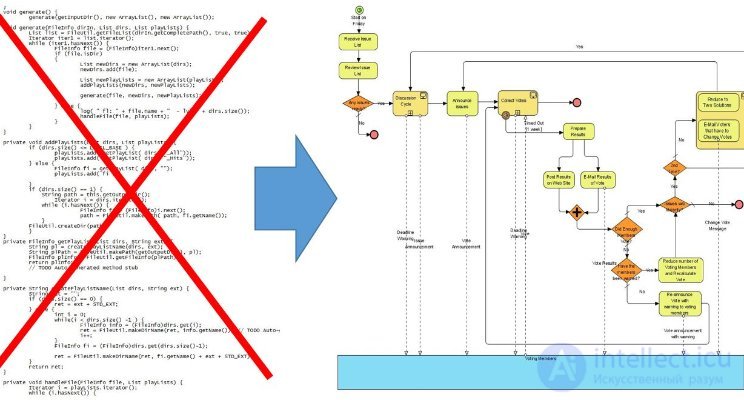
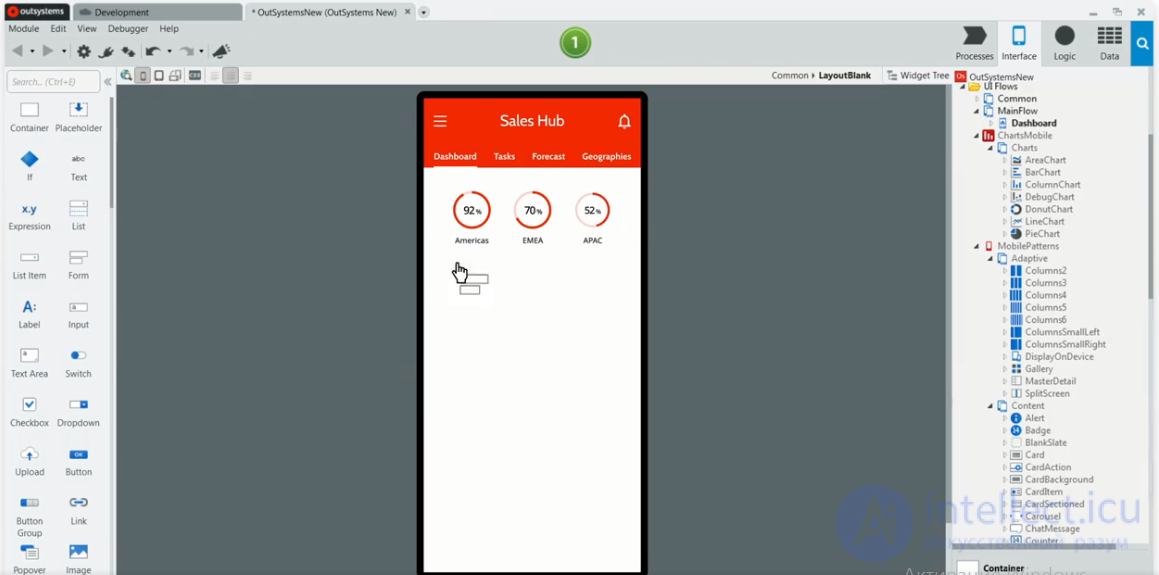
A low-code development platform ( LCDP ) is a development environment used to create application software through graphical user interfaces and configuration instead of traditional hand-coded computer programming. A low-code model allows developers with varying levels of experience to build applications using a visual user interface combined with model-driven logic. Such platforms can produce fully functional applications or require additional coding for specific situations. Low-code development platforms reduce the amount of traditional hand-coding, which enables faster delivery of business applications. A common benefit is that a wider range of people can contribute to an application's development, not just those with formal programming skills. LCDPs can also lower the initial cost of setup, training, deployment, and maintenance.
Low- and zero-code are not something fundamentally new. Visual programming, RAD (rapid prototyping and rapid application development), and other technologies have existed for many years.
Low-code and zero-code platforms are closely related to the concept of PaaS (platform as a service), which offers application capabilities as cloud services rather than as a set of code written by a developer. Platforms known as "application services" or "application builders" (aPaaS, application platform as a service) provide the highest level of abstraction in this category, allowing developers to model applications rather than program them, without worrying about the operating system, storage, infrastructure, or software updates.
Both low-code and zero-code provide the means to develop applications without needing to write a large amount of code or have programming skills. Instead, users get access to a visual development environment where they can select the functional elements they need from a library, connect them visually into a workflow—usually by dragging boxes around on the screen—and thereby build their own application.
Simply put, you do visually what a developer normally writes in code. Low-code applications require a minimum of code, whereas with zero-code you use pre-built templates and models without using any code at all.
Let's take a closer look at these approaches: what they have in common, their pros, cons, and differences.
No-code development platforms are similar to low-code development platforms, but require no coding at all. [17]
The line between them is blurry. However, there are a number of key differences:
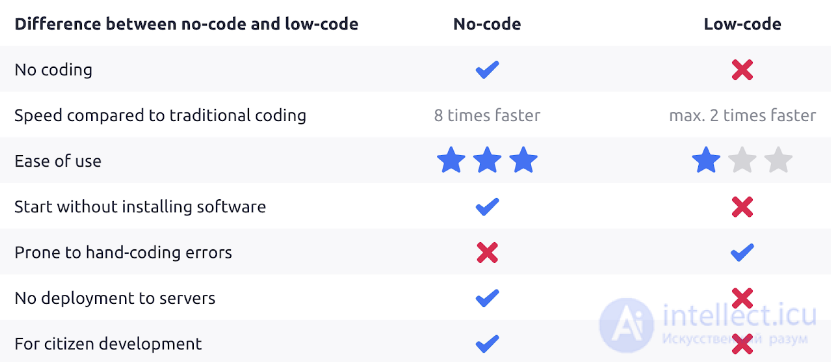
In business process management (BPM) and case management solutions, low-code is a feature rather than a strategic offering. These platforms provide a scaled-down IDE environment for visual development that lets you build applications running within the software's own framework and architecture. These platforms are purpose-built for a narrow use case and are good at what they were created for, but they do not satisfy the full set of enterprise use cases for digital transformation.
With low-code solutions, developers can build full-fledged applications with modern user interfaces, data, logic, and integration support in a visual editor, using a drag-and-drop interface and a minimal amount of code. Low-code makes it possible to create a more scalable and flexible architecture than zero-code solutions, because there is still somewhere you can write code.
In addition to using a graphical user interface, low-code solutions also eliminate the need to create frameworks, link databases, and perform other tasks usually associated with writing code by hand. If you or your employees have ideas for an application or software, then with low-code you can independently build flexible programs to accomplish specific business tasks with much less effort, faster, and even without any special technical experience.
The main advantages of the low-code approach for business include:
The main drawbacks:
The low-code approach can be used to develop more complex solutions and carry out special tasks that require a visual representation and the ability to make changes quickly, to create MVPs/prototypes, and so on. Many low-code platforms not only have an extensive library of ready-made components, but also support third-party cloud services, AI algorithms, machine learning, blockchain, image, voice, and face recognition systems, and so on.
No-code solutions are intended for non-professional developers (Citizen Developers—users within a company who have access to a visual development environment) and require neither writing code by hand nor knowledge and experience in programming. As a visual programming language, zero-code lets you build applications visually by dragging elements out of a library, and requires minimal training. Without using code, the developer decides what the application does rather than how it does it: a declarative UI describes what the user should see as the result, rather than the sequence for achieving that result.
Zero-code is often called the future of programming: it is expected that in the coming years, 80% of tasks and applications will be implemented without the need to write code.
"The future of coding is no code at all" — Chris Wanstrath, CEO of GitHub
Zero-code platforms have a lot in common with low-code solutions:
The advantages of zero-code development platforms largely coincide with those of the low-code approach: better adaptability, reduced development costs, decreased dependence on IT, increased productivity, ease of maintenance, and flexibility. There are other upsides to zero-code as well:
Despite the obvious advantages of zero-code development, business owners need to understand the hidden drawbacks and risks associated with its use:
Artificial intelligence does what previously seemed impossible: it helps make quick decisions and narrow down choices by suggesting the right options, and so on. After all, in traditional development, implementing business logic requires going through a great deal of routine work that can actually be done by a machine—provided it "understands" the business task.
Essentially, AI does the "rough," "draft" work, leaving creative tasks for the human. This gives low-code/zero-code an additional boost, allowing them to develop very quickly.
It is hard to argue with the significance and possibilities of no-code development, especially when it comes to building simple applications. Zero-code platforms are best suited for businesses that need efficient, ready-made solutions. They are ideal for solving tasks at the level of a specific department—for example, sales, finance, or HR—and can be used effectively to implement more complex tasks, such as chatbot development.
We created Kwizbot for chatbot developers in order to simplify and reduce the cost of the modification and maintenance processes, allowing chatbot dialogues and communication interfaces to be built in a visual development environment.
It is a zero-code web service developed by Evergreen that helps extend a bot's functionality by building chatbot dialogues in a visual editor.
Low-code and zero-code platforms are completely changing the development process. By eliminating dependence on programming, non-technical developers and an organization's IT departments can collaborate, model, and jointly create new functional solutions. This is a way to connect the business directly to the development process and ensure that the end result meets the company's specific requirements.
If you are planning to optimize and automate business processes and are looking for the most suitable solution, want to order our ready-made software product, or develop a unique low-code/zero-code platform using AI, do not hesitate to contact us. We will be happy to help bring innovation to your business—just call us or fill out the form.
The field of programming evolves faster than any other industry, and trends change every year. At one point everyone was into PHP, then moved on to Objective-C, and soon the era of Swift, JavaScript, Ruby, and Python arrived. In parallel, new technologies emerged, and with them new professions, such as neural network developer, VR/AR developer, and cloud platform architect.
Since the requirements for coders change, curricula are transformed too. Educational platforms usually rewrite 30-50% of the content of their coding courses every year.
Under these conditions, newcomers have an especially hard time: it is unclear which direction to choose so that it doesn't become obsolete in 2-3 years. The pace of change worries even experienced developers—they constantly track trends and retrain. The invasion of algorithms causes even greater anxiety. For example, the much-hyped GPT-3 from the OpenAI lab can already generate virtual worlds, write code for web pages, and lay out mockups in Figma from a text description.
Under such circumstances, spending years mastering a profession that could be automated in 3-5 years is too risky. The solution for many newcomers has become the no-code movement, also known as zero-code. This is development without code, also called visual programming. It uses ready-made services to which you simply give commands. A no-coder sets a specific task but does not delve into the workings of the engine itself. The main thing is to formulate what result you want to get, and the system will then decide how to implement what you have in mind.
Most of us already use no-code platforms. For example, when we build a website or store in the Tilda builder, launch a campaign in Mailchimp, create a project management system in Notion, make a database in Airtable, or put together a voice bot in TWIN.
Zero-code architecture allows an ordinary user to launch their own mini-services using handy builder programs. They are usually distinguished by a convenient and understandable interface, as well as customization—for example, you can create your own expense-tracking application, an online store with AR functionality, or an MVP for a new digital project.
Development without code makes programming more democratic and lowers the barrier to entry for beginner IT specialists. At the same time, no-code tools take the load off experienced developers, freeing them from unnecessary routine work.
It is beneficial for companies too—they can delegate minor tasks to junior specialists and direct their main resources to the salaries of senior specialists with unique expertise. By some estimates, hiring a no-coder costs roughly 50 times less than turning to an outside agency.
It is no surprise that many have become interested in the no-code solutions market. Notion, for instance, is already valued at two billion dollars. According to Forrester's forecasts, the zero-code platform market will grow from 3.8 to 21.2 billion dollars by 2022. Hackathons are already being held among no-coders, ProductHunt has a separate section dedicated to such projects, and IT giants are creating their own zero-code builders—or buying ready-made solutions.
For example, at the start of the year Google bought the no-code platform AppSheet—on it you can put together mobile applications as if in a builder. The company is also developing the Game Builder platform, on which not only professional developers can create games. Amazon recently launched Honeycode—a platform with ready-made templates for building mini-services. Applications are being written without coding at GE, ICT Group, and Pfizer. And many startups based on no-code platforms are attracting major investments.
Why did no-code systems take off specifically at the end of the 2010s? There are various theories, but the main reason is the development of technology (primarily cloud systems), as well as the popularity of Agile practices. Companies are increasingly engaged in rapid product development, testing hypotheses, and therefore need microservices that can easily be extended or reformatted. Many strive for flexibility—even Amazon claims it still operates on the principle of a startup, and no-code solutions help quickly test MVPs and address tasks in a targeted way.
But do companies need employees who specialize in no-code tools? Yes and no. If you study job postings on LinkedIn and other international platforms, you can see how proficiency in zero-code programs is being equated with digital literacy. You are no longer required to know Word and Excel—it is more important to be proficient in Notion, Webflow, or Airtable. Often basic knowledge is enough, but if you reach the level of an experienced user, your chances of success will be greater.
For example, a company wants to set up voice bots using a ready-made platform. It will need a person who understands the nuances of such tools and can make the most of their functionality.
Or an online store wants to attach AR visualization to its website and is looking for a specialist for that specific task. Many startups need to build an MVP, but in the initial stage they are not ready to bring on a team of developers—a no-coder's services will come in handy here too.
In this case, you are unlikely to be able to count on a high salary or stable work—you will most likely have to work as a freelancer. However, in the future, demand will most likely grow for such "visiting" programmers who will help companies set up zero-code tools. And if you have an excellent command of a new service that everyone is just starting to talk about, there is a chance to become an in-demand specialist. This applies to new technologies as well—for example, you can become a voice-bot configurator or a developer of embedded e-commerce solutions, since these areas are now growing all over the world.
The upside is that mastering zero-code does not require spending several years and investing hundreds of thousands of rubles in education. For instance, the Bubble platform can be learned at a basic level in 4-5 hours, and you can get into the nuances in as little as 10-15 hours.
Of course, basic programming knowledge will still not go amiss—for this you can take a course on the fundamentals of development. For example, at the Almamat IT accelerator you can study by spending 40 minutes a day, and if you need to speed up your learning, the platform provides a mentor.
By the way, having a mentor will also help you master no-code development faster—a specialist will tell you how to level up your skills more quickly and suggest interesting life hacks. No-code mentors already exist too: they hold webinars, conferences, and masterminds for beginner specialists.
And yet, why study no-code if the prospects are rather hazy? You can get the most out of it if you view no-coding as an add-on to your skills—and an extremely in-demand one at that. First, it will be easier for you to take a junior position at a company without spending a lot of resources on studying, and over time you will be able to decide which trajectory to follow. It is not a given that you will become a developer. The zero-code environment is ideal for developing hybrid skills—programming, product management, design, digital marketing, and consulting. Some companies, by the way, are already looking for such specialists.
Another trajectory is teaching. For example, you can run corporate no-coding courses for non-programmers or help companies select the zero-code tools they need.

Comments