
Lecture
Modern software development is increasingly carried out by distributed teams, where the effectiveness of communication, version control and integration becomes critically important. Under these conditions a collaborative development environment plays a key role, providing the technical and organisational foundation for productive work. It brings together tools for source code management, issue tracking, build and test automation, as well as the means of communication between project participants. The choice and configuration of such an environment determine not only development speed, but also the quality of the final product, its resilience to errors and the scalability of the solutions.
A collaborative development environment (CDE) — is a type of software platform that supports distributed software development by providing a shared online workspace. It allows project participants to collaborate in real time or asynchronously, facilitating communication, documentation and the coordinated creation of deliverables. CDEs are designed to address the challenges of working across different time zones and geographic regions by integrating tools such as version control systems, bug tracking, discussion forums, wiki resources and code review mechanisms. The term was introduced in 2002 by Grady Booch and Alan W. Brown.
It is regarded as an evolution of the integrated development environment (IDE), which brought programming tools together on the desktop, and of the extended development environment (XDE), which combined lifecycle development tools with an IDE (for example, Microsoft Azure DevOps and IBM Rational Rose XDE); whereas an IDE focuses on tools that support the individual developer, a CDE focuses on supporting the needs of the development team as a whole.
Although the CDE was originally a tool of the software development sector, it has also found application in other sectors where teams tend to be geographically dispersed and where the ability to collaborate over the Internet is beneficial, including the automotive industry, aerospace, film production and civil engineering.
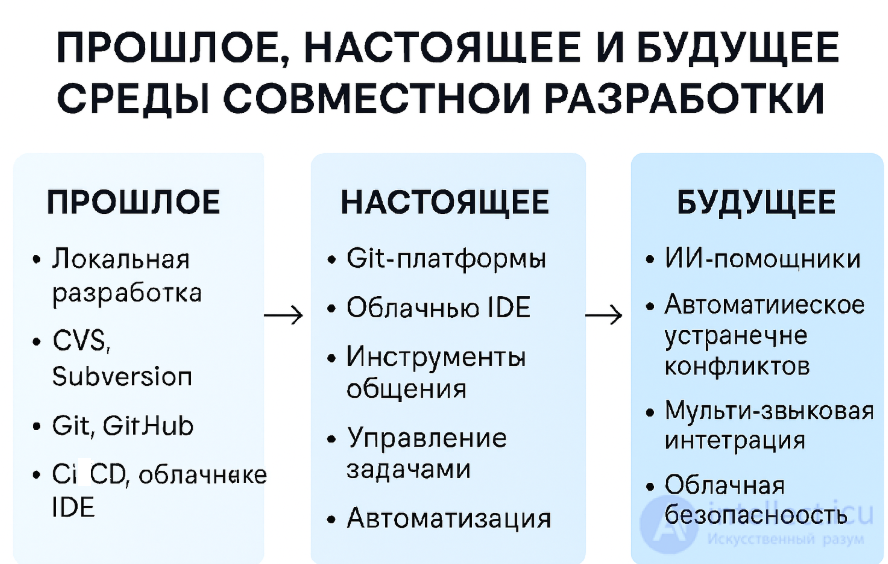
The collaborative development environment emerged in response to the growing complexity of software projects and the need for coordination between developers. Key milestones:
1980s–1990s: development was done locally, often solo. Code was exchanged via floppy disks or email. Version control was manual.
1995–2005: version control systems appeared (CVS, Subversion), making it possible to track changes and work on code as a team.
2005: the release of Git — a distributed version control system that became the industry standard.
2008: the launch of GitHub — a platform that combined Git with a web interface, issue tracking and pull requests. This revolutionised both open-source and corporate development.
2010s: the integration of CI/CD, cloud IDEs, Docker containers and DevOps approaches — the development environment became hybrid and automated.
Today a collaborative development environment is an ecosystem that includes:
Git platforms: GitHub, GitLab, Bitbucket, Forgejo — with support for pull requests, reviews and CI/CD.
Cloud IDEs: Gitpod, Codespaces, JetBrains Space — let you write code directly in the browser.
Communication tools: Slack, Discord, Microsoft Teams — integrate with repositories and task trackers.
Task management: Jira, Trello, Linear — for planning and tracking progress.
Automation: CI/CD pipelines, testing, deployment — all of this has become part of the development environment.
Modern teams work asynchronously and in a distributed way, often from different countries and time zones. The environment provides transparency, control and speed.
The future of the collaborative development environment is already taking shape today:
AI assistants: GitHub Copilot, DeepCode — automate the writing, review and refactoring of code.
Automatic conflict resolution: AI will predict and prevent conflicts when merging branches.
Multilingual integration: environments will automatically adapt to the languages the team communicates in.
Cloud security: source code will be stored in secure clouds, eliminating the risk of data loss.
New forms of interaction: VR/AR interfaces, voice assistants, live coding sessions — all of this may become part of the environment.
AI is already changing the dynamics of teamwork, automating routine tasks and improving communication between developers, testers and managers
A collaborative development environment is not merely a set of tools, but a strategic element of a project's architecture. It allows teams to synchronise their efforts, minimise risks, speed up releases and ensure transparency of processes. Successfully implementing such an environment requires taking account of technical requirements, the specifics of the team and the goals of the project. Regardless of scale — whether a startup, an open-source initiative or corporate development — a well-organised collaborative environment becomes the foundation of a sustainable and flexible software creation process.

Comments