
Lecture
The third part of the relational model, the manipulation part, states that access to relational data is performed using relational algebra or equivalent relational calculus.
In implementations of specific relational DBMS, neither relational algebra nor relational calculus is currently used in its pure form. Structured Query Language (SQL) has become the de facto standard for accessing relational data. The SQL language is a mixture of relational algebra operators and relational calculus expressions using a syntax that is close to English phrases and enhanced by additional features not found in relational algebra and relational calculus. In general, a data access language is called relationally complete if it is not inferior in its expressive power to relational algebra (or, equivalently, to relational calculus), i.e. any operator of relational algebra can be expressed by means of this language. That's exactly what SQL is.
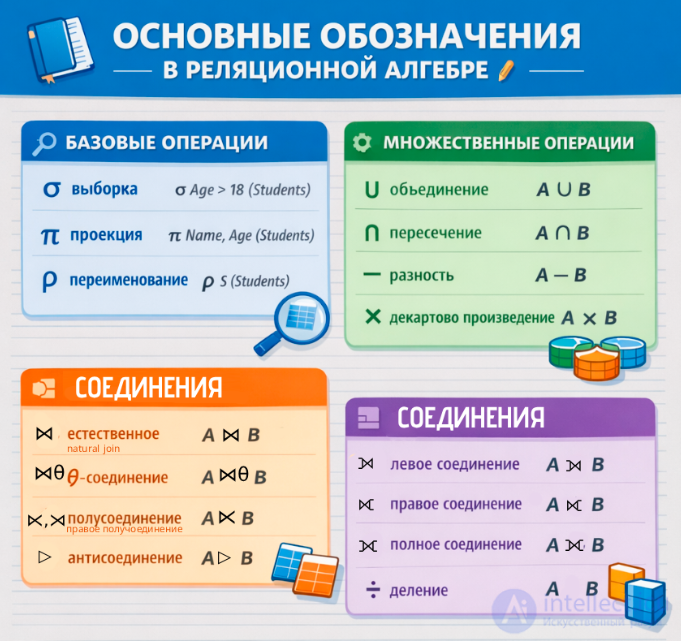
This chapter will cover the basics of relational algebra.
Relational algebra is a set of operators that use relations as arguments and return relations as a result. So the relational operator  looks like a function with relations as arguments:

Relational algebra is closed because As arguments, you can substitute other relational operators of the following type into relational operators:

Thus, in relational expressions, you can use nested expressions of arbitrarily complex structure.
Each relationship must have a unique name within the database. The name of the relationship obtained as a result of a relational operation is defined in the left part of the equation. However, you can not require the presence of names from relations derived from relational expressions, if these relations are substituted as arguments in other relational expressions. Such relations will be called unnamed relations . Unnamed relationships do not really exist in the database, but are only calculated at the time of calculating the value of the relational operator.
Traditionally, following Codd [43], eight relational operators are defined, combined into two groups.
Set theoretic operators:
Special relational operators:
Not all of them are independent, i.e. Some of these operators can be expressed through other relational operators.
Some relational operators (for example, union) require that relations have the same headers. Indeed, the relationship consists of a heading and a body. The operation of combining two relations is simply the union of two sets of tuples taken from the bodies of the corresponding relations. But will the result be an attitude? First, if the initial relations have a different number of attributes, then it is obvious that the set, which is the union of such heterogeneous tuples, cannot be represented as a relation. Secondly, even if the relationship has the same number of attributes, but the attributes have different names. How then to determine the title of the relationship, resulting from the union of sets of tuples? Third, let relations have the same number of attributes, attributes have the same name, but are defined on different domains. Then again the union of the tuples will not form a relation.
Definition 1 . We will call relationships compatible by type if they have identical headings, namely,
Some relationships are not compatible by type, but become so after some renaming of attributes. In order for such relationships to be used in relational operators, an auxiliary attribute renaming operator is introduced.
The attribute renaming operator has the following syntax:

Where
 - attitude
 - the original attribute names,
 - new attribute names.
As a result of applying the attribute renaming operator, we get a new relationship, with the attribute names changed.
Example 1
The following statement returns an unnamed relationship in which the attribute  renamed to
  :
:

Definition 2 . Combining two compatible relationships  and
and  called a relationship with the same heading as the relationship and and body consisting of tuples belonging to or , or or both relationships.
The syntax of the merge operation:

Remark A union, like any relation, cannot contain identical tuples. Therefore, if some tuple is included in and attitude , it enters the union once.
Example 2 Let two relationships be given and with employee information:
| Personnel Number | Surname | Salary |
|---|---|---|
| one | Ivanov | 1000 |
| 2 | Petrov | 2000 |
| 3 | Sidorov | 3000 |
Table 1 Attitude A
| Personnel Number | Surname | Salary |
|---|---|---|
| one | Ivanov | 1000 |
| 2 | Furs | 2500 |
| four | Sidorov | 3000 |
Table 2 Attitude B
Merging relationships and will look like:
| Personnel Number | Surname | Salary |
|---|---|---|
| one | Ivanov | 1000 |
| 2 | Petrov | 2000 |
| 3 | Sidorov | 3000 |
| 2 | Pushnikov | 2500 |
| four | Sidorov | 3000 |
Table 3 Attitude A UNION B
Remark As can be seen from the above example, potential keys that were in a relationship and not inherited by combining these relationships. Therefore, in the union of relationships and The attribute "Personnel Number" may contain duplicate values. If this were not the case, and the keys would be inherited, then this would contradict the notion of union as "union of sets". Of course, the union of relationships and has, like any relationship, a potential key, for example, consisting of all attributes.
Definition 3 . The intersection of two compatible by type of relationship and called a relationship with the same heading as the relationship and , and the body, consisting of tuples belonging simultaneously to both relationships and .
Intersection operation syntax:

Example 3 For the same relationship and , as in the previous example, the intersection has the form:
| Personnel Number | Surname | Salary |
|---|---|---|
| one | Ivanov | 1000 |
Table 4 Attitude A INTERSECT B
Remark It would seem that, unlike the union operation, the potential keys could be inherited by the intersection of relations. However, it is not. In general, no relational operators convey any data about potential keys to the resulting relation . The reason for this could be a trivial consideration that this is more simple and symmetrical - all operators are arranged in the same way. In fact, the reason is deeper, and lies in the fact that the potential key is a semantic concept that reflects the distinguishability of objects in the domain. The presence of potential keys is not derived from the structure of the relationship, but is explicitly defined for each relationship, based on its meaning. Relational operators are formal operations on relationships and are executed in the same way, regardless of the meaning of the data contained in the relationship. Therefore, relational operators cannot “know” anything about the meaning of data. The interpretation of the result of relational operations is the user's business.
Definition 4 . Subtracting two compatible relationships and called a relationship with the same heading as the relationship and , and body consisting of tuples belonging to the relation and not belonging to the relation .
Subtract operation syntax:

Example 4 For the same relationship and , as in the previous example, the subtraction is:
| Personnel Number | Surname | Salary |
|---|---|---|
| 2 | Petrov | 2000 |
| 3 | Sidorov | 3000 |
Table 5: A MINUS B Ratio
Definition 5 . Cartesian product of two relationships 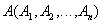 and
and 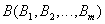 is called a relationship whose title is a concatenation of relationship headers and :
 ,
,
and the body consists of tuples that are a concatenation of relations tuples and :
 ,
,
such that 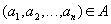 ,
, 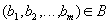 .
.
The syntax of a Cartesian product is:

Remark Power of the work equal to the product of the power relations and because every tuple relationship connects with every tuple relationship .
Remark If in a relationship and If there are attributes with the same name, then before performing the Cartesian product, such attributes must be renamed.
Remark You can multiply any two relationships, compatibility by type is not required.
Example 5 Let two relationships be given and with information about suppliers and details:
| Vendor number | Supplier name |
|---|---|
| one | Ivanov |
| 2 | Petrov |
| 3 | Sidorov |
Table 6 Attitude A (Suppliers)
| Detail number | the name of detail |
|---|---|
| one | Bolt |
| 2 | Nut |
| 3 | Screw |
Table 7 Ratio B (Details)
Cartesian product of relationships and will look like:
| Vendor number | Supplier name | Detail number | the name of detail |
|---|---|---|---|
| one | Ivanov | one | Bolt |
| one | Ivanov | 2 | Nut |
| one | Ivanov | 3 | Screw |
| 2 | Petrov | one | Bolt |
| 2 | Petrov | 2 | Nut |
| 2 | Petrov | 3 | Screw |
| 3 | Sidorov | one | Bolt |
| 3 | Sidorov | 2 | Nut |
| 3 | Sidorov | 3 | Screw |
Table 8: A TIMES B Ratio
Remark The Cartesian product operation itself is not very important, since she does not give any new information, compared with the original relationship. For real requests, this operation is almost never used. However, the operation of a Cartesian product is important for performing special relational operations, which will be discussed below.
Definition 6 . Sampling (restriction, selection) on the relationship with the condition  called a relationship with the same heading as the relationship , and by the body consisting of tuples, the attribute values of which, when substituted into the condition give the value TRUE. is a boolean expression that can include relationship attributes and (or) scalar expressions.
In the simplest case, the condition has the appearance  where
where  - one of the comparison operators (
  etc.), and
  and
and  - relationship attributes or scalar values. Such samples are called - selections ( theta sampling ) or - restrictions - selection .
Sampling syntax:
 ,
,
or

Example 6 Let given the relation with employee information:
| Personnel Number | Surname | Salary |
|---|---|---|
| one | Ivanov | 1000 |
| 2 | Petrov | 2000 |
| 3 | Sidorov | 3000 |
Table 9 Ratio A
Sample result  will look like:
| Personnel Number | Surname | Salary |
|---|---|---|
| one | Ivanov | 1000 |
| 2 | Petrov | 2000 |
Table 10 Ratio A WHERE Salary <3000
The meaning of the sampling operation is obvious - choose tuples of a relation that satisfy a certain condition. Thus, the sampling operation gives a " horizontal slice " of the relationship for some condition.
Definition 7 . Relationship projection by attributes  where each of the attributes belongs to the relation called the relationship with the title
  and body containing many tuples of view
  such for which there are tuples with an attribute value
  equal
equal  , attribute value
  equal
equal  , ..., attribute value
  equal
equal  .
.
The projection operation syntax is:

Remark The projection operation gives a " vertical cut " of the relationship, in which all duplicates of tuples arising from this cut are removed.
Example 7 Let given the relation with information about suppliers, including name and location:
| Vendor number | Supplier name | Supplier City |
|---|---|---|
| one | Ivanov | Ufa |
| 2 | Petrov | Moscow |
| 3 | Sidorov | Moscow |
| four | Sidorov | Chelyabinsk |
Table 11 Attitude A (Suppliers)
Projection  will look like:
| Supplier City |
|---|
| Ufa |
| Moscow |
| Chelyabinsk |
Table 12 Attitude A [Supplier City]
The operation of connecting relations, along with the operations of sampling and projection, is one of the most important relational operations.
Usually, several types of join operations are considered:
-connection (theta-compound)The most important of these particular cases is the operation of a natural compound. All types of compounds are special cases of the general operation of the connection.
Definition 8 . Connection relationship and by condition called attitude

is a boolean expression that can include relationship attributes and and (or) scalar expressions.
Thus, the join operation is the result of the sequential application of the Cartesian product and the sample operation. If in a relationship and If there are attributes with the same name, then such attributes must be renamed before making the connection.
Definition 9 . Let the attitude contains an attribute attitude contains an attribute  , but - one of the comparison operators ( etc.). Then - connection of the relation by attribute with attitude by attribute call attitude

This is a special case of a generic join operation.
Sometimes, for surgery -connections apply the following, shorter syntax:

Example 8 Consider a company that stores data on suppliers and parts supplied. Let suppliers and parts assigned a status. Let the business of the company be organized in such a way that suppliers have the right to supply only those parts whose status is not higher than the status of the supplier (this may be that a good supplier with a high status can supply more types of parts, and a poor supplier with a low status can supply only a limited list of parts, the importance of which (the status of the part) is not very high).
| Vendor number | Supplier name | X
(Supplier Status) |
|---|---|---|
| one | Ivanov | four |
| 2 | Petrov | one |
| 3 | Sidorov | 2 |
Table 13 Attitude A (Suppliers)
| Detail number | the name of detail | Y
(Status details) |
|---|---|---|
| one | Bolt | 3 |
| 2 | Nut | 2 |
| 3 | Screw | one |
Table 14 Ratio B (Details)
The answer to the question "which suppliers have the right to supply what parts?" gives -connection :
:
| Vendor number | Supplier name | X
(Supplier Status) |
Detail number | the name of detail | Y
(Status details) |
|---|---|---|---|---|---|
| one | Ivanov | four | one | Bolt | 3 |
| one | Ivanov | four | 2 | Nut | 2 |
| one | Ivanov | four | 3 | Screw | one |
| 2 | Petrov | one | 3 | Screw | one |
| 3 | Sidorov | 2 | 2 | Nut | 2 |
| 3 | Sidorov | 2 | 3 | Screw | one |
Table 15 Relationship "Which suppliers supply which parts"
The most important special case of a -connection is the case when there is simply equality.
Equivalent syntax :

Example 9 Let there be relationships  ,
,  and
and  , storing information about suppliers, parts and deliveries, respectively (for convenience, we introduce the brief names of the attributes):
| Vendor number
PNUM |
Supplier name
PNAME |
|---|---|
| one | Ivanov |
| 2 | Petrov |
| 3 | Sidorov |
Table 16 P ratio (Suppliers)
| Detail number
DNUM |
the name of detail
DNAME |
|---|---|
| one | Bolt |
| 2 | Nut |
| 3 | Screw |
Table 17 Attitude D (Details)
| Vendor number
PNUM |
Detail number
DNUM |
Quantity supplied
VOLUME |
|---|---|---|
| one | one | 100 |
| one | 2 | 200 |
| one | 3 | 300 |
| 2 | one | 150 |
| 2 | 2 | 250 |
| 3 | one | 1000 |
Table 18 PD ratio (Supply)
The answer to the question, what parts are supplied by suppliers, gives equi-connection  .In fact, because in a relationship there are identical attributes, then you must first rename the attributes, and then perform an equi-connection. Recording becomes more cumbersome:

Usually, such a complex form of recording is not used. But be that as it may, the result is:
| Vendor number
PNUM1 |
Supplier name
PNAME |
Vendor number
PNUM2 |
Detail number
DNUM |
Quantity supplied
VOLUME |
|---|---|---|---|---|
| one | Ivanov | one | one | 100 |
| one | Ivanov | one | 2 | 200 |
| one | Ivanov | one | 3 | 300 |
| 2 | Petrov | 2 | one | 150 |
| 2 | Petrov | 2 | 2 | 250 |
| 3 | Sidorov | 3 | one | 1000 |
Table 19 Attitude "What parts are supplied by which suppliers"
The disadvantage of an equi-connection is that if a connection occurs by attributes with the same name (and most often it happens!), Then two attributes with the same values appear in the resulting relation. In our example, the attributes PNUM1 and PNUM2 contain duplicate data. You can get rid of this drawback by taking a projection on all attributes, except for one of the duplicates. This is how a natural connection works.
Definition 10 . Let given the relationship and
and  that have the same attributes
  (i.e., attributes with the same name and defined on the same domains).
Then the natural mix of relationships and called a relationship with a header  and a body containing many tuples
 such that
  and
and  .
.
The natural connection is so important that a special syntax is used for it:

RemarkThe syntax of a natural connection does not indicate which attributes are being joined. A natural connection is made for all the same attributes.
Remark A natural connection is equivalent to the following sequence of relational operations:
Remark It is possible to perform a sequential natural join of several relations. It is easy to verify that a natural join (as well as a general join) has the associative property, i.e.

therefore, such compounds can be written omitting the parentheses:

Example 10. In the previous example, the answer to the question "what parts are supplied by suppliers" is more simply written as a natural connection of three relations  (for ease of viewing, the order of attributes has been changed, this is acceptable according to the properties of the relations):
| Номер поставщика
PNUM |
Supplier name
PNAME |
Номер детали
DNUM |
the name of detail
DNAME |
Поставляемое количество
VOLUME |
|---|---|---|---|---|
| one | Ivanov | one | Болт | 100 |
| one | Ivanov | 2 | Nut | 200 |
| one | Ivanov | 3 | Screw | 300 |
| 2 | Петров | one | Болт | 150 |
| 2 | Петров | 2 | Nut | 250 |
| 3 | Сидоров | one | Болт | 1000 |
Table 20 P JOIN PD JOIN D ratio
Definition 11 . Let given the relationship and
and  , and the attributes
  are common to the two relationships. The division of relationships on
  called a relationship with a header
 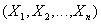 and a body containing a multitude of tuples
  , such that for all tuples there is a tuple
 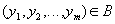 in relation to
 .
.
The relation acts as a dividend , the relation acts as a divider . Division of relations is similar to division of numbers with the remainder.
The syntax of the division operation:

RemarkTypical inquiries implemented through a division operation usually have in their wording the word "all" - "which suppliers supply all the parts?".
Example 11In the example with suppliers, parts and deliveries, we answer the question "which suppliers supply all the parts?".
As a dividend, we take a projection  containing the numbers of the suppliers and the numbers of the parts supplied by them:
| Vendor number
PNUM |
Detail number
DNUM |
|---|---|
| one | one |
| one | 2 |
| one | 3 |
| 2 | one |
| 2 | 2 |
| 3 | one |
Table 21 Projection X = PD [PNUM, DNUM]
As a divider, take a projection 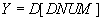 containing a list of the numbers of all parts (not necessarily supplied by someone):
| Detail number
DNUM |
|---|
| one |
| 2 |
| 3 |
Table 22 Projection Y = D [DNUM]
Division  gives a list of vendor numbers that supply all parts:
| Vendor number
PNUM |
|---|
| one |
Table 23 The ratio of X DEVIDEBY Y
It turned out that only supplier number 1 supplied all the parts.
Example 12 . Get the names of the vendors that supply part number 2.
Decision:

Example 13 . Get the names of suppliers supplying at least one nut.
Decision:

The answer to this request can be obtained in another way:

Example 14 Get the names of suppliers supplying all the details.
Decision:

Example 15 Get the names of suppliers that do not supply part number 2.
Decision:

The answer to this request can be obtained step by step:
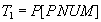 - get a list of numbers of all suppliers
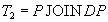 - connect data on suppliers and supplies
 - in the data on suppliers and deliveries, leave only the data on deliveries of part number 2.
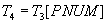 - get a list of vendor numbers that supply part number 2.
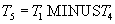 - get a list of supplier numbers that do not supply part number 2.
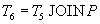 - connect the list of suppliers who do not supply part number 2 with data on suppliers (complete information will be obtained on suppliers who do not supply part number 2).
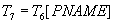 - the answer you are looking for (names of suppliers that do not supply part number 2).
As stated at the beginning of the chapter, not all relational algebra operators are independent — some of them are expressed through other relational operators.
The join operator is defined in terms of the Cartesian product and the sample operator. For the natural join operator, a projection operator is added.
The intersection operator is expressed by subtracting as follows:

The division operator is expressed in terms of the subtraction, cartesian product and projection operators as follows:

Thus, it is shown that join , intersection and division operators can be expressed through other relational operators, i.e. these operators are not primitive.
The remaining relational operators ( union , subtraction , Cartesian product , selection , projection ) are primitive operators - they cannot be expressed through each other.
The Cartesian product operator is the only operator that increases the number of attributes , so it cannot be expressed in terms of union, subtraction, selection, projection.
Projection Operator
The projection operator is the only operator that reduces the number of attributes, so it cannot be expressed using union, subtraction, Cartesian product, or sampling.
Sampling Operator
The sampling operator is the only operator that allows comparisons across relational attributes, so it cannot be expressed using union, subtraction, Cartesian product, or projection.
Union and Subtraction Operators
The proof of the primitiveness of the union and subtraction operators is more complex and is not presented here.
Queries Inexpressible with Relational Algebra
Despite the power of relational algebra, there are a number of query types that fundamentally cannot be expressed using relational algebra operators alone. This does not mean that answers to these queries cannot be obtained at all. Simply, to obtain answers to such queries, procedural extensions to relational languages must be used.
Poor Normalization of Relations
This example is taken from the book by M.M. Gilois [6, p. 43].
Example 16: Let's assume we have a CHEMICAL_COMPOSITION_OF_SUBSTANCES relation with a set of attributes (Substance name, Hydrogen, Helium, …, 105_element). The value of the "Substance" attribute is the name of the chemical substance, and the values of the remaining attributes are the percentage composition of the corresponding elements in that substance. Such a relation might look, for example, like this:
| Name of the substance | Hydrogen | Helium | ... | 105 элемент |
|---|---|---|---|---|
| Deoxyribonucleic acid | five | 3 | ... | 0.01 |
| Petrol | 50 | 0 | ... | 0 |
| ... | ... | ... | ... | ... |
Table 24. CHEMICAL_COMPOSITION_OF_SUBSTANCES Relation
Consider the query "Find all chemical elements whose content in any given substance exceeds a specified percentage (say, 90)".
Algorithmically, this query is executed in a straightforward manner: all table columns are scanned, and if a column contains at least one value greater than 90, the column header is remembered. The set of remembered column names is the response to the query.
Formally, it is impossible to express this query within relational algebra, since the response to this query must be a list of relation attributes that satisfy a certain condition. Relational algebra does not have operators that manipulate attribute names.
In fact, this example demonstrates that the table is poorly normalized (normalization of relations is discussed in Chapters 6 and 7). The table contains a set of similar attributes ("Hydrogen," "Helium," etc.) with 105 columns.
It's more correct to break this relationship into three different relationships:
| SUBSTANCE_NUMBER | SUBSTANCE |
|---|---|
| one | Deoxyribonucleic acid |
| 2 | Petrol |
Table 25 SUBSTANCE Ratio
| ITEM_NUMBER | ELEMENT |
|---|---|
| one | Hydrogen |
| 2 | Helium |
| ... | ... |
| 105 | ... |
Table 26 ELEMENTS Relationship
| SUBSTANCE_NUMBER | ITEM_NUMBER | PERCENT |
|---|---|---|
| one | one | five |
| one | 2 | 3 |
| one | 105 | 0.01 |
| 2 | one | 50 |
Table 27 Ratio CHEMICAL_COMPOSITION_OF_SUBSTANCES
For relations normalized in this way, the original query is implemented with the following sequence of operators:
R1(SUBSTANCE_NUMBER,ELEMENT_NOM,PERCENTAGE) = CHEMICAL_COMPOSITION_OF_SUBSTANCES[PERCENTAGE>90]. (Relationship selection).
R2(ELEMENT_NOM) = R1[ELEMENT_NOM]. (Relationship projection).
R3(ELEMENT_NOM,ELEMENT) = R2[ELEMENT_NOM=ELEMENT_NOM]ELEMENTS. (Natural join)
ANSWER(ELEMENT) = R3[ELEMENT]. (Table projection).
In SQL, this query is implemented with a single command:
SELECT ELEMENTS.ELEMENT
FROM ELEMENTS, CHEMICAL_COMPOSITION
WHERE
ELEMENTS.ELEMENT_NO = CHEMICAL_COMPOSITION.ELEMENT_NO
AND CHEMICAL_COMPOSITION.PERCENTAGE>90
Inexpressibility of Transitive Closure by Relational Operators
The following example illustrates a class of queries that are inexpressible using relational algebra or relational calculus due to the inexpressibility of the transitive closure of relations using relational algebra (see Chapter 1).
Example 17. Consider a relation describing employees of a certain company. The relation contains data on the employee's personnel number, last name, job title, and the employee's manager's personnel number – EMPLOYEES ( STAFF_NUMBER , SURNAME, POSITION, STAFF_NUMBER_MANAGEMENT ):
| STAFF_NUMBER | SURNAME | POSITION | STAFF_NUMBER_MANAGEMENT |
|---|---|---|---|
| one | Ivanov | Director | one |
| 2 | Petrov | Chief accountant | one |
| 3 | Sidorov | Accountant | 2 |
| four | Vasiliev | Shop foreman | one |
| five | Sukhov | Master | four |
| 6 | Sharipov | Working | five |
| ... | ... | ... | ... |
Table 28. EMPLOYEES Relation
Consider the query "List all managers (direct and indirect) of a given employee."
The answer to this query can be obtained using the concept of transitive closure. However, transitive closure cannot be expressed using relational algebra operators.
Cross-Tabulations
One of the tasks associated with presenting tabular data is constructing so-called cross-tabulations.
Suppose there is a relation with three attributes and a candidate key that includes the first two attributes. An example of such a relation might be data on sales volumes of various products over certain time periods:
| Product | Month | amount |
|---|---|---|
| Computers | January | 100 |
| Printers | January | 200 |
| Scanners | January | 300 |
| Computers | February | 150 |
| Printers | February | 250 |
| Scanners | February | 350 |
| ... | ... | ... |
Table 29: Sales Data
This data needs to be presented as a table with product names in the rows, months in the columns, and sales volumes in the cells. This will be a crosstab:
| Product | January | February | ... |
|---|---|---|---|
| Computers | 100 | 150 | ... |
| Printers | 200 | 250 | ... |
| Scanners | 300 | 350 | ... |
Table 30: Crosstab
Constructing a crosstab using relational algebra is impossible because it requires converting the data in table cells into names of new table columns.
Findings
Accessing relational data is possible using relational algebra operators. Relational algebra is a set of operators that take relations as arguments and return relations as results. Relational algebra is closed, so the results of one relational expression can be used in another.
Traditionally, eight relational operators are defined, grouped into two groups.
Set-theoretic operators: union, intersection, subtraction, and Cartesian product.
Special relational operators: selection, projection, join, and division.
Some relational operators require that the relations be type-compatible.
Not all operators of relational algebra are independent—some are expressed in terms of other relational operators. The join, intersection, and division operators can be expressed in terms of other relational operators, meaning they are not primitive. The remaining relational operators (union, subtraction, Cartesian product, selection, projection) are primitive operators—they cannot be expressed in terms of each other.
There are several types of queries that cannot be expressed by means of relational algebra. These include queries that require giving a list of attributes that satisfy certain conditions, building a transitive closure of relations, and building cross-tables. To get answers to such queries, you have to use procedural extensions of relational languages.

Comments
To leave a comment
Databases, knowledge and data warehousing. Big data, DBMS and SQL and noSQL
Terms: Databases, knowledge and data warehousing. Big data, DBMS and SQL and noSQL