
Lecture
Systems analysis
Mathematics
Causality — is the influence by which one event, process, state, or object (a cause) contributes to the production of another event, process, state, or object (an effect), where the cause is, at least in part, responsible for the effect, and the effect is, at least in part, dependent on the cause. The cause of something can also be described as the reason for an event or process.
In general, a process can have many causes, which are also called causal factors for it, and all lie in its past. An effect, in turn, can be a cause or causal factor for many other effects, all of which lie in its future. Thus, the distinction between cause and effect either follows from, or provides, the distinction between past and future. Although the former view is more common in physics, some authors argue that causality is metaphysically prior to the notions of time and space. Causality is an abstraction that indicates how the world evolves. As such, it is a basic notion, and one might expect it to be more suited as an explanation of other concepts of development than something that should itself be explained by even more fundamental ideas. This notion is akin to the notions of agency and efficacy. For this reason, understanding it may require an intuitive leap. Accordingly, causality is implicitly present in the structure of ordinary language, as well as explicitly present in the language of scientific causal notation.
In English-language studies of Aristotelian philosophy, the word «cause» is used as a specialized technical term, a translation of the Aristotelian term αἰτία, by which Aristotle meant «explanation» or «answer to the question „why“». Aristotle classified four types of answers as material, formal, efficient, and final «causes». In this case, a «cause» is an explanans for an explanandum, and failure to recognize that different kinds of «causes» are being discussed can lead to fruitless debates. Of Aristotle's four modes of explanation, the one closest to the subject of this article is the «efficient» cause.
As part of his opposition to rationalism, David Hume argued that pure reason alone is not enough to prove the reality of efficient causation; instead, he appealed to custom and mental habit, noting that all human knowledge derives solely from experience.
The topic of causality remains one of the central ones in contemporary philosophy.
The nature of cause and effect is the subject of study known as metaphysics. Kant believed that time and space are concepts that precede human understanding of the progress or evolution of the world, and he also recognized the priority of causality. But he lacked the understanding that came with the knowledge of Minkowski geometry and special relativity, namely that the concept of causality can be used as an a priori basis for constructing the concepts of time and space.
The general metaphysical question about cause and effect is: «which entities can be causes, and which can be effects?»
One view on this question is that cause and effect are the same kind of thing, and that causality is an asymmetric relation between them. In other words, from a grammatical standpoint it would be logical to say either «A is the cause, and B is the effect», or «B is the cause, and A is the effect», although in reality only one of these two can be true. In this view, proposed as a metaphysical principle in process philosophy, it is claimed that every cause and every effect is, respectively, some process, event, becoming, or occurrence. An example would be the phrase: «he tripped on the step, and that was the cause, and the broken ankle was the effect». Another view is that causes and effects are «states of affairs», with the precise nature of these entities defined more loosely than in process philosophy.
Another view on this question — a more classical one — holds that a cause and its effect can be different kinds of entities. For example, in Aristotle's efficient causal explanation, an action can be the cause, and a persisting object can be its effect. For example, the generative acts of his parents can be regarded as the efficient cause, and Socrates as the effect, with Socrates regarded as a persisting object, called in the philosophical tradition a «substance», as opposed to an action.
Because causality is a subtle metaphysical concept, establishing knowledge of it in specific empirical circumstances requires considerable intellectual effort, as well as the presentation of evidence. According to David Hume, the human mind is not able to directly perceive causal relations. On this basis, he distinguished between a regularity view of causation and a counterfactual notion. According to the counterfactual view, X causes Y if and only if, without X, Y would not have existed. Hume interpreted the latter as an ontological view, that is, as a description of the nature of causality; but, given the limitations of the human mind, he advised using the former (roughly stating that X causes Y if and only if the two events are spatiotemporally connected, and X precedes Y) as an epistemic definition of causality. We need an epistemic notion of causality in order to distinguish causal from non-causal relations. The modern philosophical literature on causality can be divided into five main approaches to causality. These include (mentioned above) the regularity, probabilistic, counterfactual, mechanistic, and manipulationist views. It can be shown that all five approaches are reductive, that is, they define causality through relations of other types. On this interpretation, they define causality, respectively, through empirical regularities (constant conjunctions of events), changes in conditional probabilities, counterfactual conditions, mechanisms underlying causal relations, and invariance under intervention.
Causality has the properties of precedence and adjacency. These are topological and are constituents of the geometry of spacetime. As developed by Alfred Robb, these properties allow the concepts of time and space to be derived. Max Jammer writes: «Einstein's postulate… opens the way to the direct construction of the causal topology… of Minkowski space». Causal efficacy does not propagate faster than the speed of light.
Thus, the concept of causality is metaphysically prior to the concepts of time and space. In practice, this is explained by the fact that the use of the causal relation is necessary for the interpretation of empirical experiments. The interpretation of experiments is necessary for establishing the physical and geometric concepts of time and space.
The deterministic worldview holds that the history of the universe can be exhaustively represented as a sequence of events following one another as cause and effect. Incompatibilism holds that determinism is incompatible with free will, so that if determinism is true, « free will » does not exist. Compatibilism, on the other hand, holds that determinism is compatible with free will, or is even necessary for it.
Causes can sometimes be divided into two types: necessary and sufficient. A third type of causation, which requires neither necessity nor sufficiency but which contributes to the effect, is called a «contributory cause».
Necessary causes
If x is a necessary cause of y, then the presence of y necessarily implies the prior occurrence of x. However, the presence of x does not mean that y will necessarily occur.
Sufficient causes
If x is a sufficient cause of y, then the presence of x necessarily implies the subsequent occurrence of y. However, another cause z may alternatively cause y. Thus, the presence of y does not imply the prior occurrence of x.
Contributory causes
For some particular effect, in a single case, a factor that is a contributory cause is one of several contributory causes. It is implied that all of them are contributory. For a particular effect, in general there is no indication that a contributory cause is necessary, although it may be. In general, a factor that is a contributory cause is not sufficient, since by definition it is accompanied by other causes, which would not be regarded as causes if it were sufficient. For a particular effect, a factor that is a contributory cause in some cases may be sufficient in other cases, but in those other cases it will not be merely contributory.
J. L. Mackie argues that ordinary talk of «the cause» actually refers to an insufficient but non-redundant part of a condition which is itself unnecessary but sufficient for the occurrence of the effect. An example would be a short circuit as the cause of a house fire. Consider the set of events: a short circuit, the proximity of flammable materials, and the absence of firefighters. Together, they are unnecessary but sufficient for the house fire (since many other sets of events could certainly have led to the house fire, for example, firing a flamethrower at the house in the presence of oxygen, and so on). Within this set, the short circuit is an insufficient (since the short circuit alone would not have caused the fire) but non-redundant (since the fire would not have occurred without it, all else being equal) part of a condition which is itself unnecessary but sufficient for the occurrence of the effect. Thus, the short circuit is one of the main causes of the house fire.
However, Mackie's INUS theory suffers from the problem of joint effects of a common cause: it mistakenly identifies one effect of a common cause as an instance of an INUS condition for another effect of the same common cause, even though the two effects are not causally related. Modern regularity theories seek to overcome this problem by using so-called non-redundant regularities.
Conditional statements are not statements about causation. An important distinction is that causal statements require that the preceding event precede or coincide with the subsequent one in time, whereas conditional statements do not require such a temporal order. Confusion often arises because many different statements in English can be expressed using the form «If..., then...» (and, perhaps, because this form is much more often used to make a causal statement). However, these two types of statements are distinct.
For example, all of the following statements are true when the phrase "If ..., then ..." is interpreted as a material conditional:
The first statement is true because both the antecedent and the consequent are true. The second statement is true in sentential logic and indeterminate in natural language, regardless of the subsequent consequent statement, because the antecedent is false.
The ordinary indicative conditional has a somewhat more complex structure than the material conditional. For example, although the former is the closest match, neither of the two previous statements seems true under the ordinary indicative mood. But the sentence:
Intuitively this seems true, although in this hypothetical situation there is no direct causal relation between Shakespeare not writing Macbeth and someone else writing it.
Another type of conditional statement, counterfactual conditionals, has a stronger connection to causation, yet even counterfactual statements are not always instances of causation. Consider the following two statements:
In the first case it would be wrong to claim that A's being triangular causes it to have three sides, since the connection between triangularity and having three sides is definitional. The property of having three sides in fact defines A's state as a triangle. Nevertheless, even under a counterfactual interpretation, the first statement is true. An early version of Aristotle's theory of «four causes» is described as recognizing an «essential cause». In this version of the theory, the fact that a closed polygon has three sides is called the «essential cause» of its being a triangle. This use of the word «cause», of course, is now long outdated. Nevertheless, within ordinary language one can say that having three sides is essential to a triangle.
A full understanding of the concept of conditional statements is important for understanding the literature on causation. In everyday speech, vague conditional statements that require careful interpretation are fairly common.
The logical fallacies of questionable causation, also known as causal fallacies, non-causa pro causa (Latin for «not-the-cause for the cause») or false cause, are informal logical fallacies in which the cause is misidentified.
Counterfactual theories define causation through the counterfactual relation and are often regarded as «overlaying» their explanation of causation on top of the explanation of the logic of counterfactual conditionals. Counterfactual theories reduce facts about causation to facts about what would be true under counterfactual circumstances. The idea is that causal statements can be formulated in the form «If C had not occurred, E would not have occurred». This approach goes back to David Hume's definition of causation as «such that if the first object had not existed, the second would never have existed». A more complete analysis of causation through counterfactual conditionals appeared only in the twentieth century, after the development of possible-world semantics for evaluating counterfactual conditionals. In his 1973 work «Causation», David Lewis proposed the following definition of the concept of causal dependence:
Event E is causally dependent on event C if and only if: (i) if event C had occurred, then event E would also have occurred, and (ii) if event C had not occurred, then event E would not have occurred either.
Causation is then analyzed in terms of counterfactual dependence. That is, C is a cause of E if and only if there exists a sequence of events C, D 1 , D 2 , ... D k , E such that each event in the sequence is counterfactually dependent on the previous one. This chain of causal dependence can be called a mechanism.
It should be noted that the analysis does not claim to explain how we make causal judgments or how we reason about causation, but rather offers a metaphysical explanation of what it means for a causal relation to hold between some pair of events. If this is correct, the analysis is able to explain some features of causation. Knowing that causation is a matter of counterfactual dependence, we can reflect on the nature of counterfactual dependence in order to explain the nature of causation. For example, in his paper «Counterfactual Dependence and Time's Arrow», Lewis attempted to explain the temporal directedness of counterfactual dependence in terms of the semantics of the counterfactual conditional. If this is correct, this theory can serve to explain a fundamental part of our experience, namely that we can causally influence the future but not the past.
One problem with the counterfactual explanation is overdetermination, in which an effect has several causes. For example, suppose Alice and Bob both throw bricks at a window, and it breaks. If Alice had not thrown her brick, the window would still have broken, which suggests that Alice was not the cause; yet intuitively Alice really was a cause of the window breaking. The Halpern-Pearl definitions of causation account for examples like this. The first and third of the Halpern-Pearl conditions are the easiest to understand: AC1 requires that Alice threw the brick and the window broke in the actual outcome. AC3 requires that Alice's throwing the brick be a minimal cause (cf. blowing a kiss versus throwing a brick). Taking the «updated» version of AC2(a), the basic idea is that we must find a set of variables and settings for them such that preventing Alice from throwing the brick would also have prevented the window from breaking. One way to do this is to prevent Bob from throwing his brick. Finally, for AC2(b) we need to hold to the conditions specified in AC2(a) and show that Alice's throwing the brick breaks the window. (The full definition is somewhat more complex and involves checking all subsets of variables.)
Interpreting causation as a deterministic relation means that if A causes B, then B must always follow A. In this sense, war does not lead to deaths, just as smoking does not cause cancer or emphysema. As a result, many turn to the notion of probabilistic causation. Informally, A («A person smokes») probabilistically causes B («The person currently has or will have cancer in the future») if the information that A occurred increases the probability of B occurring. Formally, P{ B | A }≥ P{ B }, where P{ B | A } — is the conditional probability that B will occur given the information that A occurred, and P{ B } — is the probability that B will occur without knowing whether A occurred or not. This intuitive condition is not an adequate definition of probabilistic causation, since it is too general and therefore does not match our intuitive notion of cause and effect. For example, if A denotes the event «A person smokes», B denotes the event «The person currently has or will have cancer in the future», and C denotes the event «The person currently has or will have emphysema in the future», then the following three relations hold: P{ B | A } ≥ P{ B }, P{ C | A } ≥ P{ C }, and P{ B | C } ≥ P{ B }. The last relation states that knowing that a person has emphysema increases the probability of that person developing cancer. The reason for this is that having information that a person has emphysema increases the probability that the person smokes, thereby indirectly increasing the probability of that person developing cancer. However, we do not want to conclude that having emphysema causes cancer. Thus, we need additional conditions, such as the temporal relation between A and B and a rational explanation of the mechanism of action. This last requirement is difficult to quantify, so different authors prefer somewhat different definitions.
When experimental interventions are impossible or unethical, the derivation of causation from observational studies must be based on certain qualitative theoretical assumptions, for example, that symptoms do not cause diseases, usually expressed as missing arrows in causal graphs such as Bayesian networks or path diagrams. The theory underlying these inferences relies on the distinction between conditional probabilities, as in P(cancer|smoking) and probabilities of intervention, as in P(cancer|do(smoking))
 The first expression states: «the probability of finding cancer in a person who is known to smoke, having started smoking without coercion by the experimenter at some unspecified time in the past», and the second — «the probability of finding cancer in a person whom the experimenter forced to smoke at a specific time in the past». The former is a statistical notion, which can be estimated by observation with minimal intervention by the experimenter, while the latter is a causal notion, which is estimated in an experiment with a substantial controlled randomized intervention. It is characteristic of quantum phenomena that observations determined by incompatible variables always involve substantial intervention by the experimenter, as is quantified by the observer effect . [ unclear ] In classical thermodynamics, processes are initiated by interventions called thermodynamic operations. In other areas of science, for example in astronomy, the experimenter can often observe with minimal intervention.
The theory of «causal calculus» (also known as the calculus of actions, Judea Pearl's causal calculus, the calculus of actions) makes it possible to derive probabilities of intervention from conditional probabilities in causal Bayesian networks with unmeasured variables. One very practical result of this theory is the characterization of confounding variables, namely, a sufficient set of variables which, if accounted for, will yield the correct causal effect between the variables of interest. It can be shown that a sufficient set for estimating the causal effect of X on Y
on Y is any set of persons who are not descendants of such that they d
 -separate Xfrom after removing all arrows emanating from This criterion, called the «back-door path», gives a mathematical definition of «confounding factors» and helps researchers identify available sets of variables worth measuring.
While inferences in causal calculus rely on the structure of the causal graph, parts of the causal structure can, under certain assumptions, be obtained from statistical data. The basic idea goes back to Sewall Wright's 1921 work on path analysis. The «reconstruction» algorithm was developed by Rebane and Pearl (1987), which is based on Wright's distinction between three possible types of causal substructures allowed in a directed acyclic graph (DAG):



Type 1 and type 2 represent the same statistical dependencies (i.e., and  are independent given Y) and are therefore indistinguishable using purely cross-sectional data. However, type 3 can be uniquely identified, since and are only marginally independent, and all other pairs are dependent. Thus, although the skeletons (graphs without arrows) of these three triples are identical, the direction of the arrows can be partially determined. A similar distinction applies in other cases as well. and Zhave common ancestors, except that the presence of these ancestors must first be conditioned on. Algorithms have been developed to systematically determine the skeleton of the underlying graph and subsequently orient all arrows whose direction is determined by the observed conditional independencies.
Alternative structure-learning methods examine the many possible causal relations among variables and exclude those that are strongly incompatible with the observed correlations. In general, this leaves a set of possible causal relations, which should then be tested by analyzing time-series data or, preferably, by designing appropriate controlled experiments. Unlike Bayesian networks, path analysis (and its generalization, structural equation modeling) is better suited to estimating a known causal effect or testing a causal model than to generating causal hypotheses.
For non-experimental data, causation can often be determined if timing information is available. This is because (according to many, though not all, theories) causes must precede their effects in time. This can be determined, for example, using statistical time-series models, a statistical test based on the idea of Granger causality, or through direct experimental manipulation. The use of temporal data allows statistical tests of an already existing theory of causation. For example, our degree of confidence in the direction and nature of a causal relation is significantly higher when it is supported by cross-correlations, ARIMA models, or cross-spectral analysis using vector time-series data, than when using cross-sectional data.
Nobel laureate Herbert A. Simon and philosopher Nicholas Rescher argue that the asymmetry of causation is not related to the asymmetry of any mode of contraposition. Rather, causation is not a relation between the values of variables, but a function of one variable (the cause) on another (the effect). Thus, given a system of equations and a set of variables appearing in these equations, we can introduce an asymmetric relation between individual equations and variables that ideally corresponds to our common-sense notion of causal order. The system of equations must possess certain properties, the most important of which is that if some values are chosen arbitrarily, the remaining values will be uniquely determined through sequential discovery, which is entirely causal. They postulate that the serialization inherent in such a system of equations can correctly reflect causation in all empirical domains, including physics and economics.
Some theorists equate causation with the possibility of manipulation. According to these theories, x causes y only if x can be changed in order to change y. This coincides with common notions of causation, since we often ask questions about causes in order to change some feature of the world. For example, we are interested in knowing the causes of crime in order to find ways to reduce it.
These theories have been criticized on two main grounds. First, theorists complain that these explanations are circular. Attempting to reduce causal statements to manipulation requires that manipulation be more fundamental than causal interaction. But describing manipulation in non-causal terms presents a substantial difficulty.
The second criticism concerns worries about anthropocentrism. It seems to many that causation is some relation existing in the world that we can use to satisfy our desires. If causation is identified with manipulation, then this intuition is lost. In this sense, it makes the human being an excessively central link in interactions with the world.
Some attempts to defend manipulability theories are recent conceptions that do not claim to reduce causation to manipulation. These conceptions use manipulation as a sign or characteristic of causation, without claiming that manipulation is more fundamental than causation.
Some theorists are interested in distinguishing causal from non-causal processes (Russell 1948; Salmon 1984). These theorists often want to distinguish between a process and a pseudo-process. For example, the motion of a ball through the air (a process) is contrasted with the motion of its shadow (a pseudo-process). The former has a causal nature, while the latter does not.
Salmon (1984) argues that causal processes can be identified by their ability to transmit a mark through space and time. A mark on the ball (for example, a pen mark) is carried along with it as the ball moves through the air. On the other hand, a mark on the shadow (as far as this is possible) will not be carried by the shadow as it moves.
These theorists argue that the important concept for understanding causation is not causal relations or causal interactions, but rather the definition of causal processes. These notions can then be defined in terms of causal processes.
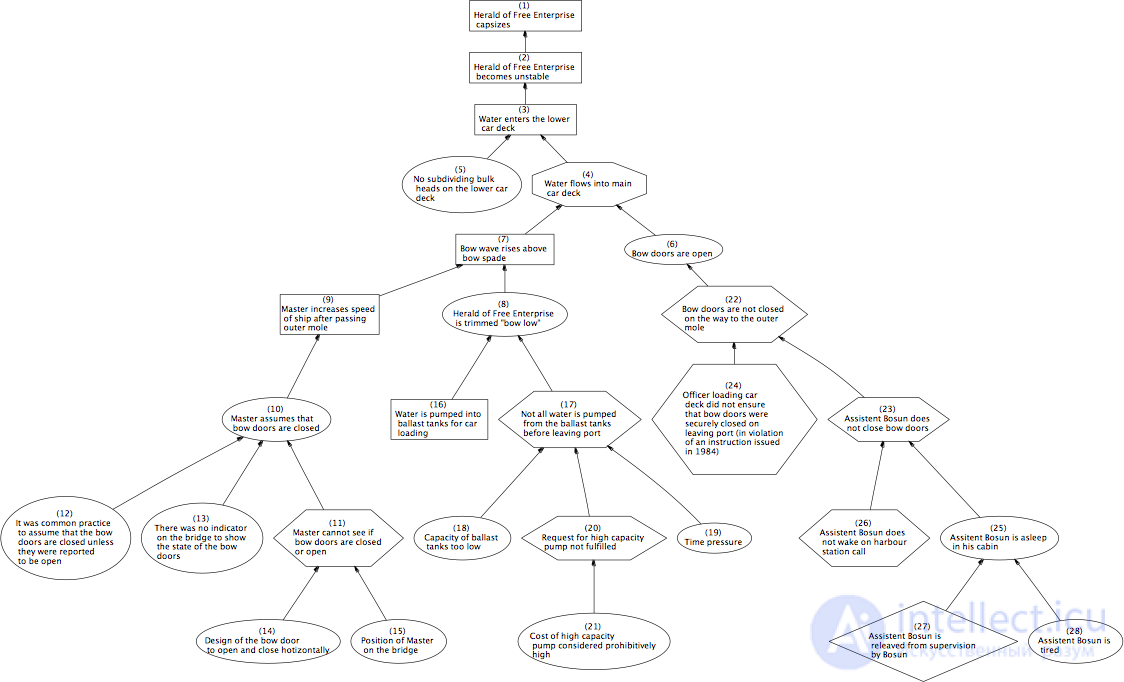
Diagram of the causes of the sinking of the ship «Herald of Free Enterprise» (click to see details).
A subgroup of process theories is the mechanistic view of causation. It holds that causal relations arise on the basis of mechanisms. Although the concept of a mechanism is understood in different ways, the definition proposed by a group of philosophers called the «new mechanists» dominates the literature. [ 4
The literature of the Vedic period (c. 1750–500 BCE) contains early discussions of karma. Karma is a belief shared by Hinduism and other Indian religions, according to which a person's actions cause certain consequences in the current and/or future life, positive or negative. Various philosophical schools (darshanas) offer different explanations of this issue. The doctrine of satkaryavada holds that the effect is in some way inherent in the cause. Thus, the effect represents either a real or an apparent modification of the cause. The doctrine of asatkaryavada holds that the effect is not inherent in the cause, but is a new occurrence. In the «Brahma-samhita», Brahma describes Krishna as the first cause of all causes.
In the «Bhagavad Gita» 18.14, five causes of any action are identified (knowledge of which allows it to be perfected): the body, the individual soul, the senses, effort, and the oversoul.
According to Monier-Williams, in the Nyaya theory of causation from sutra I.2.I,2 of Vaisheshika philosophy, from causal non-existence comes efficient non-existence; but not efficient non-existence from causal non-existence. The cause precedes the effect. Using the metaphor of threads and cloth, three causes can be distinguished:
Monier-Williams also suggested that Aristotle's and Nyaya's causation is regarded as conditional aggregates necessary for a person's productive labor.
Karma is a principle of causation focused on 1) causes, 2) actions, 3) effects, where it is precisely the phenomena of the mind that direct the actions performed by the subject. Buddhism trains the subject's actions to achieve continuous and involuntary virtuous outcomes aimed at reducing suffering. This follows the «subject-verb-object» structure
The general or universal definition of pratītyasamutpāda (or «dependent origination», «dependent arising», or «interdependent co-arising») is that everything arises in dependence on a multitude of causes and conditions; nothing exists as a single, independent entity. The traditional example in Buddhist texts is three sticks standing upright, leaning against and supporting one another. If one stick is removed, the other two will fall to the ground.
In the Buddhist school of Chittamatra, the school of Asanga (c. 400 CE), which follows an approach based solely on consciousness, it is claimed that objects cause consciousness in their own image and likeness. Since causes precede effects, which must be different entities, subject and object are distinct. For this school, there are no objects that would be entities external to the perceiving consciousness. The Chittamatra and Yogachara-Svatantrika schools acknowledge that there are no objects external to the observer's causation. This largely corresponds to the approach of the Nikayas. [
Vaibhashika (c. 500 CE) is an early Buddhist school that advocates direct contact with the object and accepts simultaneous causation. This is based on the example of consciousness, which states that intentions and feelings are complementary mental factors that support one another like the legs of a tripod. In contrast, opponents of simultaneous causation argue that if the effect already exists, it cannot act again in the same way. How the past, present, and future are accepted is the basis for the different views on causation in the Buddhist schools.
All classical Buddhist schools teach karma. «The law of karma is a particular case of the law of cause and effect, according to which all our actions of body, speech, and mind are causes, and all our experience is their effect».
Aristotle identified four kinds of answers or modes of explanation to various «Why?» questions. He believed that for any given subject, all four modes of explanation are important, each in its own way. As a result of traditional specialized philosophical features of language, with translations between Ancient Greek, Latin, and English, the word «cause» is now used in specialized philosophical works to denote the four kinds of causes proposed by Aristotle. In ordinary language, the word «cause» has many meanings, the most common of which refers to efficient causation, which is the subject of this article.
Of the four kinds or modes of explanation given by Aristotle, only one, the «efficient cause», is a cause as defined in the first paragraph of this article. The other three modes of explanation can be translated as material composition, structure, and dynamics, and, again, the criterion of completion. The word Aristotle used was αἰτία. For our purposes, this Greek word is better translated as «explanation» rather than as «cause», since these words are the ones most commonly used in modern English. Another way of translating Aristotle is that he meant the «four causes» as four kinds of answers to «why» questions.
Aristotle took the position that efficient causation refers to a basic fact of experience, not explicable and not reducible to anything more fundamental or basic.
In some of Aristotle's works the four causes are listed as (1) the essential cause, (2) the logical ground, (3) the moving cause, and (4) the final cause. In this list, a statement of the essential cause is proof that the specified object matches the definition of the word that applies to it. A statement of the logical ground is an argument for the truth of a statement about the object. These are a few more examples of the idea that «cause» in general, in the context of Aristotle's usage, is «explanation».
The word «efficient» as used here can also be translated from Aristotle's works as «moving» or «initiating».
Efficient causation was tied to Aristotelian physics, which recognized four elements (earth, air, fire, water) and added a fifth element (aether). Water and earth, by their intrinsic property of gravitas, or heaviness, naturally tend toward the center of the Earth — the fixed center of the universe — whereas air and fire, by their intrinsic property of levitas, or lightness, naturally tend away from it — in a straight line, accelerating as the substance approaches its natural place.
Since air remained on Earth and did not leave it, which would ultimately mean reaching infinite speed — an absurdity — Aristotle concluded that the universe is finite in size and contains an invisible substance that holds the planet Earth and its atmosphere, the sublunary sphere, at the center of the universe. And since the heavenly bodies exhibit eternal, unaccelerated motion, revolving around the planet Earth in unchanging ratios, Aristotle concluded that the fifth element, aether, filling space and composing the heavenly bodies, by its nature moves in eternal circles, the only constant motion between two points. (An object moving in a straight line from point A to point B and back must stop at one of the points before returning to the other.)
Left to itself, a thing exhibits natural motion, but, according to Aristotelian metaphysics, it can exhibit forced motion caused by an efficient cause. The form of plants endows them with processes of nutrition and reproduction, the form of animals adds motion, and the form of humans adds reason to this. A stone usually exhibits natural motion, explained by the material cause of its existence — the element earth — but a living being can lift the stone, whose forced motion diverts the stone from its natural place and natural motion. As an additional explanation, Aristotle defined the final cause, specifying the purpose or criterion of completion in light of which something should be understood.
Aristotle himself explained:
Cause means
(a) in one sense, that from the presence of which something comes to be — e.g. the bronze of a statue and the silver of a cup, and the classes which contain these [i.e. the material cause];
(b) in another sense, the form or pattern; that is, the essential formula and the classes which contain it — e.g. the ratio 2:1 and number in general is the cause of the octave — and the parts of the formula [i.e., the formal cause].
(c) The source of the first beginning of change or rest; e.g. the man who deliberates is a cause, and the father is the cause of the child, and in general that which produces is the cause of that which is produced, and that which changes is the cause of that which is changed [i.e., the efficient cause].
(d) The same as the «end»; that is, the final cause; e.g. the «end» of walking is health. For why does a man walk? «To be healthy,» we say, and by saying this we consider that we have supplied the cause [the final cause].
(e) All those means toward the end which arise at the instigation of something else, such as means for losing weight, purging, drugs, and instruments, are causes of health; for they all have the end as their aim, though they differ from each other in that some are instruments, others actions [i.e. necessary conditions].
— Metaphysics, Book 5, section 1013a, translated by Hugh Tredennick
Aristotle also distinguished two modes of causation: proper (per se) causation and accidental (chance) causation. All causes, proper and accidental, can be described as potential or as actual, particular or general. The same language applies to the effects of causes, so that general effects relate to general causes, particular effects to particular causes, and actual effects to acting causes.
To avoid an infinite regress, Aristotle derived the concept of the first mover — the unmoved mover. The motion of the first mover also had to be caused by something, but, being an unmoved mover, it had to move only toward some goal or desire.
Although Pyrrhonism accepted the plausibility of causation, it equally accepted that it is quite plausible that nothing is the cause of anything.
In keeping with Aristotelian cosmology, Thomas Aquinas proposed a hierarchy in which priority was given to Aristotle's four causes: «final > efficient > material > formal». Aquinas sought to identify the first efficient cause — now simply the first cause — as something everyone would agree, in Aquinas's words, to call God. Later, in the Middle Ages, many scholars accepted that the first cause is God, but explained that many earthly events occur within God's design or plan, and so scholars sought the freedom to investigate numerous secondary causes.
For Aristotelian philosophy prior to Thomas Aquinas, the word «cause» had a broad meaning. It meant «an answer to the question «why» or an «explanation», and Aristotelian scholars distinguished four kinds of such answers. With the end of the Middle Ages, in many philosophical contexts the meaning of the word «cause» narrowed. It often lost this broad meaning and was restricted to just one of the four kinds. For authors such as Niccolò Machiavelli, in the field of political thought, and Francis Bacon, concerned with science in general, Aristotle's moving cause was at the center of their interest. The widely used modern definition of causation in this new, narrowed sense was adopted by David Hume. He undertook an epistemological and metaphysical investigation of the concept of the moving cause. He denied that we can ever perceive cause and effect except by developing a habit or custom of thought, whereby we come to associate two types of objects or events, always contiguous and occurring one after the other. In Book I, Part III, Section XV of his book «A Treatise of Human Nature», Hume expanded this into a list of eight ways of judging whether two things can be cause and effect. The first three:
In addition, there are three interconnected criteria arising from our experience, which are «the source of most of our philosophical reasonings»:
And then two more:
In 1949, physicist Max Born distinguished between determination and causality. For him, determination meant that real events are so linked by natural laws that, on the basis of sufficient available data about them, reliable predictions and retrospective inferences can be made. He describes two kinds of causality: nomic, or general, causality and singular causality. Nomic causality means that cause and effect are connected by more or less definite or probabilistic general laws, covering a range of possible or potential instances; this can be regarded as a probabilistic version of Hume's criterion 3. A case of singular causality is a particular event of a certain complex of events, physically connected by precedence and contiguity, which can be regarded as criteria 1 and 2.
For the scientific investigation of efficient causation, cause and effect are best regarded as processes that are variable in time.
Within the conceptual framework of the scientific method, a researcher sets up several different and contrasting temporal, transient material processes that have the structure of experiments, and records the presumed material responses, generally with the aim of determining causation in the physical world. For example, one might want to know whether high consumption of carrots causes people to develop bubonic plague. The amount of carrots consumed is a process that varies from case to case. The occurrence or absence of subsequent bubonic plague is recorded. To establish causation, the experiment must satisfy certain criteria, of which only one example is given here. For instance, instances of the presumed cause must be arranged to occur at a time when the presumed effect is relatively unlikely in the absence of the presumed cause; such unlikelihood must be established by empirical data. Mere observation of a correlation is far from sufficient to establish causation. In almost all cases, the establishment of causation rests on the repetition of experiments and probabilistic reasoning. Causation is rarely established more firmly than as more or less probable. It is most convenient for establishing causation if the contrasting material states of affairs match exactly, except possibly for one variable factor, measured by a real number.
A causal system is a system whose output and internal states depend only on current and previous input values. A system that has some dependence on input values from the future (in addition to possible past or current input values) is called an acausal system, and a system that depends solely on future input values is called an anticausal system. Acausal filters, for example, can exist only as post-processing filters, since such filters can retrieve future values from a memory buffer or file.
In physics and engineering we must be very careful with causation. Cellier, Elmqvist, and Otter describe causality underlying physics as a misconception, since physics is fundamentally acausal. In their paper they give a simple example: «the relationship between the voltage across an electrical resistor and the current through it can be described by Ohm's law: V = IR, however the question of whether the current flowing through the resistor causes the voltage drop, or whether the difference in electric potential across the two wires causes the current to flow, is physically meaningless». In fact, if we were to explain causation by means of this law, we would need two explanations to describe an electrical resistor: as a source of a voltage drop, or as a source of a current flow. There is no physical experiment in the world that could distinguish between action and reaction.
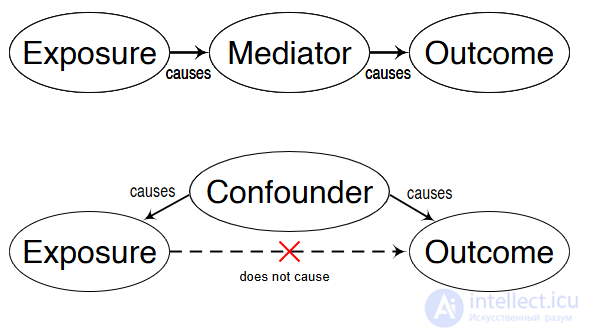
While a mediator is a factor in the causal chain (top), a confounder is a spurious factor falsely suggesting causation (bottom).
Austin Bradford Hill built on the work of Hume and Popper and, in his paper «The Environment and Disease: Association or Causation?», proposed considering aspects of association such as strength, consistency, specificity, and temporal sequence when trying to distinguish causal from non-causal associations in an epidemiological setting. (See the Bradford Hill criteria.) However, he did not note that temporal sequence is the only necessary criterion among these aspects. Directed acyclic graphs (DAGs) are increasingly used in epidemiology to better understand causal relationships.
Psychologists apply an empirical approach to causal relationships, investigating how humans and animals detect or infer causation from sensory information, prior experience, and innate knowledge.
Attribution: Attribution theory is a theory that studies how people explain individual instances of causation. Attribution can be external (attributing causation to an external agent or force — claiming that some external circumstance motivated the event) or internal (attributing causation to factors within the person themself — accepting personal responsibility for one's actions and claiming that one was directly responsible for the event). Taking this further, the type of attribution a person makes affects their future behavior.
The intention underlying a cause or effect may be described by the agent of the action. See also accident; fault; intent; and responsibility.
Causal relations
Whereas David Hume argued that causes are inferred from non-causal observations, Immanuel Kant argued that people possess innate representations of causes. In psychology, Patricia Cheng attempted to reconcile the views of Hume and Kant. According to her power theory of causal induction, people filter their observations of events guided by the intuition that causes have the power to generate (or prevent) their effects, thereby inferring specific causal relations.
Causation and salience
Our understanding of causation depends on which events we consider relevant. Another way to look at the statement «Lightning causes thunder» is to regard lightning and thunder as two perceptions of the same event, namely an electrical discharge, which we perceive first visually and then aurally.
Naming and causation
David Sobel and Alison Gopnik of the Department of Psychology at the University of California, Berkeley, developed a device known as the blicket detector, which activated when some object was placed on it. Their research shows that «even young children readily and rapidly learn about a novel causal power of an object and spontaneously use this information to categorize and name the object».
Perception of launching events
Some researchers, such as Anjan Chatterjee of the University of Pennsylvania and Jonathan Fugelsang of the University of Waterloo, use neuroscientific methods to study the neural and psychological bases of causal launching events, in which one object causes the motion of another object. Both temporal and spatial factors can be manipulated.
For further information, see «Causal reasoning (psychology)».
In statistics and economics, existing or experimental data are typically used to infer causal relations by means of regression analysis methods. Within the set of statistical methods, regression analysis is widely applied. Typically, a linear relationship is used, for example,

is postulated, in which  is the i-th observation of the dependent variable (assumed to be the caused variable).
  for j = 1,..., k is the i-th observation on the j-th independent variable (assumed to be a causal variable), and
  is the error term for the i-th observation (containing the combined effect of all other causal variables, which must be uncorrelated with the included independent variables). If there is reason to believe that none of the
  's is caused by y, then estimates of the coefficients
  are obtained. If the null hypothesis that
  is rejected, then the alternative hypothesis that
  and hence that causes y cannot be rejected. On the other hand, if the null hypothesis that cannot be rejected, then correspondingly the hypothesis of no causal effect of on y cannot be rejected either. Here the notion of causation is that of contributory causation as discussed above: if the true value then a change in will result in a change in y unless some other causal variable(s), included in or implicit in the regression's error term, changes in such a way as to exactly offset its effect; thus a change in is not sufficient to change y. Likewise, a change in is not necessary to change y, since a change in y could be caused by something implicit in the error term (or by some other causal explanatory variable included in the model).
The method described above for testing causation requires confidence that there is no reverse causation, in
продолжение следует...
Часть 1 Causality
Часть 2 Humanities - Causality
Часть 3 - Causality

Comments