
Lecture
In the classical view, systems analysis is associated with order, stability and manageability. However, any system — technical, social, economic or cultural — inevitably encounters processes of destruction, decay and transition into a chaotic state. The philosophy of system destruction treats these processes not as an anomaly, but as a natural and necessary stage of development.
The transition from order to chaos is a key theme both in philosophy and in systems analysis. It allows us to understand why systems lose stability, how a new quality arises, and why destruction is often a condition for renewal.
The development of systems analysis, synergetics, and the theory of complex and nonlinear systems affirms: instability is not an anomaly, but a normal and necessary state of most real systems.
Instability manifests itself in natural, social, economic, technical and cognitive systems. It is linked to variability, uncertainty, transitions and crises. The philosophy of instability seeks to comprehend not only the causes of system destruction, but also their capacity for self-development and transformation.
A system is a set of interconnected elements forming a whole and functioning for a specific purpose. In philosophy, a system is understood more broadly than in the technical sciences: as a form of organization of being, thought and society.
The main features of a system:
integrity;
the presence of a structure;
hierarchy of elements;
stability of connections;
capacity for self-regulation.
However, the stability of a system is never absolute. It exists only within certain limits, beyond which processes of destabilization begin.
Order is associated with:
predictability;
repeatability of processes;
stable connections;
controllability.
In systems analysis, order is expressed through models, algorithms, regulations and rules of functioning.
The instability of a system is a state in which small changes in parameters or external conditions lead to significant changes in the structure, behavior or functions of the system.
From a philosophical point of view, instability means:
the absence of a fixed equilibrium;
sensitivity to initial conditions;
the possibility of qualitative leaps;
fundamentally incomplete predictability.
Instability is opposed not to order, but to rigid staticity. Stability and instability in systems philosophy are regarded as complementary aspects of development.
Chaos in philosophy is not simply disorder, but a state of high uncertainty in which old connections are destroyed while new ones have not yet formed.
It is important to emphasize:
chaos is not the absence of structure, but the potentiality of many new structures.
2.4 A key concept of the philosophy of instability is nonlinearity. In nonlinear systems:
cause and effect are not proportional;
small influences can have large consequences;
the future cannot be derived directly from the past.
Nonlinearity gives rise to such phenomena as:
chaos;
bifurcations;
self-organization;
emergent properties.
Philosophically, this means a rejection of reductionism and the recognition that the whole is fundamentally not reducible to the sum of its parts.
2.5 Bifurcation — the moment at which a system loses its previous stability and can transition into one of several possible states.
The philosophical significance of bifurcation:
the future of a system is fundamentally plural;
the choice of path is not always determined rationally;
chance becomes a structure-forming factor.
At bifurcation points, the role increases of:
individual decisions;
fluctuations;
values and meanings (in social systems).
The idea of instability has deep philosophical roots:
Heraclitus: «Everything flows, everything changes» — an early recognition of the dynamic nature of being.
Hegel's dialectics: development through contradictions, negation and leaps.
Marxist philosophy: crises as inherent to social systems.
Process philosophy (Whitehead): reality as continuous becoming.
Post-non-classical science: a rejection of determinism and linearity.
Thus, instability gradually ceases to be perceived as a malfunction and becomes a philosophical norm.
The categories of order and destruction have accompanied philosophical thought since its inception. They express the basic tension between stability and variability, integrity and disintegration, cosmos and chaos. In various philosophical traditions, order and destruction have been understood either as opposites or as interconnected and mutually conditioning processes.
Historical-philosophical analysis shows that the idea of destruction has rarely been understood as purely negative: more often it has been viewed as a necessary moment in the emergence of a new order.
In ancient Greek mythology, Chaos is the original state of the world from which Cosmos arises as an ordered whole. Already at this stage, destruction and order are not radically opposed: chaos is a source of creation.
Philosophy inherited this idea, rationalizing it.
Heraclitus viewed the world as a process of continuous becoming. The struggle of opposites («polemos») is a source of order. The destruction of old forms is a condition for preserving the integrity of the world.
Parmenides, by contrast, asserted the immutability of being and the illusory nature of destruction. This laid the foundation for the future confrontation between the dynamic and static understanding of order.
Empedocles introduces a cyclical model: Love unites the elements (order), Strife separates them (destruction).
Plato links order with the world of ideas, and destruction with the material world, which is subject to change and decay. Matter lacks stable order and therefore needs a shaping principle.
Destruction here is a consequence of remoteness from ideal being.
Aristotle introduces the concept of entelechy — an internal purpose that ensures order and development. Destruction is understood as the loss of form or purpose.
Importantly, for Aristotle destruction is not an absolute disappearance, but a transition of matter into another state.
In medieval thought, the order of the world is based on a divine hierarchy. The cosmos is organized according to the will of the Creator, and destruction is interpreted as:
a consequence of the Fall;
a violation of the divine order;
a sign of the eschatological end.
For Augustine and Thomas Aquinas, destruction does not cancel order, but confirms its transcendent origin: true order lies outside the material world.
The Modern era forms the notion of the world as a mechanism subject to strict laws. Order is identified with mathematical predictability.
Here destruction is:
the breakdown of a mechanism;
a violation of external conditions;
a management error.
Philosophy seeks to eliminate uncertainty and chaos through rational knowledge.
The idea of progress assumes that destruction is a temporary and surmountable state. Reason is capable of restoring order and even creating a more perfect one.
Kant distinguishes between the order of phenomena and the limitations of human cognition. The destruction of rational systems is possible when one goes beyond the bounds of experience.
Hegel radically rethinks destruction. In his dialectics, negation is a necessary moment of development. The destruction of the old order is a condition for the emergence of a new, more complex one.
Here, for the first time, destruction becomes an internal mechanism of the self-development of a system.
Marx transfers dialectics to the social sphere. Social revolutions are a form of the destruction of old structures, necessary for historical development.
Nietzsche criticizes traditional values and proclaims the necessity of a «revaluation of all values». The destruction of the moral order is a condition for the birth of new meanings.
Philosophers of life emphasize the irrationality, spontaneity and tragedy of being. The destruction of order here is linked to human freedom and responsibility.
In the 20th–21st centuries, ideas of order and destruction are integrated into:
the theory of complex systems;
synergetics;
the philosophy of chaos;
post-non-classical science.
Order is regarded as temporary, local, and arising out of instability, while destruction is regarded as a phase of transition and reorganization.
4.1 Internal sources of system instability
Systems philosophy identifies a number of internal causes of instability:
Accumulation of contradictions
Conflict between the elements, goals or levels of a system.
Growth of entropy
Increasing disorder and loss of manageability.
Obsolescence of structure
A mismatch between the system and changed conditions.
Limitations of adaptive mechanisms
Loss of the capacity for self-renewal.
Philosophically, this points to the finitude of any form and the temporary nature of stability.
4.2. External factors of instability
Alongside internal ones, external influences play an important role:
changes in the environment;
technological shifts;
cultural and value transformations;
crises and conflicts.
Systems philosophy emphasizes: a system never exists in isolation, and its instability is often a consequence of changes in a broader system.
4.3 Instability as a condition for development
A fundamentally important conclusion of the philosophy of instability is that:
Development is impossible without instability.
Stability ensures preservation,
instability — the emergence of the new.
Under conditions of instability, the following are possible:
innovations;
transition to a new level of organization;
the emergence of new meanings and forms.
Thus, crisis and chaos are regarded not only as a threat, but also as a potential.
4.4 Man and the instability of systems
A human being is simultaneously:
a source of instability (through activity, thought, technology),
an object of instability (social, economic, cultural).
The philosophy of instability requires:
abandoning the illusion of full control;
developing systems thinking;
accepting uncertainty as a condition for freedom and responsibility.
The destruction of a system can occur under the influence of both internal and external factors.
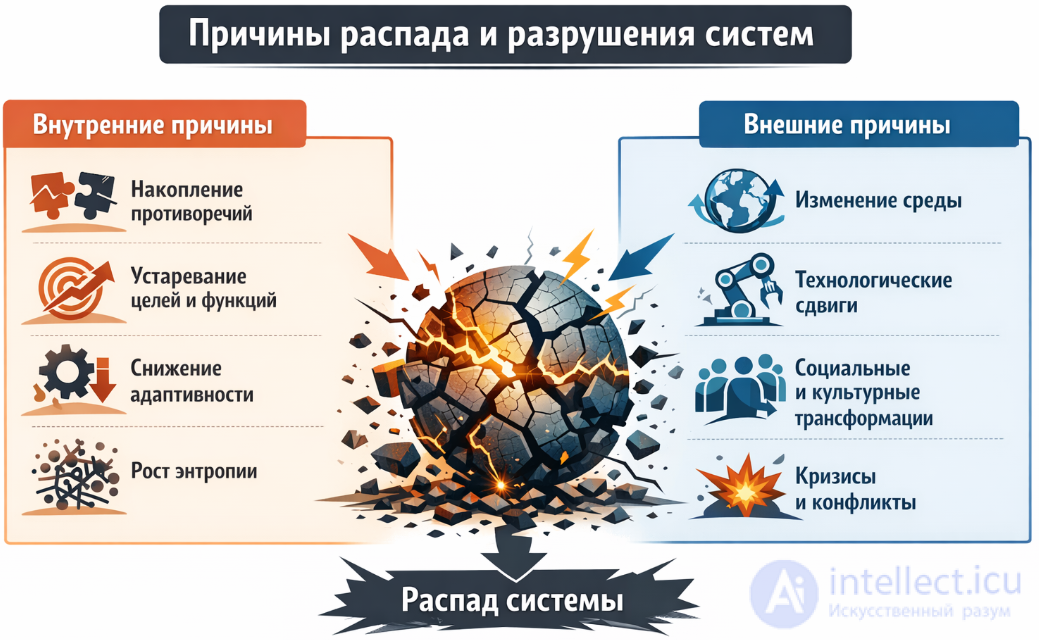
accumulation of contradictions;
obsolescence of goals and functions;
reduced adaptability;
growth of entropy.
changes in the environment;
technological shifts;
social and cultural transformations;
crises and conflicts.
From the point of view of philosophy, destruction is the result of a mismatch between a system and the reality in which it exists.
The concept of entropy, borrowed from thermodynamics, is widely used in philosophy and systems analysis.
The entropy of a system means:
growth of disorder;
loss of information;
weakening of connections between elements.
Any closed system tends toward increasing entropy over time. To preserve order, a system needs to:
receive resources from outside;
renew its structure;
change its rules of functioning.
If this does not happen, destruction becomes inevitable.
Contemporary philosophy and complex systems theory regard chaos not as an end, but as a condition for evolution.
At points of crisis:
the previous order is disrupted;
alternative paths of development arise;
a system can transition to a higher level of organization.
In systems analysis, this moment is called the bifurcation point, when a small influence can radically change the future trajectory of a system.
The history of humanity shows that:
the collapse of empires;
crises of ideologies;
the destruction of social institutions
have often become the basis for the emergence of new forms of society.
Philosophers (Hegel, Nietzsche, Foucault) regarded destruction as:
a negation of the old order;
liberation from dogma;
an opportunity to rethink values.
Thus, the destruction of a system is not only a loss, but also a philosophical act of transition.
Contemporary systems analysis recognizes that sometimes preserving a system at any cost leads to a deeper crisis. This gives rise to the concept of controlled destruction:
reorganization;
dismantling of obsolete elements;
abandonment of inefficient connections.
This approach makes it possible to shift chaos from a destructive phase into a creative one.
All interesting systems (transportation, healthcare, energy…) are naturally and inevitably dangerous by their very nature. The frequency of dangerous phenomena can in some cases be influenced, but the processes that make up these systems are themselves a source of unavoidable danger. And it is precisely the presence of this danger that leads to the creation of the numerous protective measures so characteristic of these systems.
The more dangerous the possible failures, the more complex the protective system against them becomes over time. Protective systems include both obvious technical solutions (redundancy, automated safety devices, etc.) and «human» solutions (training, drills), as well as various organizational, institutional and regulatory means of protection (policies and procedures, certification, rules…). All of them focus on building lines of defense that generally steer the system's operation along an accident-free path.
Defensive structures work. The operation of systems is, as a rule, successful. Noticeable global failures arise when several small, essentially harmless failures combine, creating the possibility of a global systemic accident. Each of these failures is necessary to create the accident, but only together do they achieve the result. In other words, there are far more opportunities for systemic accidents to arise than accidents that actually occur. Most of these opportunities are blocked at an early stage of development by the protective means created for that purpose. Most of those that reach the operational level are blocked by specialists.
The complexity of the systems in question makes it impossible to operate without multiple internal errors. Since none of them alone is capable of causing an accident, at the operational level they are regarded as insignificant. Eliminating all these errors is considered economically irrational; moreover, proactively assessing their influence on the possibility of a systemic accident is difficult. The set of errors within a system is constantly changing along with changes in technology and work organization, as well as as a result of efforts to eliminate them.
From the above it follows that complex systems always operate as damaged systems. A system continues to function because it contains numerous additional means of ensuring stability, and also because people make it work despite the presence of numerous errors. When accidents that have occurred are analyzed, it is almost always noted that the system has accumulated a history of «proto-failures» that nearly caused an accident. The claim that these situations should have been identified in advance is usually based on a simplified understanding of how systems work. Whereas this work – and the resulting performance of the system – is a continuously changing combination of failures and recoveries of components (organizational, human, technical).
Complex systems are prone to catastrophes. Specialists working with them are almost always in close proximity – both in space and in time – to a possible accident: it can happen at any moment and in almost any place. The capacity for catastrophe is a family trait of complex systems. This property cannot be eliminated; it is inherent in the very nature of complex systems.
Since systemic accidents occur as a consequence of the combination of multiple errors, there is no single «cause of the accident». Multiple factors are always at work, each insignificant on its own, but together leading to the accident. Therefore it is impossible to determine the «root cause» of an accident. Investigations aimed at identifying such a cause are based not on a technical understanding of the nature of the failure, but only on the social need to assign to someone or something a specific blame for what happened1.
Knowledge of the consequences makes us exaggerate how obvious the events leading up to it were to the specialists. This means that analysis of people's work conducted ex post facto produces inaccurate results. Knowledge of what happened afterward prevents the person conducting the analysis from objectively evaluating the specialists' behavior in the past. It seems to them that people «should have known» that certain events would «inevitably» lead to an accident2. The bias of retrospective analysis remains the main obstacle to investigating catastrophes, especially in the expert evaluation of personnel's work.
Specialists manage a system in order to obtain the product for which it was created and to prevent accidents. This is an inevitable dynamic characteristic of a system's operation – a constant search for balance between demand for output and the possibility of an accident starting. Outside observers rarely realize the duality of this role. During stable operation, the production role is the main one; when failures arise, it is the protective role. In both cases, the outside observer does not realize the constant and simultaneous involvement of specialists in performing both roles.
After accidents, when the failures that occurred look like the only possible consequence of past events, the specialists' actions are perceived as mistakes or as deliberate gross disregard for those events. In reality, all their actions are risky gambles, attempts to guess future uncertain events. The degree of uncertainty can vary from case to case. The fact that this is indeed guesswork becomes clear soon after an accident – the subsequent post-mortem analysis shows precisely that they guessed wrong.
But the fact that the successful operation of systems is also a result of guessing is not equally obvious or generally accepted.
Organizations oscillate, often unintentionally, between achieving goals, rational use of resources, cost savings, and controlling the risks of accidents. All these contradictions are resolved through the work of specialists at the sharp end of systems. After an accident, the actions of specialists may be interpreted as «errors» or «deviations», but such assessments are influenced by retrospective bias and do not take into account other driving forces, especially performance requirements.
Specialists and first-line managers actively adapt systems to obtain maximum performance with a minimum of accidents. This adaptation is often carried out unsystematically, on a case-by-case basis. Here are some examples of such adaptation:
Complex systems require serious expertise to manage and operate. This expertise changes as technologies change, but it also changes as personnel change. In any case, training and updating of knowledge is a necessary part of a system's operation. Consequently, at any given moment, every system includes specialists with different levels of expertise. Serious difficulties associated with expertise arise (1) when rare expertise is needed for the most complex or important production tasks, and (2) when expertise needs to be developed for future use.
A low level of visible disruptions in reliable systems can stimulate changes, especially the application of new technologies, in order to eliminate minor but frequent failures. These changes can create opportunities for new failures – rare, but significant. When new technologies are used to eliminate known minor errors or increase performance, they often become a source of large-scale, catastrophic accidents. Often these new accidents even have a greater impact than those that were prevented by the introduction of new technologies. New kinds of failures are difficult to identify in advance; attention is paid mainly to the anticipated benefits of introducing the change. Since major new accidents occur infrequently, several system changes may pass before their first occurrence, which makes it difficult to determine the connection between accidents and new technologies.
Post-accident measures regarding «human errors» are based on suppressing or preventing actions that could cause an accident. Such actions with respect to the extreme link of the chain do little to reduce the probability of an accident in the future. In fact, the probability of exactly the same accident recurring is vanishingly small in any case, since the combination of the many underlying errors is constantly changing. Instead of increasing the level of safety, the measures taken based on the results of accident investigations only increase the complexity of the system. Along with it, the probable number of hidden errors increases, and the work of tracking and eliminating them becomes more difficult.
Safety is a general property of a system; it cannot be reduced to a person, a device or a department. It cannot be bought or produced; it is inseparable from the other components of the system. This means that safety cannot be managed as a resource. The state of safety of any system is always dynamic; continuous changes in the system lead to continuous changes in threats and in their management.
Uninterrupted operation is the result of the activity of people who keep the system within acceptable performance limits. For the most part, this activity is part of ordinary daily activity and appears very simple on the surface. But since the operation of a system is never completely free of errors, it is precisely the specialists' ability to adapt to changing conditions that ensures the safety of the system at every moment in time. This ability often involves merely the ability to choose one of the standard behavioral options; however, in individual cases it requires creating new combinations or even fundamentally new approaches to the system's operation.
Identifying danger and successfully managing a system in order to keep performance within acceptable limits requires close contact with errors. High performance is achieved in those systems where specialists can sense the boundary at which the system's operation becomes less stable, less predictable, or cannot be confidently diagnosed. In systems that are by definition dangerous, this means calculating and controlling dangers so that the overall performance of the system remains within agreed limits. Improvements in safety depend on specialists having a scalable approach to threats and on their ability to predict the impact of corrective actions on the system's position relative to the boundary between maximum performance and uncontrolled runaway.
The philosophy of system destruction shows that the path from order to chaos is a natural and lawful process. Destruction is not the opposite of development, but acts as its necessary stage.
The philosophy of system instability forms a new worldview, in which the world appears:
dynamic;
open;
fundamentally uncertain;
developing through crises and transitions.
Instability ceases to be an exclusively negative phenomenon and is understood as an ontological condition for development, freedom and creativity.
From the point of view of systems analysis, chaos is:
a signal of the limit of stability;
a space of possibilities;
a source of renewal and evolution.
Understanding these processes makes it possible not only to analyze past crises, but also to consciously manage future changes, turning destruction into an instrument of development.

Comments