
Lecture
The lifespan of a system is determined by its type, as well as by internal and external factors:
Physical systems (equipment, machinery)
Depends on the material, operating conditions, and level of maintenance.
Example: an incandescent bulb lasts ~1000 hours, an LED — tens of thousands of hours.
Biological systems (organisms)
Lifespan depends on the species, genetics, and environment.
Example: bacteria may exist for minutes, while trees — for thousands of years.
Social systems (states, organizations)
Depends on the stability of institutions, resources, and culture.
Example: empires may exist for hundreds of years, while startups — for a few months.
Informational/mathematical systems (algorithms, models)
Lifespan is determined by relevance and applicability.
Example: Euclid's algorithm for GCD has existed for millennia, while some IT systems become obsolete within 5–10 years.
Physical systems (equipment, materials)
Governed by the laws of thermodynamics (entropy increases, wear is inevitable).
The laws of material strength and fatigue determine service life.
Example: an engine's service life depends on heating/cooling cycles and friction.
Biological systems (organisms)
Governed by the laws of biology and evolution.
Limited by aging processes, mutations, and environmental influences.
Example: cells have a division limit (the Hayflick limit).
Social systems (states, organizations)
Governed by the laws of sociology and economics.
Existence depends on the stability of institutions, resources, and cultural norms.
Example: empires collapse when the balance of power and resources is disrupted.
Informational/mathematical systems (algorithms, models)
Governed by the laws of logic and relevance.
Their existence is limited not by physics but by applicability.
Example: Euclid's algorithm is eternal as an idea, but a specific IT system becomes obsolete due to technological progress.
Law of entropy: any system tends toward destruction or simplification over time.
Law of limited resources: a system exists as long as there is energy, information, or support.
Law of adaptation: the better a system adapts to changes in its environment, the longer it lives.
Law of self-organization: complex systems can extend their existence through internal restructuring.
the Lindy law: if something has already existed for X years, then the expected remaining lifetime is also approximately X years (or proportional to X).
the Gompertz law - the probability of death grows exponentially with age,
Failure rate of a physical system: break-in (defects, early failures), stable operation, rapid wear and aging
The Lindy effect (also known as Lindy's law) — is a theoretical phenomenon whereby the future life expectancy of some non-perishable objects, such as technologies or ideas, is proportional to their current age. Thus, the Lindy effect suggests that the longer something exists or is used in the present, the longer its remaining life expectancy will be. Longevity implies resistance to change, obsolescence, or competition, as well as higher chances of continued existence in the future. Where the Lindy effect applies, mortality decreases over time. Mathematically, the Lindy effect corresponds to a Pareto distribution for lifespan.
The name of the Lindy concept comes from Lindy's, a New York delicatessen restaurant where comedians first voiced this idea. According to it, a show that has run for only two weeks is likely to last about as long again, whereas a show that has already run for two years can expect roughly two more years of existence. This theory was later developed by mathematicians and statisticians. Nassim Nicholas Taleb formulated the Lindy effect in terms of «distance to an absorbing barrier».
The Lindy effect applies to non-perishable items, such as books, that is, to those that have no «inevitable expiration date» . For example, people are perishable — life expectancy in developed countries is about 80 years. Therefore, the Lindy effect does not apply to the lifespan of an individual person — all else being equal, the probability of a 10-year-old dying within the next year is lower than that of a 100-year-old, whereas the Lindy effect would predict the opposite.
If something has already existed for X years, then the expected remaining lifetime is also approximately X years (or proportional to X).
For example:
A book has been in print for 50 years → it will likely remain in print for another ~50 years
A programming language has existed for 30 years → there is a high probability it will remain in use for a long time to come
A technology has been in use for 10 years → it is not “on its way out”, but on the contrary, most likely stable
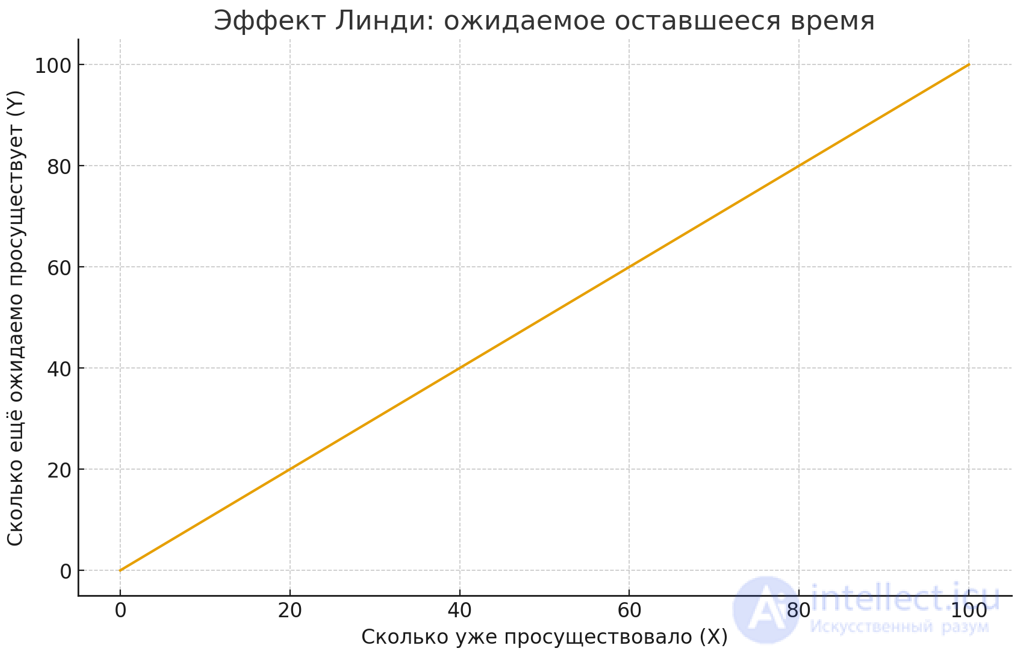
This does not work for people, but for:
ideas
books
technologies
companies
cultural phenomena
For humans, the Lindy law does not apply directly, because a person has a biological limit.
This is the opposite of things with a fixed service life, for example:
a battery (not applicable),
a person (not applicable),
a license (not applicable),
a subscription (not applicable).
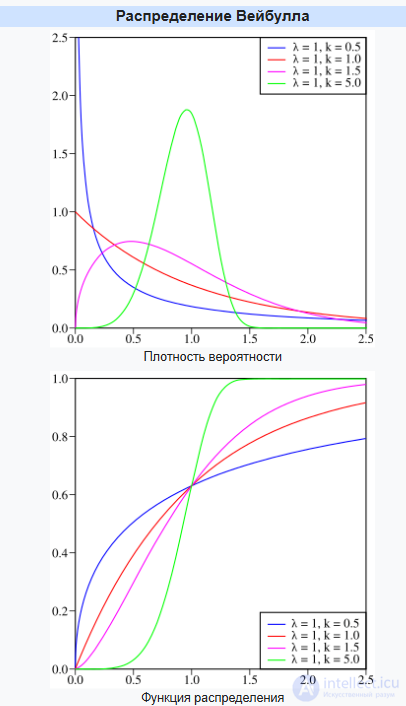
For objects with a limited service life, the Lindy effect does NOT work. Other laws apply to them, for example the Weibull distribution (THE LAW OF WEAR)
(the most universal and realistic)
Used for: equipment, mechanisms, bearings, batteries, auto parts, and even biological systems.
It accounts for three phases of life:
It is precisely this law that is used by: engineers, the aviation industry, medical equipment manufacturers, and industry.
For living organisms, for example, the Biological limit (Gompertz law) is used - the probability of death grows exponentially with age,
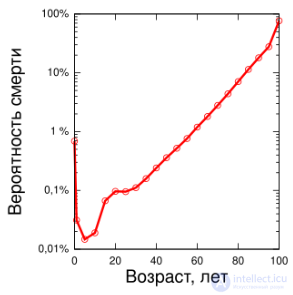
Estimated probability of death for a person at each age (for the USA, 2003). Mortality rates double every nine years after reaching the age of 30.
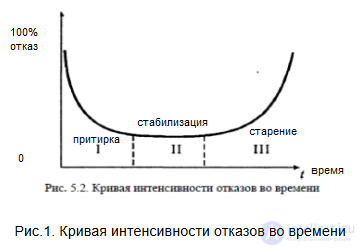
Analysis of the graph shows that the test period can conventionally be divided into three periods. In the first of them, the function λ(t) has elevated values. This is the run-in period, or the period of early failures due to hidden defects. The second period is called the period of normal operation. This period is characterized by a constant failure rate. The last, third period — is the aging period.
| Industry / Science | What is analyzed | Which law dominates | Why | Brief example |
|---|---|---|---|---|
| Culture | Books, myths, religions | Lindy | No physical wear | The Bible is 2000 years old → will last much longer |
| Philosophy | Ideas, theories | Lindy | Selection by time | Aristotle has lived on for 2300 years |
| Languages | Languages of communication | Lindy | Self-reinforcement through use | Latin has been influential for 2000 years |
| Music | Classical music | Lindy | Cultural selection | Bach has remained relevant for 300 years |
| Art | Painting, theater | Lindy | No aging period | Da Vinci has lived on for 500 years |
| Media | Newspapers, channels | Mixed | Idea — Lindy, carrier — wear | A newspaper as a brand lives on, the paper does not |
| IT (software) | Programming languages | Lindy | No physical wear | C has been alive since 1972 |
| Mathematics | Formulas | Lindy (ideal) | Absolutely immortal | The Pythagorean theorem |
| Engineering | Machines, mechanisms | Wear (Weibull) | Friction, fatigue | Engine |
| Power engineering | Batteries | Wear | Chemical degradation | Phone 2–4 years |
| Construction | Bridges, buildings | Wear | Material fatigue | A bridge ages |
| Aviation | Aircraft | Wear + fatigue | Pressure cycles | Service life in hours |
| Automotive industry | Cars | Wear | Mechanical service life | Internal combustion engine |
| Medicine | Human | Gompertz law | Exponential aging | 80 years ≠ another 80 |
| Biology | Living organisms | Wear + Gompertz | Biodegradation | Any organism |
| States | Empires, countries | Lindy (partially) | Institutional stability | China, 4000 years |
| Economics | Currencies | Hybrid | Trust + risks | The dollar since 1913 |
| Banks | Financial institutions | Lindy (while alive) | Regulation and trust | JP Morgan, 200 years |
| Business | Companies | Hybrid | Idea — Lindy, assets — wear | Coca-Cola |
| Laws | Constitutions | Lindy | Stability through age | US Constitution |
| Chemistry | Reactions, substances | Wear | Entropy | Corrosion |
| Geology | Mountains, continents | Wear (erosion) | Physical decay | Mountains erode |
| Space | Satellites | Wear | Radiation, fuel | 5–15 years |
| Manufacturing | Machine tools | Wear | Mechanical service life | Wear of guide rails |
| AI | Algorithms | Lindy | The older — the more reliable | Backprop, 40 years |
| Sociology |
Social institutions, norms, traditions, roles |
Lindy (for institutions) |
Institutions have no physical wear, stable due to repeatability |
Family, marriage, religion |
| Sociology | Social behavior patterns | Hybrid | Idea — per Lindy, but forms can become outdated | Fashion, trends |
| Sociology | Generations, demographics | Law of wear / Gompertz | Biological aging of people | Generational change |
| Sociology | State institutions | Lindy (partially) | The older the institution — the more stable | Court, parliament |
| Sociology | Social conflicts | Wear / decay | Conflicts burn out or explode | Strikes, protests |
| Political science |
Political institutions (parliament, court, elections) |
Lindy (partially) |
No physical wear, stability through tradition and trust |
Parliaments have existed for centuries |
| Political science | Constitutions, legal systems | Lindy |
The longer it has been in effect — the higher its legitimacy |
The US Constitution (1787) |
| Political science | Political ideologies | Lindy | These are ideas, not material objects | Liberalism, socialism |
| Political science | Political parties | Hybrid | Ideology — Lindy, organization — wear | The US Republican Party |
| Political science | Elites, political leaders | Biological wear (Gompertz) | People age and die | Any ruler |
| Political science | Political conflicts | Wear / decay | The resources and energy of the parties run out | Waves of protest |
|
Political science, political regime |
Monarchy |
Lindy |
Transmission of tradition increases stability |
The British monarchy |
|
Political science political regime |
Democracy | Lindy (institutional) |
The longer a system operates, the more stable its rules become |
USA, Switzerland |
|
Political science political regime |
Authoritarianism | Hybrid |
The institution of power can be stable, but depends on the individual |
The USSR after Stalin |
|
Political science political regime |
Totalitarianism | Wear |
Requires constant mobilization of finite resources |
the Third Reich |
|
Political science political regime |
Military juntas | Wear | Held together only by force and fear | Often last 5–20 years |
|
Political science political regime |
Revolutionary regimes | Wear |
Explosive start → rapid burnout |
France in the 1790s |
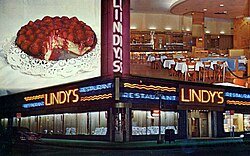
Lindy's delicatessen restaurant on the corner of Broadway and 51st Street in New York
The origin of this term can be traced to Albert Goldman and his 1964 article in The New Republic titled «Lindy's Law». The term Lindy refers to Lindy's delicatessen restaurant in New York, where comedians «gather every night to discuss recent events in show business». In this article, Goldman describes a folk belief among observers of the New York media that a comedian's amount of material is constant, and therefore the frequency of appearances predicts how long their show will last:
... The lifespan of a television comedian is inversely proportional to his total time on screen. If, pitifully deceived by pride, he takes on a regular weekly or even monthly program, his chances of lasting beyond the first season are negligible, but if he adheres to the policy of conserving resources favored by these aging «show business» philosophers, and limits himself to «specials» and «guest appearances», he may live to the age of Ed Wynn (died at the age of 79 in 1966, still appearing in films)
Benoit Mandelbrot, in his 1982 book The Fractal Geometry of Nature, proposed a different concept under the same name. In his interpretation, comedians do not have a fixed supply of jokes for television appearances. On the contrary, the more appearances they make, the more future appearances are predicted for them. Mandelbrot expressed mathematically that for certain things limited by the lifespan of their creator, such as human promises, the expected future lifespan is proportional to the past. He refers to Lindy's law and the parable of the graveyard of young poets, and then applies this to researchers and their publications: «However many works a person has produced over past years, on average they will continue for just as long again. When they do stop, it happens exactly at the halfway point of what was promised» .
Nassim Nicholas Taleb, in his 2012 book Antifragile: Things That Gain from Disorder, was the first to openly name his idea the Lindy effect. He expanded its application beyond the lifespan of the producer to cover anything without a natural upper bound, and incorporated it into his broader theory of antifragility.
If a book has been in print for forty years, I can expect it to remain in print for another forty years. But, and this is the key difference, if it survives another decade, then it is expected to remain in print for another fifty years. This is, in essence, the rule explaining why things that have existed for a long time do not «age» like people, but «age» in reverse. Every year that passes without disappearing doubles the additional life expectancy. This is an indicator of a certain robustness. The robustness of an item is proportional to its longevity!
According to Taleb, Mandelbrot agreed with the expanded definition of the Lindy effect: «I [Taleb] proposed the boundaries of perishable/non-perishable and he [Mandelbrot] agreed that non-perishable objects obey a power-law distribution, whereas perishable ones (the original interpretation of the Lindy effect) serve only as a metaphor».
Taleb later defined the term in his book Skin in the Game, where he linked the Lindy effect to fragility, disorder, and time. According to Taleb, «fragility theory leads directly to the Lindy effect», he defines «fragility as sensitivity to disorder», and asserts that «time is the equivalent of disorder, and resistance to the destructive effect of time, that is, what we proudly call survival, — is the ability to cope with disorder» . Since time acts through «skin in the game», Taleb believes that «things that survive hint, after the fact, that they possess a certain robustness». He concludes from this that «the only effective judge of things — is time», which, in his opinion, answers the «eternal meta-questions: Who will judge the expert? Who will guard the guards? [...] Well, survival» . He further argues that the Lindy effect is itself proof of the Lindy effect, citing the words of the pre-Socratic philosopher Periander («Use old laws, but fresh food») and Alfonso X («Burn old logs. Drink old wine. Read old books. Keep old friends»)
Among modern proponents of the Lindy effect are the Twitter user Paul Skallas, known as LindyMan, and Marc Andreessen, co-founder of Andreessen Horowitz. Skallas promotes a lifestyle inspired by the Lindy effect, an eclectic combination of Mediterranean writers such as the Greek philosopher Plutarch and the Catholic theologian Thomas Aquinas, as well as presumed lifestyles of Mediterranean peoples. In her article for The New York Times, Ezra Marcus notes that Skallas's approach to the Lindy effect differs from Taleb's statistical analysis in that it focuses on lifestyle aspects such as diet, dating, and exercise. Skallas urges skepticism toward new products and ideas whose longevity has not yet been proven. Skallas acknowledges that cultural longevity does not imply moral value, noting, for example, that sexual abuse by a wealthy person such as Jeffrey Epstein is also «Lindy».
Mathematically, the relationship postulated by the Lindy effect can be expressed by the following statement about a random variable T corresponding to the lifespan of an object (for example, a comedy show), which is assumed to take values in the range c  (with a lower bound
  )
)

Here the left-hand side denotes the conditional expectation of the remaining lifetime T−t , given that T has exceeded t, and the parameter p on the right-hand side (called the «Lindy proportion» by Iddo Eliazar) is a positive constant .
This is equivalent to the survival function of T

which has a failure rate
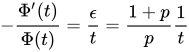
This means that the lifetime  follows a Pareto distribution (a power-law distribution) with exponent ε
In contrast, only Pareto distributions with exponent  correspond to a lifespan distribution satisfying the Lindy law, since the Lindy proportion p
 must be positive and finite (in particular, it is assumed that the lifespan T has a finite expected value). Iddo Eliazar proposed an alternative formulation of the Lindy law involving the median instead of the mean (expected value) of the remaining lifespan T−t , which corresponds to Pareto distributions for the lifespan T with the full range of possible Pareto exponents
  . Eliazar also demonstrated a connection with Zipf's law and socioeconomic inequality, arguing that «the Lindy law, the Pareto law, and Zipf's law are, in essence, synonymous laws».
Here are similar but not identical concepts:
Survivorship bias
We only see those who survived, and ignore those who disappeared.
Regression to the mean
After extreme values, everything returns to normal.
System inertia
Something that has worked for a long time is hard to break.

Comments