
Lecture
Topic. METHODS OF MANAGERIAL DECISION-MAKING
5.1. The problem of decision-making
5.2. Managerial decision-making under certainty
5.3. Criteria for selecting alternatives
5.4. The voting method
5.5. Expert methods of choosing solutions
Topic. DECISION-MAKING UNDER UNCERTAINTY
6.1. Scheme of a matrix game against nature
6.2. Decision-making under partial uncertainty
6.3. Decision-making under complete uncertainty
Topic. System analysis of solutions for information support of decision-making processes
10.1. Basic concepts of decision theory. Basic principles of decision theory. The problem of decision-making. Components of the decision-making task. Generalized decision-making process: understanding the task, systems analysis of the task, optimization, selection and analysis of the decision. Classification of decision-making tasks according to novelty, type of consequence, type of problem situation, method of description and representation, method of solution search, number of criteria, type of criterion evaluation of decisions, and field of application of decisions.
10.2. Formulation and classification of decision-making tasks. Formulation of decision-making tasks. Sequence of actions in formulating a task: establishing system boundaries, determining the performance indicator, selecting system variables, building a model.
10.3. Stages and procedures of decision-making. Stages of decision-making. Model of the decision-making cycle in problem situations. The theory of "economic man". Awareness of the situation.
Formulating the goals of decision-making. Determining ways to achieve
the goal. Choosing an effective solution. Decision-making scheme in systems analysis. Measures of information in different information environments.
10.4. Information system for decision support. Information system for decision support. Object-cognitive analysis of the subject domain: object-oriented analysis, ontological analysis, semantic analysis. Use of CASE tools for modeling knowledge processing systems.
In the process of management, the manager (the person making the decision – DM) has to make decisions under conditions where the system's development can follow many different paths. The sequence of decisions made and the principles by which they are made constitute the management of the system. The goal of managing a system is to increase the efficiency of its operation. To ensure the effectiveness of decisions, expert,
logical, or mathematical justification is required.
One of the conditions for effective decision-making is the availability of sufficient information. Depending on the level of information provided, situations are distinguished with full information support, partial information support,
and lack of information. An insufficient amount of information increases the uncertainty of the decision-making process.
Whoever owns the information owns the world (Winston Churchill). Often, in the course of economic activity, obtaining the necessary information involves
not entirely honest methods (industrial espionage). Therefore, an important aspect
of a company's activity is ensuring that particularly important information is inaccessible to outsiders.
Given the large volumes of information in the modern economy, automatic devices – computers – were created
to process it. Today the amount of information is so large that even computer technology fails to solve the problem of processing all incoming information. Every manager must master the basic techniques of processing information on a computer: building tables and
charts, building simple models (regression, enumeration and evaluation of options,
estimating the probability of each option), building simple forecasts (trend extrapolation, moving average model). More complex information processing should be performed by an information processing and analysis specialist.
The problem of decision-making presupposes the existence of several possible courses of action (alternatives). The decision-making procedure includes the following stages: description of the problem, statement of the task, analysis of available information, development of alternatives, selection of the optimal alternative. An alternative is understood as one of the
possible decision options.
One of the basic methods of cybernetics is to consider a system as an object that can alternately be in several mutually exclusive states. The transition from one state to another occurs instantaneously. In the decision-making process it is necessary to take into account the state of the environment: weather conditions, economic situation, political situation, etc. If information about the future state of the environment is known, this is called decision-making under certainty. If the state of the environment is unknown, decisions are made under uncertainty. If information about the state of the environment is probabilistic in nature – decisions are made under partial uncertainty.
Let us consider the first situation, when the future state of the environment is considered
known and does not significantly affect the decision-making process. For this case
there are well-developed mathematical procedures for evaluating alternatives,
such as methods of mathematical programming, operations research methods, etc.
Unconditional optimization (a production-management problem).
A classic example of the simplest systems-analysis problem under
certainty is the problem of the optimal technology for producing and delivering goods. A certain firm must produce and deliver products to customers in equal batches totaling N = 24,000 units per year. In the event of a delivery
failure, the firm pays a very large penalty. According to the technological conditions, the entire batch must be launched into production at once. The cost of launching one
batch (regardless of its size) is Cp = 40,000 hryvnias. The cost of storing one unit of product in a warehouse is Cx = 120 hryvnias per year. Thus, launching many batches per year is unprofitable, because the costs of launching batches will be large.
But it is also unprofitable to produce few batches, because the batch volume will become very large and storage costs will increase sharply. It is necessary to find the "golden mean" – what number of batches per year is most profitable to produce?
Let us build a model of the system.
Let us denote by
N – the number of items produced per year,
n – the batch size.
Let us find the number of batches produced per year:
p= N/n. (5.1)
Preparing to launch p batches of n units of product each will cost
 . (5.2)
The average inventory of items in the warehouse is n/2 units. Storage costs will
cost
 . (5.3)
The total annual costs amount to
 . (5.4)
It is necessary to find the value n=n0 at which the sum E reaches a minimum. To
solve this problem, it is necessary to take the derivative of E with respect to n and set it equal to
zero. We obtain
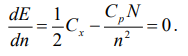 . (5.5)
From this we find the solution
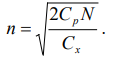 . (5.6)
For our example n=4000 units per batch, which corresponds to a release interval between batches of 2 months. The minimum costs amount to 4800 hryvnias per year.
Let us compare these costs with the costs when producing 2000 items per batch, or
releasing a batch once a month:
E1 = 0.1 • 12 • 2000/2 + 400 • 24 000/2000 = 6000 hryvnias per year.
As we can see, the costs for this option are significantly higher.
Now let us take a batch size of 8000 items. The costs amount to… (calculate independently)
Mathematical programming problems.
There is an entire class of systems-analysis problems in which it is necessary to minimize
a certain objective function of the following type:

where Xi are the unknown variables, ci are their corresponding coefficients, and in this case there are
constraints called resource constraints. Problems of this class are studied in a special branch of mathematics – linear programming.
Mathematicians have developed algorithms for finding the extrema of such functions, which are studied in a course on mathematical programming.
A classic example of mathematical-programming problems is the resource-allocation problem. These problems use several types of resources (labor, finances, raw materials), each of which is limited. The goal of systems
analysis is to find the most economically advantageous way of performing operations,
taking into account resource constraints. In general form, the resource-allocation problem is formulated as follows:
find the minimum of the objective function (costs)
 (5.7)
(5.7)
subject to the following conditions:
.
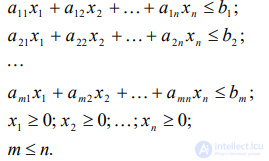 (5.8)
(5.8)
The theoretical foundation and practical methods for solving linear-programming problems were developed by G. Dantzig and L.V. Kantorovich.
The linear-programming problem illustrates the method of making an optimal decision under
certainty.
Situations often arise where the decision-maker (DM) can carry out only one of several possible actions, after which it is no longer possible to return the system to its previous state. Possible courses of action
are called alternatives. Among all alternatives, the best one can be chosen,
if there is a way to compare alternatives (a preference criterion).
Let us denote by x a certain alternative from the set X
. It is assumed that for all x ∈ X a function q(x) can be defined, which is called the preference criterion and has
the following property: if alternative x1 dominates alternative x2, then
 ,and vice versa.
The best alternative is considered to be x* – the one at which the criterion attains its largest value:
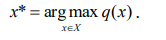 (5.9)
(5.9)
Sometimes, for a more objective evaluation of alternatives, it is necessary to use several criteria

(a multi-criteria problem). Different best alternatives may correspond to each of the criteria. For example: criterion 1
– choose the fastest way to reach the goal; criterion 2 – choose the cheapest way to reach the goal. The question arises – how to choose the best
alternative in this case? Let us consider methods of decision-making for multi-criteria problems.
The first way of choosing the best alternative – reducing the multi-criteria problem to a single-criterion one. A possible variant of the generalized criterion is
an additive function
 (5.10)
Relation (9) is called the convolution of criteria, wi is called the weight of the different
criteria
Usually the criteria are not equally significant among themselves (some of them are more important than
others). The second way of choosing the best solution involves maximizing the main criteria on condition that the less important criteria do not fall
below certain established limits.
The third way of determining the optimal alternative is used if
the optimal values of all parameters are known

. Treating the parameters of the current state as the coordinates of a point in phase space, we find the distance between the current and optimal state.
 (5.11)
The idea of solution optimization consists in constructing such a phase trajectory that each successive point on it is closer to the optimal point.

The choice of the best alternative can be described using binary
relations. A binary relation R on the set X
is defined as a certain set of pairs
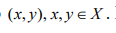
. The simplest method of specifying a binary relation R is that the matrix of relation R consists only of zeros and ones:
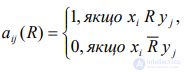 (5.12)
An example of such a representation of relations is sports tournament tables (losses are denoted by zeros, wins by ones, draws are impossible).
One of the most common decision-making methods is the voting method: the alternative that receives the largest number of votes is accepted. This rule is attractive for its simplicity and democratic nature, but it should be applied with caution. After all, not all persons taking part in the vote are equally informed about the situation. Sometimes the majority rule does not work: for example, an even split of votes in the case of an even number of voters.
Some experts may not vote. This gives rise to variants such as: "the chairman has two votes", "relative majority (more than 51 %)", "overwhelming majority (more than
2/3)", "the principle of unanimity (consensus, right of veto)".
Let us consider the main voting variants.
Rule 1 (simple majority). Each voter chooses only one alternative. The one that gathers the greatest number of votes wins. Sometimes
an additional condition is introduced into this rule: the winner must gather 50%
percent of the votes + 1 vote. If this condition is not met, the election is held in
2 rounds. The two candidates who gathered the most votes in the
first round advance to the second round. In the second round, the simple-majority rule applies. Example: the presidential election in Ukraine.
Rule 2. The alternative that outperforms any other one wins according to the relative-majority rule (binary relations 1 – 0). However, when using
this method, a configuration of preferences is possible in which there is no winner (the Condorcet phenomenon). For example: Porto – Shakhtar 1:0, Shakhtar – Zenit 1:0, Zenit
– Porto 1:0.
Rule 3 (the Borda rule, or ranking). Each voter ranks the alternatives from best to worst. An alternative receives 1 point for
first place, 2 points – for second, …, n points – for last place. The alternative with the smaller sum of points wins.
If, in the decision-making process, there is not enough information about the preliminary behavior of the system, one turns to the services of experts – experienced
specialists who can evaluate the options for the system's functioning.
Experts are given questionnaires asking them to evaluate the proposed alternatives. Experts can evaluate alternatives on a numerical or ordinal
scale. Let us consider the first case – a numerical evaluation scale. Let  – the evaluation
of the i-th alternative by the j-th expert (i=1,n,j=1,k; n alternatives, k experts). As the final characteristic of each alternative
the sample mean of all expert evaluations for that alternative is chosen
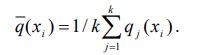 . (5.13)
The consistency of experts' opinions is measured using the quantity
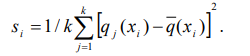 . (5.14)
If the experts only rank the alternatives (an ordinal evaluation
scale), arithmetic operations are not possible. Let us consider the methods of processing
expert information in this case.
The results of the expert survey are compiled into a table whose rows
correspond to the alternatives and whose columns correspond to the experts. In the i-th row, the places (ranks)
aij
, given by the experts to
the i-th alternative, are recorded. In the last column
the sums of the ranks received by the objects from all experts are recorded
 . (5.15)
The objects are ordered according to the sums of the ranks. At the head
is placed the object whose sum of ranks is the smallest (Ri=1), and so on. The degree of consistency of experts' opinions is determined using the concordance coefficient
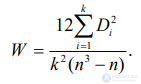 . (5.16)
Here
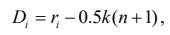 , (5.17)
n – the number of objects,
k – the number of experts,
ri – the sum of the ranks
of the i-th object.
When surveying experts, the problem of a low-qualified expert may arise. For example, let us consider the results of an examination of goods
Table 5.1 (n = 6; k = 4).
The concordance coefficient is very low
W =12*90/(16*210) = 0.32
, this indicates that the experts' opinions are not consistent. To assess the professional level
of the experts, an additional row ”Expert score” can be added to Table 1, which
is calculated using the formula
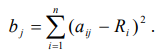 . (5.18)
Here
aij – the rank
of the i-th object according to
the j-th expert;
Ri - the final rank
of the i-th object, agreed upon by all experts. The lower the score calculated by formula (18), the higher the expert's level.
Table 5.1. Processing of expert evaluation results
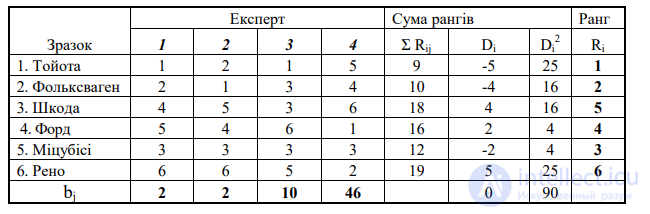
Having examined the experts' scores, we note the low professional level of the fourth
expert. We exclude the fourth expert according to the voting procedure. We obtain a new Table 2. We calculate the concordance coefficient again
W =12*129.5/9/(216- 6) = 0.82
A high value of the concordance coefficient indicates a high degree of consistency among the experts' opinions. As can be seen from Table 2, the first expert turned out to be closest to the overall decision. This indicates his high qualification.
Table 5.2. Processing of expert evaluation results
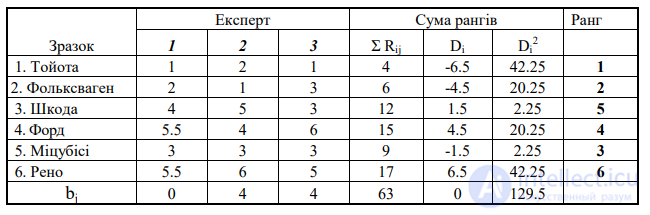
Sometimes the same ranks are assigned to certain objects, that is, they "share among themselves"
the places" (non-strict ranking). Such ranks are called tied, and their group -
a tie. For tied ranks, averaging is performed and each tied rank is assigned the averaged value. The concordance coefficient for strict ranking is determined by the formula 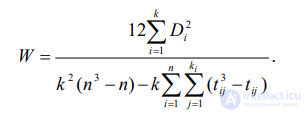 . (5.19)
where
ki
– the number of groups of identical ranks in the evaluation
of the i-th expert;
tij – the number of identical ranks in
the j-th group in the evaluation
of the i-th expert (in the example above ki =1,t
i1 = 3.
For example, objects 2, 3, and 5 are identical according to the 3rd expert, so each of them is assigned rank 3. The value of the concordance coefficient
in this case
W = 0.85
. In the calculation we took into account two ties: for the first expert
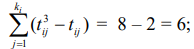 ;
;
for the third expert
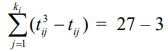 = 24.
= 24.
The concordance coefficient is calculated by the formula
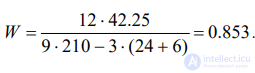
Let us consider the problem of decision-making under complete or partial uncertainty. Exactly which of the possible states of the environment will occur is unknown, or is known with a certain probability. Decision-making in such a situation
is characterized by environmental uncertainty. Environmental uncertainty generates the risk of material losses.
As an example, let us consider the interaction of a person with the environment in
the form of a matrix-game-against-nature model. A farmer grows vegetables in the steppe zone of Ukraine. The environment can be in the following states:
C1 – a very dry summer,
C2 – a dry summer,
C3 – a summer with normal humidity,
C4 – a humid summer,
C5 – a very humid summer.
The strategies of the decision-maker (DM) consist in choosing the amount of investment in watering the vegetables:
S1 – no funds are invested;
S2 – 50% of the planned funds are invested;
S3 – full planned investment.
The investment (payment for irrigation water) should be made as a prepayment.
By choosing one of the possible strategies, the DM obtains as a result a certain financial gain (loss)
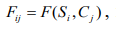
, the magnitude of which depends on the state of the environment
This matrix characterizes the player's payoff in the event that they choose decision Si, while the environment is in state Cj
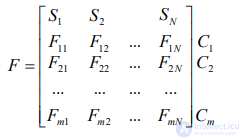
Depending on the situation, information about the probabilities of the states may be known or unknown. It is necessary to provide recommendations for choosing the optimal strategy.
The player's optimal strategy under uncertainty is chosen based on reducing the stochastic decision-making problem to a deterministic optimization problem. Depending on the amount of available information about the environment, one or another decision-making criterion is chosen.
Decision-making is also influenced by the decision-maker's attitude toward risk (a cautious strategy, a risky strategy, a balanced strategy).
Let us consider the first information situation, characterized by partial uncertainty of the environment. This means that each state of the environment corresponds to a certain probability of that state occurring. There are several approaches to choosing the best alternative in such a situation. The most common of these are the Bayes criterion (average statistical income) and the minimum-variance criterion (minimum risk).
These criteria are used in cases where the probabilities of the states of the environment are known, calculated on the basis of long-term observations of the state of the economy.
Let us denote
p1 - the probability of a very dry summer occurring,
p2 – the probability of a dry summer occurring,
p3 – the probability of a summer with normal humidity occurring,
p4 - the probability of a humid summer occurring,
p5 – the probability of a very humid summer occurring.
The condition p1 + p2 + p3 + p4 + p5 =1 must hold (the events form a complete group).
The Bayes criterion evaluates strategies by the maximum value of the probability-weighted average payoff ( N = 5 - the number of possible states of the environment)
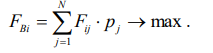 . (6.1)
Example. Let the payoff matrix be as follows (Table 1):
Table 1. Payoff matrix and probabilities of the states
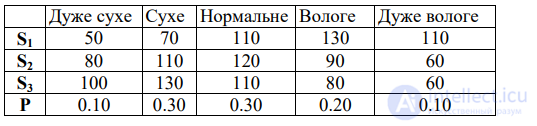
We calculate the value of the Bayes criterion (weighted-average payoff) for each of the strategies using formula (1):

According to the Bayes criterion, the optimal strategy is strategy 3.
b. Many managers are put off by situations in which the degree of risk is high.
To assess the degree of risk, variance is used – the average statistical
deviation from the average payoff. Let us consider the example given in the following table.

As we can see, the Bayes criterion gives the same evaluation for both strategies.
But of course the first strategy is riskier compared to the second.
The minimum-variance criterion corresponds to the behavior type – “maximum caution” (minimum risk) and is calculated from the minimum value of the expression
 . (6.2)
We calculate the value of the minimum-variance criterion for each of the strategies using the data from Table 1.
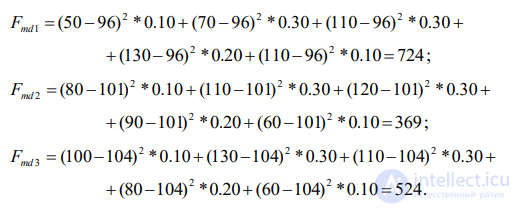
According to the minimum-variance criterion, strategy 2 is optimal.
The second information situation consists in the fact that the probabilities of the environment's states occurring are unknown – a situation of complete uncertainty. In such a situation, methods of evaluating alternatives are used that take into account the psychological motives of decision-making.
Let us consider the second information situation, in which the probability distribution of the states of the natural environment is unknown. Whereas in agricultural production an orientation toward average risk is possible, in certain other situations threatening large losses, it is advisable to choose the most cautious strategy. Such, for example, are problems involving the calculation of the risk of a flood, an earthquake, or an accident at a nuclear power plant. In such problems, to choose the DM's behavior strategy, the maximin criterion (the Wald criterion) is used, oriented toward the most unfavorable conditions of the environment
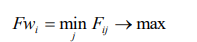 (6.3)
(6.3)
Let us calculate the value of the Wald criterion for each of the strategies using the data from Table 1.
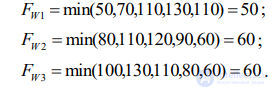
According to the Wald criterion, strategy 2 or strategy 3 is optimal.
The Savage criterion is the antipode of the Wald criterion. Whereas the Wald criterion is oriented toward unfavorable states of the environment,
the Savage criterion is oriented toward the most favorable states of the environment. Therefore it is often called the optimistic criterion. The last column of the table is filled with the maximum values of each row. Then the
maximum among them is chosen. According to this maximum criterion, the first
strategy is optimal, since it allows obtaining the maximum payoff.
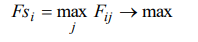 (6.4)
(6.4)
Let us calculate the value of the Savage criterion for each of the strategies.
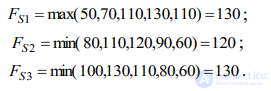 .
.
According to the Savage criterion, strategy 1 or strategy 3 is optimal.
Let us now suppose that the DM has certain information about the ratio of optimism to pessimism in decision-making
An information situation of the third type. It is intermediate between the first IS and the second IS.
The essence of the Hurwicz criterion consists in determining a weighted combination of the Wald and Savage decisions. A weighting coefficient is used

 . (6.5)
At  we arrive at the Savage criterion,
at  - at the Wald criterion.
Let us choose the value  and calculate the Hurwicz criteria for each of the strategies (data from Table 1):

According to the Hurwicz criterion, strategy 3 is optimal.
Under conditions of complete ignorance about the environment's behavior (information situation of type I4), it is advisable to use the
Bernoulli-Laplace criterion. Its essence comes down to the fact that, since there is no reason to prefer any one of the possible scenarios, they are considered equally probable.
Then, as the mathematical expectation for strategy Si, the arithmetic mean of all variants of the states of the environment is taken.
Then the maximum among them is chosen
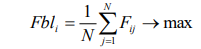 (6.6)
(6.6)
We calculate the value of the Bernoulli-Laplace criterion for each of the strategies.
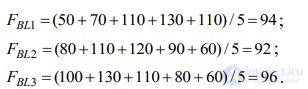
According to the Bernoulli-Laplace criterion, the optimal strategy is strategy 3.
1. Characterize the main principles of decision theory.
2. What is the problem of decision-making?
3. Characterize the generalized decision-making process.
4. Give a classification of decision-making tasks. Characterize each of the classes, and give examples of tasks in each class.
5. How is the formulation of decision-making tasks carried out?
6. Define the main stages of decision-making.
7. What is the decision-making scheme in systems analysis?
8. What is the theory of "economic man"?
9. What measures of information are used in different information environments?
10. What is the purpose of an information system for decision support? What is its composition?

Comments