
Lecture
Это продолжение увлекательной статьи про причинно-следственная связь.
...
which y could cause  This confidence can be established in several ways. First, the variable may be a non-economic variable: for example, if rainfall is assumed to affect the futures price y of some agricultural commodity, it is impossible for the futures price to actually affect the rainfall (assuming cloud seeding is never undertaken). Second, the instrumental variables method can be used to eliminate reverse causation, by introducing the role of other variables (instruments) that are known to be unrelated to the dependent variable. Third, one can apply the principle that effects cannot precede causes, by including on the right-hand side of the regression only variables that temporally precede the dependent variable; this principle is applied, for example, in testing Granger causality and in its multivariate analogue, vector autoregression, in both of which the lagged values of the dependent variable are controlled for when testing the causal effects of lagged independent variables.
Regression analysis controls for other relevant variables by including them as regressors (explanatory variables). This helps avoid spurious conclusions about causation due to the presence of a third, underlying variable that affects both the potentially causal and the potentially caused variable: its effect on the potentially caused variable is captured by directly including it in the regression, so that this effect will not be picked up as an indirect effect through the potentially causal variable of interest. Given the procedures described above, spurious (as opposed to causal) correlation can be probabilistically rejected if the data samples are large and if the regression results pass cross-validation showing that the correlations hold even for data that were not used in the regression. It is in principle impossible to state with certainty that no common cause is present and that the regression represents the true causal structure.
However, the problem of omitted-variable bias must be weighed against the risk of causal colliders arising, in which the addition of a new variable produces such colliders.  induces a correlation between and
  through Berkson's paradox.
Beyond building statistical models based on observational and experimental data, economists use axiomatic (mathematical) models to derive and represent causal mechanisms. In microeconomics, highly abstract theoretical models that isolate and idealize a single mechanism predominate. In macroeconomics, economists use broad mathematical models calibrated on historical data. A subgroup of calibrated models, dynamic stochastic general equilibrium (DSGE) models, are used to represent (in simplified form) the entire economy and to model changes in fiscal and monetary policy.
Statistical and economic analysis often relies on regression methods applied to observational or pre-existing data to infer causal relations. Experimental designs, by contrast, establish causation by systematically manipulating independent variables under controlled conditions. Thus, experiments provide higher internal validity, since causal mechanisms are demonstrated directly rather than inferred from patterns in observational data.
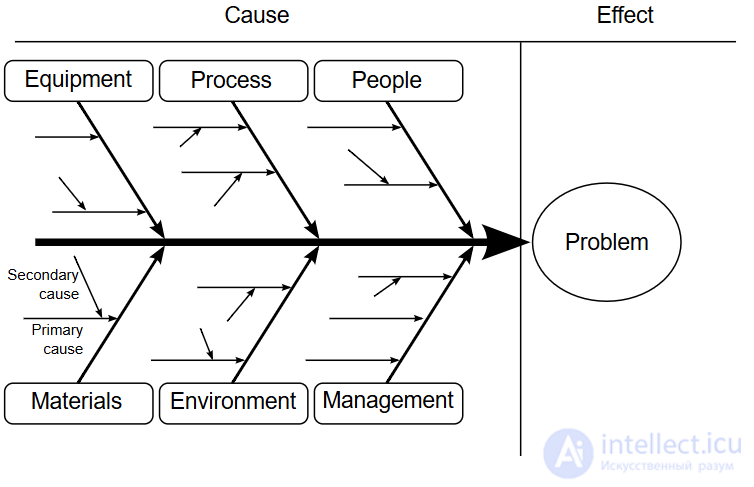
An Ishikawa diagram, used in management and engineering, shows the factors that cause a given effect. Small arrows connect minor causes to major ones.
For quality control in manufacturing, in the 1960s Kaoru Ishikawa developed a causal diagram known as the Ishikawa diagram or fishbone diagram. The diagram classifies causes, for example, into six main categories, shown here. These categories are then subdivided. Ishikawa's method identifies «causes» through brainstorming sessions held among the various groups involved in the production process. These groups can then be labeled as categories on the diagrams. The use of these diagrams has now spread beyond quality control, and they are used in other areas of management as well as in design and engineering. Ishikawa diagrams have been criticized for not distinguishing between necessary and sufficient conditions. Ishikawa himself apparently was not even aware of this distinction.
In historical discussions, events are sometimes treated as a kind of driving force capable of then causing other historical events. Thus, the combination of crop failures, the hardships of the peasantry, high taxes, insufficient representation of the people, and the incompetence of the king are counted among the causes of the French Revolution. This is in part a Platonic and Hegelian view, which reifies causes as ontological entities. In Aristotelian terminology, this usage approaches the case of the efficient cause.
Some philosophers of history, such as Arthur Danto, have argued that «explanations in history and elsewhere» describe «not simply an event — what happens — but a change». Like many practicing historians, they regard causes as intersecting actions and sets of actions that produce «larger-scale changes», in Danto's words: determining «what elements persist through a change» is «fairly straightforward» when it concerns a «shift in attitude» of an individual person, but «it is considerably more difficult, and poses a metaphysical problem, when we are interested in a change such as, say, the breakdown of feudalism or the rise of nationalism».
Much of the historical discussion of causes centers on the relationship between communicative and other actions, between singular and repeated actions, and between actions, structures of action, or group and institutional contexts, and a broader set of conditions. John Gaddis distinguished between exceptional and general causes (following Marc Bloch) and between «routine» and «distinctive links» in causal relations: «in explaining what happened at Hiroshima on August 6, 1945, we attach greater significance to the fact that President Truman ordered the atomic bomb dropped than to the Army Air Forces' decision to carry out his order». He also pointed to the distinction between immediate, intermediate, and remote causes. For his part, Christopher Lloyd puts forward four «general conceptions of causation» used in history: the «metaphysical idealist conception, which holds that the phenomena of the universe are products or emanations of an omnipotent being or of such a final cause»; the «empiricist (or Humean) regularity conception, which is based on the idea that causation is a matter of constant conjunctions of events»; the «functional/teleological/consequentialist conception», which is «purposive, such that goals are causes»; and the «realist, structural, and dispositional approach, which regards relational structures and internal dispositions as causes of phenomena».
Causality refers to the existence of « cause-effect » relations among a set of variables. Causality assumes that variables acting in a predictable way can produce changes in related variables, and that this relation can be established through direct and repeated observation. Theories of causality underlie social research, since they aim to establish causal links between structural phenomena and individuals and to explain these links through the application and development of theory. Because of divergences between theoretical and methodological approaches, different theories, namely functionalism, hold different views of the nature of causality and causal relations. Similarly, the multiplicity of causes has led to a distinction between necessary and sufficient causes.
— A and B represent some forms of phenomena (concrete or abstract).

— Statistically, the relation of A to B is that an observed change in A will produce a proportional change in B.
— If the change in A precedes the change in B, and this change is not caused by any intervening variable (a spurious relation), then:
- A is said to have a causal relationship (sufficient or necessary) with B.
However, the nature, scale, and scope of these relationships must be further clarified through additional research that takes into account the shortcomings and limitations of previous work.
Classical notions of causality have had a significant influence on the development of social research and various methodological approaches, since the overwhelming majority of research seeks to explain phenomena in terms of cause and effect. Typical criteria for inferring causation include: i) a statistical association between two variables; ii) the direction of influence (changes in the causal factor produce a change in the dependent variable); and iii) the requirement that the relationship between the variables not be spurious. Identifying intervening variables and further replicating studies can also strengthen claims of causation. Different methodological approaches involve a trade-off between statistical rigor (the ability to confidently attribute a change to one variable or cause), qualitative depth, and the financial feasibility of the research. Experimental methods, which maximize statistical rigor, are often difficult to carry out, since they are costly and can be detached from the social processes that researchers seek to investigate. In contrast, ethnographic methods and surveys, which maximize the qualitative richness of the data, lack the statistical generalizability that experimental studies provide. Thus, causation inferred from social research can be relatively abstract (ethnographic findings) or precise (statistical research, laboratory studies). One should therefore always exercise caution when establishing or describing causal relations based on the results of social research, since this will vary depending on the methodology and, accordingly, on the nature of the data.
In sociology, causation is the subject of epistemological debate, especially with regard to the external validity of research findings; one factor contributing to the instability of causation in social research is the wide range of potential «causes» that can be attributed to any given phenomenon. Max Weber, in his work «The Protestant Ethic and the Spirit of Capitalism», explained the development of capitalism in Northern Europe by the regional predominance of Protestant religions. However, material and geographic variables also played a significant role in the spread of Puritan beliefs, and this was one of the main criticisms leveled at Weber's study. Talcott Parsons argued that such an interpretation of Weber's thought is simplistic and misleading with respect to his claims: that the correspondence between the Protestant ethic and modern capitalism was necessary for the unprecedented growth of wealth in Northern Europe, whereas material factors were only sufficient.
To this end, Weber distinguished two types of causation;
Several causes, both sufficient and necessary, often intersect and interact with one another in producing a given phenomenon, and so theories of a single or essential cause are often unsuited to social research. For this reason, statistical models that can account for and control multiple variables are widely used in social research.
The normative notions of causation that underlay the development of standards for social research are largely tied to functionalist and Newtonian thought and were introduced into social research by figures such as Comte and Durkheim. This broader paradigmatic shift in social research is often linked to a desire for sociology to gain recognition among the natural sciences. This perspective on causation regards individuals, structural variables, and the relationships between them strictly in terms of their functional and productive outcomes. Thus, causal relations must be observed and inferred through scientific observation.
In the context of culture, causation underlies the logic surrounding sociocultural norms and deviance. Social structures perform the function of establishing, disseminating, and enforcing both cultural and legal norms, and thus play an indispensable role in shaping and maintaining social order; however, for these standards to be effective, they must be applied universally and predictably. If this is so, then violations of norms and punishment can be said to have a causal relationship, since violating a standard directly entails equivalent sanctions. Through punishment, standards are then visibly reaffirmed among the population at large. All humanistic societies function, to one degree or another, on the basis of some principle of causation.
The concept of elective affinity was used by Max Weber to describe the relationship between capitalism and the Protestant ethic, and differs from a purely deterministic approach to individual behavior. The Newtonian notion of causality underlies the deterministic camp of the structure-agency debate, whereas interactionist paradigms emphasize the rational choices made by more or less free individuals in light of the broader social forces that guide them. Rather than social forces playing an essentialist role in determining one's life course, rational individuals make personal choices based on the knowledge, experience, and resources available to them. Thus, elective affinity serves to bring together both structuralist and agency-oriented paradigms, incorporating (albeit in different ways) the capacity of social actors to make choices in light of their personal experience and resources. However, this distinction is largely theoretical in nature and is further complicated by Weber's use of the ideal-type schema. In addition, the degree of priority given to agency and structure varies across different social theories and, correspondingly, across different notions of causal relations.
Under the law and judicial practice, in order to hold a defendant liable for a crime or tort (i.e., a civil wrong such as negligence or trespass), legal cause must be proven. Causation, or «sufficient causation», must be proven, linking the defendant's actions to the criminal event or damage in question. Causation is also an essential legal element that must be proven for the application of remedies under international trade law.
Causation is «the causal relationship between the defendant's conduct and the end result». In other words, causation allows conduct to be linked to a resulting effect, typically the infliction of harm. In criminal law, it is defined as the actus reus (act) from which a particular harm or other effect arose, and, combined with the mens rea (mental state), constitutes the elements of culpability. Causation applies only in cases where the result has already been achieved, and therefore has no bearing on inchoate crimes.
Legal systems seek, to one degree or another, to uphold the principles of fairness and justice. If the state is going to punish a person or require them to pay compensation to another person for losses suffered, liability is established according to the principle that persons who cause harm to others must be held accountable for their actions. Although some aspects of any legal system have features of strict liability, in which intent is irrelevant to the outcome and the subsequent liability of the responsible party, most seek to establish liability by proving that the defendant themself caused the particular harm or loss.
Even very young children quickly learn that physical acts and omissions lead to consequences with varying degrees of probability. The more foreseeable the outcome, the higher the probability that the person at fault caused the harm or damage intentionally. The law can reflect this simple rule of practical experience in various ways: that events unfold naturally, that a reasonable person in the same situation would have foreseen such a consequence as probable, that damage naturally flows from a breach of contractual obligations or wrongful conduct, and so on. However it is formulated, the essence of the degree of fault will be that reasonable people try to avoid causing harm to others, so that if the harm was foreseeable, there must be liability to the extent that the degree of harm caused was foreseeable.
Causal connection to an event alone is not sufficient to give rise to legal liability.
Sometimes causation is only one element of a multi-step test for legal liability. For example, for a defendant to be held liable for the tort of negligence, they must have owed the plaintiff a duty of care, breached that duty, thereby causing damage to the plaintiff, and that damage must not be too remote. Causation is only one component of the tort.
In other cases, the sole requirement for legal liability is causation (beyond the fact that the result is a prescribed one). For example, in the law relating to product liability, courts have come to apply the principle of strict liability: the only thing that matters is the fact that the defendant's product caused harm to the plaintiff. The defendant did not also need to have been negligent.
In yet other cases, causation is not relevant to legal liability at all. For example, under a liability insurance contract, the insurer undertakes to compensate the injured party for damage caused not by the insurer, but by other persons.
Because of the difficulty of establishing causation, this is one area of law where judicial practice overlaps substantially with the general doctrines of analytic philosophy concerning causation. These two subjects have long been intertwined.
When establishing causation is required for legal liability, this usually involves a two-step inquiry: first, «factual» causation is established, and then legal (or proximate) causation. Factual causation must be established before the inquiry into legal or proximate causation.
The «but for» test is typically used to establish factual causation. The «but for» test asks the question: «But for the defendant's act, would the harm have occurred?» A shoots and wounds B. We ask: «But for A's act, would B have been wounded?» The answer: «No». Thus, we conclude that A caused harm to B. The «but for» test is a test of necessity. It asks the question: was the commission of the defendant's act «necessary» for the harm to occur? In New South Wales, this requirement exists in section 5D of the Civil Liability Act 2002 (NSW), which affirms established common law principles.
One weakness of the «but for» test arises in situations where each of several acts is independently sufficient to cause the harm. For example, if both A and B, at roughly the same time, fired fatal shots at C, and C died, it becomes impossible to say that but for A's shot, or but for B's shot alone, C would have died. In such a case, if the «but for» test is understood literally, it would appear that neither A nor B is liable for C's death.
Courts have generally accepted the «but for» test despite these shortcomings, refining it so that causation should be understood «as an ordinary person would understand it», or supplementing it with «common sense».
This dilemma was addressed in the United States in State v. Tally, 15 So 722, 738 (Ala. 1894), where the court held: «The assistance given... need not contribute to the criminal result in the sense that but for it the result would not have occurred. It is sufficient if it contributed to the result which would have occurred without it». Following this reasoning, both A and B are liable, because regardless of who was responsible for the fatal shot, the other «contributed to» the criminal act, even though his shot was not necessary to inflict the fatal blow.
However, legal scholars have tried to dig deeper into the causal basis of these difficult cases. Some scholars have proposed a sufficiency test instead of a necessity test. H.L.A. Hart and Tony Honoré, and later Richard Wright, argued that something is a cause if it is a «necessary element of a set of conditions jointly sufficient for the result». This is known as the NESS test. In the case of the two hunters, the set of conditions necessary to cause harm to the victim would include the shot to the eye, the victim being in the right place at the right time, gravity, and so on. In such a set, either hunter's shot would be a member of that set, and hence a cause. This arguably gives us a more theoretically compelling basis for concluding that something was the cause of something else than an appeal to notions of intuition or common sense.
Hart and Honoré, in their celebrated work «Causation in the Law», also address the problem of «too many causes». For them, there are degrees of causal contribution. An element of the NESS set is a «causally relevant condition». It is elevated to the status of a «cause» if it represents a deliberate human intervention or an abnormal act in the given context. Thus, returning to our hunter example, the birth of hunter A's grandmother is a causally relevant condition, but not a «cause». On the other hand, hunter A's shot, being a deliberate human intervention in the ordinary course of events, is elevated to the status of a «cause». An intermediate position may be occupied by those who «cause» harm, such as accomplices. Imagine an accomplice to murder who drives the principal offender to the scene of the crime. Clearly, the principal offender's act in committing the murder is a «cause» (by the «but for» or NESS test). The same applies to the accomplice's act of driving the principal offender to the scene of the crime. However, causation does not exist at the same level in both cases (and, incidentally, this provides grounds for treating principals and accomplices differently under criminal law). Leon Green and Jane Stapleton are two scholars who hold the opposite view. They believe that once something becomes a «but for» condition (Green) or a condition independent of the facts of the case (Stapleton), this fully completes the factual inquiry, and all further consideration becomes a matter of policy.
Even where causation can be established in the above situations, the law often intervenes and states that it will nonetheless not hold the defendant liable, because in the given circumstances the defendant should not be regarded, in a legal sense, as the cause of the loss. In the United States this is known as the doctrine of proximate cause. The most important doctrine is that of novus actus interveniens, meaning «a new intervening act», which can «break the chain of causation».
The «but for» test is a factual test of causation, and it often gives us the right answer to problems of causation, but sometimes it does not. Two difficulties are immediately apparent. First, under the «but for» test, almost everything is a cause. But for the birth of the wrongdoer's grandmother, the wrongful act in question would not have occurred. If the crime victim had not missed the bus, they would not have been at the scene of the crime, and therefore the crime would not have occurred. Nevertheless, in these two cases, the birth of the grandmother or the victim missing the bus are intuitively not causes of the harm caused. This often does not matter in a case where causation is only one element of liability, since the removed actor would most likely not have satisfied the other elements of the test. The legally responsible cause is the one that is closest to the harm caused, or most directly connected to it. This is known as the proximate cause rule. However, such a situation can also arise in cases of strict liability. In Glanville Williams and Dennis Baker's treatise «Textbook of Criminal Law» (LexisNexis, London, 2024), at paragraphs 10.9A–10.9F, Baker argues that legal causation alone is sufficient to establish manslaughter by gross negligence in the performance of duty or the rendering of assistance, since it is impossible to know whether the victim would have survived had the accused performed their duty and attempted to halt the cause of the victim's death by seeking help. Baker cites R v Broughton EWCA Crim 1093 in connection with the question of causal uncertainty and the court's insistence that causation must be based on it being provable that the victim would have survived had assistance been given.
Consider the following. A seriously injures B. While B is being taken to the ambulance, she is struck by lightning. She would not have been struck if she had not been injured in the first place. Clearly, A caused all of B's injury, according to the «but for» or NESS test. However, under the law, the intervention of the subsequent event means the defendant is not held liable for the injury caused by the lightning.
The operation of this principle can be stated simply:
If a new event, whether due to human fault or natural causes, does not break the chain, the original actor is liable for all consequences flowing naturally from the original circumstances. But if a new act breaks the chain, the original actor's liability ends there, and the new actor, if a person, will be liable for everything flowing from their contribution.
However, this does not apply where the «eggshell skull» rule is used. Baker argues (Glanville Williams and Dennis Baker, «Treatise on Criminal Law» (LexisNexis 2024) at paragraph 10.59) that the «eggshell skull» rule has no place in criminal law, and that even where it is applied it often has no effect, since intent must still be established for the relevant offense, and most crimes that are the consequence of an offense require intent. See the article on the «eggshell skull» doctrine for more information.
When two or more negligent parties cause damage through joint negligence, in circumstances where either of them would have caused the damage in any event, each is considered an «independent sufficient cause», since each can be regarded as a «substantial factor», and both are legally liable for the damage. For example, if a fire negligently started by A combines with a fire negligently started by B and results in the burning of C's house, then both A and B are liable. (e.g., Anderson v. Minneapolis, St. P. & S. St. RR Co., 146 Minn. 430, 179 NW 45 (1920).) This is an element of legal cause.
Another problem is overdetermination. Imagine two hunters, A and B, who negligently fire a shot that damages C's eye. Each shot alone would have been sufficient to cause the harm. But for A's shot, would C's eye have been damaged? Yes. The same answer follows for B's shot. But under the «but for» test, this leads us to the paradoxical position that neither shot caused the injury. However, the courts have held that, in order to prevent each defendant from escaping liability for lack of factual cause, both must be held liable. This is known simply as the Summers v. Tice rule.
Suppose that the negligent acts of two parties together produce a single kind of damage, whereas without the negligent act of either one, no damage at all would have been caused. These are two instances of negligence contributing to a single cause, as distinct from two separate instances of negligence contributing to two successive or separate causes. These are «concurrent factual causes». In such cases, courts have held both defendants liable for their negligent acts. Example: A leaves a truck parked in the middle of the road at night with its headlights off. B fails to notice it in time and collides with it — a collision that would have been avoided but for the negligence — causing damage to both vehicles. Both parties were negligent. (Hill v. Edmonds, 26 AD2d 554, 270 NYS2d 1020 (1966).)
Causation in law is usually expressed as a question of «foreseeability». An actor is liable for foreseeable, but not for unforeseeable, consequences of their act. For example, it is foreseeable that if I shoot someone on a beach, and they are immobilized, they might drown in the incoming tide rather than from the injury caused by the gunshot wound or from blood loss. However, it is (typically) not foreseeable that they will be struck by lightning and die from that event.
This type of causal foreseeability must be distinguished from foreseeability of the extent or kind of harm, which is a matter of remoteness of damage rather than of causation. For example, if I carry out welding work on a pier that results in an oil slick destroying a ship far downriver, it will be difficult to construe my negligence as anything other than causally connected to the damage to the ship. There is no new intervening act. However, I may not be liable if that damage is not of a type foreseeable as a result of my negligence. That is a question of public policy, not of causation.
An example of how foreseeability does not affect the extent of an injury is the «eggshell skull» rule. If Neil hits Matt on the jaw, it is foreseeable that Matt will suffer bodily harm requiring hospitalization. However, if his jaw is very weak and is dislocated by the blow, then the medical expenses, which would have been about $5,000 to wire the jaw, now become $100,000 for a full jaw reimplantation. Neil will still be liable for the full $100,000, even though $95,000 of that amount was not foreseeable.
Because causation in law is a complex mixture of fact and policy, other doctrines, such as foreseeability and risk, are also important. Especially in the United States, where the doctrine of «proximate cause» effectively merges the two-step approach to establishing causation based on factual and then legal grounds that is preferred in the English system, these considerations must always be taken into account when assessing the alleged connection between two events.
Some aspects of the physical world are so inevitable that it is always reasonable to assume knowledge of their occurrence. Thus, if A abandons B on a beach, A should be taken to have foreseen the ebb and flow of the tide. But the mere fact that B subsequently drowned is not enough. The court will need to consider where the body was left and what level of injury A believed B had sustained. If B was left in a place that any reasonable person would consider safe, but a storm surge caused extensive flooding in the area, this may be a new intervening act (novus actus). The fact that B suffered additional injuries as a result of an event falling within a foreseeable category does not, by itself, require the court to hold that every incident falling within that category is a natural link in the chain. Only those causes that are reasonably foreseeable fit naturally into the chain. Thus, if A heard a weather forecast predicting a storm, drowning would be a natural consequence. But if it was an event like a flash flood, a wholly unforeseeable event, this would be a new intervening act (novus actus).
The question of A's beliefs is no different. If A genuinely believes that B suffered only minor injuries and could therefore easily escape the danger zone, how fair is it to say that A should have foreseen otherwise? The test is what a reasonable person would have known and foreseen, given A's actions. It is the function of any court to assess conduct. A defendant cannot escape liability through willful blindness. Fault lies not only in what a person actually believes, but in a failure to understand what the overwhelming majority of other people would have understood. Consequently, the test is a hybrid one, considering both what the defendant actually knew and foresaw (i.e., subjectively) and what a reasonable person would have known (i.e., objectively), and then combining these findings into an overall assessment of the degree of fault or culpability.
Similarly, when determining the overall amount of damages and/or apportioning damages between two or more defendants, the extent of the claimant's (claimants') liability for compensation will be determined by what was reasonably foreseeable. Thus, if, for example, the claimant unexpectedly contributed to the extent of the loss suffered, this additional element will not be included in the amount of compensation awarded, even if the claimant would not have had the opportunity to make this mistake but for the defendant's breach. In cases where damage is apportioned among several defendants, each will be liable to the extent that their contribution foreseeably led to the loss.
Sometimes a situation arises that is the reverse of the novus actus principle, that is, causation cannot be proven, but the court nevertheless wants to hold the defendant liable. In Sindell v. Abbott Laboratories, 607 P.2d 924 (Cal. 1980), the plaintiff's mother took diethylstilbestrol as a means of preventing miscarriage. The drug, subsequently withdrawn from the market, caused the plaintiff to develop a malignant bladder tumor due to negligent manufacture. However, there were many manufacturers of this drug on the market. The manufacturer of the specific drug that caused the injury could not be established with sufficient precision. The court held that the defendant was liable in proportion to its market share. They departed from traditional notions of pure causation and adopted a «risk»-based approach to liability. The defendant was found liable because of the degree of risk it contributed to causing the harm. Risk theory is not strictly a theory based on notions of causation, since by definition the person who caused the harm cannot be established with certainty. However, it shows that legal notions of causation are a complex mixture of factual causes and public-policy ideas concerning the availability of legal remedies. In R v Miller UKHL 6, the House of Lords held that a person who places someone in a dangerous situation, in that case a fire, will be criminally liable if they fail to properly remedy the situation.
For any legal rule to be acceptable, it must be applied consistently, and so criteria must be defined for this qualitative analysis. Suppose the starting point is a purely factual analysis. A injures B and leaves him lying on the road. C is a driver who fails to notice B on the road and, by hitting him, contributes to his death. One could request a detailed medical examination at the post-mortem to determine the original extent of the injury and the degree of threat to B's life, and then assess the second set of injuries received in the collision and their contribution. If the first incident had only injured B's leg, so that he could not move, it is tempting to say that C's driving was the more substantial cause and therefore constitutes a new act breaking the chain. Similarly, if B was bleeding to death, and the only contribution of the driving was merely to injure B's arm, then the driving is not a new act and does not break the chain. However, this approach ignores the question of foresight on A's part.
Roads are, by their very nature, used by vehicles, and it is quite obvious that a person left lying on the road is at risk of sustaining further injuries from an inattentive driver. Consequently, if A leaves B on the road, knowing of this risk, and a foreseeable event occurs, then A remains the more proximate cause. This raises the question of whether the test of foresight should be subjective, objective, or hybrid (i.e., both subjective and objective at once). Clearly, there is no difficulty in holding A liable if A actually knew of the likelihood that B would sustain further injuries from a driver. The fault that led to the original injury is compounded by the failure to move B to a safer place or call for help. But suppose A never averted to the possibility of further injury at all. Now the question is to what extent knowledge can be imputed objectively.
A difficult question that has arisen recently concerns cases where the defendant does not actually cause the harm and does not increase the risk of its occurrence. In Chester v Afshar 4 All ER 587 (HL), a doctor negligently failed to warn a patient of risks inherent in the operation, namely cauda equina syndrome. The patient underwent the operation, and the risk materialized, resulting in injury. It was found that even if the patient had been warned, she would still have undergone the operation, just at a different time. The risk of injury would have been the same either time. Accordingly, the doctor did not cause the injury (because, had there been no failure to warn, the patient would still have undergone the operation) and did not increase the risk of its occurrence (because the risk was the same either way). Nevertheless, the House of Lords, taking a more normative approach to causation, still held the doctor liable. Lawyers and philosophers continue to debate whether, and how, this will change the state of the law.
Even if the negligence in the treatment of the victim was the immediate cause of his death, the jury should not regard it as excluding the responsibility of the defendant unless the negligent treatment was so independent of his acts, and in itself so potent in causing death, that they regard the contribution made by his acts as insignificant.
In physics one must be careful in the use of the word «cause». In a strict sense, the presumed cause and the presumed effect are processes occurring in time. For example, force is a useful concept for explaining acceleration, but force by itself is not a cause. Something more is needed. For example, a process occurring in time may be characterized by a certain change in force at a certain point in time. Such a process can be regarded as a cause. Causality is not intrinsically implied by the equations of motion, but is postulated as an additional constraint that must be satisfied (i.e., the cause always precedes the effect). This constraint has mathematical consequences, such as the Kramers–Kronig relations.
Causality is one of the most fundamental and important concepts in physics. Causal efficacy cannot «propagate» faster than light. Otherwise, it would be possible to construct coordinate systems (using the Lorentz transformation of special relativity) in which an observer would see an effect precede its cause (i.e., the postulate of causality would be violated).
Causal notions arise in the context of the flow of mass-energy. Any real process possesses causal efficacy, which cannot propagate faster than the speed of light. By contrast, an abstraction does not possess causal efficacy. Its mathematical expression does not propagate in the ordinary sense of the word, although it may refer to virtual or nominal «velocities» with magnitudes exceeding the speed of light. For example, wave packets are mathematical objects possessing a group velocity and a phase velocity. The energy of a wave packet propagates at the group velocity (under normal conditions); since energy possesses causal efficacy, the group velocity cannot be faster than the speed of light. The phase of a wave packet propagates at the phase velocity; since phase is not causal, the phase velocity of a wave packet can be faster than the speed of light.
Causal notions are important in general relativity to the extent that the existence of an arrow of time requires the semi-Riemannian manifold of the universe to be orientable, so that «future» and «past» are globally defined quantities.
Causality is the relation between causes and effects. Although causality is also studied from the standpoint of philosophy and physics, it is operationalized such that the causes of an event must lie within the event's past light cone and ultimately reduce to fundamental interactions. Similarly, a cause cannot have effects outside its future light cone.
Causality can be defined macroscopically, at the level of human observers, or microscopically, for fundamental events at the atomic level. The strong causality principle forbids the transmission of information faster than the speed of light; the weak causality principle operates at the microscopic level and does not necessarily result in the transmission of information. Physical models can obey the weak principle without obeying its strong version. In the algebraic formulation of quantum field theory, microscopic causality is taken as an axiom, formulated technically, but equivalent to the idea that two measurements at different locations at the same time cannot influence one another. : 250
In classical physics, an effect cannot occur before its cause, and so solutions such as advanced-time solutions of the Liénard–Wiechert potential are discarded as physically meaningless. In Einstein's theories, both special and general, causality means that an effect cannot arise from a cause that does not lie within the backward (past) light cone of that event. Similarly, a cause cannot have an effect outside its forward (future) light cone. These constraints are consistent with the restriction that mass and energy, acting as causal influences, cannot propagate faster than the speed of light and/or backward in time.
Another requirement of causality is that the cause and effect must be transmitted through space and time (the requirement of contiguity). This requirement has been highly influential in the past, firstly, as a result of direct observation of causal processes (e.g., pushing a cart); secondly, as a problematic aspect of Newton's theory of gravity (the Earth's attraction to the Sun via action at a distance), replacing mechanistic proposals such as Descartes's vortex theory; and thirdly, as a stimulus for the development of dynamic field theories (e.g., Maxwell's electrodynamics and Einstein's general relativity), restoring contiguity in the transmission of influences in a more successful way than in Descartes's theory.
In modern physics, it became necessary to refine the concept of causality. The word «simultaneous» in special relativity is observer-dependent. The principle involved is the relativity of simultaneity. Consequently, the relativistic principle of causality states that the cause must precede the effect according to all inertial observers. This is equivalent to saying that the cause and its effect are separated by a timelike interval, and that the effect belongs to the future of its cause. If a timelike interval separates two events, this means that a signal can be transmitted between them at a speed less than the speed of light. On the other hand, if signals could travel faster than the speed of light, this would violate causality, since it would allow a signal to be transmitted across spacelike intervals, which means that, for at least some inertial observers, the signal would propagate backward in time. For this reason, special relativity does not allow communication faster than the speed of light.
In general relativity, the concept of causality is generalized in the most natural way: an effect must belong to the future light cone of its cause, even though spacetime is curved. When investigating causality in quantum mechanics and, in particular, in relativistic quantum field theory, new subtleties must be taken into account. In these two theories, causality is closely tied to the principle of locality. Bell's theorem shows that conditions of «local causality» in experiments involving quantum entanglement lead to the non-classical correlations predicted by quantum mechanics.
Despite these subtleties, causality remains an important and well-founded concept in physical theories. For example, the notion that events can be ordered by causes and effects is necessary to prevent (or at least to define) causality paradoxes, such as the grandfather paradox, which asks: what would happen if a time traveler killed his own grandfather before meeting his grandmother? See also the chronology protection conjecture.
The word «causality» in this context means that all effects must have concrete physical causes attributable to fundamental interactions. Causality in this context is not tied to defining principles such as Newton's second law. Thus, in the context of causality, force does not cause the acceleration of a mass, and vice versa. Rather, Newton's second law can be derived from the conservation of momentum, which is itself a consequence of the spatial homogeneity of physical laws.
The empiricists' aversion to metaphysical explanations (e.g., Descartes's vortex theory) meant that scholastic arguments about the causes of phenomena were either rejected as untestable or simply ignored. The complaint that physics does not explain the cause of phenomena was, accordingly, dismissed as a philosophical or metaphysical problem rather than an empirical one (e.g., Newton's «Hypotheses non fingo»). According to Ernst Mach, the concept of force in Newton's second law was pleonastic, tautological, and redundant and, as noted above, is not regarded as a consequence of any principle of causality. Indeed, one can consider the Newtonian equations of motion for the gravitational interaction of two bodies,

as two coupled equations describing the positions  and
and  . The equations describing the interaction of the two bodies describe the process of interaction, without any need to regard the right-hand sides of these equations as forces; they simply describe the process of interaction, without any need to interpret one body as the cause of the other's motion, and they allow the states of the system to be predicted at later (as well as earlier) points in time.
In ordinary situations, where people have singled out particular factors of a physical interaction as prior and therefore as determining the cause of the interaction, this has often arisen in situations where people decided to bring about a certain state of affairs and directed their efforts toward achieving it — a process that took time to establish and left a new state of affairs that persisted after the completion of the agent's activity. However, it would be difficult and pointless to explain the motion of binary stars relative to one another in this way, since they are, indeed, reversible in time and independent of the direction of time, though establishing such a direction of time would allow the entire evolution of the system to be fully determined.
The possibility of such a time-independent approach underlies the deductive-nomological (DN) approach to scientific explanation, according to which an event is considered explained if it can be subsumed under a scientific law. Within the DN approach, a physical state is considered explained if, by applying a (deterministic) law, it can be derived from given initial conditions. (Such initial conditions might include the momenta and mutual distances of binary stars at any given moment.) Such «explanation by determinism» is sometimes called causal determinism. A shortcoming of the DN approach is that causality and determinism are more or less identified with one another. Thus, in classical physics it was assumed that all events are caused by earlier events in accordance with known laws of nature, which led Pierre-Simon Laplace to assert that if the current state of the world were known with precision, it could be computed for any time in the future or in the past (see Laplace's demon). However, this is usually called Laplacian determinism (rather than «Laplacian causality»), since it is based on determinism in mathematical models, as considered in the mathematical Cauchy problem.
In quantum mechanics, the confusion between causality and determinism is felt especially acutely: this theory is acausal in the sense that, in many cases, it is unable to identify the causes of actually observed effects or to predict the effects of identical causes, but under some interpretations it can be deterministic (for example, if the wave function is assumed not actually to collapse, as in the many-worlds interpretation, or if its collapse is attributed to hidden variables, or if determinism is simply redefined as determinism meaning that probabilities, rather than specific effects, are determined).
Theories in physics, such as the butterfly effect from chaos theory, open up the possibility of systems with distributed parameters in causal relations. Butterfly-effect theory holds that:
«Small changes in the initial conditions of a nonlinear dynamical system can lead to large changes in the long-term behavior of the system».
This opens up the possibility of understanding distributed causality.
Similarly, the butterfly effect can be interpreted as highlighting the difference between the application of the concept of causality in physics and the more general use of causality represented by Mackie's INUS conditions. In classical (Newtonian) physics, generally only those conditions that are both necessary and sufficient are (explicitly) taken into account. For example, when a massive ball begins to roll down a slope from a point of unstable equilibrium, its speed is assumed to be due to the force of gravity accelerating it; the small push needed to set it in motion is not explicitly regarded as a cause. To be a physical cause, there must be a certain proportionality with the subsequent effect. A distinction is drawn between triggering and causing the ball's motion. By the same logic, a butterfly can be regarded as triggering a tornado, with its cause assumed to lie in pre-existing atmospheric energies rather than in the butterfly's movements.
In causal set theory, causality occupies an even more central place. The foundation of this approach to quantum gravity is David Malament's theorem. This theorem states that the causal structure of spacetime is sufficient to reconstruct its conformal class, so that knowledge of the conformal factor and the causal structure is sufficient to know the spacetime. Building on this, Rafael Sorkin proposed the idea of causal set theory, which is a fundamentally discrete approach to quantum gravity. The causal structure of spacetime is represented as a partially ordered set (POset), and the conformal factor can be reconstructed by identifying each element of the POset with a unit
продолжение следует...
Часть 1 Causality
Часть 2 Humanities - Causality
Часть 3 - Causality

Comments