
Lecture
Introduction
Relevance of technological forecasting
Goals and objectives of forecasting in the scientific and technological sphere
Technological forecasting is the process of predicting the directions of technology development and their impact on society, the economy, and industry. It is studied within disciplines such as innovation management, strategic management, technology management, science and technology policy, and futurology. The goal of technological forecasting is to identify promising directions of scientific and technological progress, assess risks and opportunities, and form strategic guidelines for business, government, and research organizations.
The forecasting process includes collecting and analyzing initial data, selecting methods, building scenarios, assessing risks, and presenting results. Among the methods of technological forecasting are expert methods (for example, the Delphi method), trend extrapolation, scenario analysis, SWOT and PEST analysis, technology roadmaps, and patent activity analysis. These methods make it possible to take into account both quantitative and qualitative aspects of future changes.
Technological forecasting plays an important role in innovation management, helping to make informed decisions, shape science and technology policy, and determine priorities in research and development. It is applied in various fields — from forecasting the development of artificial intelligence and biotechnology to energy and transport. However, forecasting faces a number of limitations: a high degree of uncertainty, the rapid obsolescence of technologies, and difficulties in accounting for social and ethical factors.
Definition of technological forecasting
Types of forecasts: short-term, medium-term, long-term
Difference from scientific and economic forecasting
Technological forecasting is the process of anticipating future changes in the field of technology, aimed at identifying promising directions of scientific and technological development and assessing their impact on the economy, society, and industry. It is based on a systematic analysis of current trends, scientific achievements, patent activity, and expert assessments. Depending on the time horizon, technological forecasts are divided into short-term (up to 3 years), medium-term (3 to 10 years), and long-term (over 10 years). Short-term forecasts are oriented toward operational planning and the implementation of already existing technologies, medium-term forecasts toward the development and adaptation of new solutions, and long-term forecasts toward strategic vision and the formation of science and technology policy. Unlike scientific forecasting, which focuses on the development of fundamental knowledge and discoveries, technological forecasting is aimed at the practical application of this knowledge in the form of new products, processes, and systems. Economic forecasting, in turn, assesses the macro- and microeconomic consequences of technology implementation, including investment, employment, productivity, and market changes. Thus, technological forecasting occupies an intermediate position between scientific and economic approaches, combining elements of both for a comprehensive analysis of the future.
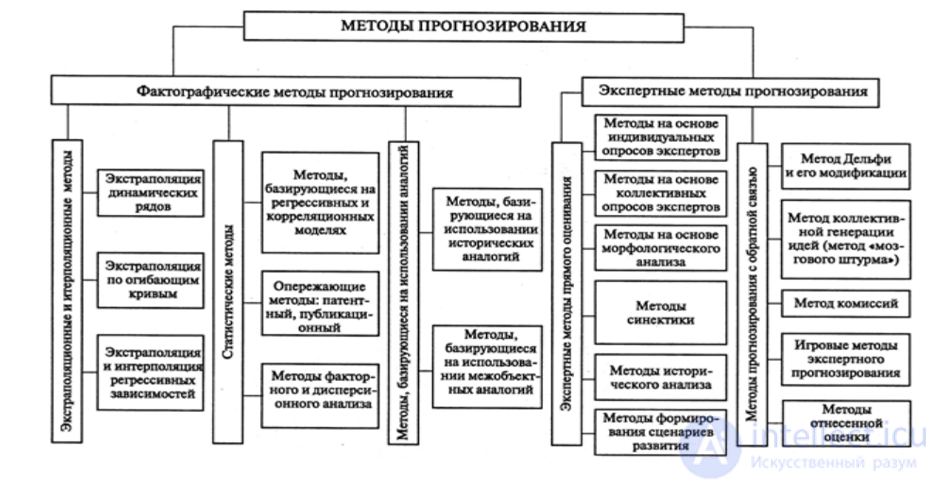
Expert methods (Delphi method, brainstorming)
Trend extrapolation
Scenario analysis
SWOT and PEST analysis
Technology roadmaps (Technology Roadmapping)
Patent activity analysis
Methods of technological forecasting represent a set of approaches that make it possible to assess the prospects for technology development and their impact on various spheres. One of the key directions is expert methods, which include the Delphi method and brainstorming. The Delphi method is based on an anonymous survey of a group of experts followed by processing and refining their opinions, which makes it possible to reach consensus on complex issues. Brainstorming, in turn, stimulates the collective generation of ideas and future scenarios. Trend extrapolation involves analyzing historical data and extending identified trends into the future, which is particularly effective for stable technological trajectories. Scenario analysis is used to build alternative variants of how events might unfold, taking into account various factors of uncertainty and possible risks. SWOT analysis makes it possible to assess the strengths, weaknesses, opportunities, and threats associated with a particular technology, while PEST analysis examines the political, economic, social, and technological factors of the external environment. Technology roadmaps (Technology Roadmapping) are a strategic tool that visualizes the stages of technology development, key goals, and the resources needed to achieve them. Patent activity analysis helps identify directions of scientific research, assess the level of competition, and determine technological niches with high potential. All these methods are applied comprehensively, ensuring more accurate and well-founded forecasting of the technological future.
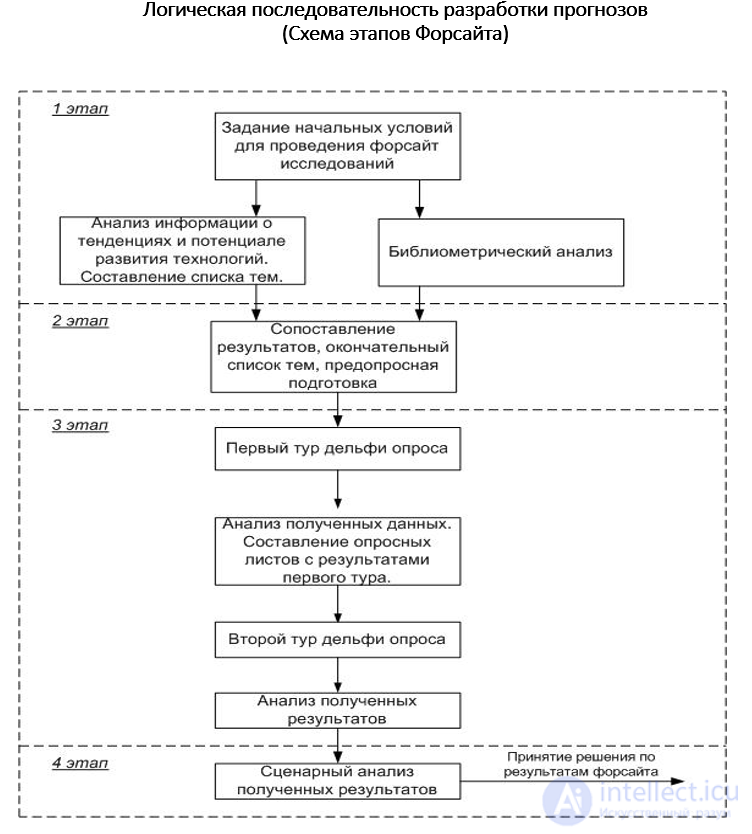
Collecting and analyzing initial data
Selecting methods
Building scenarios
Assessing risks and uncertainties
Presenting results
The technological forecasting process includes several sequential stages, each of which plays an important role in forming well-founded conclusions about the future development of technology. The first stage is the collection and analysis of initial data. At this stage, current scientific and technological trends, patent activity, market indicators, expert opinions, and other relevant sources of information are studied. The second stage is the selection of forecasting methods. Depending on the goals, available resources, and the nature of the forecasting object, suitable methods are chosen, such as expert assessments, trend extrapolation, scenario analysis, or technology roadmaps. The third stage is the building of scenarios, within which possible variants of how events might unfold are formed, taking into account various factors of influence, including technological, economic, social, and political aspects. The fourth stage is the assessment of risks and uncertainties, aimed at identifying potential threats, limitations, and points of uncertainty that could affect the implementation of the forecasted scenarios. The final stage is the presentation of results, which involves formalizing conclusions in the form of reports, presentations, strategic documents, or roadmaps intended for decision-making in the field of science and technology policy, innovative development, and investment planning.
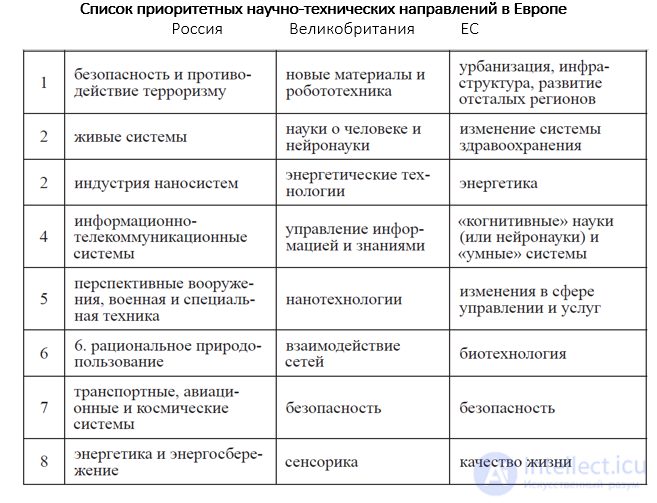
Examples of Application
Forecasting the development of AI, biotechnology, and energy
National and corporate technology strategies
Technological forecasting is actively applied in various industries where strategic planning and the assessment of future changes are required. One of the key directions is forecasting the development of artificial intelligence, biotechnology, and energy. In the field of AI, this makes it possible to assess the prospects of automation and intelligent systems and their impact on the labor market, security, and ethics. In biotechnology, forecasting helps identify future achievements in medicine, genetics, pharmacology, and agriculture, as well as assess the risks and opportunities of introducing new bioproducts. In the energy sector, technological forecasting is used to analyze the transition to renewable energy sources, the development of storage systems, and improvements in energy efficiency and infrastructure resilience. In addition, forecasting underlies national and corporate technology strategies. At the state level, it helps shape science and technology policy, determine priority areas for research and investment, and ensure technological security. In the corporate environment, forecasting is used to develop innovative products, assess competitive advantages, plan R&D, and adapt to future market conditions. Thus, technological forecasting is an important tool for both government structures and business, ensuring sustainable development and strategic readiness for technological change.
The Role of Technological Forecasting in Management
Decision-making support
Shaping innovation policy
Determining R&D priorities
Technological forecasting plays an important role in the management system, providing a basis for strategic decision-making under conditions of uncertainty and rapid scientific and technological progress. It supports decision-making at various levels — from government structures to corporate management — making it possible to assess the prospects of implementing new technologies, identify risks, and choose the most effective directions for development. Forecasting underlies the formation of innovation policy aimed at stimulating scientific research, developing technology clusters, supporting startups, and creating conditions for technology transfer. In addition, technological forecasting helps determine priorities in the field of research and development (R&D), highlighting the most promising directions that require investment and organizational support. This makes it possible to allocate resources rationally, accelerate the implementation of advanced solutions, and ensure competitiveness at the national and global levels.
Accuracy and reliability of forecasts
Rapid obsolescence of technologies
Ethical and social aspects
Despite its importance, technological forecasting faces a number of problems and limitations that must be taken into account when applying it. One of the key difficulties is the accuracy and reliability of forecasts. The future of technology depends on many factors, including scientific discoveries, market changes, political decisions, and social preferences, which makes any forecast subject to a high degree of uncertainty. Even with the use of complex models and expert assessments, it is impossible to guarantee absolute accuracy of predictions. An additional difficulty is created by the rapid obsolescence of technologies: innovations develop rapidly, and what seems promising today may be replaced by a more effective solution tomorrow or lose relevance. This requires constant updating of forecasts and flexibility in strategic planning. In addition, technological forecasting touches on important ethical and social aspects. The introduction of new technologies can cause public controversy, affect employment, increase social inequality, or raise issues of privacy and security. Therefore, when developing forecasts, it is necessary to take into account not only technical and economic parameters, but also the possible consequences for society, culture, and human rights.
The importance of technological forecasting for sustainable development
Prospects for the development of forecasting methods
In the context of rapid scientific and technological progress, technological forecasting is becoming particularly important for ensuring sustainable development. It makes it possible to identify promising directions of technological change in advance, assess their impact on the economy, society, and the environment, and formulate strategic decisions aimed at the balanced and safe implementation of innovations. Forecasting can help minimize the risks associated with technological uncertainty and ensure adaptation to future challenges while preserving environmental, social, and economic sustainability. Prospects for the development of technological forecasting methods are linked to the integration of artificial intelligence, big data, machine learning, and digital platforms, which makes it possible to improve the accuracy, flexibility, and adaptability of forecasts. The role of an interdisciplinary approach, encompassing not only technical but also humanitarian, social, and ethical aspects, is also growing. In the future, technological forecasting will become an integral part of strategic management, contributing to the formation of an innovation culture and sustainable technological development at the global level.

Comments