
Lecture
Emergence (from the English "emergent" — "arising, appearing unexpectedly") in systems theory is the presence in a system of properties that are not inherent in its components taken individually; the irreducibility of a system's properties to the sum of the properties of its components.
Analogous concepts in systems theory and other fields of knowledge include synergy, holism, systemic effect, superadditive effect, non-compositionality, and epiphenomenality (Eng.).
The phenomenon of composite materials — in some composite systems the interaction of components results in the final material having a quantitative value of at least one property (for example, electrical conductivity, tensile strength, etc.) that is not simply the sum of the corresponding values of the constituent components. For example, the improved strength characteristics of a carbon-fiber composite with hardening resins compared to individual carbon fiber.

Ripples on a sand dune, created by wind or water, are an example of an emergent structure in nature

The "Giant’s Causeway" in Northern Ireland is an example of a complex emergent structure
Emergent structures can be found in many natural phenomena, from physical to biological. For example, weather phenomena such as hurricanes are emergent structures. The development and growth of complex ordered crystals, occurring as a result of the random movement of water molecules in a favorable natural environment, is another example of an emergent process, where randomness can lead to the emergence of complex and very interesting ordered structures.
Water crystals forming on glass demonstrate an emergent, fractal process that occurs under appropriate temperature and humidity conditions. However, crystalline structures and hurricanes go through a period of self-organization.

Water crystals forming on glass demonstrate an emergent, fractal process that occurs under appropriate temperature and humidity conditions
It is important to distinguish three forms of emergent structures. A first-order emergent structure arises from the interaction of forms (for example, hydrogen bonds in water molecules produce surface tension). A second-order emergent structure involves the interaction of forms that is consistently reproduced over time (for example, changing atmospheric conditions as a snowflake falls to the ground and changes its shape). Finally, a third-order emergent structure is a consequence of form, time, and inherited instructions. For example, an organism’s genetic code influences the shape of the organism’s systems in space and time.
Synergetic effects of various kinds have played an important role in the evolutionary process in general and in the evolution of cooperation and complexity in particular. Natural selection is often depicted as a "mechanism" or personified as a causal factor. In reality, the differential "selection" of a trait, or adaptation, is a consequence of the functional effects it produces in relation to the survival and reproductive success of a given organism in a given environment. It is these functional effects that are ultimately responsible for the continuity of generations and changes in nature.
In evolutionary processes, causality is iterative; effects are also causes. And this applies equally to the synergetic effects produced by emergent systems. In other words, emergence itself is the main cause of the evolution of emergent phenomena in biological evolution; it is the synergy produced by organized systems that is the key to understanding this.
Swarming is a well-known behavior of many animal species, from locusts to schooling fish and flocking birds. Emergent structures are a common strategy inherent in many animal groups: ant colonies, termite mounds, bee swarms, fish schools, bird flocks, and mammal herds/packs.
In an ant colony, the queen does not give direct orders or tell the ants what to do. Instead, each ant reacts to stimuli in the form of scents from larvae, other ants, intruders, food, and waste accumulation, and leaves behind a chemical trail that, in turn, provides a stimulus for other ants. Here, each ant is an autonomous unit that reacts based only on its local environment and the genetically encoded rules for its particular species of ant. Despite the absence of centralized decision-making, ant colonies exhibit complex behavior and have even demonstrated the ability to solve geometric problems. For example, colonies typically find the maximum distance from all colony entrances to dispose of dead bodies.
Cold Emergence
Konstantin Anokhin raised the question of "cold" emergence — which can manifest in non-living and artificial systems (including neural networks), where emergent properties arise from the interaction of components, but without the biological "warmth" of life — without metabolism, without genuine autonomy, without an evolutionary history, in effect like a zombie.
A broader example of emergent properties in biology can be seen in the biological organization of life, ranging from the subatomic level to the level of the entire biosphere. For example, individual atoms can combine into molecules, such as polypeptide chains, which fold and fold to form proteins, which in turn create even more complex structures. These proteins, deriving their functional status from their spatial conformation, interact with each other and with other molecules to achieve higher biological functions and ultimately create an organism. Another example is how the cascading phenotypic responses described in detail in chaos theory arise from individual genes mutating at the appropriate position. At the highest level, all biological communities in the world form the biosphere, where its human participants form societies and complex interactions of social systems, such as collective intelligence.
In physics, emergence is used to describe a property, law, or phenomenon that occurs at macroscopic scales (in space or time) but not at microscopic scales, even though the macroscopic system can be regarded as a very large ensemble of microscopic systems. An emergent property need not be more complex than the underlying non-emergent properties that give rise to it. For example, the laws of thermodynamics are remarkably simple, even though the laws governing the interactions between the constituent particles are complex. Thus, the term "emergence" in physics is used not to denote complexity, but rather to distinguish which laws and concepts apply at macroscopic scales and which apply at microscopic scales.
However, another, perhaps more widely applicable way of understanding emergent separation does indeed involve a degree of complexity, since the numerical feasibility of the transition from a microscopic to a macroscopic property speaks to the "strength" of the emergence. This can be better understood by considering the following definition from physics:
"The emergent behavior of a physical system is a qualitative property that can occur only in the limit where the number of microscopic constituents tends to infinity." But since there are no truly infinite systems in the real world, there is no obvious natural notion of a rigid separation between the properties of a system’s constituents and the properties of the emergent whole. Classical mechanics is thought to arise from quantum mechanics; in principle, quantum dynamics fully describes everything that happens at the classical level. However, describing the motion of a falling apple in terms of the positions of its electrons would require a computer larger than the size of the Universe, with more computation time than the lifetime of the Universe. Thus, this can be considered a "strong" emergent separation.
Examples of emergence in physical systems:
Temperature is sometimes used as an example of emergent macroscopic behavior. In classical dynamics, a snapshot of the instantaneous momenta of a large number of particles in equilibrium is sufficient to find the average kinetic energy per degree of freedom, which is proportional to temperature. For a small number of particles, the instantaneous momenta at a given moment in time are statistically insufficient to determine the temperature of the system. However, using the ergodic hypothesis, the temperature can be found with arbitrary accuracy by further averaging the momenta over a sufficiently long time.
Convection in a liquid or gas is another example of emergent macroscopic behavior that only makes sense when temperature differences are considered. Convection cells, particularly Bénard cells, are an example of a self-organizing system, or dissipative system, whose structure is determined both by the constraints of the system and by random perturbations: the possible realizations of the shape and size of the cells depend on the temperature gradient, as well as on the nature of the liquid and the shape of the container, but which configurations are actually realized is due to random perturbations. Thus, these systems exhibit symmetry breaking.
According to Laughlin, for many-particle systems nothing can be precisely computed from the microscopic equations, and macroscopic systems are characterized by broken symmetry: the symmetry present in the microscopic equations is absent in the macroscopic system due to phase transitions. As a result, these macroscopic systems are described in their own terminology and possess properties that do not depend on many microscopic details. This does not mean that microscopic interactions do not matter, but simply that you no longer see them directly — you see only their renormalized effect. Laughlin poses a pragmatic question: if you can perhaps never compute the macroscopic properties of broken symmetry from the microscopic equations, what is the point of speaking of reducibility?
The theoretical understanding of condensed matter physics is closely linked to the concept of emergence, in which a collection of particles behaves quite differently from its individual constituents. This term is used to describe a law or phenomenon that manifests itself at the macroscopic level but not at the microscopic level, despite the macroscopic system being represented as a collection of microscopic systems
For example, a number of phenomena associated with high-temperature superconductivity are poorly understood, even though the microscopic physics of individual electrons and lattices is well known. Similarly, models of condensed matter systems have been studied in which collective excitations behave like photons and electrons, thereby describing electromagnetism as a new emergent phenomenon. Emergent properties can also appear at the interface between materials: one example is the lanthanum aluminate–strontium titanate interface[Eng.], where two non-magnetic insulators are joined to produce conductivity, superconductivity, and ferromagnetism.
In some physical theories of elementary particles, even such basic structures as mass, space, and time are regarded as emergent phenomena, arising from more fundamental concepts such as the Higgs boson or strings. In some interpretations of quantum mechanics, the perception of a deterministic reality, in which all objects have definite coordinates, momentum, etc., is in fact an emergent phenomenon, with the true state of matter described by a wave function that does not necessarily have a single position or momentum. Chemistry, in turn, can be regarded as an emergent property of the laws of physics. Biology (including the theory of evolution) can be regarded as an emergent property of the laws of chemistry. Likewise, psychology can be understood as an emergent property of neurobiological laws. Finally, some economic theories understand economics as an emergent feature of psychology.
According to philosopher Jenann Ismael, in order to understand the phenomena of locality and non-locality in quantum physics, space should be regarded as an emergent structure:
…one must look at space as we know it — the everyday space in which we make judgments about measurements in its various parts — as an emergent structure. Perhaps when we look at two parts, we are seeing one and the same event. We are interacting with one and the same fragment of reality from different parts of space.
Groups of people left to themselves tend to create spontaneous order rather than the senseless chaos that is often feared. This has been observed in human society at least since the time of Zhuangzi in ancient China. People are the basic elements of social systems, which constantly interact and create, maintain, or dissolve social ties. Social ties within social systems are constantly changing in their structure. A good example is the traffic roundabout, into and out of which cars move with such effective organization that some modern cities have begun replacing stop signals at problem intersections with traffic circles and obtaining better results. Open-source software and wiki projects are an even more compelling illustration of spontaneous order. Whenever there are many interacting individuals, a pattern, solution, structure, or change of direction emerges out of disorder.
The stock market is an example of emergence on a large scale. Overall, it accurately regulates the relative prices of the securities of companies around the world, yet it has no leader; in the absence of centralized planning, there is no single organization that controls the operation of the entire market. Agents, or investors, know only a limited number of companies in their portfolio and must follow market regulation rules and analyze trades individually or in large groups. Trends and patterns emerge, which are intensively studied by technical analysts.
The World Wide Web is a popular example of a decentralized system exhibiting emergent properties. There is no centralized organization regulating the number of links, yet the number of links pointing to each page follows a power law, in which a small number of pages have the majority of links, while most pages have few links. However, almost any pair of pages can be connected to each other through a relatively short chain of links. Although this property is now relatively well known, it was initially unexpected in an unregulated network that shares this feature with many other types of networks having a "small world" graph structure. Internet traffic can also exhibit some emergent properties. In congestion control mechanisms, TCP flows can become globally synchronized at bottlenecks, simultaneously increasing and decreasing their throughput. Network congestion, widely regarded as a nuisance, is an emergent property of the propagation of bottlenecks across a network under high traffic flows, which can be viewed as a phase transition.
Another important example of emergence in web systems is social bookmarking. In social bookmarking systems, users assign tags to resources shared by other users, giving rise to a type of information organization that emerges from this crowdsourcing process. Recent studies that empirically analyze the complex dynamics of such systems have shown that consensus on stable distributions and a simple form of shared vocabularies arises even in the absence of a centralized controlled vocabulary. Some researchers believe this may be because the users contributing tags use the same language and share common semantic structures underlying word choice. Thus, convergence in social tagging can be interpreted as an emergence of structures, in which people with similar semantic interpretations jointly index online information — a process called semantic imitation.

Movement patterns in cities can be regarded as an example of spontaneous order
Emergent structures appear at many different levels of organization or in the form of spontaneous order. Emergent self-organization often arises in cities, where neither design nor zoning predetermines the city’s layout. The comprehensive study of emergent behavior is usually not regarded as a uniform field, but is divided into applied or problem-specific areas. Architects cannot design all the pedestrian pathways within a building complex. Instead, they may allow patterns of pedestrian behavior to emerge and then place a sidewalk where a path has become well-trodden.
Christopher Alexander’s school of architecture takes a deeper approach to emergence: it seeks to change the very process of urban growth in order to influence its form, establishing a new methodology of planning and design linked both to traditional practices and to emergent urbanism. The emergence of cities has also been linked to theories of urban complexity and urban evolution.
Building ecology is a conceptual framework for understanding architecture and the built environment as an interface between the dynamically interdependent elements of buildings, their occupants, and the surrounding environment. Rather than viewing buildings as inanimate or static objects, they can be regarded as interfaces or overlapping regions of living and non-living systems. The microbiological ecology of the indoor environment is strongly dependent on building materials, occupants, maintenance, ecological context, and indoor and outdoor climate. There is a strong link between the chemical composition of the atmosphere, indoor air quality, and the chemical reactions taking place indoors. Chemical substances can be nutrients, neutral agents, or biocides for microorganisms. Microbes produce chemical substances that can affect building materials and the health and well-being of occupants. People use ventilation and control temperature and humidity to achieve comfort, with a concomitant effect on the microorganisms that populate and multiply within the space.
Emergent computational phenomena have also been used in architectural design processes, for example for research and experimentation in the field of digital materiality.
The structure and regularity of language grammar and language change are emergent phenomena. While each speaker is simply trying to achieve their own communicative goals, they use language in a certain way. If a large number of speakers act in the same way, the language changes. More broadly, the norms of a language, that is, the linguistic conventions among its speakers, can be regarded as a system that arises from prolonged engagement in solving communicative problems under various social conditions.
An excellent example of emergence is the appearance of Nicaraguan Sign Language, invented by deaf children in specialized schools.
In physics, the term "weak emergence" is used to describe a property, law, or phenomenon that occurs at macroscopic scales (in space or time) but not at microscopic scales, even though the macroscopic system can be regarded as a very large ensemble of microscopic systems.
The emergent behavior of a physical system is a qualitative property that can manifest itself only in the limit where the number of microscopic constituents tends to infinity.
According to Robert Laughlin, for many-particle systems nothing can be precisely calculated from the microscopic equations, and macroscopic systems are characterized by symmetry breaking: the symmetry present in the microscopic equations is absent in the macroscopic system due to phase transitions. As a result, these macroscopic systems are described in their own terminology and possess properties that do not depend on many microscopic details.
The writer Arthur Koestler used the metaphor of Janus (a symbol of the unity underlying such complementary pairs as open/closed, peace/war) to illustrate how two perspectives (strong versus weak, or holistic versus reductionist) should be regarded as not mutually exclusive and must work together to address the problems of emergence. The theoretical physicist Philip W. Anderson puts it this way:
The ability to reduce everything to simple fundamental laws does not imply the ability to start from those laws and reconstruct the universe. The constructivist hypothesis breaks down when confronted with the twin difficulties of scale and complexity. At each level of complexity, entirely new properties appear. Psychology is not applied biology, and biology is not applied chemistry. We now see that the whole becomes not merely more, but very different from the sum of its parts.
Meanwhile, others worked on developing analytical proofs of strong emergence. Renormalization methods in theoretical physics allow physicists to study critical phenomena that cannot be analyzed as a combination of their parts. In 2009, Gu et al. presented a class of infinite physical systems that exhibit uncomputable macroscopic properties. More precisely, if it were possible to compute certain macroscopic properties of these systems from a microscopic description of the systems, then it would be possible to solve computational problems known to be undecidable in computer science. These results concern infinite systems, while finite systems are considered computable. However, macroscopic concepts applicable only in the limit of infinite systems, such as phase transitions and the renormalization group, are important for understanding and modeling real, finite physical systems. Gu et al.
Recent advances in theoretical physics have explored strong emergence through intrinsic mechanisms of transition from quantum to classical motion. In the theory of emergent motion, George (2025) proposes that classical directional motion arises as a probabilistic resolution beyond a discrete temporal threshold.  where quantum trajectory uncertainty transitions into deterministic trajectories via a switching function.
  a reinterpretation of the Feynman path integral over finite histories without relying on decoherence or measurement collapse. Similarly, Prakash’s (2025) framework of vibrational dynamics describes the emergence of classical spacetime curvature from standing-wave patterns in vibrational fields generated by quantum fluctuations interacting with a foam-like spacetime structure, modulated by a curvature-dependent logarithmic suppression function.
 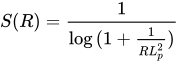 which governs coherence and leads to the principle of quantum equivalence, geometrically unifying quantum and classical behavior. These approaches suggest that macroscopic laws may include uncomputable elements from microscopic quantum descriptions, complementing earlier work on undecidability in physical systems. Recent work by George et al. (2025) synthesizes entropic stochastic resonance in Brownian transport with fundamental quantum models such as ToEM, EDFPM, and EBM, alongside objective collapse theories such as spontaneous unitarity violation and continuous spontaneous localization, deriving extensions for colored noise and non-Markovian fluctuation-dissipation relations to integrate the stochastic Schrödinger equation for joint measurement of position and momentum, suggesting that entropic mechanisms govern quantum-state transitions in stochastic geometries. These approaches suggest that macroscopic laws may include uncomputable elements from microscopic quantum descriptions, complementing earlier work on undecidability in physical systems.
Although macroscopic concepts are essential to understanding our world, much of fundamental physics has been devoted to the search for a "theory of everything," a set of equations that perfectly describe the behavior of all fundamental particles. The notion that this is the goal of science is based in part on the idea that such a theory would allow us to derive the behavior of all macroscopic concepts, at least in principle. The evidence we have presented suggests that this view may be overly optimistic. A "theory of everything" is one of many components needed for a complete understanding of the universe, but not necessarily the only one. Developing macroscopic laws from first principles may involve more than mere systematic logic, and may require assumptions put forward on the basis of experiments, modeling, or insight.
People are the basic elements of social systems, which constantly interact and create, maintain, or break mutual social ties. Social ties within social systems are constantly changing in the sense of a continuous reconfiguration of their structure. An early argument (1904–05) for the emergence of social formations can be found in Max Weber’s most famous work, "The Protestant Ethic and the Spirit of Capitalism." More recently, the emergence of a new social system has been linked to the emergence of order from nonlinear relations among a multitude of interacting units, where the interacting units are individual thoughts, consciousness, and actions. In the case of the global economic system, under capitalism, growth, accumulation, and innovation can be regarded as emergent processes, where not only do technological processes sustain growth, but growth itself becomes a source of further innovation in a recursive, self-expanding spiral. In this sense, the exponential trend of the growth curve is evidence of a long-term positive feedback loop among growth, accumulation, and innovation, and of the emergence of new structures and institutions associated with the multi-scale process of growth. This is reflected in the work of Karl Polanyi, who traces the process by which labor and nature are turned into commodities during the transition from an agriculture-based economic system to an industry-based one. This shift, together with the idea of a self-regulating market, laid the groundwork not only for a different economy, but also for a different society. The principle of emergence is also raised when reflecting on alternatives to the current growth-based economic system as it confronts social and ecological limits. Both degrowth theory and socio-ecological economics advocate a coevolutionary perspective for theorizing transformations that overcome the dependence of human well-being on economic growth.
Economists intensively study emerging economic trends and patterns. In the field of group organization and organizational development, many new group processes have emerged aimed at maximizing emergence and self-organization by providing a minimal set of effective initial conditions. Examples of such processes include SEED-SCALE, appreciative inquiry, future search, the world café or knowledge café, open space technology, and others (Holman, 2010). In international development, concepts of emergence are used within a theory of social change called SEED-SCALE, to show how standard principles interact to foster socio-economic development consistent with cultural values, the community economy, and the natural environment (local solutions emerge from the broader socio-economic biosphere). These principles can be implemented using a sequence of standardized tasks that self-organize in an individually specific way using recursive evaluation criteria.
Considering emergence in the context of social and systemic change prompts us to rethink our understanding of parts and wholes and their interrelationship. Unlike machines, living systems at every level of recursion — whether a sentient body, a tree, a family, an organization, an education system, an economy, a healthcare system, a political system, and so on — are constantly creating themselves. They continually grow and change together with the elements surrounding them, and therefore represent something more than the sum of their parts. As Peter Senge and co-authors argue in "Presence: An Exploration of Profound Change in People, Organizations, and Society," "as long as our thinking is governed by habits — particularly the industrial concepts of the ‘machine age,’ such as control, predictability, standardization, and ‘faster is better,’ — we will continue to recreate institutions as they were, despite their disharmony with the surrounding world and the need for all living systems to evolve." Although change is predictably constant, it is unpredictable in direction and often occurs at the second and nth orders of systemic interconnection. Understanding emergence, and what creates the conditions for the emergence of its various forms — whether hidden or life-nourishing — is essential in the search for profound transformation.
The work of Nora Bateson and her colleagues at the International Bateson Institute is devoted to this question. Since 2012, they have been studying questions such as: what makes a living system ready for change? Can unforeseen readiness for change be sustained? Here, readiness is regarded not as preparedness but rather as the nurturing of flexibility, the need for which we do not yet know. This research challenges the widespread view that a theory of change is built around a particular preferred goal or outcome. As explained in their essay "An Essay on Readiness: Preparing for Change": "While linear management or control of the direction of change may seem desirable, attending to how a system becomes ready opens up avenues of possibility previously unimaginable." This brings a new perspective to the field of emergence in social and systemic change, since it addresses attending to the pre-emergent process. Warm Data Labs are the fruit of their practice; they are spaces for transcontextual mutual learning in which aphanipoietic phenomena unfold. Having run hundreds of Warm Data processes involving thousands of people, they have found that these spaces of shared multi-learning across different contexts lead to a realm of potential change — an inevitably hidden zone of turbulent interaction of invisible, unspoken, unknown flexibility. It is precisely this flexibility that nurtures the readiness living systems need to respond to complex situations in new ways and through change. In other words, this process of preparation precedes whatever will emerge. When examining questions of social change, it is important to ask ourselves what lies hidden in the current social imagination, and perhaps, instead of focusing all our resources and energy on managing direct responses, we should nurture flexibility in ourselves and in the systems of which we are a part.
Another approach that uses the concept of emergence for social change is Theory U, where "deep emergence" is the result of a self-transcendence of knowledge following a successful journey through the U across layers of awareness. This practice nurtures transformation at the level of inner being, allowing new ways of being, seeing, and interacting to emerge. The concept of emergence is also used in the field of facilitation. In the book "Emergent Strategy," Adrienne Maree Brown defines emergent strategies as "ways for people to practice complexity and grow the future through relatively simple interactions."
In linguistics, the concept of emergence has been applied in the field of stylometry to explain the relationship between the syntactic structures of a text and authorial style (Slautina, Marusenko, 2014). It has also been argued that the structure and regularity of language grammar, or at least language change, are emergent phenomena. Although each speaker is simply trying to achieve their own communicative goals, they use language in a certain way. If a sufficient number of speakers behave in this way, the language changes. More broadly, the norms of a language, that is, the linguistic conventions of its speech community, can be regarded as a system arising from prolonged engagement in solving communicative problems under various social conditions.
The bulk conductive response of binary (RC) electrical networks with random arrangements, known as the universal dielectric response (UDR), can be regarded as an emergent property of such physical systems. Such arrangements can be used as simple physical prototypes for deriving mathematical formulas for the emergent responses of complex systems. Internet traffic can also exhibit certain seemingly emergent properties. In congestion control mechanisms, TCP flows can become globally synchronized at bottlenecks, simultaneously increasing and then decreasing their throughput in coordination. Congestion, widely regarded as a nuisance, is perhaps an emergent property of the propagation of bottlenecks across a network under high traffic flows, which can be viewed as a phase transition. Some artificial intelligence (AI) computer applications simulate emergent behavior. One example is Boids, which simulates the swarming behavior of birds.
In religion, emergentism underlies expressions of religious naturalism and syntheism, in which the sense of the sacred is perceived in the functioning of fully naturalistic processes, through which more complex forms arise or develop from simpler ones. Examples are discussed in detail in "The Sacred Emergence of Nature" by Ursula Goodenough and Terrence Deacon and "Reinventing the Sacred: A New View of Science, Reason, and Religion" by Stuart Kauffman (both 2006), as well as in "Syntheism – Creating God in the Internet Age" by Alexander Bard and Jan Söderqvist (2014) and "Emergentism: A Religion of Complexity for the Metamodern World" by Brendan Graham Dempsey (2022)
Michael J. Pearce used the concept of emergence to describe the perception of works of art in the context of contemporary neuroscience. The practicing artist Leonel Moura, in turn, attributes to his "art bots" a real, though elementary, creativity based on emergent principles.
Objects are made up of components whose properties differ from the properties of the object itself. We call these properties emergent because they did not exist at the level of the components. The same applies to artifacts (constructions, devices, tools, and even works of art). They are created for a specific purpose and are therefore subjectively emergent: someone who does not understand the purpose cannot use them.
An artifact is the result of invention: through the skillful combination of components, something new is created with emergent properties and functions. Such an invention is often difficult to predict, and so it is usually based on a chance discovery. An invention based on a discovery is often improved through feedback, making it more applicable. This is an example of downward causation.
Example 1: A hammer is a combination of a head and a handle, each of which has different properties. Through their skillful combination, the hammer becomes an artifact with new, emergent functional capabilities. Through downward causation, the components of the head and handle can be improved in such a way that the hammer’s functionality increases. Example 2: A mixture of tin and copper forms a bronze alloy with new, emergent properties (hardness, a lower melting point). Finding the correct ratio of tin to copper is an example of downward causation. Example 3: Finding the right combination of chemical substances to create a superconductor at high temperatures (i.e., at room temperature) is a difficult task for many scientists, in which chance plays a significant role. On the other hand, however, the properties of all these invented artifacts can easily be explained by the reductionist method.
Something similar happens in nature: random mutations in genes rarely create an organism with new, emergent properties that increase its chances of survival in a changing ecosystem. This is how evolution works. And here too, through downward causation, new organisms can sometimes manipulate their ecosystem in such a way that their chances of survival increase even further.
In both artifacts and living organisms, certain components can be decisive for the final outcome: the final outcome depends on these components. Examples include: a design error, a software bug, an error in the genetic code, or the absence of a particular gene.
Both aspects — supervenience and the unpredictability of the emergent outcome — are characteristic of strong emergence (see above). (However, this definition differs significantly from the definition found in the philosophical literature.)
The concept of emergence has, over many years, been subject to considerable interpretation and discussion by numerous philosophers and scientists.
| Philosopher or Scientist | Contribution | Major Work |
|---|---|---|
| Aristotle | One of the first thinkers to propose that the whole could possess properties not found in its individual parts. This idea laid the foundation by emphasizing that some phenomena cannot be fully explained by their individual components alone. | Metaphysics |
| George Henry Lewes | The term "emergence" was formally introduced in the 19th century. He distinguished between "resultant" and "emergent" properties, with emergent properties being unpredictable from the properties of their constituent parts. | Problems of Life and Mind |
| John Stuart Mill | Mill was one of the earliest proponents of the concept of emergence in a social and political context. In his works, he stressed the importance of understanding social phenomena as more than merely the sum of individual actions. | A System of Logic |
| CD Broad | In his 1925 book "The Mind and Its Place in Nature," Broad argued that mental states are emergent properties of brain processes. He developed a comprehensive philosophical framework for emergentism and defended the irreducibility of higher-level properties. | The Mind and Its Place in Nature |
| Samuel Alexander | In his work "Space, Time, and Deity," Alexander proposed that emergent qualities such as consciousness and life cannot be fully explained by the underlying physical processes alone. | Space, Time, and Deity |
| Jaegwon Kim | A well-known critic and commentator on emergence. Kim analyzed in detail the limits and scope of emergent properties, particularly in the context of mental causation and the philosophy of mind, questioning the coherence and causal efficacy of emergent properties. | Mind in a Physical World |
| Michael Polanyi | He put forward the idea that emergent properties are irreducible and possess their own causal power. Polanyi’s work in chemistry and the philosophy of science provided empirical and theoretical support for emergentist concepts, particularly in complex systems and hierarchical structures. | Personal Knowledge |
| Philip W. Anderson | Nobel Prize-winning physicist Anderson, in his work on condensed matter physics and the theory of superconductivity, provided significant empirical examples of emergent phenomena. His famous essay "More Is Different" showed that as the scale and complexity of systems grow, qualitatively new properties and principles emerge, requiring autonomous theories rather than simple extrapolations from particle-level laws. | More Is Different |
| Stuart Kauffman | A theoretical biologist whose work on complex systems and self-organization highlighted the role of emergence in biological evolution and the origin of life. Kauffman emphasized the unpredictability and novelty of emergent biological properties. | The Origins of Order |
| Roger Sperry | Neuropsychologist and Nobel Prize winner Sperry, in his split-brain research, contributed to the understanding of consciousness as an emergent property of brain processes. He argued that emergent mental properties possess a causal influence on lower-level neural processes. | Science and Moral Priority |
| Terrence Deacon | Anthropologist and neuroscientist Deacon, in his work on the evolution of language and human cognition, explored how emergent properties arise from neural and social interactions. In his book "Incomplete Nature," he delves into an emergentist explanation of life and mind. | Incomplete Nature: How Mind Emerged from Matter |
| Steven Johnson | An author and theorist whose popular science books, such as "Emergence: The Connected Lives of Ants, Brains, Cities, and Software," introduced the concept of emergentism to a wider audience, Johnson demonstrates how complex systems in nature and society exhibit emergent properties. | Emergence: The Connected Lives of Ants, Brains, Cities, and Software |

Comments