
Lecture
Feedback ( from the English feedback ) — the influence of the outcome of a system's functioning on the nature of its further functioning. The term «feedback» is used to describe processes in social, biological, technical, economic, and other systems, as well as in cybernetics and the theory of automatic control and regulation .
One of the first studies of the influence of feedback on the outcome of a system's functioning was carried out by Michael Faraday in his popular work «The Chemical History of a Candle» .
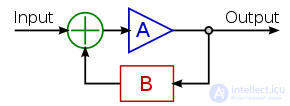
Feedback in systems is the process of transmitting information or data from the output of a system back to its input in order to regulate and correct its operation. It is important in various fields, such as engineering, biology, psychology, economics, and others. Feedback allows systems to adapt to changes and to maintain stability and an optimal state.
Principles of feedback:
Measurement and comparison: The system measures the output data and compares it with the desired or expected value.
Error analysis: The difference between the measured and desired values is interpreted as an error, which shows how far the system deviates from the desired state.
Correction and regulation: The error is used to correct the system's parameters or to act on the input data in order to minimize the error and maintain the desired state.
Examples of feedback:
Thermoregulation in organisms: Organisms use feedback to maintain a constant body temperature. When the temperature changes, the organism responds, for example by increasing or decreasing sweating, in order to restore the normal temperature.
Automatic regulators: In engineering, automatic regulators use feedback to maintain certain parameters, such as temperature, pressure, or speed, at a set level.
Social systems: Feedback can also play an important role in social systems. For example, feedback from public opinion can influence politicians' decisions.
Computer systems: In programming, feedback can be used to improve the performance and stability of software.
Feedback allows systems to adapt to changing conditions, maintain stability, and achieve their desired goals.
By the nature of their effect, a distinction is made between :
In addition, in automatic control systems a distinction is made between external feedback, connecting the output of the entire system to its input, and internal (local) feedback, connecting the output of an individual element or group of series-connected elements to their input.
Let the input signal u and the output signal U of a certain object (a black box) be related by the linear relation
 ,
,
where k – is the gain coefficient .
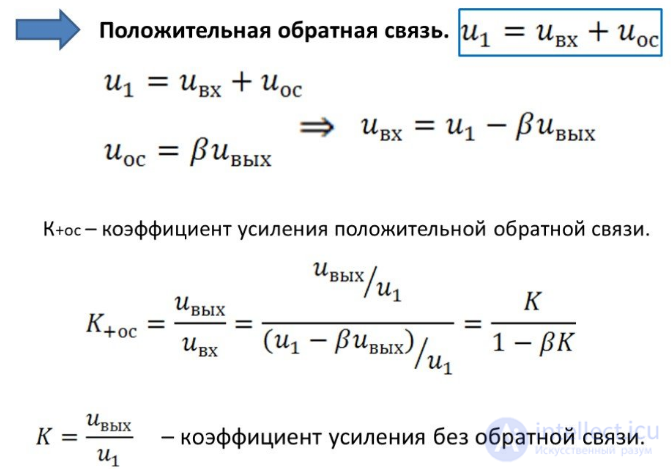
If, in addition to the signal u, part of the output signal is also fed to the system's input, so that the overall input signal becomes  , where
  — a certain feedback coefficient, we get
 .
.
In this case the output signal will be determined by the formula
 .
.
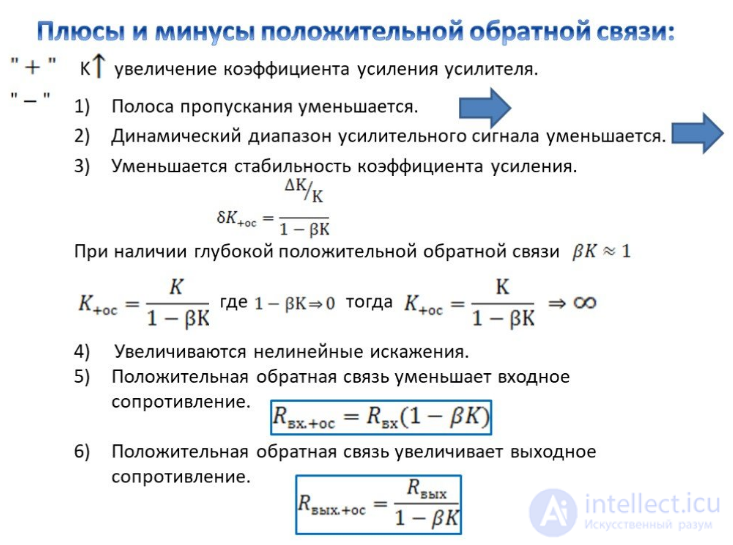
For positive values, the output signal will be amplified, but stability will decrease. At α = 1/k the output signal becomes infinitely large (in reality, in that case the system would leave its linear operating mode).
For negative values, the gain decreases and the system stabilizes.
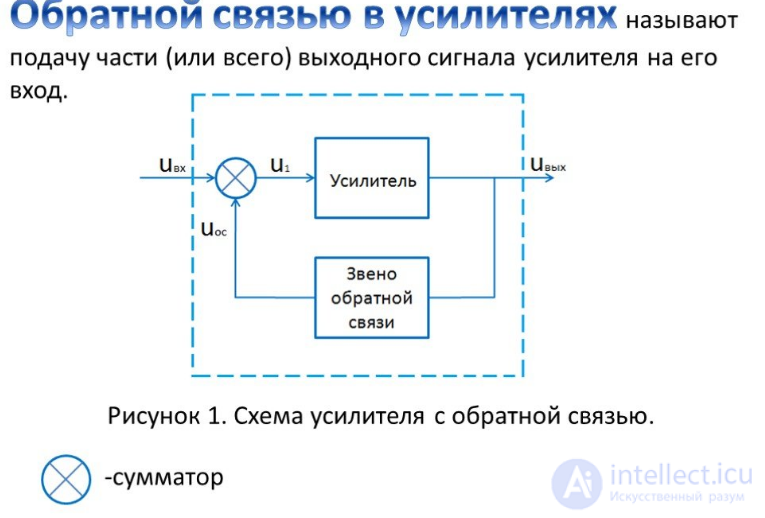
1) Negative feedback (NFB) - (UIN-UOUT) the signal from the output to the input arrives in antiphase.
2) Positive feedback (PFB)- (UIN+UOUT)the signal from the output to the input arrives in phase.
 By type of connection:
1) Series feedback – the feedback signal is inserted in a break in the input circuit.
2)Parallel feedback – the feedback signal is connected in parallel with the input circuit.
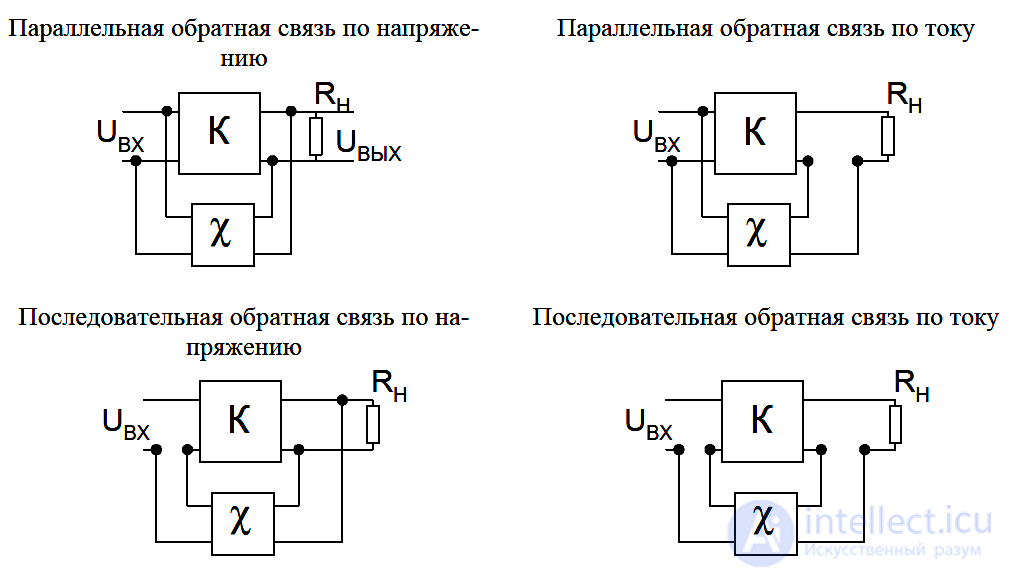
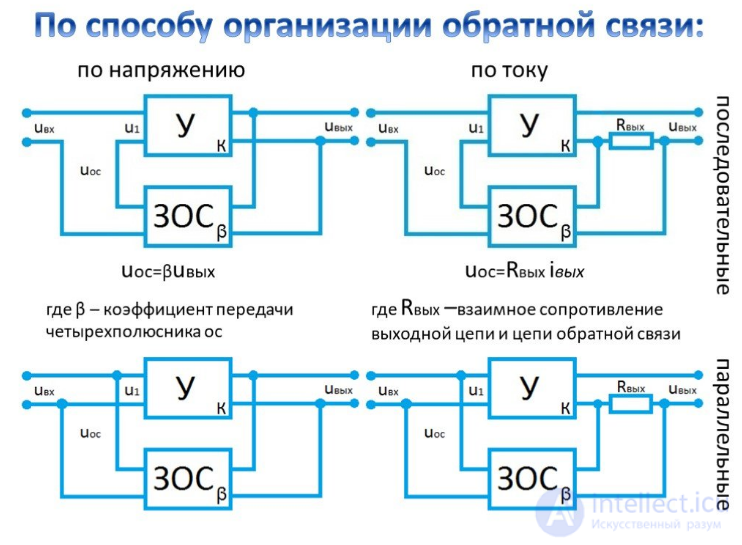
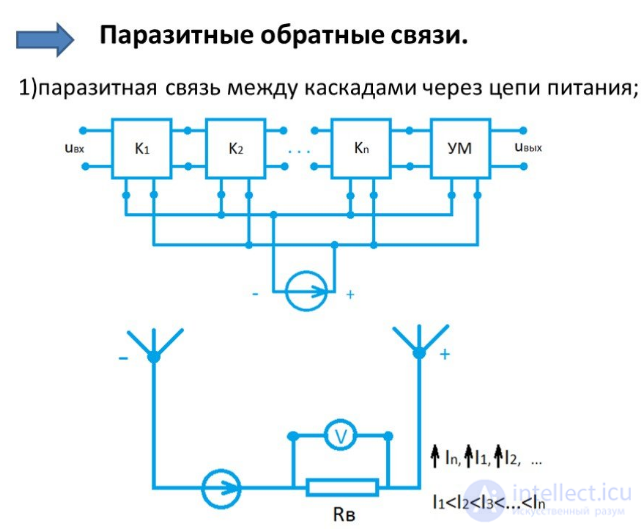
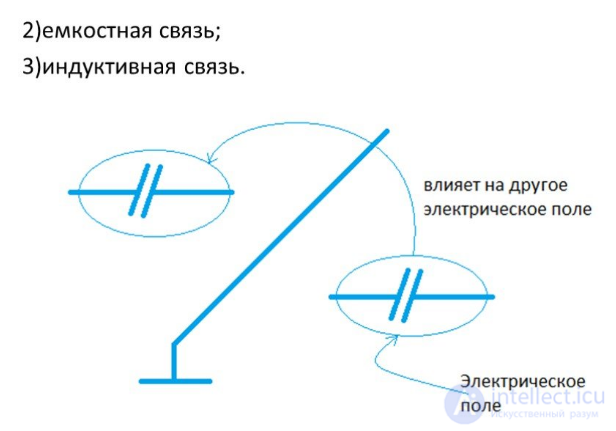
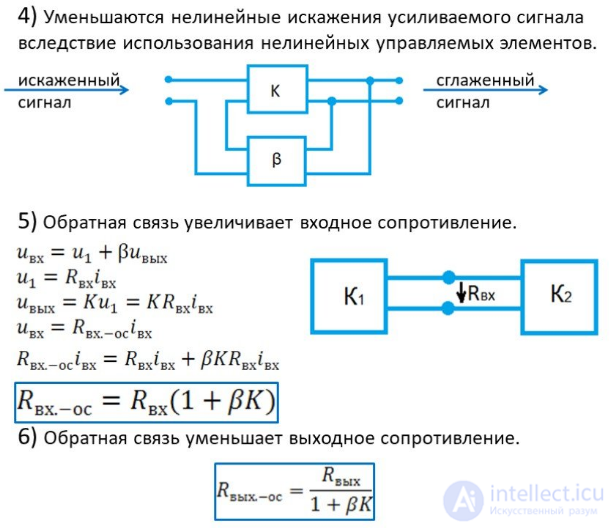
+The output impedance of an amplifier depends on how the FB is introduced. If negative FB is introduced by voltage, the output impedance decreases; if by current -— it increases. The introduction of FB is widely used for the purposeful modification of the output impedance and makes it possible to build amplifiers with very low (hundredths of an ohm) and very high (hundreds to thousands of megohms) output impedances. When FB is introduced by voltage, the amplifier approaches an ideal voltage source, whose output signal changes little for different load resistances. Current FB stabilizes the load current, bringing the amplifier closer to an ideal current source.
The input impedance likewise depends on how the FB signal is introduced into the input circuit. In its absence, the input impedance is determined by the amplifier's input voltage and current. With a series FB scheme, the input impedance increases by a factor of (1+BKo) for negative feedback and decreases by a factor of (1-BKo) for positive feedback. Introducing parallel FB is equivalent to connecting an additional resistance in parallel with the amplifier's input impedance, so that the input impedance decreases for both negative and positive FB. At large Ko values and low resistance in the feedback circuit, the input impedance can amount to tenths or thousandths of an ohm.
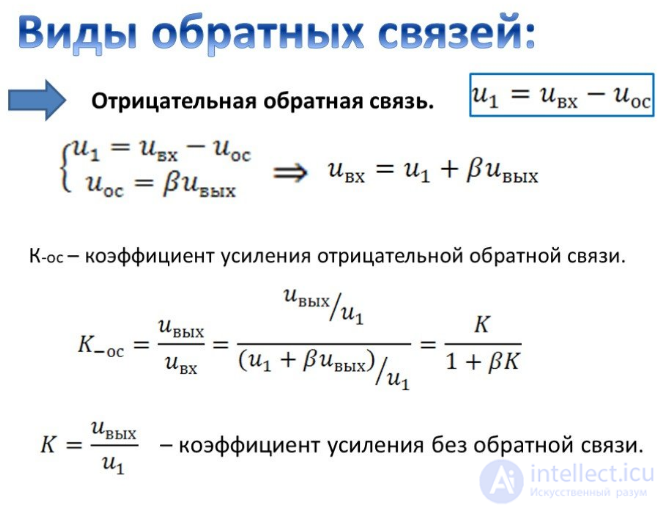
Negative feedback (NFB) — a type of feedback in which a change in a system's output signal causes such a change in the input signal that counteracts the original change.
In other words, negative feedback is an influence of the system's output on its input (a «backward» influence) that reduces the effect of the input signal on the system.
Negative feedback makes a system more resistant to random changes in its parameters.
Methods of mathematical analysis of systems, including those employing negative feedback, are examined in detail by automatic control theory.
One of the simplest examples is the mechanism of an ordinary toilet cistern. As the cistern fills, the water level inside it rises, causing a float to rise, which blocks further inflow of water.
Negative feedback is of enormous importance in power generation for stabilizing the quality parameters of electrical energy — voltage and frequency. When the electrical load fluctuates, the voltage drop across the generator windings and the outgoing wires changes, i.e., the generator's output voltage changes, and often the generator's speed changes as well, especially in cases where the generator is installed not as an auxiliary unit (for example, on a car or aircraft engine) but is the main generator of a power plant or diesel locomotive, where fluctuations in its power output strongly affect the drive engine. When the speed fluctuates, the generator's voltage also changes, since a generator's EMF is proportional to its speed, and if the generator produces alternating current — the frequency changes too. That is why practically every generator used for power supply (excluding tachogenerators and other special electrical machines) is paired with one or more negative-feedback regulators.
A voltage regulator (VR) almost always controls the excitation (magnetic flux) of the generator by regulating the current in the field winding (inductor) — when the voltage sags, the regulator increases the excitation current, the generator's EMF rises, and the voltage is restored; when the voltage rises, the reverse process occurs. The VR can be installed inside the generator itself, as is done in most modern automotive alternators — the regulator is built into a single housing together with the brushes that feed excitation current to the rotor (in jargon this unit is called a «pill» because of the regulator housing's characteristic shape) — or it can be installed separately: for example, on most aircraft the generators are mounted on the engines, i.e. in an unpressurized zone, while the regulator units are located in the fuselage near the switchgear, so that the negative feedback accounts for the voltage drop both across the generator windings and along the wires from the generator to the switchgear.
Frequency regulators vary widely because of the diversity of drive-engine types and the ratios of generator to engine power. In some cases, the drive engine's own regulator is sufficient — for example, an idle-air valve on a fuel-injected engine or a diesel governor — in which case the generator is not part of the NFB loop at all: the engine's governor, detecting a drop in speed (as the generator load increases) or a rise in speed (as the load decreases), correspondingly increases or decreases the fuel supply. In other cases the engine and the generator are linked by some form of feedback — for example, the governors of diesel-locomotive engines include a rheostat (e.g., in the ChME3 governor) or an inductive sensor (in the 2TE116 governor, among others), which, under heavy diesel load, reduces the excitation of the main generator, protecting the diesel engine from overload.
There may also be some kind of frequency-regulating device between the engine and the generator — for example, the design of the APA-50 ground power unit includes a variable-fill fluid coupling, while aircraft AC generators mounted on the main engines are often fitted to constant-speed drives (CSDs). A CSD can be purely mechanical (the air-driven PPO-40, the hydrostatic GP21) or it can have electronic control — for instance, the Tu-154M, Il-76, and some other aircraft carry BRCh-62 frequency-regulation units, which adjust the CSD whenever the generator frequency deviates from its nominal value (400 Hz).
Negative feedback is widely used in the traction drives of locomotives. The simplest example is the differential (anti-compound) winding of the exciter (a small generator that supplies the field current for the main traction motors). It is wound on the exciter's poles together with the main (separately excited) field winding, and the traction motors' current flows through it, but its direction is such that its magnetic flux opposes the flux of the main winding. If the motor current is small, it has little effect on the resulting excitation flux, but as the current grows, the flux of the differential winding grows too and the resulting flux falls. As a result, the exciter's voltage drops, and with it the traction-motor current.
This NFB is important on diesel locomotives for preventing wheel slip and equipment overload, and on VL8, VL10, VL11, and other electric locomotives, where a converter with a differential winding is installed to excite the motors during regenerative braking (recuperation) — to prevent wheel slip and equipment overload. During recuperation, if the catenary voltage suddenly drops (traction being switched on for another electric locomotive, a substation being disconnected), the recuperation current rises sharply, since the voltage difference between the catenary and the traction motors, which are operating as generators, increases; and as the current rises so does the braking force, up to the point of the wheelsets slipping. But the current, flowing through the differential winding, reduces the converter's voltage, the excitation current and, consequently, the motors' voltage, thereby reducing the voltage difference between the catenary and the motors. The reverse process occurs when the catenary voltage rises.
In the excitation systems of diesel-locomotive generators, which are more complex than a system with a multi-winding exciter, there are several NFB loops — by current (implemented with a current sensor of one design or another), by voltage (protects the equipment from an excessive rise in the main generator's voltage), by wheel slip (in the event of slip, i.e., an increase in the rotational speed of one or more wheelsets due to loss of adhesion with the rails, it reduces or completely removes the generator's excitation), and others.
The idea of using negative feedback in electronics was first proposed by Harold Black to improve the linearity of amplification for intercontinental telecommunications. The essence of the idea is to sacrifice part of the gain in order to improve the linearity of the output signal. A classic electronic signal amplifier (a vacuum tube, a field-effect transistor, etc.) introduces nonlinear distortion into the shape of the signal. Consequently, by subtracting from the input signal a fraction of the output signal divided by the gain, one can obtain the shape of the nonlinear distortion itself. Then, by superimposing the inverse of that distortion onto the input signal, one can achieve a compensated signal that, after passing through the amplifier, will have reduced nonlinearity.
An illustrative example of the use of negative feedback is building an amplifier with a stable gain based on an operational amplifier (op-amp).
Suppose we are given some op-amp with a gain on the order of 106. Based on this op-amp we need to build an amplifier with an input impedance of at least 5 kOhm and a gain of 3 (for a non-inverting amplifier K=1+R2/R1). To do this, a resistor with a resistance slightly greater than the required input resistance (say, 7 kOhm) is placed on the op-amp's inverting input, and a resistor with a value twice as large is placed in the feedback circuit. The analytical formula shows that this method of building amplifiers is approximate; however, because of the large gain value, the error introduced by the assumptions made turns out to be smaller than the error from manufacturing inaccuracies of the components.
Usually NFB makes it possible to achieve good amplifier parameters, but in general this holds true only for DC gain or low frequencies. As the frequency rises, the delay introduced by the amplifier begins to produce a significant phase shift of the amplified signal, so NFB no longer works as calculated. If the frequency is raised further, once the delay duration becomes on the order of half the signal's period (i.e., around 180 degrees of phase), the NFB turns into PFB, and the amplifier turns into an oscillator. To prevent this, the NFB circuit must be made frequency-dependent.
In microwave amplifiers, feedback is not applicable, so stabilizing the gain of microwave stages is quite difficult. However, if it is not the gain but the amplitude (power) of the output signal that needs to be stabilized, this is easily implemented as an AGC (automatic gain control).
NFB is used in voltage regulators (though not in all cases).
Negative feedback is widely used by living systems at various levels of organization — from the cell to entire ecosystems — to maintain homeostasis. For example, in cells, many mechanisms of gene-expression regulation (such as the tryptophan operon), as well as enzyme regulation (end-product inhibition of a metabolic pathway), are based on the principle of negative feedback. In the organism, the hypothalamic-pituitary system of function regulation is based on the same principle, as are many mechanisms of nervous regulation that maintain individual homeostatic parameters (thermoregulation, maintaining a constant concentration of carbon dioxide and glucose in the blood, etc.). In populations, negative feedback loops (for example, the inverse relationship between population density and individual fecundity) ensure homeostasis of numbers. Negative feedback can be used to normalize a person's body weight in cases of obesity, for which the caloric content of the diet is periodically (e.g., weekly) adjusted by tracking the dynamics of body weight.
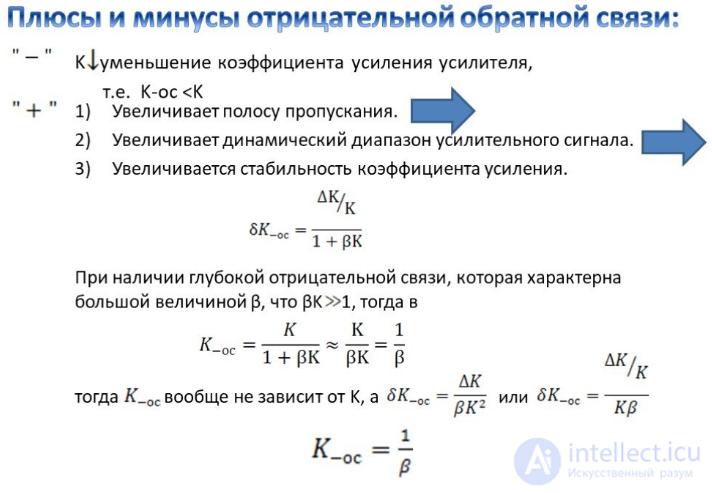
Positive feedback (PFB) — a type of feedback in which a change in a system's output signal causes such a change in the input signal that promotes further deviation of the output signal from its original value, i.e., the sign of the change in the feedback signal matches the sign of the change in the input signal.
Positive feedback amplifies or reinforces an effect by influencing the process that caused it. For example, when part of an electronic output signal is fed back to the input and is in phase with it, the system's gain increases. The feedback from the result to the initiating process can be direct or can pass through other state variables. Such systems can exhibit rich qualitative behavior, but whether the feedback is instantaneously positive or negative in sign has an extremely important influence on the outcomes. Positive feedback amplifies, while negative feedback dampens, the original process. Positive and negativein this sense refer to loop gains greater than or less than zero and do not imply any value judgment about the desirability of the outcomes or effects. A key feature of positive feedback is that small disturbances become larger. When a change occurs in a system, positive feedback causes a further change in the same direction.
Positive feedback speeds up a system's response to a change in the input signal, which is why it is deliberately used in engineering in situations where a faster response to changes in external parameters is required.
At the same time, positive feedback can lead to instability in the system. As an example, let us assume there are no phase delays in the loop.
If the loop gain in a positive feedback loop (in the open system, or open loop) is greater than 1, then either self-sustained oscillations arise in the system (which is used in various self-oscillators), or the system switches to one of its stable, quasi-stationary states (for example, various types of flip-flops).
If the open-loop gain equals 1, the system is on the verge of self-excitation, and any randomly arising self-oscillations either die out slowly or grow until they reach a limit.
With an open-loop gain of less than 1, the system is stable.
For example, a Wien-bridge oscillator, built around an amplifier with a Wien bridge in the positive feedback path, is an example of a circuit with frequency-dependent positive feedback; moreover, for this oscillator to generate a sinusoidal signal with low distortion, the loop gain of the circuit is kept exactly equal to 1 by means of amplitude-dependent nonlinear negative feedback.
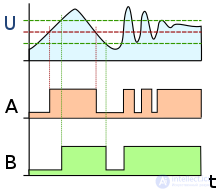
Another example of the use of positive feedback is the Schmitt trigger. If a digital logic gate or an operational amplifier is wrapped with correctly chosen positive feedback, a circuit with hysteresis is formed, called a Schmitt trigger. A Schmitt trigger with an integrating RC circuit at its input is used to eliminate contact bounce, to increase the noise immunity of sensor signals (or cable receivers), to eliminate an «undefined» state in communication channels caused by interference, and so on.
Positive feedback is present in chain chemical reactions, autocatalytic chemical reactions, and chain reactions of heavy-nucleus fission in a nuclear explosion. In a controlled nuclear reaction inside nuclear reactors, the effective neutron multiplication factor (the loop gain, in automatic-control terms) is maintained equal to 1 by a servo system that regulates the position of the neutron-absorbing control rods.
Nonlinear positive feedback leads to the development of a blow-up regime in the system.
PFB in electronics
In 1914, regenerative circuits for amplifying and receiving very weak radio signals were invented and patented. Carefully controlled positive feedback around a single transistor amplifier can increase its gain by a factor of 1000 or more. Consequently, a signal can be amplified 20,000 or even 100,000 times in a single stage, which normally has a gain of only 20 to 50. The problem with regenerative amplifiers operating at such very high gains is that they easily become unstable and start to oscillate. The radio operator has to be prepared to constantly adjust the amount of feedback for good reception. Modern radio receivers use a superheterodyne design, with far more amplification stages, but with much more stable operation and without positive feedback.
The oscillations that can arise in a regenerative radio circuit are used in electronic oscillators. When tuned circuits or a piezoelectric crystal (usually quartz) are used, the signal amplified by positive feedback remains linear and sinusoidal. There are several designs of such harmonic oscillators, including the Armstrong oscillator, the Hartley oscillator, the Colpitts oscillator, and the Wien-bridge oscillator. All of them use positive feedback to produce oscillations.
Many electronic circuits, especially amplifiers, have negative feedback. This reduces their gain but improves their linearity, input impedance, output impedance, and bandwidth, and also stabilizes all of these parameters, including the closed-loop gain. These parameters also become less dependent on the details of the amplifying device itself and more dependent on the feedback components, which are less likely to change with manufacturing tolerances, age, and temperature. The difference between positive and negative feedback for AC signals is one of phase: if the signal is fed back in antiphase, the feedback is negative, and if it is in phase, the feedback is positive. One of the problems facing designers of amplifiers that use negative feedback is that some circuit components introduce a phase shift into the feedback path. If there is a frequency (usually a high frequency) at which the phase shift reaches 180 °, the designer must ensure a very low amplifier gain at that frequency (usually by means of low-pass filtering). If the loop gain (the product of the amplifier's gain and the degree of positive feedback) at any frequency is greater than one, then the amplifier will oscillate at that frequency (the Barkhausen stability criterion). Such oscillations are sometimes called parasitic oscillations. An amplifier that is stable under one set of conditions may produce parasitic oscillations under another. This can be caused by changes in temperature, supply voltage, front-panel control settings, or even by a person or other conductive object approaching.
Amplifiers can oscillate mildly, which is hard to detect without an oscilloscope, or the oscillations can be so severe that only a heavily distorted signal gets through, or no signal is required at all, or damage occurs. Low-frequency parasitic oscillations have been called «motorboating» because of their resemblance to the sound of a low-revving exhaust.
Positive feedback is used in many common digital electronic circuits. Whereas ordinary simple logic gates usually rely simply on amplification to push the digital signal voltages from intermediate values to the values intended to represent logical «0» and «1», many more complex gates make use of feedback. When the input voltage is expected to vary in an analog fashion but precise thresholds are needed for subsequent digital processing, a Schmitt trigger circuit uses positive feedback to ensure that if the input voltage rises smoothly above a threshold, the output will be flipped quickly and cleanly from one logic state to the other. One consequence of a Schmitt trigger's use of positive feedback is that if the input voltage smoothly falls back below the same threshold, positive feedback will hold the output in the same state without any change. This effect is called hysteresis: the input voltage must fall past a different, lower threshold in order to «unlock» the output and reset it to its original digital value. Reducing the degree of positive feedback can narrow the width of the hysteresis, but it cannot be eliminated entirely. A Schmitt trigger is, to some extent, a latching circuit.
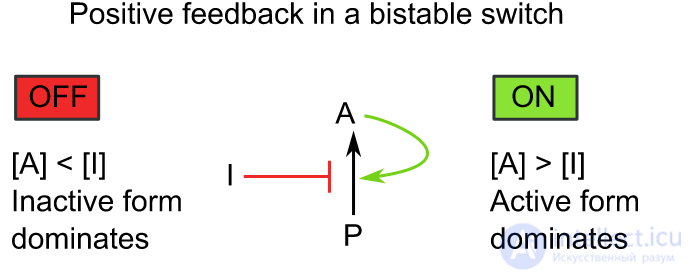
Positive feedback is a mechanism by which an output, such as a protein level, is increased. However, to avoid any oscillations in the protein level, this mechanism is stochastically inhibited (I), so that when the concentration of the activated protein (A) exceeds a threshold value ([I]), the loop mechanism is activated and the concentration of A increases exponentially, given that d [A] = k [A]
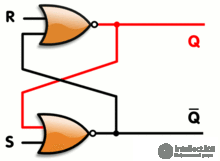
An electronic flip-flop, or «latch», or «bistable multivibrator», is a circuit that, because of strong positive feedback, is unstable in a balanced or intermediate state. Such a bistable circuit is the basis of a single bit of electronic memory. A flip-flop uses a pair of amplifiers, transistors, or logic gates connected to each other so that positive feedback holds the circuit's state in one of two unbalanced stable states after the input signal has been removed, until a suitable alternative signal is applied to change the state. Computer random-access memory (RAM) can be built this way, with one latching circuit for each bit of memory.
Thermal runaway occurs in electronic systems because some aspect of a circuit can pass more current as it heats up, and the hotter it gets, the more current it passes, which heats it up even further, so it passes even more current. The consequences for the device in question are usually catastrophic. If devices must be operated at the limit of their maximum power rating, and thermal runaway is possible or likely under certain conditions, improvements can usually be achieved through careful design.

The more sheep start running, the more sheep will run after them. Alarm signals in herds and flocks spread by a mechanism of positive feedback.
Speciation accelerates speciation, since the appearance of each new species creates new ecological niches, which drives the specialization of further new species. For example, the appearance of a new species of herbivore automatically creates vacant ecological niches for new predators, parasites, scavengers, and dung insects. In turn, the appearance of new herbivores becomes a new vector of selection for the plants that serve as food for that species or that depend on it for seed dispersal. New species of predators and parasites add positive feedback loops, becoming a selective factor for their prey. The coevolution of predators and their prey is known as a specific case of the «black queen principle» (The Red Queen Effect).
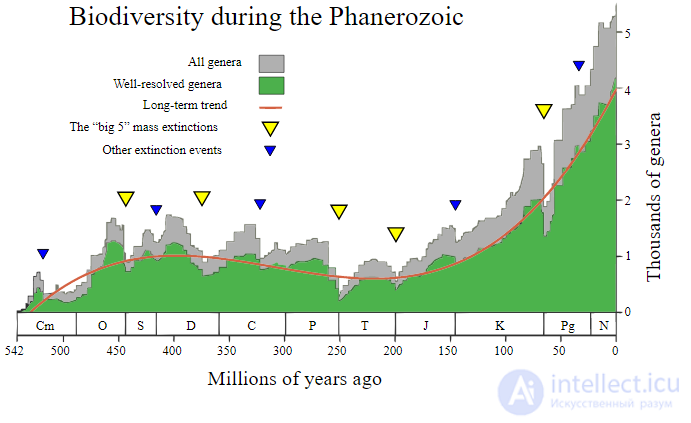
It is hypothesized that the growth of human intelligence is likewise driven by positive feedback, an arms race, arising from increasing intergroup and intragroup competition.
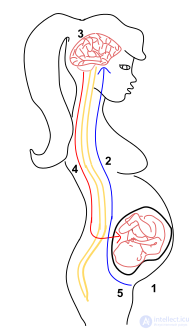
Examples of positive feedback in physiology include:
Septic shock and «cytokine storm» can serve as examples of positive feedback in the regulatory interactions among participants in the immune response. Immune cells activated by cytokines at the site of inflammation release new batches of cytokines, recruiting and activating new batches of immune cells — as a result, the cascade of reactions can become uncontrolled and maladaptive, causing damage at the site of inflammation, spreading to neighboring tissues, and eventually engulfing the whole organism.
Winner (1996) described gifted children as moving through positive feedback loops that involve creating their own course of study, being satisfied by that feedback, and thereby further raising their learning goals to a higher level, and so on. [40] Winner called this positive feedback loop the «rage to master». Vandervert (2009a, 2009b) suggested that prodigies can be explained in terms of positive feedback between the output of thinking/performance in working memory, which is then passed on to the cerebellum, where it is optimized, and then returned to working memory, thereby steadily increasing the quantitative and qualitative output of working memory. [ Vandervert also argued that this positive feedback loop between working memory and the cerebellum is responsible for language evolution in working memory.
Product recommendations and information about past purchases have been shown to significantly influence consumer choices, whether for music, films, books, technology, or other types of products. Social influence often gives rise to the «rich get richer» phenomenon (the Matthew effect), whereby popular products tend to become even more popular.
According to the theory of reflexivity put forward by George Soros, price changes are driven by a process of positive feedback, in which investors' expectations are influenced by price movements, so their behavior reinforces the movement in that direction until it becomes unsustainable, after which the feedback drives prices in the opposite direction.
Systemic risk is the risk that a process of amplification, reinforcement, or positive feedback poses to a system. It is usually unknown, and under certain conditions this process can grow exponentially and rapidly lead to destructive or chaotic behavior. A Ponzi scheme is a good example of a positive feedback system: funds from new investors are used to pay unusually high returns, which in turn attract more new investors, causing rapid growth toward a collapse. W. Brian Arthur has also studied and written about positive feedback in economics (see, e.g., W. Brian Arthur, 1990). Hyman Minsky proposed a theory according to which certain methods of credit expansion can turn a market economy into a «deviation-amplifying system» that can suddenly collapse , that is sometimes called a «Minsky moment».
Simple systems that clearly separate inputs from outputs are not subject to systemic risk. This risk becomes more likely as a system's complexity increases, because it becomes increasingly difficult to see or analyze all possible combinations of variables in the system, even under thorough stress testing. The more efficient a complex system is, the more likely it is to be susceptible to systemic risks, because only a small deviation is needed to disrupt the system's operation. Consequently, well-designed complex systems usually have built-in features to avoid this condition, such as a small amount of friction, resistance, inertia, or time delay, to decouple the outputs from the inputs within the system. These factors constitute inefficiencies, but they are necessary to avoid instability.
The 2010 Flash Crash incident was blamed on high-frequency trading (HFT) practices, although whether HFT actually increases systemic risk remains disputed. [ citation needed ]
Agriculture and the human population can be considered to be in a positive feedback regime meaning that each drives the other with increasing intensity. It is hypothesized that this positive feedback system will someday end in catastrophe, since modern agriculture uses up all readily available phosphate and resorts to highly efficient monocultures that are more susceptible to systemic risk.
Technological innovation and the human population can be viewed the same way, and this has been proposed as an explanation for the apparent hyperbolic growth of the human population in the past, rather than simpler exponential growth. The growth rate is thought to accelerate because of second-order positive feedback between population and technology. Technological growth increases the earth's carrying capacity for people, which leads to population growth, which in turn stimulates further technological growth.
Gunnar Myrdal described a vicious circle of growing inequality and poverty known as «circular cumulative causation».
Drought is intensified by positive feedback. A lack of rain lowers soil moisture, which causes plants to die and/or to release less water through transpiration. Both factors limit evapotranspiration, the process by which water vapor enters the atmosphere from the surface, and add dry dust to the atmosphere, which absorbs moisture. Less water vapor means both lower dew-point temperatures and more efficient daytime heating, reducing the likelihood of atmospheric humidity leading to cloud formation. Finally, without clouds there can be no rain, and the loop is complete.
Climate «forcings» can push the climate system toward warming or cooling , for example, elevated concentrations of greenhouse gases in the atmosphere cause surface warming. Forcings are external to the climate system, while feedbacks are internal processes of the system. Some feedback mechanisms act relatively independently of the rest of the climate system, while others are closely coupled. Forcings, feedbacks, and the dynamics of the climate system determine how much and how quickly the climate changes. The main positive feedback in global warming is the tendency of warming to increase the amount of water vapor in the atmosphere, which in turn leads to further warming. The main negative feedback comes from the Stefan–Boltzmann law: the amount of heat radiated from the Earth into space is proportional to the fourth power of the temperature of the Earth's surface and atmosphere.
Other examples of positive feedback subsystems in climatology include:
The Fourth Assessment Report of the Intergovernmental Panel on Climate Change (IPCC) states that «anthropogenic warming could lead to some effects that are abrupt or irreversible, depending on the rate and magnitude of the climate change».
A self-fulfilling prophecy is a form of social positive feedback between beliefs and behavior: if enough people believe something to be true, their behavior can make it so, and observations of their behavior can in turn increase the belief. A classic example is a bank run.
Another sociological example of positive feedback is the network effect. When more people are encouraged to join a network, this increases the network's reach, so the network expands even faster. A viral video is an example of the network effect, in which a link to a popular video is shared and re-shared, ensuring that more and more people watch the video and then re-post the link. This is the basis of many social phenomena, including Ponzi schemes and chain letters. In many cases, the size of the population is the limiting factor for the feedback effect
.
If a chemical reaction releases heat, and the reaction itself proceeds faster at higher temperatures, then positive feedback is highly likely. If the heat released is not carried away from the reactants quickly enough, thermal runaway can occur, which will very rapidly lead to a chemical explosion.
Many wild animals are hunted for their body parts, which can be quite valuable. The closer the targeted species come to extinction, the higher their price becomes. This is an example of positive feedback.


Comments