
Lecture
In science, computing, and engineering, a «black box» is a system that can be viewed in terms of its inputs and outputs (or transfer characteristics), without any knowledge of its internal workings. Its implementation is «opaque» (black). The term can be used to refer to many internal mechanisms, such as a transistor, an engine, an algorithm, the human brain, or an institution or government.
When analyzing an open system using a typical «black box» approach, only the stimulus/response behavior is taken into account in order to define the (unknown) «box». Usually, such a «black box system» is represented as a data flow diagram centered inside this «box».
The opposite of a «black box» is a system whose internal components or logic are available for inspection; it is most often called a «white box» (sometimes also a «transparent box» or «glass box»).
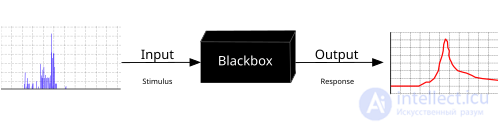
The «black box» model can be used to describe the output data of systems.
The modern meaning of the term «black box» apparently entered the English language around 1945. In circuit theory, the process of network synthesis from transfer functions, which led to electronic circuits being viewed as «black boxes» characterized by their response to signals applied to their ports, can be traced back to Wilhelm Cauer, who published his ideas in their most developed form in 1941. Although Cauer himself did not use the term, others who followed him certainly described this method as «black box» analysis. Witold Belevitch traces the concept of «black boxes» back even further, attributing the explicit use of two-port networks as «black boxes» to Franz Breisig in 1921, and arguing that two-terminal components had been implicitly treated as «black boxes» even earlier.
In cybernetics, a complete account of this topic was given by Ross Ashby in 1956. In 1961, Norbert Wiener described the «black box» as an unknown system that needs to be identified using system identification methods. He considered the ability to copy the output behavior of a «black box» to be the first step in self-organization. Many other engineers, scientists, and epistemologists, such as Mario Bunge, used and refined black box theory in the 1960s.
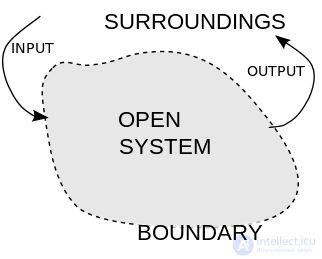
Open systems theory underlies black box theory. Both theories focus on the input and output flows representing exchange with the environment.
In systems theory, a «black box» is an abstraction representing a class of specific open systems that can be considered solely in terms of their input stimuli and output responses:
The composition and structure of the «box» are completely irrelevant to the approach in question, which is purely external or phenomenological. In other words, only the behavior of the system will be taken into account.
— Mario Bunge
Understanding the «black box» is based on the «explanatory principle», a hypothesis about the causal relationship between input and output. This principle states that the input and output are distinct, that the system has observable (and related) inputs and outputs, and that the system is «black» to the observer (unopenable).
The observer makes observations over time. All observations of the inputs and outputs of the «black box» can be recorded in a table, in which the states of the various parts of the box, inputs, and outputs are logged at each point in time. Thus, using Ashby's example, an investigation of a box that fell from a flying saucer might produce the following log:
| Time | Input and output states |
|---|---|
| 11:18 | I did nothing — the device emitted a steady hum at a frequency of 240 Hz. |
| 11:19 | I pressed the switch marked K: the frequency of the sound rose to 480 Hz and remained unchanged. |
| 11:20 | I accidentally pressed the button marked "!" — the temperature in the box rose by 20 °C. |
| ... | Etc. |
Thus, each system is, in essence, investigated by collecting a long log, stretched out over time, showing the sequence of input and output states. From this follows the fundamental conclusion that all knowledge derived from a «black box» (with given inputs and outputs) is knowledge that can be obtained by recoding the log (the observation table); this and nothing more.
If the observer also controls the input data, the investigation turns into an experiment (illustration), and hypotheses about causal relationships can be tested directly.
When the experimenter is also motivated to control the box, active feedback arises in the box/observer relationship, contributing to the development of what is called a feedforward architecture in control theory.
The modeling process involves constructing a predictive mathematical model using existing historical data (observation tables).
A developed black box model is considered a validated model if black box testing methods guarantee that it is based solely on observable elements.
In back-testing, data originating outside the time domain is always used to validate the black box model. The data must be recorded before it is used as input for the black box model.
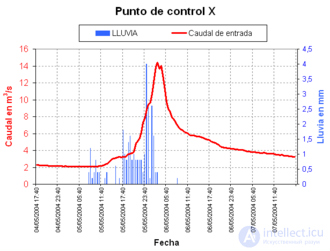
The hydrograph shown is a graphical representation of the response of a catchment basin (black box), with its runoff (shown in red), to incoming precipitation (shown in blue).
Black box theories are theories defined only in terms of their function. This term can be applied in any field where relationships between aspects of a system's appearance (the outside of the «black box») are studied, without attempting to explain why these relationships should exist (the inside of the «black box»). In this context, Newton's theory of gravity can be described as a black box theory.
In particular, the research is focused on a system that has no directly obvious characteristics and therefore has only factors for consideration hidden within itself from direct observation. The observer is considered ignorant at the first stage, since most of the available data is stored in the internal situation, away from simple examination. The «black box» element in the definition is shown as being characterized by a system in which observable elements enter a possibly imaginary box, from which a set of various output data emerges, which are also observable.
In humanities disciplines such as the philosophy of mind and behaviorism, one application of black box theory is to describe and understand psychological factors in fields such as marketing, as applied to the analysis of consumer behavior.
Black box theory finds application even in a broader area than just professional research:
A child trying to open a door must manipulate the handle (input signal) to produce the desired movement of the latch (output signal); and he must learn to control one by means of the other, without being able to see the internal mechanism that connects them. In our everyday lives, we constantly encounter systems whose internal mechanisms are not fully open to inspection and which require the application of methods appropriate to a «black box».
— Ashby [ 6 ]
(...) This simple rule has proven very effective and illustrates how the «black box» principle in cybernetics can be used to manage situations that, if examined in depth, might seem very complex.
Another example of the «black box» principle is the treatment of the mentally ill. The human brain is certainly a «black box», and although a great deal of work is being done to study the mechanisms of its functioning in neurology, progress in treatment is also being achieved by observing patients' responses to stimuli.
— Duckworth, Gear, and Lockett
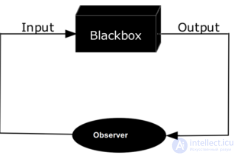
When the observer (agent) can also exert some influence (enter data), the connection with the «black box» is not merely an observation, but an experiment.

Comments