
Lecture
Это окончание невероятной информации про ветхий завет.
...
completed the formation of the spiritual-value core of the traditional culture of the Far East. It corresponds to several Chinese (and to the Japanese, Korean, and Vietnamese terms derived from them):
«dao xue» – «the teaching of the [true] Way»; «[xing ming yi] li xue» – «the teaching of [individual nature, destiny, due righteousness, and] principle»; «xin xue1» – «the teaching of the mind (psyche)»; «shi xue» – «the teaching of the real», or «real (practical) learning»; «sheng xue» – «the teaching of perfect wisdom», or «the teaching of the perfectly wise»; «Song xue» – «the teaching [of the era] of Song (960–1279)». In the narrowest sense, Neo-Confucianism is the teaching of the 11th–12th-century philosophers singled out by the official «History of the [Song] Dynasty» (Song shi, 14th century) as the «dao xue» current, that is, Zhou Dunyi, Zhang Zai, Cheng Hao, Cheng Yi, Zhu Xi, and their closest disciples and followers. In a somewhat broader sense, Neo-Confucianism encompasses all Confucian-oriented thinkers of the 11th–17th centuries (the Song–Ming era); sometimes only officially recognized philosophers are included here. In the broadest sense, Neo-Confucianism refers to the entire body of Confucian and Confucianized teachings created in the Far Eastern region from the 11th century to the present. The native designations of Neo-Confucianism emphasize its different aspects: «Song xue» – the time of its emergence; «shi xue»
– its «realism» and «practicality» as opposed to Daoism and Buddhism, which preach withdrawal from active life and from reality itself; «dao xue» – following the orthodox truth – the dao-Way – disclosed by the ancient «perfectly wise»; «sheng xue» – the recognition that every person has the possibility of personally attaining «perfect wisdom» (sheng1) by virtue of the «good nature» originally inherent in him. The most widespread Chinese designations of Neo-Confucianism – «[xing ming yi] li xue», «xin xue1» – highlight its central categories: «[individual] nature» (xing1), «destiny» (ming1), «due righteousness» (yi1), «principle» (li1), «mind/heart» (xin1).
At the origins of Neo-Confucianism stood the apologists of Confucianism amid the wide popularity of Daoism and Buddhism – Wang Tong (6th–8th centuries), Han Yu, and his disciple Li Ao (8th–9th centuries). The ideology of Neo-Confucianism began to be created by the «three masters of the teaching on principle» – Sun Fu, Hu Yuan (end of the 10th – 11th century), and Shi Jie (11th century); it was in the works of Zhou Dunyi that it first acquired a systematized and thematically comprehensive form. The leading current within Neo-Confucianism became that of his followers and commentators – the Cheng [brothers] – Zhu [Xi] school, which was originally in opposition to the official ideology, but was canonized in 1313 and retained that status in China until the beginning of the 20th century, and in the mid-20th century gave rise to Feng Youlan's «new teaching on principle» (xin li xue). Its main rival was the Lu [Jiuyuan] – Wang [Yangming] school, ideologically dominant in the 16th–17th centuries. The rivalry between the Cheng–Zhu and Lu–Wang schools, which upheld, respectively, sociocentric objectivism and personocentric subjectivism – sometimes characterized through the opposition «the teaching on principle» versus «the teaching on the mind» – spread to Japan and Korea, where, as in Taiwan, it continues in renewed forms to this day. From these main currents, two narrower trends split off within Neo-Confucianism from the very beginning: the representatives of the first showed heightened attention to natural-philosophical problems and numerological constructions (Shao Yong, 11th century; Cai Jiufeng, 12th–13th centuries; Fang Yizhi, Wang Chuanshan, 17th century), while the representatives of the second emphasized the socially utilitarian significance of knowledge (Lü Zuqian, Chen Liang, 12th century; Ye Shi, 12th–13th centuries; Wang Tingxiang, 15th–16th centuries; Yan Yuan, 17th – beginning of the 18th century). In the 17th–19th centuries the dominant teachings of the Cheng–Zhu and Lu–Wang schools came under attack from the «empirical» school, which emphasized the critical study of the classical texts and the empirical investigation of nature. The forerunner of this current, now called «the study of the natural», or «concrete learning» (pu xue), was
|
Gu Yanwu (17th century), and its greatest representative – |
Dai Zhen (18th century). |
|
|
|
|
|
The further development of Neo-Confucianism, beginning with Kang Youwei (1858–1927), is connected with attempts to assimilate Western theories.
Unlike original Confucianism, Neo-Confucianism is based above all on the texts of Confucius (6th–5th centuries BCE), Mencius (Meng Ke, 4th–3rd centuries BCE), and their closest disciples, rather than on the proto-philosophical canons. The Cheng–Zhu school embodied this new approach in the Four Books (Sishu). During the period when Neo-Confucianism was taking shape, the normative form of the Thirteen Classics (Shisanjing) also encompassed the ancient proto-philosophical classics. First place among them was occupied by the methodological «organon» – the Zhou[yi], in which numerological ideas are set forth, fully explicated (including by means of graphic symbolism) and developed
within Neo-Confucianism. The Neo-Confucians actively worked out the ontological, cosmological, and gnoseo-psychological problematic, which had been considerably less developed in original Confucianism. Having borrowed certain abstract concepts and conceptions from Daoism and Buddhism, Neo-Confucianism assimilated them by means of ethical interpretation. The moral dominant of Confucianism, within Neo-Confucianism, turned into an ethical universalism
within whose framework every aspect of being came to be treated in moral categories, which was expressed by means of successive mutual identifications of human («humaneness» – ren, «[individual] nature», «mind/heart») and natural (Heaven-tian, «destiny», «grace/virtue»-de) essences. Contemporary interpreters and continuators of Neo-Confucianism (Mou Zongsan, Du Weiming, and others) define this approach as «moral metaphysics» (daode de xingershangxue), which is simultaneously a theology.
End of the 2nd – beginning of the 1st millennium BCE – the emergence of Judaism;
551–479 BCE – the years of the life of Kongzi (Confucius);
4th–3rd centuries BCE – the emergence of Daoism;
3rd–2nd centuries BCE – the completion of the compilation of the sacred scripture of the Jews (the Talmud);
2nd century BCE – Confucianism acquires the status of official religion of China;
555 – the deification of Confucius in the Chinese state;
6th–7th centuries – the emergence of Shinto.
1. What are the main features of the religion of the ancient Hebrews?
2. Can Confucius's teaching be considered a religion?
3. How and when did Hinduism arise? What are the features of this religion?
4. What is Daoism?
5. What are the roots of the divergence between Judaism and Christianity?
6. What are the traditions, rites, and holidays of the Jews?
7. What are the features of the mythology, teaching, and cult of the Shinto religion?
1. The genesis and specificity of national religions.
2. The origin and evolution of Confucianism.
3. Shinto – the religion of Japan.
4. Features of the doctrine, cult, and organization of Judaism.
5. The origin and genesis of Hinduism.
1. The role of national religions in the life of contemporary society.
2. The socio-political conditions for the emergence and development of Confucianism in China.
3. The traditions, rites, and holidays of the Jews.
4. The Shinto religion in contemporary Japan.
5. Daoism.
6. Hinduism, its origin and development.
1. Formulate the most important religio-philosophical ideas of Hinduism.
2. Familiarize yourself with the life and teaching of Confucius.
3. Read and comment on the passages of the Old Testament that tell of the great flood.
4. Solve the crossword puzzle on the topic.
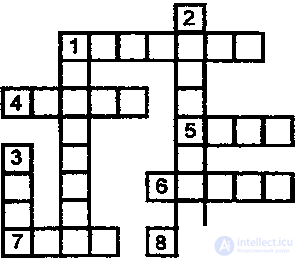
Down:
1. A community of believers, and also a house, in Judaism.
2. The supreme goddess, personification of the sun, in Shinto.
3. An object of cult in Hinduism.
Across:
1. King of the Kingdom of Israel and Judah, son of David.
4. A religion widespread in Japan.
5. The country where Adam and Eve dwelt before the Fall.
6. The Jewish king who created a state with its capital at Jerusalem.
7. The father of the human race in the Bible and the Qur'an.
8. A representative of a monotheistic religion with the cult of the god Yahweh.
Aggadah: Tales, Parables, and Sayings of the Talmud and Midrashim. Moscow, 1993.
Belenky, M.S. Judaism. 2nd ed., Moscow, 1974.
Bongard-Levin, G.M. Ancient Indian Civilization. Philosophy, Science, Religion. 2nd ed. Moscow, 1993.
Vasilyev, L.S. History of the Religions of the East. Moscow, 1988.
Vasilyev, L.S. Cults, Religions, and Traditions in China. Moscow, 1970.
Geche, G. Biblical Stories. 2nd ed. Moscow, 1990.
Guseva, N.V. Hinduism. History of Its Formation. Cult Practice. Moscow, 1977.
Dao and Daoism in China. Moscow, 1989.
Dimont, M. Jews, God, and History. Jerusalem, 1989.
Ancient Chinese Philosophy. Collected Texts. In 2 vols. Translations. Moscow, 1972–1973.
Confucianism in China: Problems of Theory and Practice / Edited by L.P. Delyusin. Moscow, 1982.
Malyavin, V.V. Confucius. Moscow, 1992.
Perelomov, L.S. Confucius: Life, Teaching, Destiny. Moscow, 1993.
Rizhsky, M.I. Biblical Prophets and Biblical Prophecies. Moscow, 1987.
Rubin, V.A. Personality and Power in Ancient China. Moscow, 1993.
Semenenko, I.I. Aphorisms of Confucius. Moscow, 1887.
Telushkin, D. The Jewish World. Moscow, 1992.
Torchinov, E.A. Daoism: An Attempt at a Historico-Religious-Studies Description. St. Petersburg, 1993.
Shokhin, V.K. Brahmanist Philosophy. Moscow, 1993.
Shifman, I.Sh. The Old Testament and Its World. Moscow, 1987.
Ethics and Ritual in Traditional China. Moscow, 1988.
Yang, L. The Essence of Judaism. Moscow, 1993.
Часть 1 7. Confucianism and Neo-Confucianism
Часть 2 Key dates - 7. Confucianism and Neo-Confucianism

Comments