
Lecture
Objective: to build students' knowledge on this topic, to familiarise them with the types of first aid, the basic principles of its provision, the aims and tasks of first aid, and the methods of transporting casualties, and to foster in students a sense of responsibility and moral readiness for unexpected and extreme situations.
Medical actions are any actions aimed at preserving health and life.
The task of first aid consists in saving the casualty's life by carrying out the simplest measures, reducing his suffering, preventing the development of possible complications, and easing the severity of the course of the injury or illness.
First aid can be given at the site of injury by the casualty himself (self-aid), by a comrade (mutual aid), or by medical volunteers (sanitary squad members).
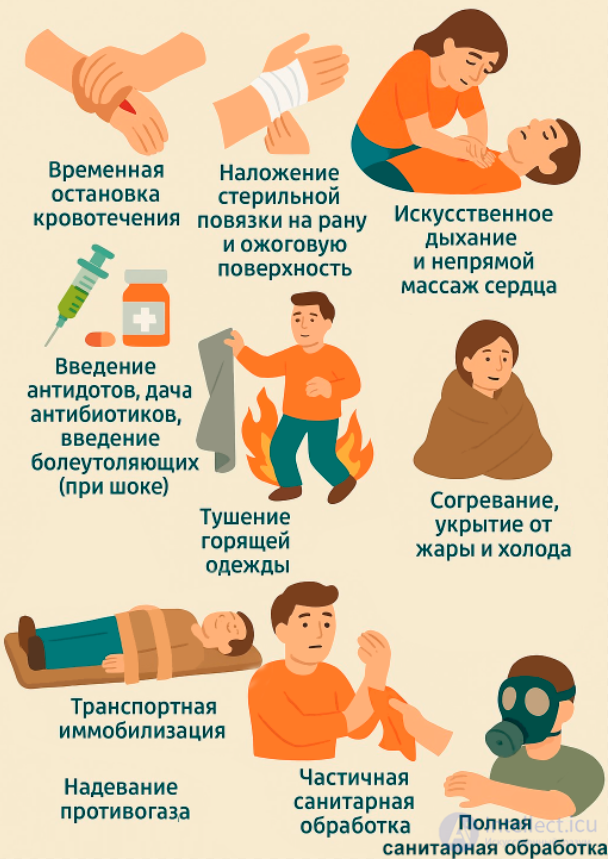
Providing first aid as early as possible is of decisive importance for the further course and outcome of the injury, and sometimes for saving life. In case of severe bleeding, electric shock, drowning, cessation of cardiac activity and breathing, and a number of other cases, first aid must be given immediately.
When providing first aid, both standard-issue and improvised means are used. The standard-issue means of first aid are dressing materials - bandages, medical dressing packets, large and small sterile dressings, and gauze pads, cotton wool, etc. To stop bleeding, haemostatic tourniquets are used - strap-type and tubular - and for immobilisation, special splints - plywood, ladder, mesh and others. In providing first aid, certain medications are used - 5% alcohol solution of iodine in ampoules or in a bottle, 1-2% alcohol solution of brilliant green in a bottle, validol tablets, valerian tincture, ammonia solution in ampoules, sodium bicarbonate (baking soda) in tablets or powder, petroleum jelly, etc. For personal prophylaxis against injury by radioactive, chemical warfare and bacteriological agents near the affected areas, the individual first-aid kit (AI-2) is used.
According to the current classification, the following types of medical aid are distinguished:
1) First aid (unqualified). Provided by non-medical personnel, in the form of self-aid and mutual aid, at the scene of the incident. There is no question of making a diagnosis at this stage.
2) First pre-hospital aid (first qualified medical aid) - provided by a medical worker (paramedic, nurse, laboratory assistant, dental technician, etc.);
3) First medical aid - provided by a physician who has at his disposal the necessary medical equipment, instruments and medications.
1) Immediate cessation of exposure to external damaging factors (electric current, high or low temperature, compression by a heavy object) and/or removal from a danger zone (water, a burning room, a room containing poisonous gas). The measures belonging to this group constitute first aid in general.
Such aid can be given by any person, without special skills or knowledge, and without the necessary medications and equipment.
2) Providing first aid to the casualty depending on the nature and type of the injury, accident or sudden illness (stopping bleeding, applying a dressing to a wound, artificial respiration, cardiac massage, administering antidotes). Such aid can be given by a medical worker, or by a person who has studied the main signs of injuries and the special techniques
of providing first aid.
3) Organising the swiftest transportation of the casualty/patient to a medical facility in the position safest for the patient, in accordance with the nature of the illness or type of injury (in case of unconsciousness or possible vomiting, the patient should be transported lying on his side).
The medical worker is obliged to ensure the correct carrying of the patient, his transfer from one means of transport to another, to provide medical aid en route, and to take measures to prevent complications that may be caused by vomiting, disruption of transport immobilisation, hypothermia, jolting, etc. Specialised transport should be used to transport the casualty; in its absence, transportation should be carried out by any means of conveyance; in the absence of those, delivery is carried out on improvised stretchers or a tarpaulin.
Timely and correct provision of first aid (FA) not only often saves the casualty's life, but also ensures successful further treatment, preventing the development of a number of severe complications (shock, wound suppuration, sepsis), and reduces the risk of loss of working capacity.
standard-issue (dressing materials, haemostatic tourniquets, certain medications, special splints); improvised (a clean sheet, a shirt, fabric (preferably uncoloured), a trouser belt, a fabric tie, strips of hard cardboard or plywood, boards, sticks, etc.).
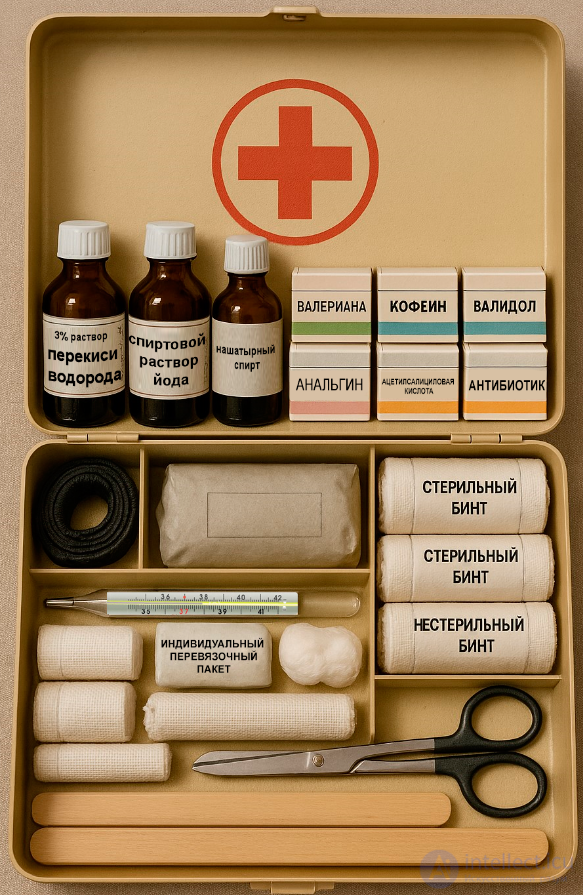
Contents of a first-aid kit:
1 - 3% hydrogen peroxide solution,
2 - iodine alcohol solution,
3 - ammonia solution,
4 - painkillers: analgin, amidopyrine,
5 - agents that improve the function of the cardiovascular system:
valerian tincture, caffeine, validol, nitroglycerin, cordiamin, papazol,
6 - antipyretic agents: acetylsalicylic acid, phenacetin,
7 - antimicrobial agents: sulfonamides, antibiotics,
8 - haemostatic tourniquet,
9 - thermometer,
10 - individual dressing packet,
11 - sterile and non-sterile bandages,
12 - cotton wool,
13 - splints,
14 - blunt-tipped scissors.
If an accident happens at home, before the ambulance arrives, help can be given by any adult familiar with the principles of first aid and having first-aid supplies at hand - a home first-aid kit.
In emergency situations, when there are several casualties, the question arises: who should be given first aid first?
To resolve this question, there is a method called medical triage.
Medical triage is the process of determining the priority of providing aid to patients depending on the severity of their condition. Medical
triage can determine the order and priority of providing emergency aid and the transportation of the casualty.
Many countries use a mixed system of treatment-and-evacuation provision, which combines the principles of treatment "on the spot" and evacuation "to the appropriate facility".
Types of medical triage:
- in-facility medical triage
- evacuation-transport medical triage
Tasks of in-facility triage:
- determine the number of casualties requiring medical aid;
- determine the order of priority for providing medical aid;
- determine the functional unit where the medical aid should be provided;
Tasks of evacuation-transport triage:
- determine those requiring medical evacuation to the next stage;
- determine the type of transport vehicles to be used for the medical evacuation of casualties;
- determine the position of casualties during evacuation;
- determine the destination point of the transport carrying the casualties (evacuation destination).
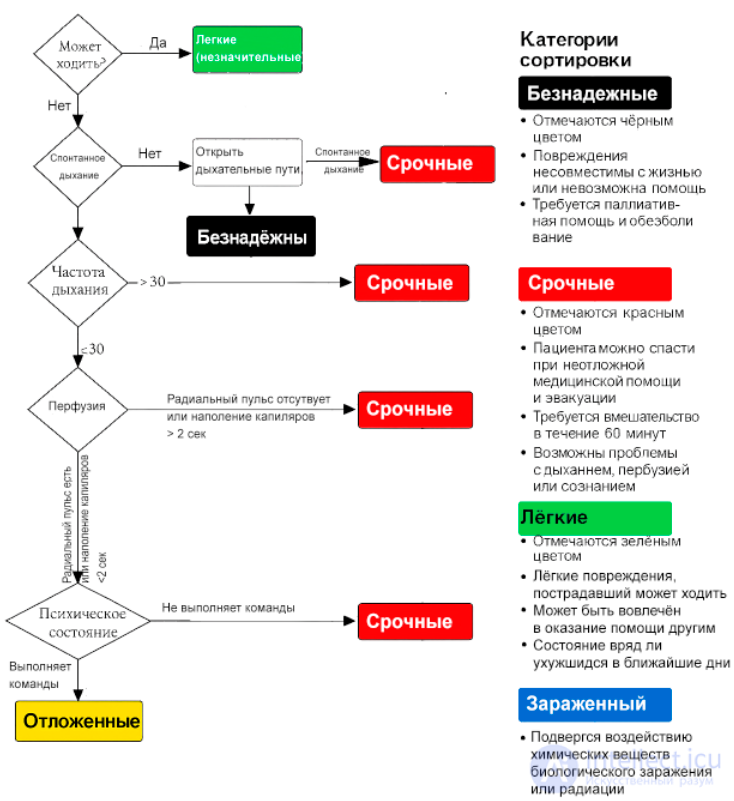
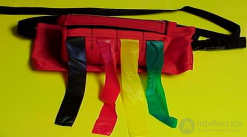
If, at the scene of an incident in an emergency situation, the number of casualties exceeds 15 people, then providing aid in such cases involves primary triage of casualties using tape of a particular colour, which denotes the following categories of persons:
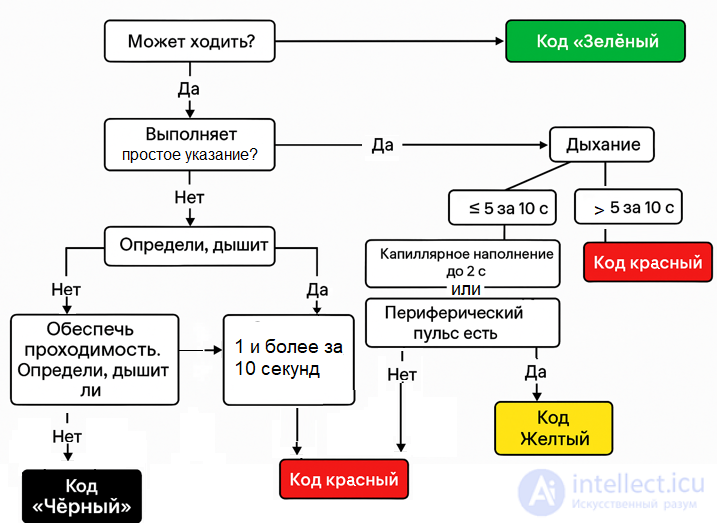
In 1983, experts of the Fire Department of the city of Newport Beach in California, in cooperation with doctors of the local hospital, developed the triage algorithm START (Simple Triage and Rapid Treatment), which would in future become the most widespread method of primary medical triage, intended for use by emergency and fire services in cases of large-scale technogenic, natural and other disasters. According to the START algorithm, rescuers who are the first to arrive at the scene of an emergency incident first identify the group of walking wounded from the other casualties. To this end, they instruct everyone able to move independently to move away from the other casualties and gather at a designated place, where such casualties are marked with the colour green. These casualties have received either minor injuries or no injuries at all, and aid is provided to them only after aid has been provided to more severely injured casualties.
1. What underlies medical triage?
2. What does a blue tape mean when triaging casualties?
3. In the final stages of the course of incurable diseases, patients are provided with:
4. In which regulatory legal document is it stipulated as one of the duties of a police officer to provide urgent, in particular pre-medical and medical, aid to persons injured as a result of offences, accidents, as well as to persons found in a helpless state or a state dangerous to their life or health?
5. A branch of medicine representing a special system of scientific research and knowledge and a distinctive form of practical activity, aimed at developing the strategy and tactics of providing emergency medical aid to a large number of casualties in emergency situations amid an acute shortage of medical personnel and resources of the healthcare system:

Comments