
Lecture
Objective: to give students knowledge of the basic means of skin protection (MSP) and individual medical protective equipment (IMPE), their purpose, design, and rules of use; to convince students of the effectiveness of measures for protecting the population from peacetime and wartime emergency situations and of the need to take part in them.
The previous lecture examined individual respiratory protective equipment and looked in detail at the design and use of the GP-5 and GP-7 civilian filtering gas masks.
However, radioactive substances, chemical warfare agents, and bacterial agents can penetrate the human body not only through the respiratory organs but also through the skin. Therefore, in the event of a threat of radiation, chemical, or bacteriological contamination, or in accidents and natural disasters involving the release of hazardous chemical substances, it is necessary to protect not only the airways but also the whole body and skin. Skin protective equipment (SPE) is intended for this purpose.
Skin protective equipment includes:
Skin protective equipment includes: special clothing, which supplements or replaces a person's ordinary clothing and footwear, made from special materials (rubberized fabrics, coarse woollen cloth, tarpaulin, polyethylene, and other moisture- and dust-proof materials) and providing protection of the skin from chemical warfare agents (CWA), radioactive dust (RD), biological agents (BA), and hazardous chemical substances (HCS).
Special (the L-1 light protective suit, the emergency isolating suit), intended for emergency-rescue units;
Improvised : used by the population.
Standard-issue equipment reliably protects the skin from gases, vapours, aerosols, and droplets of CWA, HCS, RS, and BA, fully protects against α-particles, and attenuates β-radiation and thermal radiation.
Improvised SPE, which includes ordinary clothing and footwear, is used when standard-issue equipment is not available.
By principle of use, SPE is divided into equipment for constant wear (the combined-arms set of protective equipment and impregnated uniform), equipment for periodic wear, including single-use and reusable equipment (the light protective suit, the combined-arms protective kit, the chemical kit, and others).
The classification of SPE by principle of protective action is based on the type of material (impregnation) from which the item of SPE is made. According to this principle, all SPE is divided into filtering and isolating types. Filtering SPE is intended to protect against harmful substances in the vapour (gas) phase. The main purpose of isolating SPE is to protect the skin from harmful substances in the liquid phase (aerosols, droplets).
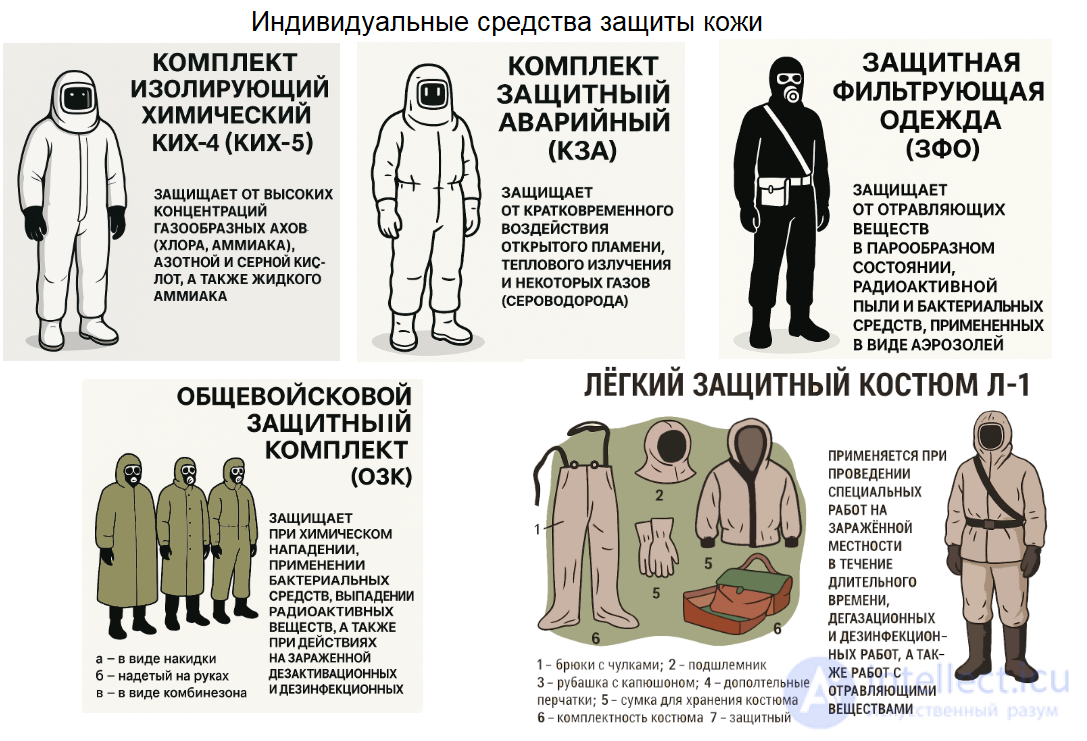
Filtering SPE
Filtering SPE is made from air- and vapour-permeable fabrics and nonwoven materials. This makes it possible to wear it continuously for extended periods without significantly affecting the wearer's ergonomic comfort. Some types of filtering SPE are intended to be worn continuously for months at a time during a period when the enemy threatens to use weapons of mass destruction. They are used together with gas masks or self-contained breathing apparatus, boots, and gloves.
Filtering-type SPE is intended mainly for non-militarized Civil Defence units of industrial facilities.
Filtering protective clothing kit (FPC).
The FPC is intended to protect against vapours and aerosols of hazardous chemical substances, chemical warfare agents, biological agents, and radioactive dust. The FPC kit includes: an impregnated filtering protective coverall made of moleskin, a cotton balaclava, two pairs of cotton foot wraps (one of which is impregnated), as well as rubber gloves and protective rubber boots.
Special equipment. Isolating SPE.
Isolating SPE is made from air-impermeable rubberized fabrics or polymer materials and is used when carrying out degassing, decontamination, and disinfection work in affected areas and contaminated zones, i.e. in cases where a person encounters high levels of contamination. It is used only to protect the personnel of non-militarized Civil Defence units of economic facilities.
Isolating-type SPE, depending on how it is worn and the manner of putting it on (as a cape or as a coverall), may be gas-tight or non-gas-tight. Gas-tight equipment protects against vapours (gases), aerosols, and droplets of hazardous chemical substances (CWA). Non-gas-tight equipment protects only against aerosols and droplets.
Isolating SPE affects the body's heat exchange. At high temperatures and under heavy physical work, the body overheats significantly, which can lead to heat stroke. For this reason, the use of isolating SPE is limited in time. It may be worn again only after 30 minutes of rest.
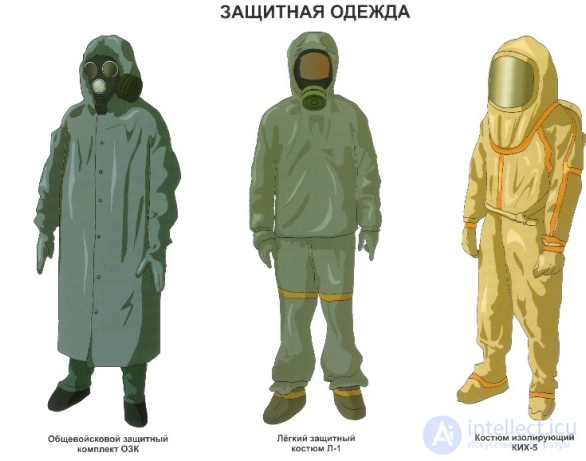
The Civil Defence system of economic facilities makes use of isolating SPE that is also issued to units and subunits of the Armed Forces of the Russian Federation. These include the OZK combined-arms protective kit and the L-1 light protective suit. At present, production has been organized of modern isolating SPE to equip the structures of the Unified State System for Prevention and Elimination of Emergency Situations (RSChS), including the Civil Defence of economic facilities. These include isolating protective suits of the KZIM, LG-5, KIKh, and other types.
Combined-arms protective kit (OZK)
The OZK is intended to protect a person's skin, uniform, equipment, and individual weapon from CWA, BA, RS, and hazardous chemical substances. When put on in advance, the OZK increases the level of skin protection against incendiary mixtures and open flame, and also reduces the destructive effect of thermal factors on items of equipment worn underneath it. The OZK is periodic-wear protective equipment. When contaminated with CWA, BA, or RS, the OZK is subjected to special treatment and reused.
The OZK consists of:
♦ the OP-1 protective cape;
♦ protective stockings made of rubberized fabric;
♦ rubber protective gloves with obturators made of impregnated fabric, five-fingered summer gloves and two-fingered winter mittens. All gloves are of a single size.
The protective cape is made of special fabric and can be used as a cape, put on with sleeves, or as a coverall.
As a cape, it is used for protection against RS falling from a contaminated cloud, liquid-droplet hazardous chemical substances (CWA), and BA. When the OZK is used to eliminate the consequences of an accident on ground contaminated with RS and BA, and also when carrying out work on decontaminating equipment, transport, and process machinery, the cape is put on with sleeves. In actions in areas, affected zones, and sections contaminated with hazardous chemical substances (CWA), and in cases of heavy dust formation in areas contaminated with RS and BA, the kit is used as a coverall.
Capes are made in four heights: the first - for people up to 166 cm tall; the second - from 166 to 172; the third - from 172 to 178; the fourth - from 178 cm and above.
The soles of the protective stockings are reinforced with a tarpaulin or rubber welt. They are put on over ordinary footwear. Protective stockings are made in three sizes: the first - for shoe sizes 37-40, the second - for 41-42, the third - for size 43 and above.
The light protective suit (L-1) protects not only against CWA, BA, and RD, but also against many hazardous chemical substances. It is a special protective item and is used during prolonged work on contaminated ground, as well as when carrying out degassing, decontamination, emergency-rescue, and other urgent work. It is made of rubberized fabric. The L-1 suit is periodic-wear protective equipment. When contaminated with CWA, RS, or BA, the L-1 suit is subjected to special treatment and reused.
The suit includes:
The L-1 suit is made in three sizes: the first - for people up to 165 cm tall, the second - from 166 to 172 cm, the third - above 172 cm.
IPP-8(11) — an individual anti-chemical packet for decontaminating liquid-droplet CWA that has landed on exposed skin and clothing.
It contains a bottle of degassing solution and four cotton-gauze swabs. When degassing, make sure the liquid does not get into the eyes, because it is poisonous. The affected area is, as a rule, treated twice.
In the event of a sudden enemy use of CWA, it is necessary to:
Getting the solution into the eyes is not permitted.
Improvised means of skin protection — these are items of clothing and footwear that anyone might have.
To protect the population, ordinary work clothing may be used as improvised SPE - jackets and trousers, coveralls, and hooded gowns, most often sewn from coarse woollen cloth, tarpaulin, fireproof, or rubberized fabric. It not only protects the skin from radioactive substances and bacterial agents but also, for some time, keeps out liquid-droplet CWA. Clothing made of tarpaulin protects against chemical warfare agents (in winter — for up to 1 hour, in summer — for up to 30 min.). Among everyday clothing items, the most suitable for skin protection are raincoats and capes made of rubberized fabric or fabric coated with a polyvinyl chloride film, and winter items — coats made of coarse fabric or heavy woollen cloth, quilted jackets, and the like. Against liquid-droplet CWA - a coat of woollen cloth or heavy cloth together with other clothing protects: in winter — for up to 1 hour; in summer — for up to 20 min.; a quilted jacket — for up to 2 hours. Rubber boots, high boots, or galoshes are needed to protect the feet: they keep out liquid-droplet CWA for up to 3-6 hours. Rubber or leather mittens should be put on the hands.
Clothing should be fastened on all buttons, hooks, or snaps, the collar raised, and a scarf or kerchief tied around the neck over it; the sleeves should be tied around the wrists with tapes; the trousers should be pulled out over the boots (high boots) and tied at the bottom. To improve the airtightness of the clothing, special flaps are used to close the openings of jackets or coats at the chest, and gussets are sewn in at the openings on the sleeves and trousers. A hood can be sewn from dense fabric or synthetic film to protect the neck and head.
At home, in the event of a threat of exposure to radioactive substances, chemical warfare agents, or bacterial agents, everyone should be able to adapt improvised means - work, sports, and everyday clothing and footwear - for skin protection. Here is how this can be done.
To increase the protective properties of clothing against CWA vapours, it must be impregnated with a special solution. To impregnate one set of clothing, it is enough to dissolve 250-300 g of shredded laundry soap in 2 l of hot water and add 0.5 l of vegetable or mineral oil, after which the solution is heated. After impregnation, the clothing is lightly wrung out and dried in the open air.
If the protective properties of the suit prove insufficient, raincoats and capes made of waterproof material are put on over it. Such clothing protects the skin from RS and BA, and it protects against liquid-droplet CWA for about 10 minutes in summer. For protection of the feet and hands - mittens, gloves, rubber boots, galoshes, felt boots, and others.
1. Read the following text carefully: «…this protective clothing kit consists of a protective cape, protective stockings, and protective gloves». What protective clothing is being described:
2. Among everyday clothing items, the most suitable for skin protection are:
3. Individual skin protective equipment is used to protect:
4. The main components of the simplest individual skin protective equipment:
|
Question |
1 |
2 |
3 |
4 |
5 |
|
Correct answer |
c |
a |
a |
a |
b |
1.Name the composition and purpose of skin protective equipment.
2.What is the most reliable means of skin protection?
3. Name the individual protective equipment that can be used at home in the event of radioactive contamination of the area.

Comments