
Lecture
Objective: to build students' knowledge of the design and purpose of the individual dressing packet, the individual first-aid kit (AI-2), and the individual anti-chemical packet (IPP-8, IPP-9, IPP-10).
Mass injury of people can arise as a result of natural disasters (earthquakes, hurricanes, floods) or technogenic catastrophes accompanied by the destruction of vessels containing hazardous chemical substances (AHOV), or in accidents at nuclear power plants, in the use of modern weapons, or as a result of a terrorist act.
In this case, the population may be affected simultaneously by various damaging factors (traumatic injury, radiation injury, chemical injury, or combinations of these).
When a mass casualty incident occurs, it is impossible to provide first aid to all casualties simultaneously. Therefore, in such a situation, the population itself must be able to provide it.
First aid in the mass injury of people is a set of the simplest measures carried out at the site of injury by the casualty themselves (self-aid) or by another person. First aid is provided using standard or improvised means, with the aim of eliminating the life-threatening consequences of the injury and preventing dangerous complications.
First aid at sites of mass casualties may include carrying out the following measures:
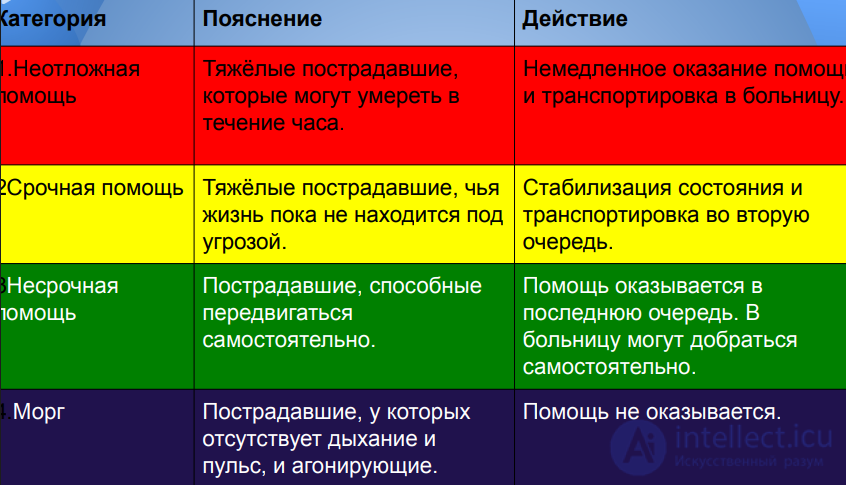
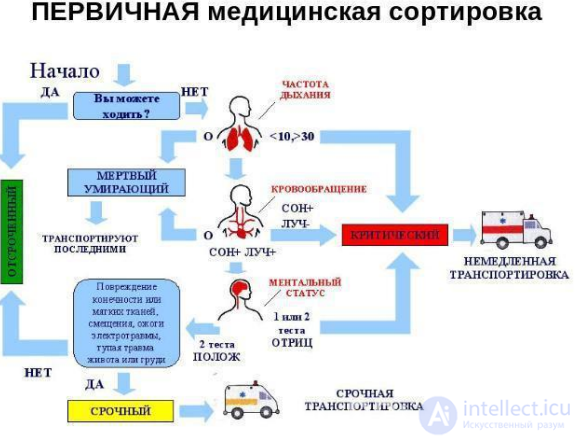
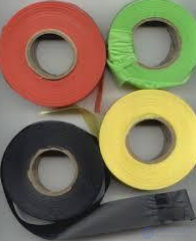
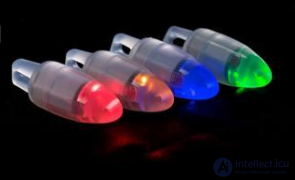
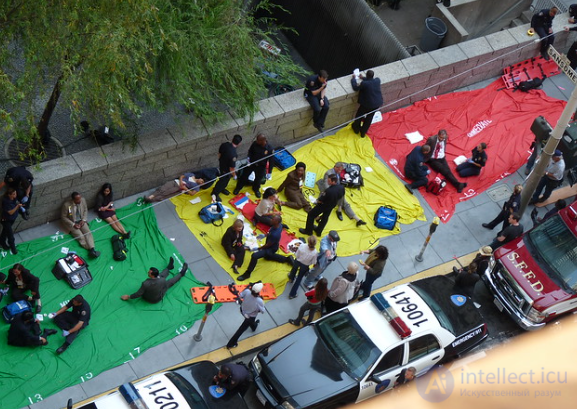
Upon completion of the assessment, casualties are marked with the colour of one of four triage categories,
in the form of a special coloured tag and a coloured flashlight (during the hours of darkness), or simply a coloured ribbon.
Medical personal protective equipment includes: the individual dressing packet, the individual first-aid kit (AI-2), and the individual anti-chemical packet (IPP-8, IPP-9, IPP-10).
The individual dressing packet is used to apply primary dressings to wounds. It consists of a bandage (10 cm wide and 7 m long) and two cotton-gauze pads. One of the pads is sewn fixedly near the end of the bandage, while the other can be moved along the bandage. The pads and bandage are usually wrapped in waxed paper and placed in a sealed cover made of rubberised fabric, cellophane or parchment paper. The packet contains a safety pin. The rules for using the packet are indicated on the cover.
When using the packet, it is taken in the left hand, the right hand grips the notched edge of the outer cover, the seal is torn off with a jerk, and the packet in its waxed paper with the safety pin is removed. The safety pin is taken from the fold of the paper wrapper and temporarily pinned in a visible place on the clothing. The paper wrapper is carefully unfolded, the end of the bandage to which the cotton-gauze pad is sewn is taken in the left hand, and the rolled bandage — in the right hand, and it is unrolled. This releases the second pad, which can be moved along the bandage. The bandage is stretched by moving the hands apart, causing the pads to straighten out.
One side of the pad is stitched with red thread. If necessary, the person providing aid may touch only this side with their hands. The pads are placed on the wound with the other, unstitched side. For small wounds, the pads are placed one on top of the other, while for extensive wounds or burns — side by side. In the case of through-and-through wounds, one pad closes the entry wound and the second — the exit wound, for which the pads are spread apart to the required distance. They are then bound in place with circular turns of the bandage, the end of which is secured with the safety pin.
The outer cover of the packet, the inner surface of which is sterile, is used to apply airtight (occlusive) dressings, for example, in the case of a penetrating chest wound.
The packet is stored in a special pocket of the gas-mask bag or in a clothing pocket.
Instructions for opening and using it are attached to each packet.
The AI-2 individual first-aid kit is intended for providing self-aid and mutual aid in the case of wounds and burns (for pain relief), for preventing or reducing injury from radioactive substances, poisonous substances or highly toxic substances (SDYAV), and also for preventing infectious diseases.
The kit contains a set of medical items distributed among compartments in a plastic box. The box measures 90x100x20 mm and weighs 130 g. The size and shape of the box allow it to be carried in a pocket and kept on hand at all times.
In cold weather the kit is carried in an inner pocket of clothing to prevent the liquid medicinal product from freezing. The kit's compartments hold the following medical items:
Compartment No. 1 — a pain-relief agent (promedol) contained in a syringe-tube. It is used for bone fractures, extensive wounds and burns, by injection into the soft tissue of the thigh or arm. In emergencies the injection can be given even through clothing.
Compartment No. 2 — an agent for preventing poisoning by organophosphorus chemical warfare agents (CWA) — an antidote (tarene), 6 tablets of 0.3 g. It is contained in a red round case with four semi-oval projections on the body. Under threat of poisoning the antidote is taken first, and then the gas mask is put on. If signs of poisoning appear and increase (deterioration of vision, onset of severe shortness of breath), one more tablet should be taken. A repeat dose is recommended no sooner than 5-6 hours later.
Compartment No. 3 — antibacterial agent No. 2 (sulfadimethoxine), 15 tablets of 0.2 g. It is contained in a large round case without colouring. The agent should be used for gastrointestinal disorders occurring after radiation injury. On the first day 7 tablets are taken (in one dose), and on each of the following two days — 4 tablets. This drug is a means of preventing infectious diseases that may arise from the weakening of the protective properties of an irradiated organism.
Compartment No. 4— radioprotective agent No. 1 (cystamine), 12 tablets of 0.2 g. It is contained in two pink octagonal cases. It is taken for personal prophylaxis under threat of radiation injury, 6 tablets at once, preferably 30—60 minutes before exposure. A repeat dose of 6 tablets is permitted after 4-5 hours if remaining in territory contaminated with radioactive substances.
Compartment No. 5 — antibacterial agent No. 1 — a broad-spectrum antibiotic (chlortetracycline hydrochloride), 10 tablets of 1,000,000 units. It is contained in two four-sided cases without colouring. It is taken as a means of emergency prophylaxis under threat of contamination by bacteriological agents or upon contamination by them, as well as for wounds and burns (to prevent infection). First the contents of one case are taken — 5 tablets at once, and then, after 6 hours, the contents of the other case are taken — also 5 tablets.
Compartment No. 6 — radioprotective agent No. 2 (potassium iodide), 10 tablets. It is contained in a white four-sided case with longitudinal semi-oval notches in the walls of the sides. The drug should be taken, one tablet daily, for 10 days after an accident at a nuclear power plant and in the event a person consumes fresh milk from cows grazing on ground contaminated with radioactive substances. The drug prevents deposition of radioactive iodine, which enters the body with milk, in the thyroid gland.
Compartment No. 7 — an antiemetic agent (etaperazine), 5 tablets of 0.004 g. It is contained in a light-blue round case with six longitudinal raised ribs. It is taken, 1 tablet, for head injuries, concussions and contusions, and also immediately after radioactive exposure to prevent vomiting.
Individual anti-chemical packet (IPP-8, IPP-9, IPP-10). is intended for decontaminating droplet-liquid chemical warfare agents and certain hazardous chemical substances that have gotten onto a person's body and clothing, onto personal protective equipment and onto tools.
IPP-8: consists of a flat glass bottle with a capacity of 125-135 ml, filled with a decontaminating solution, and cotton-gauze swabs. The whole packet is contained in a cellophane bag.
To use it, open the packet's shell, remove the bottle and the swabs, unscrew the bottle's cap and soak a swab liberally with its contents. Carefully wipe the moistened swab over the open areas of skin suspected of contamination and the hood (mask) of the gas mask. Moisten the swab again and use it to wipe the edges of the collar and cuffs that touch the skin. Treatment with the liquid may cause a burning sensation of the skin, which quickly passes and does not affect well-being or ability to work.
It must be remembered that the liquid in the packet is toxic and dangerous to the eyes. Therefore the skin around the eyes should be wiped with a dry swab and rinsed with clean water or a 2% soda solution.
IPP-9: — a cylindrical metal vessel with a screw-on lid. When using the packet, the lid is placed onto its base. To moisten the sponge (used here instead of the cotton-gauze swabs), the piercer used to open the vessel must be pushed in as far as it will go, and the packet turned over and shaken 2-3 times. Use the moistened sponge to wipe the skin of the face, hands, and contaminated areas of clothing. Then pull the piercer back out of the vessel as far as it will go and screw the lid back on. The packet can be used for repeat treatment.
IPP-10: - is a cylindrical metal vessel with an attachment-lid with stops, fastened on a strap. Inside the lid there is a piercer. To use the packet, the lid must be turned to move it off the stops and, by striking it, the vessel (under the lid) is opened. Remove the lid and, through the resulting opening, pour 10-15 ml of liquid onto the palm and treat the face and the front of the neck. Then pour another 10-15 ml of liquid and treat the hands and the back of the neck. Close the packet with the lid and keep it for repeat treatment.
Knowledge check:
Answer the questions:
1. List the components and purpose of the individual dressing packet, the individual first-aid kit (AI-2), and the individual anti-chemical packet (IPP-8, IPP-9, IPP-10).
2. In what cases are the items of the individual first-aid kit used, and what are the rules for taking them?
3. How are the items of AI-2 taken for the prophylaxis of radiation injuries?
4. What causes can lead to mass casualties among people?

Comments