
Lecture
Objective: to develop students' knowledge of the types of natural emergency situations, their consequences, and the rules of safe behaviour.
In recent decades there has been an increase in the number of hazardous natural phenomena, natural disasters, and epidemics.
Natural disasters now occur about 5 times more often than 30 years ago
The economic damage caused by natural disasters has increased 8-fold.
Every year on Earth there occur: about 10 thousand floods.
Every year, natural disasters in various regions of the country and industrial accidents in municipal power and utility systems cause large-scale destruction, loss of life, and heavy losses of material assets. Regardless of the causes of a disaster, the following criteria are used to characterise its consequences:
A person and their life are constantly linked to nature, and sometimes nature mercilessly kills them; no war, no uprising has ever claimed as many victims as natural disasters and catastrophes do, since it is precisely for these that people are usually least prepared.
A catastrophe is a situation representing a sudden, serious and unforeseen threat to the health of society.
A natural disaster, in the broad sense, is understood to mean destructive natural phenomena as a result of which a threat to the life and health of people arises or may arise, and destruction or loss of material assets and elements of the surrounding natural environment occurs.
An emergency situation is an unfavourable state of affairs in a given territory, arising as a result of a hazardous natural phenomenon, catastrophe, natural disaster or other calamity, which may entail loss of human life, harm to people's health, material losses and disruption of the population's living conditions.
As a result of natural disasters, the population has a particular need for medical care and other forms of assistance.
Natural disasters on our planet are quite frequent phenomena. According to UN data, over the last 20 years more than three million people have died from natural disasters alone. Almost one billion inhabitants of our planet have experienced the effects of natural disasters during this period. Every year, about two hundred natural emergency situations occur in the country, entailing great moral and material damage.
Natural disasters, fires, accidents ... They can be met in different ways. In confusion, even resignedly, as people have met various calamities for centuries, or calmly, with unshakeable faith in their own strength, hoping to tame them. But only those who, knowing how to act in a given situation, make the one correct decision can confidently meet the challenge of a disaster: they will save themselves, help others, and prevent, as far as they can, the destructive action of the elemental forces.
Having armed themselves with knowledge of personal safety, in order to work out how to behave during catastrophes and natural disasters, a person must first of all, without panicking, understand all the finer points of how to actually survive.
Classification of natural disasters.
So, let us begin studying such a tedious subject as the classification of natural disasters.
At first glance this is not so complicated; one need only picture the general components that make up our nature. Well, let's say there are two main parameters: the first is climatic, and the second is seismic, and as a result of the rampage of one or the other component of nature, all natural disasters can be classified.
By place of occurrence, natural phenomena are divided into:
The most destructive of these are earthquakes, floods, mass forest and peat fires, mudflows and landslides, hurricanes, tornadoes, snow drifts, and icing.
Hazardous natural phenomena of cosmic origin.
The Earth is a cosmic body, a tiny particle of the Universe. Other cosmic bodies can have a strong influence on life on Earth.
Everyone has seen «shooting stars» appear and fade in the night sky. These are meteors — small celestial bodies. We observe a brief flash of incandescent glowing gas in the atmosphere at an altitude of 70—125 km. It occurs when a meteor enters the atmosphere at high speed.
If, during their passage through the atmosphere, the solid particles of a meteor do not manage to fully break up and burn away, their remnants fall to Earth. These are meteorites.
There are also larger celestial bodies that planet Earth may encounter. These are comets and asteroids.
Comets — are bodies of the Solar System that move rapidly across the starry sky, travelling along highly elongated orbits. As they approach the Sun they begin to glow, and develop a «head» and a «tail». The central part of the «head» is called the nucleus. The diameter of the nucleus can range from 0.5 to 20 km. The nucleus is an icy body of frozen gases and dust particles. The «tail» of a comet consists of gas molecules and dust particles that have escaped from the nucleus under the action of the sun's rays. The length of the «tail» can reach tens of millions of kilometres.
Asteroids — are minor planets whose diameter ranges from 1 to 1000 km.
At present, about 300 cosmic bodies are known that may cross Earth's orbit. In total, according to astronomers' estimates, there are approximately 300 thousand asteroids and comets in space. An encounter of our planet with large celestial bodies poses a serious threat to the entire biosphere.
Algorithm of actions in the event of a natural disaster or catastrophe:
Prevention of emergency situations - is a set of measures carried out in advance and aimed at reducing, as far as possible, the risk of emergency situations occurring, as well as at preserving people's health and reducing the extent of damage to the surrounding natural environment and material damage in the event they do occur.
1. The home should have the telephone numbers of emergency services (police, ambulance, fire service, the civil defence and emergency situations authority, etc.), which can be contacted in emergencies.
2. It is important to be able to make the simplest means of personal protection yourself and to seal off a room from the external environment (for example, if a fire breaks out in your home, to isolate yourself from the open source of the fire you should first of all cover the door bordering the fire with a wet, thick blanket and take shelter in the bathroom, also under a wet blanket, which will, as far as possible, block toxic smoke from entering your body).
3. Do not panic.
4. In case of evacuation, prepare a minimum set of essential items (documents, footwear, clothing, food, etc.)
5. If there is a threat that houses may be destroyed, find the safest place in the house, one where there is a good chance of surviving (door frames, window frames, etc.).
Algorithm of actions in an emergency situation(briefly).
2. Obtaining information.
3. Knowledge of warning signals.
4. Seeking help.
5. Making the simplest means of protection and rescue.
6. Actions for self-rescue.
7. Providing assistance to those around you.
Principles of organising medical care during catastrophes.
The basis of the discipline of " Medicine in Catastrophes and Natural Disasters " is a unified understanding of the pathological process forming in the body during trauma, unified views on treatment tactics, and the timeliness, continuity and sequence of medical measures at various stages of evacuation.
During catastrophes and natural disasters, assistance is provided by the emergency medical service (EMS), which includes the following organisations:
The volume of medical care provided is determined, above all, by two fundamental factors:
Overall, all losses in catastrophes are divided into:
Medical Irrecoverable
- The wounded and injured - The dead
The work of EMS teams in the affected area includes the main stages:
Medical triage is understood as the identification of homogeneous groups of casualties, and their evacuation and transportation to medical facilities
In accordance with the rules of medical triage, it is possible to distinguish
4 main groups of casualties:
Group IV (about 20% of casualties) - severely injured casualties. These patients are given assistance on the spot, since transportation, given the severity of their condition, may lead to the patient's death (multiple injuries to organs and body tissues, shock, disturbances of cardiac and respiratory function, up to and including their cessation, etc.).
Emergency situations of geological origin.
Earthquakes.
Hazardous geological natural phenomena include earthquakes, volcanic eruptions, landslides, rockfalls and snow avalanches.
Earthquakes – are seismic phenomena arising from sudden shifts and ruptures in the Earth's crust or in the upper part of the mantle, transmitted over great distances as sharp vibrations that lead to the destruction of buildings and structures, fires and human casualties. Earthquakes with an intensity greater than 7 points, or above 5 on the 12-point Richter scale, are destructive. Earthquakes are the most terrible of natural disasters. Up to 1,500 earthquakes occur on Earth every year, up to three hundred of which are destructive in nature. In recent decades the most destructive earthquakes occurred in 1988 in Armenia (25,000 people died); in 1995 in Japan (6,336 people died); in 1995 the town of Neftegorsk was completely destroyed (of 3,000 people, 2,000 died).
Characteristics of earthquake strength
|
Magnitude on the Richter scale |
Earthquake characteristics |
Typical signs |
|
2.0 and below |
imperceptible, very weak |
1 point - detected only by seismic instruments; 2 points - felt by individual people who are completely at rest |
|
3.0 |
weak |
weak vibration, like that from a lorry passing nearby |
|
4.0 |
moderate |
general shaking of buildings, movement of furniture, cracking of plaster and window glass. Outdoors the tremors are felt by a large number of people; indoors, those who were asleep wake up |
|
5.0 |
strong |
felt by everyone. Pictures fall off walls, heavy furniture shifts, pieces of plaster fall off. Cracks appear in the walls of stone houses; anti-seismic and wooden houses are not damaged |
|
6.0 |
destructive |
furniture is overturned, buildings suffer significant damage, cracks appear on slopes and on wet ground |
|
7.0 |
devastating, ruinous |
serious damage and destruction of stone houses, old wooden houses become skewed. Cracks in the ground up to 1 m wide, landslides and rockfalls on slopes, destruction of stone structures. |
|
8.0 |
catastrophic |
wide cracks in the ground, numerous rockfalls, landslides, change of river courses, formation of jams on rivers and lakes, complete destruction of structures and buildings. |
Signs of an approaching earthquake may include:
- sparking of closely spaced (but not touching) electrical wires;
- 5-6 hours before an earthquake, animals and birds begin to show signs of restlessness.
During an earthquake it is forbidden to:
-use the lift;
- light matches.
Upon feeling tremors, it is necessary to:
- quickly leave the building;
The consequences of earthquakes are extremely dangerous and diverse. They cause various geological phenomena, tsunamis and mudflows, panic, injury and loss of life, damage and destruction of buildings, fires, releases of harmful substances, transport accidents, failure of life-support systems, and also:
The main causes of casualties during an earthquake:
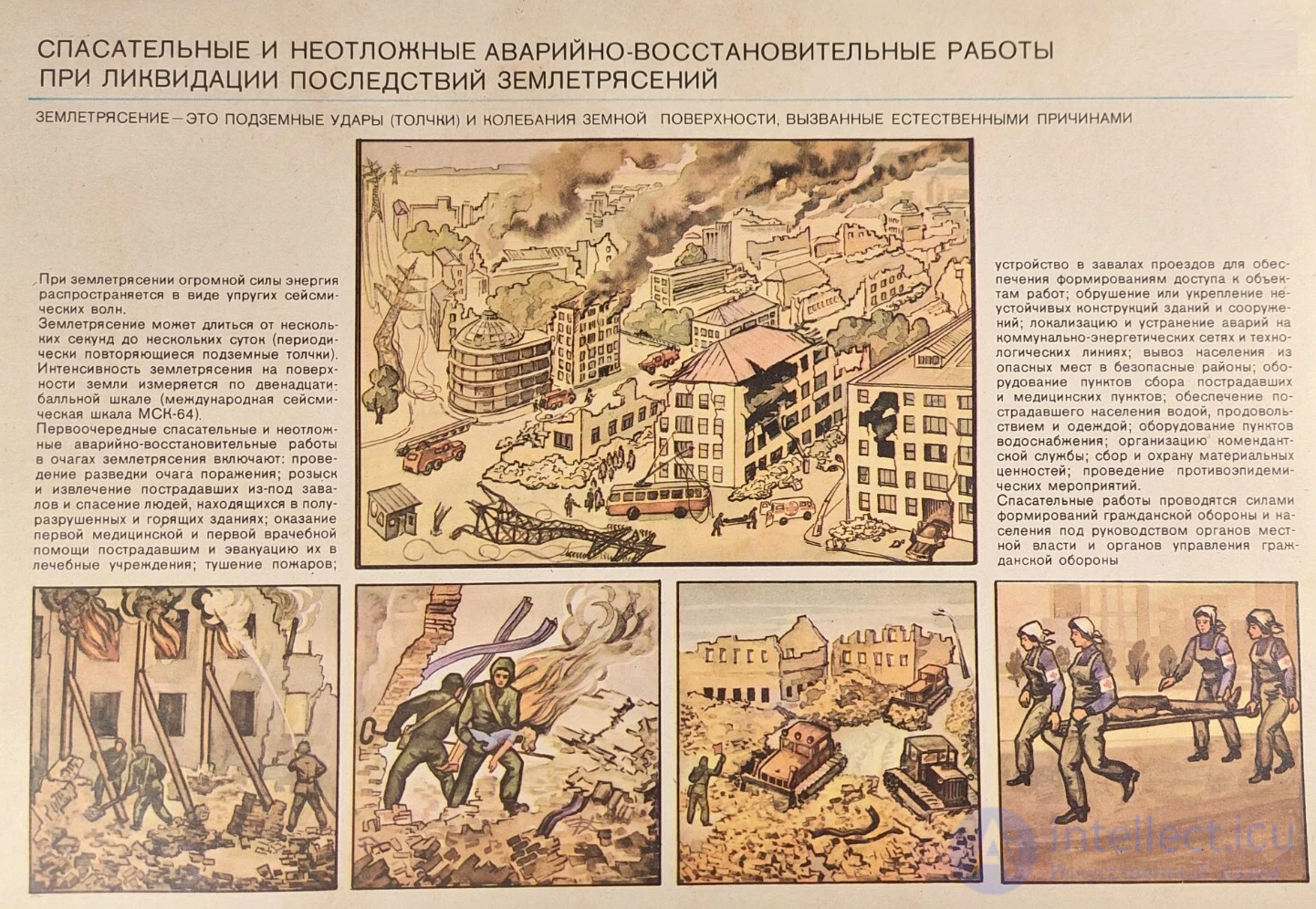
Actions of the population during an earthquake.
In a sudden earthquake the main thing is not to give in to panic and to protect yourself from debris, glass, and heavy objects. From the first tremors (crockery rattling, objects falling, whitewash crumbling) to the subsequent ones, from which the building will begin to collapse, there are 15-20 seconds. It is during this period that a sensible course of action must be chosen: either to try to leave the building, or to take up the optimally safe place inside it.
If, during a strong earthquake, a decision is made to leave the building, a route of movement must be planned in advance (allowing for the 15-20 seconds) before the strongest vibrations and tremors. During evacuation, crowding and jams must not be created in doorways, and one must not jump out of windows. When leaving, it is forbidden to use the lift. Having run out of the building, one should move away from it to open ground. When circumstances do not allow leaving the building, one must, while remaining in it, take shelter in a pre-chosen, relatively safe place. If there is a danger of falling pieces of plaster, light fittings, or glass, one should hide under a table.
With the start of an earthquake, fire must be extinguished; matches, candles and lighters must not be used during or immediately after underground tremors.
At enterprises, institutions and organisations, measures to reduce the danger during an earthquake and to protect personnel in case one occurs must be developed and adopted in advance.
In the buildings and premises of enterprises and institutions, corridors, passageways, stairwells and internal doors should be cleared of obstruction by unnecessary objects. Massive cabinets and shelving units should be securely fastened to the walls. Heavy objects should not be placed on upper shelves. Every employee is required to know the location of electrical switches, and fire and gas valves.
After an earthquake it is necessary to make sure there is no injury, examine the people around you and, if necessary, provide them with assistance, and also to free casualties trapped under easily removable debris. It is forbidden to move seriously injured people, unless they are in danger (fire, collapse of a structure, etc.)
Upon entering a building, it is essential to check the water supply, gas, and electricity. If there is damage to an electric line, switch it off. A gas leak can only be detected by smell, and if one is present, all windows and doors should be opened, the premises left immediately, and the incident reported to the relevant services.
If water-supply networks are damaged, fix the fault or shut off the water supply. Water may only be drunk after boiling and if kept in a closed vessel. If there are sources of fire, they must be extinguished. If this cannot be done, the fire service must be contacted.
One must not approach or enter clearly damaged buildings. One must be prepared for strong repeated tremors. Such tremors occur days, weeks and even months later. The first few hours after an earthquake are the most dangerous. In view of this, for at least the first 2-3 hours, entering a building without extreme necessity is forbidden.
It is unacceptable to pass on any invented information, forecasts, guesses, or rumours about possible tremors. Only official reports on the matter should be used. To obtain information about the situation, one should switch on the radio broadcast (radio receiver) and obey the instructions of local authorities and the headquarters for eliminating the consequences of the natural disaster.
Subsidence of the Earth's surface – is the sinking of ground as a result of various kinds of geological processes. The formation of karst subsidence is promoted by the drainage of territories. In some regions of Ukraine, the degree of damage from karst processes reaches 60 – 100% of the territory.
Karst is a process of dissolution or leaching of fractured soluble rocks by underground and surface waters, as a result of which negative landforms are formed on the surface of the Earth, along with various cavities, channels and caves at depth.
Karst develops under the combined action of surface and underground waters. The dissolution of rock is often accompanied by mechanical erosion. In this process, erosion may be prepared for by the dissolution of the bonds between grains of the rock, which frees them from cohesion and facilitates washing away.
Areas of open karst are especially dangerous, since cracks form in the ground into which structures, buildings and vehicles fall.
Activation of karst quite often causes the sudden appearance of ground-surface collapses (the towns of Kramatorsk, Slavyansk, Novy Kargofen) or causes gradual subsidence of the ground surface (the settlement of Stupki, the station of Kudryavka, the town of Slavyansk, Novy Kargofen, etc.).
Karst often causes the destruction of public-utility and residential facilities and can be the cause of serious catastrophes.
Besides the territories mentioned, karst processes are noted within the extent of the “karst strata” and in areas adjoining the coast of the Sea of Azov.
A characteristic feature of the region is that the activation of karst formation and its manifestations are caused predominantly by man-made factors (gypsum extraction – Artemovsk, Kramatorsk; salt extraction – Slavyansk, Artemovsk; extraction of flux-dolomite raw material), as well as losses from water-supply and sewerage networks, storage reservoirs, and tailings ponds, which change the chemical composition of groundwater, a rise in the temperature of the natural rock mass, especially beneath large industrial facilities, and subsidence and destruction above underground workings.
Rockfalls – are the detachment and catastrophic fall of large masses of rock, their fragmentation and rolling down from cliffs, gorges and slopes. Rockfalls of natural origin are observed in mountains, on sea coasts, and on the escarpments of river valleys. Their occurrence is promoted by the geological structure of the terrain and the presence of cracks and zones of fragmented rock on the slopes. But most often, in up to 80% of cases, modern rockfalls arise from improperly conducted construction work and mining operations.
Scree – is an accumulation of rubble or soil at the foot of slopes. Scree is most characteristic of high-mountain areas with a harsh climate, which promotes the process of physical weathering of rock.
A characteristic feature of scree is its mobility. By degree of mobility it is divided into active, subsiding and stable.
Active scree is devoid of all vegetation. The mass of fragments keeps growing and is in a loose, highly unstable state, and is set in motion by an increase in total weight, heavy moistening, undercutting of the lower part of the scree slope by roads, by earthquakes and even by smaller tremors arising from the operation of machinery or the movement of transport.
Subsiding scree is characterised by the development of vegetation. Stable scree is completely covered with turf, overgrown with shrubs and even forest.
Abrasion – is the process of destruction of the shores of seas, rivers and reservoirs by surf waves. This leads to the destruction of shore structures and a reduction in land area. Abrasion is one of the determining factors in the activation of shoreline shift along the coast of the Sea of Azov.
The intensity of abrasion is primarily determined by the mean and long-term variability of storms and sea level, which in turn determines the rate of shore destruction, as well as by the resistance of coastal rock to erosion. The extent of abrasive shores reaches 40% of the total length of the coastline. The rate of abrasion here is 0.1-1.2 m/yr. The width of the beach has a significant influence on the extent of abrasion (beaches up to 5 m wide practically do not protect the shore; at a width of 5-7 m the rate decreases from 10 to 15 m/yr, and at 15 m abrasion practically stops, except during periods of severe storms.
The increase in the rate of abrasion in recent years is linked to intensive economic activity (regulation of water flow, irrational development of beaches, disruption of the natural regime of sediment migration).
Waterlogging - is a rise in the level of underground groundwater, leading to disruption of economic activity in a given territory and to changes in the structure and functions of natural biogeocenoses. Waterlogging often occurs with improper irrigation, as well as with wasteful water use, and leads to the swamping of land, alkalisation, soil salinisation, and a reduction in the strength of soils.
Emergency situations of meteorological and hydrological origin.
Floods.
Hazardous natural phenomena of a hydrological nature include floods, tsunamis and mudflows.
Hydrological natural phenomena are connected with the constant circulation of water in nature and interact closely with the Earth's air envelope and with land.
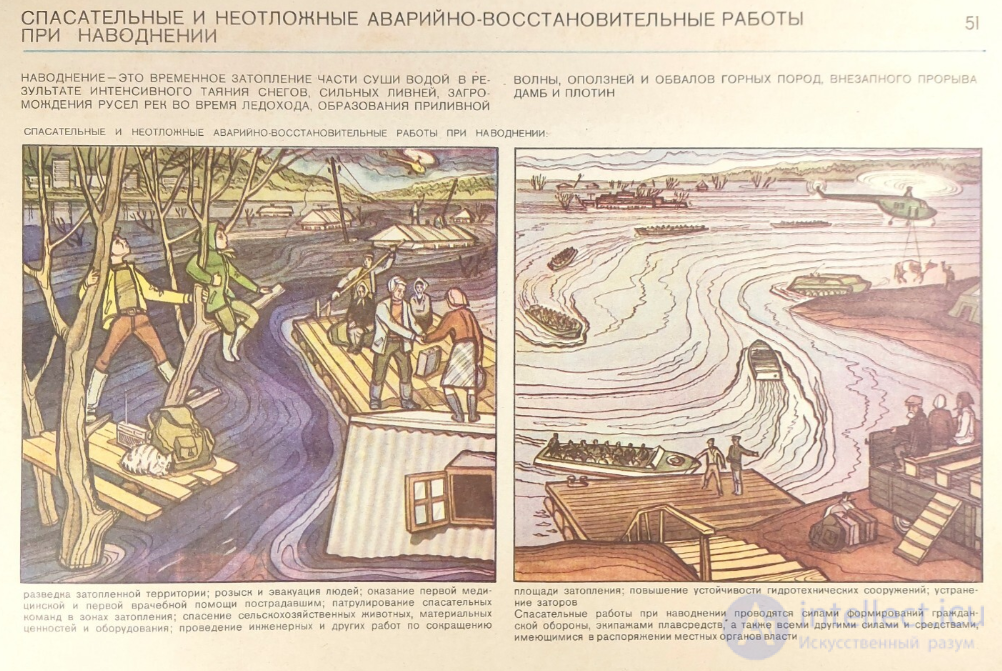
ACTIONS OF THE POPULATION DURING FLOODS
A large part of the territory of our country is subject to flooding for various reasons. Floods create a threat to the lives of people and animals, buildings, structures and municipal power lines are destroyed, equipment is damaged, and crops and material assets are lost. Especially dangerous are
floods arising from the sudden bursting of dams and dykes, landslides and
rockfalls, and storm-surge floods.
Such floods, since they cannot be foreseen in advance, practically rule out the timely implementation of protective measures and often take on a catastrophic
character.
To reduce or eliminate the consequences of a flood's impact, great
importance attaches to timely forecasting and warning of the population.
Unlike earthquakes, floods can be forecast with much greater
accuracy. Thus, floods caused by spring, summer and autumn snowmelt and rains
can be forecast a month or more in advance, while storm-surge floods can be forecast several hours
or a day ahead.
The actions of the population during floods are carried out with regard to the flood's lead
time.
When there is a significant lead time before a flood, measures are carried out in advance
to reinforce existing hydraulic engineering structures and build new ones, to protect bridges, dams and dykes, to clear riverbeds of ice and jams, to prepare for and carry out the advance evacuation of the population and farm animals, and to protect and remove material assets from areas of possible flooding. The population is informed of the start and procedure of evacuation via local radio broadcasting networks and local television by the administration of enterprises, institutions,
and educational establishments, through housing-maintenance offices and building management authorities.
The population is informed of the locations of assembly evacuation points, the deadlines for reporting to these
points, the evacuation routes by transport and on foot, and the expected scale
of the flood and its lead time.
When protective measures against flooding are carried out in advance, the population is evacuated from dangerous areas together with its property. In this case each
family is provided with a motor vehicle or other means of transport, with the time of its arrival specified. Evacuation is carried out to the nearest settlements not subject to
flooding. The evacuated population is housed in public buildings or in the living
space of local residents. In zones of possible flooding, the operation of
schools and pre-school childcare institutions is temporarily suspended; children are transferred to schools and childcare institutions located in safe places. At enterprises and institutions, when threatened by flooding, a special mode of operation is introduced, and,
where necessary, operations are halted, with all available floating craft placed on standby;
measures are also carried out to protect material assets and equipment that cannot be removed, in place.
In rural areas, in addition to evacuating people, measures are carried out for the transfer,
relocation and maintenance of farm animals outside the flood zones, and for the removal
of grain and fodder, the evacuation of agricultural machinery, and the protection of material assets.
The population is warned of a sudden flood by means of technical warning
devices (radio, telephone, telegraph, mobile loudspeaker units).
In the event of a sudden rise in water level, one should quickly leave flats located on the ground floors and go up to the upper floors; if the house is single-storey,
go up into the attic or onto the roof.
To save themselves and their loved ones during a catastrophic rise in water, every person
must be able to use whatever floating objects are available.
logs, floats, inner tubes, inflatable mattresses, etc.
One should keep documents and necessary belongings on one's person.
Work should be stopped by order of the administration and, observing the established procedure, elevated places should be occupied. For the evacuation of workers and employees:
if necessary, all publicly and privately owned floating craft should be used — motor ships, barges, launches, boats, ferries, boats, etc. Evacuation is carried out in an organised manner, in the order established by the administration.
If you are outside a populated area, then in the event of sudden flooding you should
occupy the nearest elevated place, climb a tree, or use
various kinds of floating objects.
Searching for casualties in the flooded area, and rescuing people (taking them off the roofs of buildings
and, if necessary, structures and other elevated places) and delivering them to safe places is carried out immediately using all available floating craft, as well as helicopters,
Floating craft must be equipped with a sufficient quantity of rescue equipment (life rings, life jackets, ropes, boat-hooks) and fittings for boarding and disembarking people.
People caught in a flood must show composure and self-control, and strictly comply with all requirements of the commandant's service and the commanders and seniors of the watercraft. Rescue equipment must not be overloaded, as this endangers people's safety. Children, the disabled,
women and elderly citizens are given priority to board floating craft.
Having ended up in the water, one should remove one's outer clothing and footwear, look nearby for
floating objects or objects rising above the water and use them until
help arrives.
In rescue operations, in addition to special services, military units and formations,
civil defence formations, the entire population that has found itself in the flood zone and adjacent
settlements is obliged to take part.
Hail – is atmospheric precipitation in the form of irregularly shaped ice particles, ranging in size from 5 to 55 mm, and sometimes larger. Hail causes great harm to agriculture, destroying crops, as well as to commercial vegetable growing, breaking the glass of greenhouses.
Meteorological temperature-related emergency situations (for example, an emergency situation associated with very severe frost (air temperature minus 30°C and below), with very intense heat (air temperature 35 ° C and above), etc.).
Intense heat – is the persistence of a high temperature, above 30˚C, over a long period of time. Such temperatures have a negative effect on people's health, especially those with cardiovascular diseases. Intense heat can result in drought, which occurs at high temperature and low humidity as a consequence of prolonged absence of precipitation. Droughts lead to stunted growth, and sometimes to the death, of agricultural and other plants.
Frosts – are a short-term drop in air or ground-surface temperature to below-zero values at night and in the morning, with above-zero temperature values during the rest of the day. Frosts, especially in spring, cause great harm to agriculture.
Other meteorological emergency situations (for example, those associated with strong wind (speed of 25 m/s or more), including squalls and tornadoes; with a severe dust storm (at a wind speed of 15 m/s or more, lasting 12 hours or more); with severe icing (a layer of ice on trees and power-line wires 20 mm or more in diameter), etc.).
Ice glaze – is a layer of ice on the surface of the ground or on objects, formed after the freezing of raindrops or drizzle. Ice glaze most often occurs at an air temperature slightly below 0˚C. The duration of severe ice glaze can be around 12 hours, and sometimes up to 2 days
A flood – is the temporary inundation of land as a result of a rise in water above the normal level.
Floods kill people and farm and wild animals, destroy or damage buildings, structures and communications, cause the loss of other material and cultural assets, interrupt economic activity, destroy harvests, wash away or submerge fertile soils, alter the landscape, and complicate the sanitary-epidemiological situation.
Floods can arise suddenly and last from several hours to 2-3 weeks. If you are located in an area that suffers from floods, study and remember the boundaries of possible flooding, as well as elevated places rarely subject to flooding, located in the immediate vicinity of your place of residence, and the shortest routes to reach them.
Causes:
When there is a threat of flooding, it is necessary to:
-constantly listen to information about the situation and the procedure for action;
-move food, valuables, clothing and footwear to upper floors;
-evacuate the population from dangerous areas;
- take with you a bag with documents and money, a medical kit, and a three-day supply of food;
- drive livestock to elevated places.
During the flood:
After the water has receded, one should beware of torn and hanging electrical wires. Food and drinking-water supplies that have been in contact with water must be checked by representatives of the sanitary inspectorate before use, and any wells with water must be drained by pumping. Before entering a house (or building) after a flood, one should make sure that its structures have not suffered obvious damage and do not pose a danger. When inspecting interior rooms it is not advisable to use matches or lamps as a light source because of the possible presence of gas in the air; battery-powered torches should be used for this purpose. Until specialists have checked the condition of the electrical wiring, it is forbidden to use sources of electricity for lighting or other needs.
Landslides. Mudflows.
A landslide – is the sliding displacement of masses of rock along a slope under the influence of gravity. They occur on all slopes. The causes of a landslide are most often undermining of the slope, its excessive saturation by heavy precipitation, earthquakes, or human activity (blasting work, etc.). The volume of ground in a landslide can reach tens and hundreds of thousands of cubic metres, and in individual cases even more. The speed of landslide displacement ranges from several metres per year to several metres per second.
Safety measures:
A mudflow – is a turbulent flow of mud or mud and rock, consisting of a mixture of water and rock debris, that arises suddenly in mountain river basins. A mudflow is born after prolonged, heavy rains, intensive melting of snow or glaciers, the bursting of reservoirs, earthquakes and volcanic eruptions. It arises suddenly, moves at high speed (up to 10 m/sec or more) and most often passes in several waves over a period ranging from tens of minutes to several hours. The steep leading front of a mudflow wave can reach a height of 15 m or more. The rumble and roar of a moving mudflow can be heard from great distances.
When people, buildings and other structures find themselves on the surface of a moving landslide section, it is necessary to leave the premises, move upward where possible and, acting according to the situation, beware of the boulders, rocks, structural debris, earth banks and scree sliding down from the rear part of the landslide as it slows. The frontal zone of a landslide may be crumpled and heaved up when it stops, and may also absorb stationary rock masses. When a landslide moving at high speed comes to a halt, a strong jolt is possible, which poses a great danger to the people on it.
Safety measures:
A rise in the groundwater level – is a negative phenomenon that leads to the flooding of extensive territories. The development of this process depends on a number of causes and factors: water losses from water-bearing utilities, unorganised drainage of surface water, hydraulic engineering construction, construction of irrigation systems, delayed introduction of drainage structures and systems, etc. A rise in the groundwater level leads to contamination of groundwater, increased humidity and deterioration of the sanitary condition of the territory, salinisation and waterlogging of soils, waterlogging of green plantings, reduced yields of agricultural land, deformation of buildings and structures, and the occurrence of landslides and rockfalls
Hurricanes. Cyclones. Typhoons. Storms. Tornadoes. Gales.
The movement of air masses and their interaction are linked to the appearance of dangerous meteorological phenomena that can cause natural disasters. These are typhoons and hurricanes, gales, snowstorms, tornadoes, thunderstorms, droughts, severe frosts and fogs.
Wind speed during a hurricane is 30-40 m/s, during a storm – 20-30 m/s, during a gale – 15-30 m/s, during a typhoon – more than 50 m/s. Cyclones and typhoons are accompanied by torrential rain.
A tornado – is a vortex motion of air at enormous speed, sometimes exceeding the speed of sound, having the appearance of a dark column with a diameter ranging from several tens to several hundreds of metres. It exists only briefly, moving together with the cloud. A tornado, on making contact with the surface of the earth, often causes destruction of the same degree as strong hurricane winds, but over considerably smaller areas. This destruction is caused by the action of rapidly rotating air and a sharp upward surge of air masses. As a result, some objects (cars, light buildings, the roofs of buildings, people and animals) can be torn from the ground and carried hundreds of metres. Tornadoes are very dangerous to people. Their consequences can include not only injuries and concussions but also death. Because large numbers of small objects are drawn into the air, indirect injuries to people are also observed.
Hurricane-force wind destroys sturdy structures and sweeps away light ones, devastates fields, tears down wires, uproots trees, sinks ships, damages vehicles, damages municipal and utility networks, oil and gas pipelines, which can lead to large-scale fires, global environmental disasters and numerous human casualties.
A hurricane - is a large atmospheric vortex with wind speeds of up to 120 km/h, and up to 200 km/h in the surface layer.
Hurricane-force wind damages sturdy structures and sweeps away light ones, tears down power and communication lines, devastates fields, breaks and uproots trees. People caught in the hurricane zone are injured as a result of being thrown through the air, struck and crushed by flying objects and collapsing structures. As a hurricane passes over the ocean, it forms powerful clouds that are a source of catastrophic downpours, which in turn cause floods, mudflows and landslides.
A gale - is a prolonged, very strong wind with a speed of more than 20 m/s. It is usually observed as a cyclone passes and is accompanied by heavy seas and destruction on land.
Gales (storms), because the wind speeds characteristic of them are considerably lower than those of hurricanes, lead to far less destructive consequences. However, if they are accompanied by the transport of sand (sandstorms), dust (dust storms) or snow (blizzards), significant damage to agriculture, transport and other sectors is possible, as well as loss of life.
Strong winds at low temperatures promote the occurrence of dangerous meteorological phenomena such as glaze ice, rime and ice crust. The result of their occurrence is the failure of overhead power and communication lines, the contact networks of electrified transport, antenna masts and other similar structures.
The main signs of the onset of hurricanes, gales and tornadoes are: an increase in wind speed and a sharp drop in atmospheric pressure; torrential rain and storm surge; violent snowfall and ground dust.
The strength of a hurricane-force wind is assessed in points on the Beaufort scale:
|
Point |
Wind speed, m/sec |
Wind description |
Effects of the wind |
|
0 |
0 – 0,5 |
calm |
complete absence of wind, smoke rises vertically from chimneys |
|
1 |
0,6 – 1,7 |
light air |
smoke from chimneys rises at an angle |
|
2 |
1,8 – 3,3 |
light breeze |
wind is felt on the face, leaves rustle |
|
3 |
3,4 – 5,2 |
gentle breeze |
leaves rustle, small branches sway, light flags flutter |
|
4 |
5,3 – 7,4 |
moderate breeze |
tree branches sway, wind raises dust and paper |
|
5 |
7,5 – 9,8 |
fresh breeze |
large tree branches sway, waves appear on water |
|
6 |
9,9 – 12,4 |
strong breeze |
large tree branches sway, telephone wires hum |
|
7 |
12,5 – 15,2 |
near gale |
small tree trunks sway, waves rise at sea and begin to foam |
|
8 |
15,3 – 18,2 |
gale |
tree branches break, it is hard to walk against the wind |
|
9 |
18,3 – 21,5 |
strong gale |
minor damage to buildings, slate and tiles are torn off |
|
10 |
21, - 25,1 |
storm |
considerable damage to buildings, trees are uprooted |
|
11 |
25,2 – 29,0 |
violent storm |
widespread destruction |
|
12 |
More than 29,0 |
hurricane |
devastating consequences |
On receiving a storm warning, you must:
On receiving information about the imminent approach of a hurricane or a strong gale, people take up previously prepared places in buildings or shelters, and in the case of a tornado - only in underground structures. While in a building, one should beware of injury from window-glass fragments. In strong gusts of wind, move away from windows and take a place in wall niches, doorways, or stand close against a wall, and also make use of built-in cupboards, other furniture and mattresses.
If forced to remain outdoors, protection from flying debris and glass fragments can be provided by sheets of plywood, cardboard and plastic boxes, boards and other materials at hand. It is advisable to move as far away from buildings as possible and take shelter in ravines, pits, ditches or roadside drainage channels; one should lie down in them and press close to the ground. Such actions considerably reduce the number of injuries caused by the throwing action of hurricanes and gales, and also provide full protection from flying fragments of glass, slate, tiles, brick and other objects. It is not advisable to remain on bridges, pipelines, or in the immediate vicinity of facilities holding hazardous chemical substances and flammable materials.
When hurricanes and gales are accompanied by a thunderstorm, situations in which the probability of injury by electric discharge increases should be avoided. For this reason one must not take shelter under solitary trees, posts or masts, or approach close to power-line supports.
A hurricane, gale or tornado can arise suddenly. And not everyone knows how to behave at such a time.
After a hurricane, gale or tornado has ended, observe precautionary measures. Do not approach or touch downed wires. Beware of fallen trees, swinging shutters, signs and banners. When returning home, light your way with electric torches, since a gas leak is possible during a natural disaster, and the use of open flame can cause an explosion. For this reason the premises must be aired immediately and the gas valve shut off. Electrical appliances may be switched off only after they have been dried and the premises aired.
Snowdrifts. Blizzards. Hurricanes.
Heavy snowfalls and blizzards – the deposition of large quantities of snow over a short time, resulting in snowdrifts that often take on the character of a natural disaster. Traffic on roads and railways is halted, the normal life of populated areas is disrupted, power and communication lines become coated in ice, which leads to their breaking. Snowdrifts are, as a rule, forecast quite reliably and in good time.
On receiving a warning of a gale and snowdrifts, you must:
After a snowstorm:
Fires.
A fire – is an uncontrolled process of combustion entailing loss of life and destruction of property. Fires arise spontaneously (10%) and through human fault (up to 90%).
Causes of fires:
The destructive action of fires is characterised by the combustion temperature and the speed of fire spread. By nature, forest fires are: ground, underground and crown fires. In ground fires the flame moves at a speed of 0.11 km/h through the surface litter layer only, crown fires – 3-10 km/h, engulfing tree crowns, ground (peat) fires arise within a mass of combustible material (peat, shale, lignite). Peat's ability to self-ignite and burn without access to air, and even under water, poses a great danger. Above burning peat bogs… "columnar vortices" of hot ash and burning dust form, which in strong wind are carried great distances and cause new outbreaks of fire or burns to people and animals.
A steppe fire occurs in the dry season when grasses and cereal crops ripen. The speed of such a fire is 20-30 km/h.
Necessary measures in the event of a fire:
moving along streams, brooks, or through water;
Prevention of forest and peat fires.
Important measures for preventing fires during this dangerous period are a complete ban on lighting campfires, cutting off access to the forest, and also suspending work in the areas of forestry plots, forest districts and forestry enterprises.
During periods of high fire danger, depending on road conditions, checkpoints staffed by forest guard workers and public auto-inspectors are set up at entrances to the forest; they warn drivers and citizens about the rules of conduct in the forest.
During the fire-danger season it is forbidden in the forest:
- to throw down lit matches or cigarette butts, or to shake hot ash out of campfire sites;
- to use flammable materials as wadding when hunting;
- to leave in the forest (except in specially designated places) wiping materials soaked in oil, petrol, kerosene or other combustible substances;
- to refuel the tanks of running internal-combustion engines, to bring equipment with a faulty fuel supply system into operation, or to smoke or use an open… near vehicles being refuelled;
- leaving bottles or glass on a sunlit forest clearing;
- burning off grass or stubble in fields;
- lighting campfires.
Persons found guilty of violating fire-safety rules, regardless of the nature of the violations and their consequences, bear disciplinary, administrative or criminal liability.
Involving the population in fighting forest fires.
When forest and peat fires occur, the local population is involved in extinguishing them, with the exception of persons under 18 years of age, pregnant women and breastfeeding mothers. Before work begins, citizens must be given a detailed briefing on safety rules and the existing procedure for extinguishing forest fires. People assigned to work directly on the fire edge are supplied with protective clothing, helmets, smoke masks and self-contained breathing apparatus. Where visibility in a smoke zone is less than 10 metres, entry into it is prohibited, as this poses a danger. Before work begins, all firefighting participants should be briefed on shelter locations, the routes leading to them, and the sound signals warning of danger.
Each group of the population taking part in firefighting operations is assigned a guide who knows the terrain well, and an observer is also designated to monitor the direction of fire spread and falling trees. If there is a threat of people being surrounded by fire, the guide is obliged to lead them to a safe place.
Extinguishing underground fires requires special caution. The edge of such a fire is not always visible, and one can fall into a burnt-out pit or burning peat. To avoid accidents, one should move across a peat field only in groups. The person leading the group must constantly probe the peat ground ahead with a pole in the direction of travel. Serious dangers include: an unexpected breakthrough of fire from the seat of the fire in the underground layers of peat; sharp changes in wind direction; and an increase in the rate of peat combustion.
It is forbidden to make camp for the night within a zone of an active fire. Rest and overnight sites must be located no closer than 400 m from the contained part of the fire and must be surrounded by mineralised strips at least 2 m wide.
The flame of small ground fires can be beaten out with branches of broad-leaved trees, doused with water, smothered with damp soil, or stamped out underfoot. Peat fires are extinguished by digging up the burning peat and dousing it with water. When extinguishing a fire, act with caution, do not move far from roads and firebreaks, do not lose sight of other participants, and maintain visual and audible contact with them. When extinguishing a peat fire, bear in mind that deep pits can form in the combustion zone, so movement should be careful, having first checked the depth of the burnt-out layer.
Residents of a district where forest or peat fires have broken out are informed of the fact of their occurrence, the direction of their spread and the danger of their spreading to residential areas and other facilities.
If there is a threat of a fire front approaching a populated area or individual houses, measures must be taken to prevent structures from catching fire. For this purpose, firebreaks between the forest and the boundaries of development are widened by felling trees and shrubs, wide mineralised strips are laid out around settlements and individual buildings, and stocks of water and sand are created. If there is a threat of heavy smoke, the population is issued gas masks with hopcalite cartridges. At the same time, property is prepared for evacuation or stored in safe places, and livestock is moved out of the danger zone.
If there is a threat to the life of the population, evacuation of populated areas to safe places is organised.
Mass infectious diseases among people, farm
animals and plants, and human actions when they occur.
The mass spread of infectious diseases among people, farm animals or plants can lead to the emergence of emergency situations.
Infectious diseases are characterised by the intensity of their development and spread (the epidemic process).
Especially dangerous infections.
- cholera;
- plague;
- tularaemia;
-anthrax;
-smallpox;
-yellow fever;
-typhus and typhoid fever;
-botulism;
-Ebola haemorrhagic fever;
- SARS.
Epidemics – are the rapid and widespread spread of infectious diseases among people. These include: Asiatic cholera, smallpox, anthrax, typhoid fever, typhus, influenza, AIDS and others.
Epizootics – are the spread of diseases among animals such as: anthrax, glanders, foot-and-mouth disease, tularaemia, African swine fever and others. Some animal diseases are also dangerous to people.
Epiphytotics – are plant diseases, among which the most widespread are: rust of cereal crops, rice blast, potato blight and a whole series of other diseases.
Mass spread of pests – causes great harm to agriculture. The main ones include: locusts, the Colorado beetle, the Siberian silk moth, cutworm moths, termites and others.
8.Why is the number of victims always high in catastrophes and natural disasters?
9.Describe the main groups of casualties according to the rules of medical triage?
10. Give a definition of a hurricane, a gale, a tornado, an earthquake, a flood.
11.Actions of the population in the event of the sudden onset of a hurricane, a gale, a tornado, an earthquake, a flood.

Comments