
Lecture
Objective: to build students' knowledge on this topic, to build students' understanding of the characteristics of the anthropogenic factor in environmental pollution, its main sources and negative consequences; to form students' ecological culture, and to contribute to forming an emotionally valuable attitude towards their own health and the health of people in general;
Health is the summit that a person must climb alone."
I. Brekhman
The French philosopher and writer Michel de Montaigne wrote: "Health is capital given to a person by nature from the outset, and once lost it is hard to get back."
How do you understand the phrase "healthy lifestyle"? (observing the rules for preserving and strengthening health is called a healthy lifestyle)
A person has a right to health. This right is closely linked to their responsibility. In many countries, responsibility for one's own health is encouraged by the state (bonuses, premiums, extra leave for those who do not get sick, do not smoke, engage in sport, etc.). A conscious and responsible attitude towards one's own health should become the norm of life and behaviour for each of us.
A person is themselves a source of danger to their own health if they do not follow a healthy lifestyle and create hazardous factors for their own health.
Environmental pollution is a complex process linked to the everyday activity of human beings
Indeed, humanity is guilty of many present-day problems that negatively affect people's health. Negative environmental factors created in the course of human activity are called anthropogenic.
In modern life, the likelihood of dangerous situations arising is increasing, and consequently the risk factor for human life and health is increasing. In more than 80% of cases, the human factor is the cause of the tragic consequences of various dangerous and emergency situations and of loss of life.
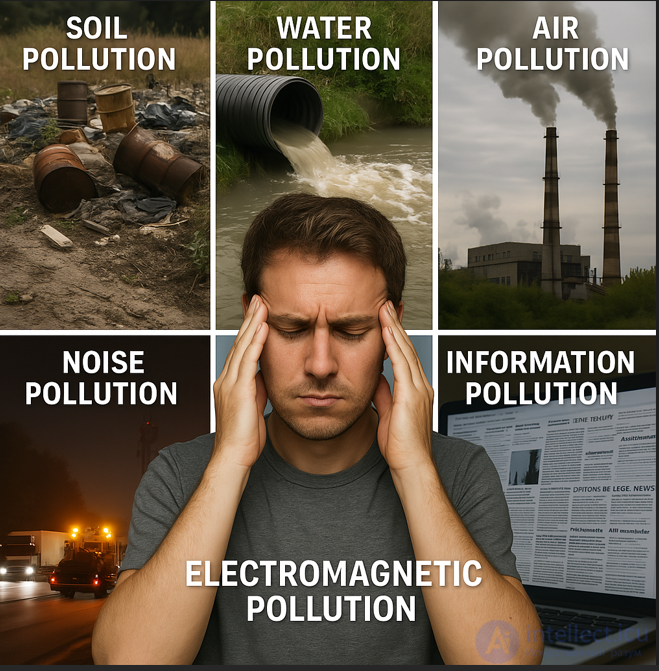
The impact of humans on the environment is becoming increasingly noticeable, and this impact has intensified particularly sharply under the conditions of the modern scientific and technological revolution. All natural components of the environment - air, soil, water - have been altered to varying degrees. The development of humanity has led to the emergence of new anthropogenic factors, such as noise pollution and electromagnetic pollution. The consequences caused by anthropogenic factors significantly affect the health of humanity. In the course of group work, your task is to determine what the sources of environmental pollution are and what consequences this type of pollution carries for humanity.
| Name of the anthropogenic factor | Sources of pollution | Main consequences of pollution |
|---|---|---|
| Soil pollution | Agriculture (fertilisers, pesticides), industrial waste, unauthorised dumps | Decline in fertility, accumulation of toxins in the food chain, degradation of ecosystems |
| Water pollution | Wastewater, industrial discharges, oil and chemical spills, dumps near bodies of water | Death of aquatic organisms, poisoning of drinking water, spread of disease |
| Air pollution | Transport emissions, industrial emissions, fuel combustion | Respiratory diseases, the greenhouse effect, acid rain |
| Noise pollution | Transport, construction, loud music, industrial enterprises | Stress, insomnia, hearing impairment, disruption of animal behaviour |
| Electromagnetic pollution | Power lines, mobile network base stations and wireless devices, household appliances, radio transmitters | Potential effects on human health, disorientation of animals (for example, birds and bees) |
| Information pollution | The internet, mass media, advertising, spam, fake news | Information overload, decreased capacity for critical thinking, spread of disinformation |
The general culture of the population of our country in the field of safety largely does not correspond to the actual conditions of life, and it lags behind the rapid pace of development of civilisation. It should be understood that the concepts of "human safety" and "healthy lifestyle" are interrelated.
Ensuring the safety of each person in the course of their life activity and raising the level of their general culture in the field of safety are components of an individual system of healthy lifestyle.
Raising the level of the culture of safety involves forming vital skills, convictions and habits in the field of safety, including those directly related to a person's healthy lifestyle.
A steady increase in the general level of the culture of life safety will contribute to ensuring a person's social well-being and, consequently, a high level of their health. It can be noted that the level of the culture of life safety is becoming one of the important criteria determining the level of health of the individual and of society.
A person's ability to ensure personal safety in everyday life and in various dangerous and emergency situations is the main component of a healthy lifestyle, ensuring a person's social well-being.
Conclusion:
A.V. Yablokov wrote: "Life without danger is practically impossible, but humanity is obliged to reduce ecological risk, if it does not want to perish."
- Explain this statement.
1. What is the negative impact of the human factor on the safety of the individual, society and the state?
2. What knowledge, abilities and skills determine a person's general level of culture in the field of life safety?
3. What significance does the level of general culture in the field of life safety have for forming an individual system of healthy lifestyle?
4. What qualities should be formed in a person when they observe the norms of a healthy lifestyle?
5. Why can the level of a person's general culture in the field of life safety currently be considered one of the criteria of their level of health?

Comments