
Lecture
Objective: to form students' understanding of the causes of accidents and their types; to study the types and degrees of skin damage in electrical injuries, to form students' knowledge of workplace and household safety rules and of providing first (pre-medical) aid to victims of electrical injury.
«A person is capable of surviving in the most
difficult conditions, if they know how
to act competently and decisively».
Electrical injury. Exposure to electric current above 50 V causes a thermal and an electrolytic effect. The most common cause of electrical injury is failure to observe safety regulations when working with electrical appliances at home and in the workplace. In cases of electric shock, the following factors are significant: its strength, voltage, frequency; the moisture of the casualty's skin, clothing, and the air; the duration of contact, as well as the type of electrical loop, i.e. the path of the current through the body.
The passage of electric current through the body leads to mechanical (ruptures, tissue delamination) and thermal (burn) injuries, causes chemical changes in the tissues (ionisation, electrolysis) and other reactions. These tissue injuries are observed along the entire path of the current.
Types of electrical injuries:
A distinction is made between local and general symptoms of electrical injury.
Local symptoms include characteristic tissue changes, similar to thermal burns, arising under the influence of heat, as well as ionisation and electrolysis at the points where the current enters and exits. The entry and exit points of the current are called «current marks». At these points, yellowish-brown or whitish spots with a depression in the centre form on the skin. Sometimes these spots are firm to the touch, raised above the surface of the skin, and often look like an ordinary scab. «Current marks» are low in pain and inconspicuous.
2.Signs of electric shock:
The following possible signs of electric shock can be identified:
— the casualty is lying on or near an electrical appliance;
— a smell of burning may be present;
— pale skin colour;
— absence of a pulse in the carotid arteries;
— absence of breathing;
— «current marks» (burns at the points where the electric current entered or exited).
General symptoms depend on the effect of the electric current on the central nervous, cardiovascular and respiratory systems. In mild injuries, strong convulsive contractions of the skeletal muscles, chest pain, headache, general weakness, rapid fatigue, decreased memory, hearing, vision and smell, shortness of breath, and an increased white blood cell count are noted. These disturbances often do not develop immediately but after some time. In severe cases, in addition to the symptoms listed, casualties may experience clouding or loss of consciousness, motor agitation, retrograde amnesia, increased irritability, photophobia, a feeling of fear, impaired bowel function, slowed pulse, arrhythmia, pulmonary oedema, enlargement of the heart's borders, and the development of acute renal failure. In more severe cases, cardiac activity stops. With direct action of the electric current on the respiratory centre and respiratory muscles, respiratory arrest and suffocation are possible. It is of significant importance which organs the current passes through, which can be roughly estimated by mentally connecting the points where the current enters and exits. The passage of current through the heart or brain is particularly dangerous.
Exposure to high-voltage electric current causes deep tissue injuries and burns. They have a number of distinguishing features: deep tissue damage; absence of blisters on the skin; suppuration develops less often; healing occurs with the formation of soft scars.
The duration of a person's contact with electricity is not an unimportant factor. Thus 1 ampere with contact lasting one tenth of a second can cause skin burns. And 100 milliamperes acting on a person for 10 minutes often lead to death.
|
Current strength, mA |
Alternating current 50 — 60 Hz |
Direct current |
|
0,6 — 1,5 |
Onset of sensation - slight itching, tingling of the skin |
Not felt |
|
2 — 3 |
Sensation of the current spreads to the wrist, the hand is slightly cramped |
Not felt |
|
5 — 7 |
Pain sensations, cramps in the arms |
Itching. Sensation of warming |
|
8 — 10 |
The hands can be pulled away from the electrodes only with difficulty. Severe pain in the arms and cramps |
Increased sensation of warming |
|
20 — 25 |
The hands are paralysed instantly, it is impossible to pull them away from the electrodes. Very severe pain in the arms and chest. Breathing becomes difficult |
Even greater increase in the sensation of warming, slight contraction of the arm muscles |
|
50 — 80 |
Breathing is paralysed. Onset of ventricular flutter of the heart |
Strong sensation of warming. Contraction of the arm muscles. Cramps. Difficulty breathing |
|
90 — 100 |
Respiratory paralysis and fibrillation after 1-3 s. |
Respiratory paralysis |
5.Degrees of electrical injury:
The degree of electric shock injury is determined by three criteria:
The local effect of electricity can lead to various outcomes. From unpleasant sensations to deep burns.
General electrical injuries cause a number of disturbances of a general nature.
Depending on the strength and duration of the current's action, four degrees of electrical injury are distinguished.
6.First aid for a victim of electrical injury.
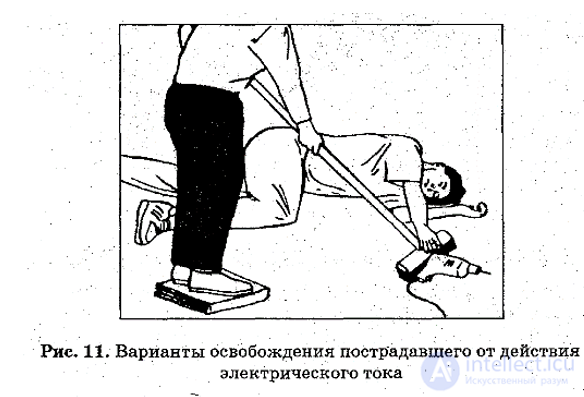
First aid for a victim of electrical injury consists in freeing them from contact with the electric current. The power source is switched off, and if this is not possible, the wire is torn or thrown off with a dry wooden stick. If the person providing aid is wearing rubber boots and rubber gloves, the casualty can be pulled away from the electric wire by hand. If there are no rubber gloves, the person providing aid should wrap their hands in some item of clothing, a dry cloth, and if possible it is advisable to put on rubber footwear or stand on a dry board. When pulling the injured person away, they should be taken not by the body but by the clothing. If the injured person is unconscious but breathing on their own, the same measures are taken as for fainting. If breathing and cardiac activity stop, artificial lung ventilation and chest compressions are performed. An aseptic dressing is applied to the electrical burn wound.
If consciousness is present, aspirin and sedatives should be given (best of all - 50-100 drops of Corvalol).
NOT PERMITTED!!!!
1. Touching the casualty without first disconnecting the power.
2. Stopping resuscitation measures before signs of biological death appear.
3. Approaching a wire lying on the ground near the casualty at a run or with large strides.
All cases of general electric shock injury must be hospitalised. This is primarily due to the risk of delayed arrhythmias occurring. They can occur even in degree I by the end of the first day. However, mandatory inpatient observation is carried out for casualties with degrees II and III. Degree I can be observed at home. It is also mandatory to go to hospital for burns of the second degree and higher and for eye injuries.
In some cases of electrical injury, so-called "apparent death" develops - a condition in which the casualty is unconscious, heart contractions are rare and difficult to detect, breathing is rare and shallow, - that is, extreme depression of the body's basic vital functions is observed.
Despite the outward resemblance, "apparent death" is not clinical death, and the observed symptoms may undergo reverse development even after a fairly long period of time. Therefore, in cases of electrical injury it is customary to provide aid (including resuscitation measures) right up until the appearance of livor mortis and rigor mortis.
Knowledge check:
Give answers to the questions:

Comments