
Lecture
Objective: To familiarise students with the aim and objectives of the subject «medical and sanitary training». To introduce them to heroism and courage in peacetime and wartime, and to the concepts of «citizenship» and «patriotism», and to form the concept of civil defence in an emergency situation.
Pre-medical (first) aid consists of urgent actions and organisational measures aimed at saving and preserving the life of a person in an emergency condition and minimising the effects of such a condition on their health, which are carried out at the scene of the incident by persons without medical education who, by virtue of their professional duties, must possess basic practical
skills for saving and preserving the life of a person in an emergency condition, and who, in accordance with the law, are obliged to perform such actions and measures.
Tactical medicine – this is the provision of medical care during military operations.
First medical (pre-medical) aid includes the following groups of measures:
1. Immediate cessation of the action of damaging factors and provision of assistance to the casualty (pulling out of water, removing from a burning room or a room filled with toxic gas, etc.).
2. Provision of medical assistance to the casualty depending on the nature and type of injury
3. Organisation of transportation of the casualty to a medical facility
If we take historical data into account, during the Vietnam War (1959 – 1975) about 2,500 soldiers died from simple limb wounds. The casualties bled to death due to a lack of intervention or an attempt to stop the bleeding, or because the intervention was performed improperly, with direct pressure on the wound or application of a tourniquet.
Retired Army Colonel Ronald F. Bellamy studied a huge amount of data collected from the battlefield and concluded that there are three causes of death from penetrating trauma that can potentially be prevented. Each of the potentially fatal consequences of penetrating trauma can be minimised by the person providing aid, if they have undergone.
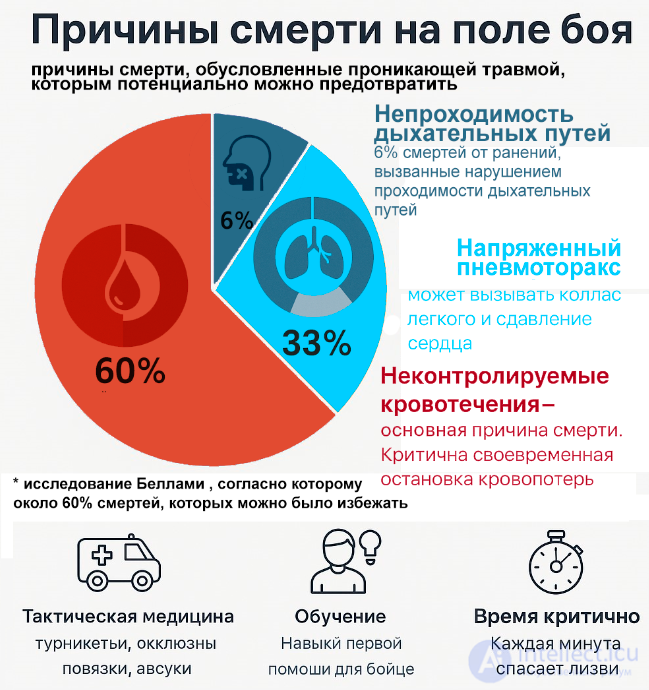
Fig. 1 Causes of death
even basic medical training. In Bellamy's study, about 60% of the deaths that could have been avoided were caused specifically by uncontrolled bleeding, 33% of deaths were caused by tension pneumothorax, and 6% of deaths from wounds were caused by airway obstruction
(fig. no. 1).
Therefore, the problem of timely provision of emergency medical care to the population affected by an emergency situation is extremely relevant. The primary task in solving this problem is to ensure the earliest possible start of medical care for casualties. Modern medical science has defined the concept of the so-called «golden hour», an astronomical hour (60 min.) from the moment of injury or damage, during which the maximum amount of medical care must be provided to the casualty in order to save their life and health
Emergency aid can be provided both by a medical professional and by people of other professions, an ordinary passer-by, a witness to the incident.
Types of emergency aid depending on who provides it:
1. First (pre-medical) aid
2. Pre-hospital (paramedic) aid
3. First medical aid;
4. Qualified medical aid.
5. Specialised medical aid
«Civil defence, as a system of nationwide measures to protect the population from dangers arising from the conduct of military operations or as a result of these operations».
Our life does not always proceed calmly…
Protection of the population and the territory of the state from emergency situations of natural and technogenic character, as well as from dangers arising from the conduct of military operations or as a result of these operations, has been and remains one of the most pressing problems.
Today it is recognised as an important element in ensuring the national security of the country, an integral part of the defence function of the state.
An important element of the mandatory training for the defence of the country is the subject «medical and sanitary training».
In the course of their studies, students must master the constitutional rights and duties of citizens regarding the defence of the Motherland, practical skills in military affairs and civil defence of the population, methods of providing first pre-hospital aid, as well as psychological stability, methods of providing first medical aid and actions in emergency situations to preserve their own health and the health of those around them.
The objective of the academic discipline: fostering patriotism, forming in them a readiness to defend the Motherland and to act in emergency situations in peacetime and wartime.
The study of the subject «medical and sanitary training» implements the following objectives:
1. Military-patriotic education of the student body.
2. Formation of moral-psychological, professional and physical readiness for the defence of the country.
3. Formation of motivation for service in the Armed Forces, military-professional orientation of students.
4. Preparing young people to protect life and health, ensuring their own safety and the safety of others in emergency situations in peacetime and wartime.
In everyday life, emergency situations arise unexpectedly: sudden cardiac arrest, fractures, loss of consciousness, massive bleeding, drowning, asphyxia, road traffic accidents, strokes, epileptic seizures, etc.
Such cases often occur in conditions where it is not possible to quickly provide qualified medical care, while a life-threatening condition can arise within a few minutes after an incident.
According to the World Health Organization (WHO), about 30% of people who die as a result of accidents could have been saved if first medical aid had been provided to them promptly and correctly. It has been calculated that, of all potentially possible causes of death, up to 90% of them can be avoided by simply applying a tourniquet for bleeding from a limb, performing cardiopulmonary resuscitation for sudden cardiac arrest, and timely treatment of pneumothorax of the airways in asphyxia.
Usually the first to arrive at the scene of an incident are patrol police officers, and it is the level of their training that determines the life of each casualty. In accordance with the Law «On the National Police», a police officer is obliged to provide emergency, including pre-medical and medical, aid to persons injured as a result of offences, accidents, as well as to persons found in a helpless condition or a condition dangerous to their life or health.
Civil defence – is a system of measures for preparing to protect and for protecting the population, material and cultural values on the territory of the country from dangers arising from the conduct of military operations or as a result of these operations, as well as in the event of emergency situations of natural and technogenic character.
Law «On Civil Defence» .
Citizens are obliged to:
Other Laws :
Resolutions :
This course of lectures sets out the main material on pre-medical training for future police officers, namely:
- legal and ethical aspects of providing medical care;
– the main anatomical and physiological features of the body;
- medical equipment for providing aid;
- observing one's own safety when providing medical care to casualties;
- carrying out an initial assessment of the casualty's condition;
- procedures for providing medical care to casualties in terminal conditions with the basics of resuscitation;
- procedures for providing medical care to casualties with bleeding, trauma and other emergency conditions;
- principles of immobilisation and evacuation of casualties from vehicles;
- providing medical care during out-of-hospital childbirth.
The material of each lecture contains a theoretical description of the topic, illustrations and questions for testing knowledge acquisition.
The activity of the state must be effective, sensitive to changes in natural and technogenic hazards, in order to ensure reliable protection of its citizens, as well as to provide them with the necessary assistance during emergency situations.
Difficult life situations require a person to be courageous, resolute and ready not to become confused in a difficult situation. And it is important that, in an emergency, a person can pull themselves together, remember how to behave in such circumstances, how to save themselves and help others.

Comments