
Lecture
Objective: to build students' knowledge of collective protective equipment, and to examine the fundamentals of engineering protection of the population against peacetime and wartime emergency situations.
Engineering protection of the population against hazards arising from the conduct of military operations or as a consequence of such operations is carried out in advance, in peacetime, and includes building up a stock of protective structures in cities, populated areas and at facilities.
Collective protective equipment for the population - these are engineering structures or facilities intended to protect people. Sheltering in protective structures – one of the principal means of protecting the population. Collective protective equipment provides the most complete protection against the effects of damaging factors. Protective structures – these are sealable shelters, fallout shelters and simple shelters.
Engineering protection of the population is provided primarily in civil defence protective structures, which include shelters, fallout shelters and simple shelters.
Depending on their protective properties, protective structures are divided into shelters and fallout shelters (PRU). In addition, simple shelters may be used to protect people.
Protective structures may be built either in advance or on special instruction. As a rule, structures built in advance are freestanding or built into the basement of a building, and are designed for long-term use. It should be noted that sheltering the population in protective structures is the most reliable means of protection against modern weapons. Protective structures are intended primarily to protect against the effects of the air blast wave.
A promising direction, especially for megacities, – protection in artificial and natural underground spaces (metro systems, underground workings, cavities, etc.).
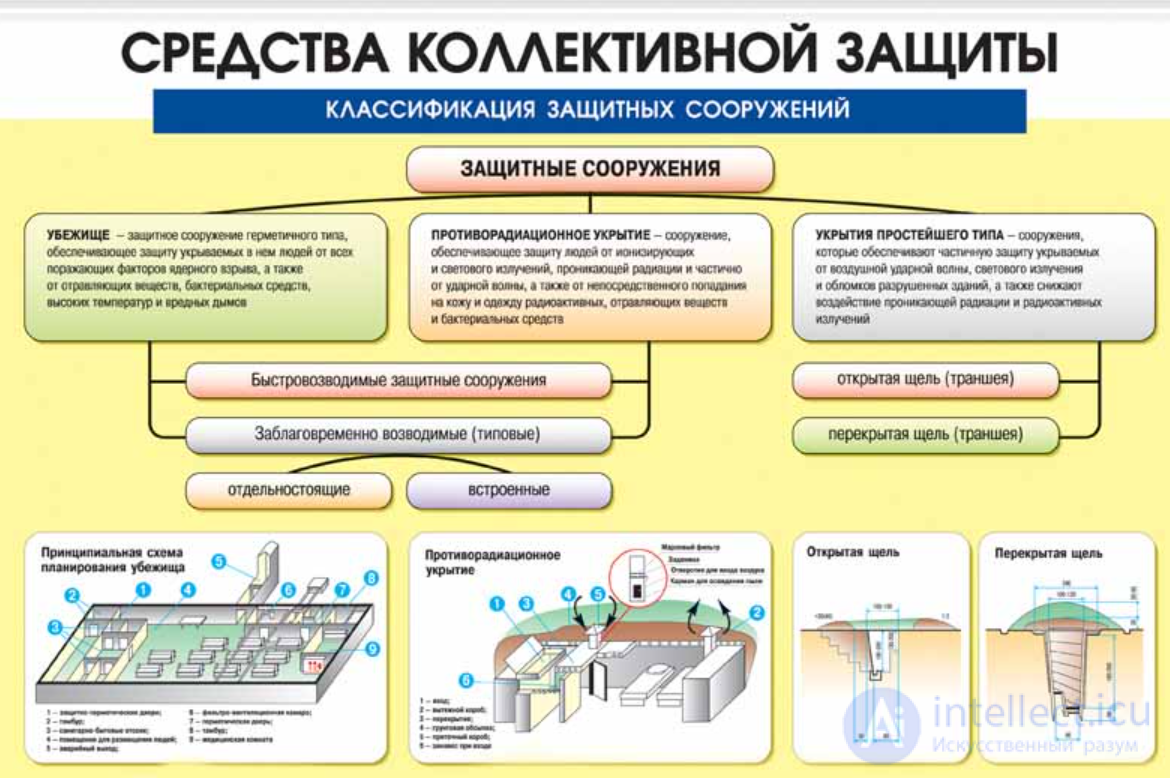
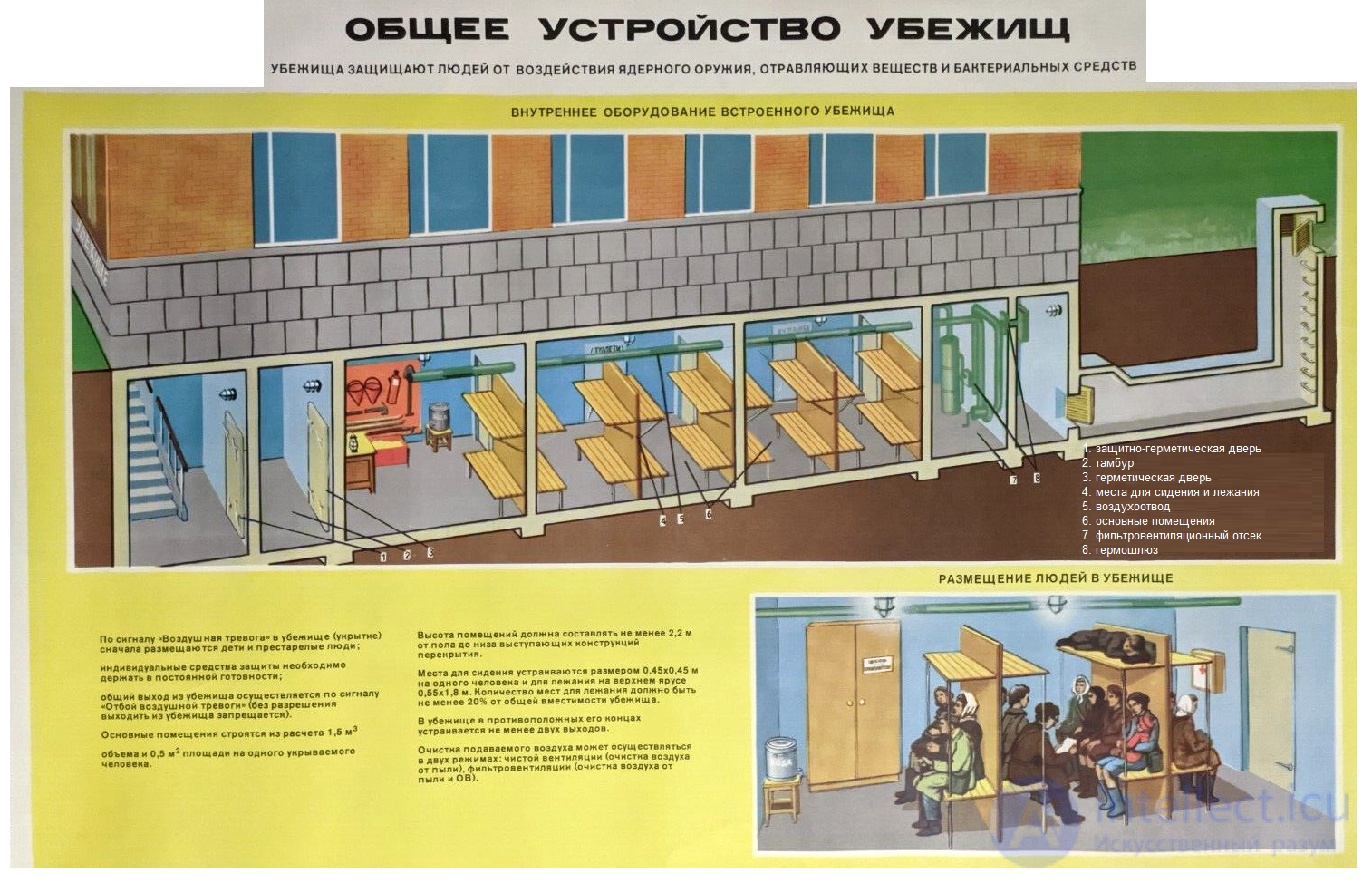
Shelters include structures that provide the most reliable protection of people from all the damaging factors of a nuclear explosion – the blast wave, light radiation, penetrating radiation (including the neutron flux), and radioactive contamination. Shelters also protect against chemical warfare agents and biological agents, against high temperatures and harmful gases in fire zones, and against collapses and debris from explosions.
People can remain in shelters for a long time. Even in buried shelters, safety is ensured for several days.
Shelters are divided into classes, while fallout shelters—into groups.
Characteristic features of a shelter:
* the presence of equal-strength airtight structures capable of withstanding a certain excess pressure as the blast wave passes
* filtration and ventilation equipment to ensure the continuous presence of people for several days.
Shelters may be located in the basements of buildings or may be freestanding, at some distance from buildings. Freestanding shelters are built in open terrain, in an area not subject to burial by debris (building height divided by two, plus 3 metres).
Shelter rooms must be at least 2.2 metres high, and the area depends on the number of occupants, at a norm of 0.4-0.5 sq. m per occupant. A stock of food, water and medicines is created in the shelter; it is provided with the necessary equipment, furniture, inventory, etc.; and it is connected to the electrical, wired-radio, telephone, water-supply, sewerage and heating networks.
The main requirements for shelters are the presence of uniform enclosing structures able to withstand the specified loads from the blast wave, the presence of a life-support system and a filtration-ventilation unit, and cost-effectiveness.
The shelter rooms house dosimetric instruments, chemical reconnaissance instruments, protective clothing, fire-extinguishing equipment, emergency spare tools, emergency lighting equipment, a stock of food and water, and medical supplies.
Shelters operate in three modes: 1 - clean ventilation - purifying the air of dust, 2 - filter-ventilation - purifying the air of bacterial aerosols, and 3 - complete isolation - when a cloud appears or in the event of fire.
Shelters are classified by protective properties, by capacity, by location, by provision of filtration-ventilation equipment, and by the time (conditions) of construction.
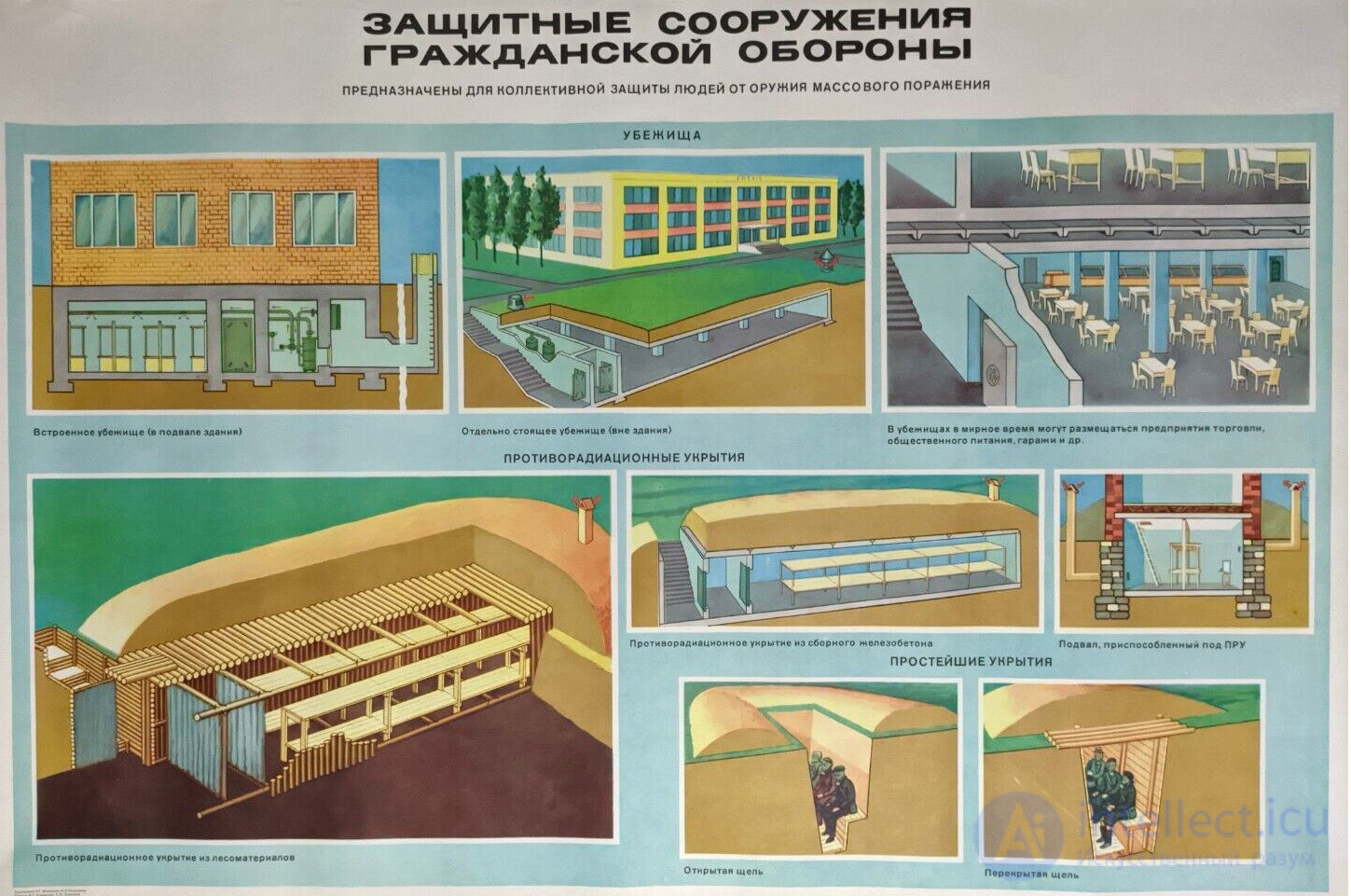
Fallout shelters (PRU) protect people from ionising radiation in the event of radioactive contamination (pollution) of the terrain (fig. 5). In addition, they protect against light radiation, penetrating radiation (including the neutron flux), and partially against the blast wave, as well as against the direct contact of radioactive, poisonous substances and biological agents with people's skin and clothing.
The protective properties of a fallout shelter against radioactive radiation are assessed by the protection factor, which shows how many times the radiation level in open terrain at a height of 1 m is greater than the radiation level inside the shelter. In other words, the protection factor shows how many times the fallout shelter attenuates the effect of radiation, and consequently the radiation dose received by people.
How fallout shelters are set up.
Fallout shelters are set up so that their protection factor is as high as possible. They are equipped primarily in the basement floors of buildings and structures. Basements in wooden houses attenuate radiation by a factor of 7-12, in stone buildings – by a factor of 200-300, and the middle part of the basement of a multi-storey stone building by a factor of 500-1000. The above-ground floors of buildings and structures may also be used as fallout shelters; the interior rooms of stone buildings with capital walls and a small area of openings are best suited for this purpose. The first floors of two-storey stone buildings attenuate radiation by a factor of 5-7. In rural areas, particular attention should be paid to using privately owned cellars, as well as vegetable stores, as fallout shelters.
In order to enhance the protective properties of rooms used as fallout shelters, they should be appropriately upgraded.
To increase the protective properties of a room, windows and unnecessary doorways are sealed up, a layer of soil is placed on the ceiling, and if necessary, an earth bank is built up outside against walls that project above ground level. Sealing of rooms is achieved by carefully filling cracks, gaps and openings in the walls and ceiling, at the junctions of window and door openings, and at the joints of heating and water pipes; by fitting doors properly and covering them with felt, with the seal of the doorframe tightened with a roller of felt or other soft, dense fabric.
Upgrading basement floors and interior rooms of buildings increases their protective properties several times over. Thus, the protection factor of upgraded basements of wooden houses is increased to approximately 100, and of stone houses – to 800-1000. Unequipped cellars attenuate radiation by a factor of 7-12, while equipped ones – by a factor of 350-400.
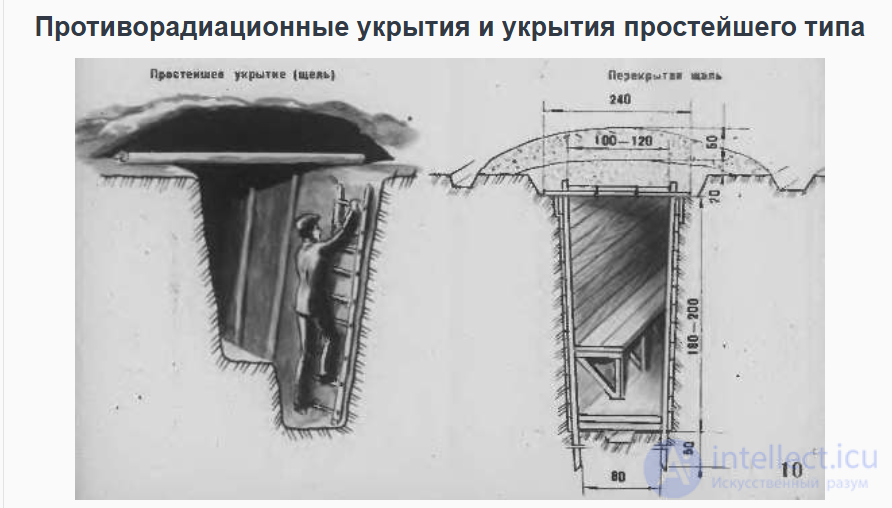
Simple shelters - open and covered slit trenches, trenches, underground passages. They protect people from flying debris clouds and also reduce the effect of radiation.
They are built when there is an immediate threat or when an emergency situation arises, by the population's own efforts, using materials at hand and building materials. Simple shelters are constructed outside zones of possible debris and flooding. They must not be built near explosion-hazardous workshops and warehouses, tanks containing poisonous substances, or near power lines and trunk pipelines.
People should remain in such shelters wearing personal protective equipment; in open shelters, in protective clothing and gas masks; in covered ones – in gas masks.
The most accessible simple shelters are slit trenches – open ones, and especially covered ones. If, for example, people take shelter even in simple, open slit trenches, the probability of their being harmed by the blast wave, light radiation and penetrating radiation of a nuclear explosion is reduced by a factor of 1.5-2 compared with remaining in open terrain, and the possibility of exposure as a result of radioactive contamination – by a factor of 2-3.

Comments